

A portfolio manager asked ChatGPT, “What’s the best robo-advisor for beginners with $5,000?” and got back four names. Your platform, the one with 200,000 managed accounts and a 4.8 app store rating, wasn’t on the list.
This is happening across the finance industry right now. Consumers are skipping Google, typing full questions into ChatGPT, Perplexity, and Gemini, and getting direct answers that shape where their money goes. If your brand isn’t in those answers, you’re invisible at the exact moment someone is making a financial decision.
The good news: you don’t need to guess where you stand. A set of free tools can show you, in under 60 seconds, exactly how AI search engines see your finance brand today.
Your Google Rankings Look Great. Here’s What They’re Missing.
Ranking on page one of Google used to be enough. For finance brands, it was the moat. But AI search has opened a second front, and most financial institutions haven’t noticed.
60% of U.S. adults now use AI-powered search to find financial information. A global EY survey of 18,000 consumers found that 49% had used AI in the past six months to help with savings and investment decisions, with adoption among Gen Z reaching 68%. These aren’t casual queries. An Intuit Credit Karma poll found that 85% of users who received AI-generated financial advice actually acted on it.
Here’s the thing: the sources AI pulls from are not the same sources that rank well on Google. Research from Fintel Connect shows that across major AI models, more than 60% of citations come from publishers and affiliate sites, not from the financial institutions themselves. And the overlap between Google’s top organic results and the sources AI actually cites has dropped from 70% to below 20%.
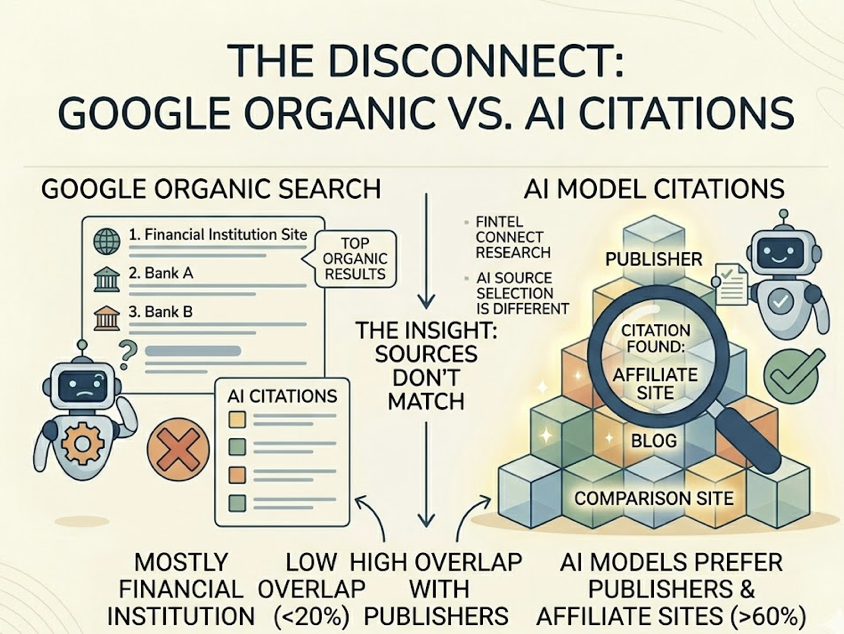
That gap explains why a bank can dominate Google for “best savings account” and still be absent from ChatGPT’s answer to the same question. The prompts your potential customers are asking AI look like this:
- “What’s the best high-yield savings account right now?”
- “Compare mortgage rates for first-time homebuyers in California”
- “Is Schwab or Fidelity better for retirement accounts?”
- “Best credit card for international travel with no foreign fees”
You can’t optimize what you can’t see. The first step is using free tools to build a baseline of where your brand actually stands in AI search.
7 Free AI Visibility Tools Finance Brands Can Use Right Now
These tools are built for this exact blind spot. No signup, no credit card, no demo calls. Each one checks a different dimension of your AI visibility, and together they give you a full diagnostic of how AI search engines perceive your finance brand.
Is Your Site Even Accessible to AI Crawlers?
Before anything else, check whether AI search engines can actually read your pages. Topify’s GEO Score Checker evaluates your site across four dimensions: AI bot access, structured data, content signals, and overall visibility readiness.
GEO Score Checker
For finance brands, this often surfaces a specific blind spot. Compliance-heavy sites frequently block AI crawlers in their robots.txt without realizing it. Security-focused configurations that protect customer data can also prevent GPTBot, ClaudeBot, and PerplexityBot from indexing your product pages. If AI crawlers can’t read your content, no amount of content quality will get you recommended.
Which AI Bots Can Actually Crawl Your Site?
The AI Robots Checker goes one level deeper than a general GEO score. It shows you exactly which AI crawlers are allowed or blocked by your current robots.txt configuration.
AI Robots Checker
This matters because not all AI platforms use the same bot. A finance brand might be visible in Perplexity but completely blocked from ChatGPT’s search index because GPTBot is specifically disallowed. You need to know which doors are open and which are closed.
What Does AI Actually Say When Someone Asks About You?
The AI Visibility Report is where diagnosis gets specific. Enter your brand name and a set of prompts relevant to your category, and see exactly how AI models respond.
For a wealth management firm, you might test prompts like “best wealth management platforms for high-net-worth individuals” or “top financial planning tools for retirement.” The report shows whether your brand appears, how it’s described, and who else gets recommended alongside you. In finance, where product accuracy is tied to trust, this report often reveals surprising gaps between what your marketing says and what AI tells potential customers.
How Strong Is Your Brand Authority in AI’s Eyes?
AI models don’t just look at your website. They weigh a brand’s authority across the entire information ecosystem: news coverage, expert mentions, review sites, industry publications. The Brand Authority Checker measures how AI perceives your overall brand strength.
AI Brand Authority Checker
The eMarketer Q1 2026 AI Visibility Index found that Capital One led all financial services brands with a 21% mention rate, ahead of JPMorgan Chase at 17%. Meanwhile, Similarweb’s 2026 GenAI Brand Visibility Index showed that NerdWallet and Bankrate, both content-first brands, ranked 66 to 68 positions higher in AI visibility than their traditional search rank would predict. That’s not a coincidence. AI rewards distributed authority, not just domain authority.
Is AI Describing Your Products Accurately?
This is where finance gets uniquely risky. If AI misquotes your interest rate, misrepresents your fee structure, or omits a key compliance disclosure, the consequences go beyond lost traffic.
The Brand Sentiment Checker shows how AI characterizes your brand: the tone, the emphasis, the features it highlights or ignores. For a credit card issuer, it might reveal that ChatGPT consistently mentions your annual fee but never mentions your sign-up bonus. For an insurance provider, it might show that AI describes your coverage as “basic” when you’ve expanded it significantly. These are narrative problems, and they’re fixable once you can see them.
Who Does AI Recommend Instead of You?
The Competitor Analysis tool shows which brands AI considers your direct competitors and how often they appear in the same answer.
In finance, the competitive set in AI responses often looks different from the one your sales team tracks. A regional bank might discover that AI groups it with national players. A fintech might find that AI recommends legacy institutions for the same use case. Understanding who you’re actually competing against in AI answers is the first step to changing the outcome.
What Are Your Customers Actually Asking AI?
Most finance brands optimize for the keywords they assume customers use. The Prompts Researcher reveals the actual prompts people type into AI platforms when looking for financial products and services.
The difference between a Google keyword and an AI prompt is structural. A Google search might be “best savings account 2026.” An AI prompt is more likely “I have $10,000 in a checking account earning nothing, what should I do with it?” The second query is conversational, context-rich, and requires a different kind of content to match. If your content library is built entirely around short-tail keywords, it’s likely invisible to these longer, intent-driven prompts.
Finance Brands Over-Index on SEO and Under-Index on Brand Narrative
The pattern across the finance industry is clear: massive investment in traditional search rankings, minimal investment in controlling how AI tells the story of your brand.
This isn’t a minor blind spot. It’s a structural mismatch between where budgets go and where buyer behavior is moving. Gartner projects traditional search volumes will fall by more than 25% by 2028 as users shift to AI tools. Meanwhile, AI search traffic converts at 14.2% compared to Google’s 2.8%. The channel that’s growing faster also converts better, and most finance brands aren’t even visible in it.
The brands winning in AI search right now aren’t necessarily the biggest. They’re the ones with the clearest, most consistent narrative across the information ecosystem. NerdWallet and Bankrate don’t have the product portfolios of JPMorgan or Wells Fargo, but AI models cite them far more often because their content is structured, authoritative, and present on the third-party sites that AI relies on.
That’s the core insight: AI doesn’t rank pages. It synthesizes narratives. When a consumer asks “what’s the best way to invest $50,000 for retirement,” AI doesn’t return your product page. It assembles an answer from NerdWallet explainers, Forbes comparisons, Reddit threads, and Investopedia guides. If your brand’s narrative is consistent across those sources, you get recommended. If it’s not, you don’t.
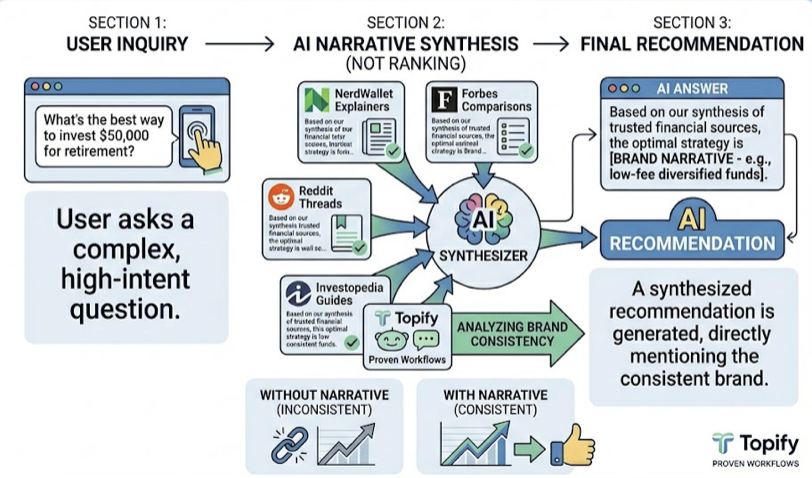
The risk for finance brands is especially high because AI inaccuracy carries real consequences. An AI response that misrepresents your APR, misclassifies your account type, or omits a regulatory disclosure doesn’t just cost you a lead. It introduces compliance risk you didn’t know existed.
The fix starts with diagnosis. Run your brand through the free tools above to see where your narrative gaps are. Check whether AI crawlers can access your site. See what AI actually says about your products. Identify where competitors are showing up instead of you. That baseline is what turns a vague concern into a specific action plan.
From a Free Checkup to Continuous AI Monitoring
These free tools give you a clear snapshot of where your brand stands today. The gap they can’t close is continuity. AI answers change every time a model updates its index, and a quarterly manual check misses the shifts that happen in between.
Topify’s paid platform picks up where the free tools leave off: continuous tracking across ChatGPT, Perplexity, Gemini, and AI Overviews, with alerts when your visibility drops or a competitor gains ground. You can monitor specific prompts, track sentiment changes over time, and benchmark against competitors, all from one dashboard.
For finance brands managing multiple products, regulatory requirements, and fast-moving competitive dynamics, the difference between a one-time snapshot and ongoing monitoring is the difference between knowing you have a problem and catching it before it costs you.
Get started with Topify with a 30-day free trial. Plans start at $99/month. See Topify Pricing for details.
Conclusion
AI search is already shaping how consumers choose banks, credit cards, investment platforms, and insurance providers. The finance brands that show up in those answers aren’t always the biggest or the best known. They’re the ones whose content is accessible to AI crawlers, whose brand narrative is consistent across third-party sources, and whose products are accurately described in the information ecosystem AI relies on.
You don’t need a six-figure budget to start. The seven free tools above can show you, today, exactly where your brand stands in AI search, what AI says about you, and where the gaps are. That diagnostic is the foundation for everything that comes next.
FAQ
Are these tools really free? Do I need to sign up?
Yes, all seven tools listed are completely free with no signup required. You can run a check on your brand or website in under 60 seconds. The tools are provided by Topify as part of their free AI visibility toolkit.
Which tool should a finance brand use first?
Start with the GEO Score Checker. If AI crawlers can’t access your site, nothing else matters. From there, run the AI Visibility Report to see what AI actually says when someone asks about your category. These two checks together give you the most actionable baseline.
How often should I check my AI visibility?
AI models update their indices frequently, and competitor activity can shift your visibility overnight. A manual check using free tools every month is a reasonable starting point. For brands in competitive categories like credit cards, banking, or wealth management, continuous monitoring through a paid platform provides more reliable coverage.
What if AI is inaccurately describing my financial products?
This is a common and serious issue in finance. Start by documenting exactly what AI says (the Brand Sentiment Checkerhelps here). Then audit your own content and the third-party sources AI relies on for consistency. In many cases, outdated information on comparison sites or review platforms is the root cause. Updating those sources and structuring your own content for AI extraction can correct the narrative over time.

