

A shopping benchmark can look rigorous while measuring almost nothing. One hundred prompts copied from a keyword tool may represent the same broad question. One run per prompt can turn normal answer variation into a leaderboard. Mixing countries, logged-in personalization, changing product availability, and different scoring rules creates percentages that cannot be reproduced.
A credible AI shopping visibility benchmark begins with a written method and ends with uncertainty, not a dramatic chart. This framework shows how to design 100 prompts, capture recommendation evidence, calculate transparent metrics, and publish a result that another analyst could audit. It provides the scorecard, not invented findings.
Define the Decision the Benchmark Will Support
Choose one decision before selecting prompts. A benchmark might compare brands within a category, establish one brand’s baseline, compare platforms, or measure change after product-data improvements. Those purposes require different samples.
Write the population statement in plain language. For example: “High-intent U.S. prompts for selecting noise-canceling headphones across three buyer stages.” That statement sets boundaries for language, region, product category, availability, and interpretation.
Do not call a convenience sample “all AI shopping.” A benchmark of one category and market can be useful without pretending to represent every product or shopper.
Build 100 Prompts With a Quota Matrix
Use a quota matrix so the sample covers distinct buyer decisions rather than 100 paraphrases. A balanced single-category design could allocate prompts across five intent families and five constraint families.
| Prompt quota | Count | Example purpose |
|---|---|---|
| Category discovery | 20 | Find credible options without naming a brand |
| Use-case fit | 20 | Select for travel, work, home, sport, or another context |
| Constraint fit | 20 | Apply budget, size, compatibility, risk, or policy limits |
| Comparison | 20 | Compare named or discovered alternatives |
| Purchase-ready | 20 | Ask where to buy, availability, shipping, or current value |
Within each family, distribute role, budget, compatibility, geography, and exclusion signals. Keep a unique prompt ID, exact text, intent, constraint tags, expected answer type, and inclusion reason.
Pilot ten prompts before freezing the full set. Remove ambiguous wording, duplicate decisions, prompts that require unavailable private information, and questions no credible answer could resolve.
Freeze the Test Conditions Before Collection
Document platform, product experience, account state, memory or personalization settings where controllable, region, language, device, date, and time window. Record whether the system asks follow-up questions and how researchers respond.
OpenAI says Shopping Research can use constraints, merchant ACP data, public product information, and other retail sources in a multi-step discovery process. Google AI shopping experiences can use conversational refinement and its Shopping Graph. The benchmark must therefore define whether follow-ups are answered, skipped, or scripted.
Check product availability and major price changes before each collection window. A recommendation can change because inventory changed, not because brand visibility improved.
Do not change prompts halfway through a baseline. Version any revision and report it as a new wave.
Repeat Observations Instead of Trusting One Answer
Generated responses can vary. Run each prompt more than once when budget and platform rules allow, spacing observations according to the study purpose. A cross-sectional snapshot may use several repetitions in a short window; a trend benchmark may repeat the frozen set weekly.
Define the observation count before seeing results. Do not rerun only the prompts where a preferred brand lost.
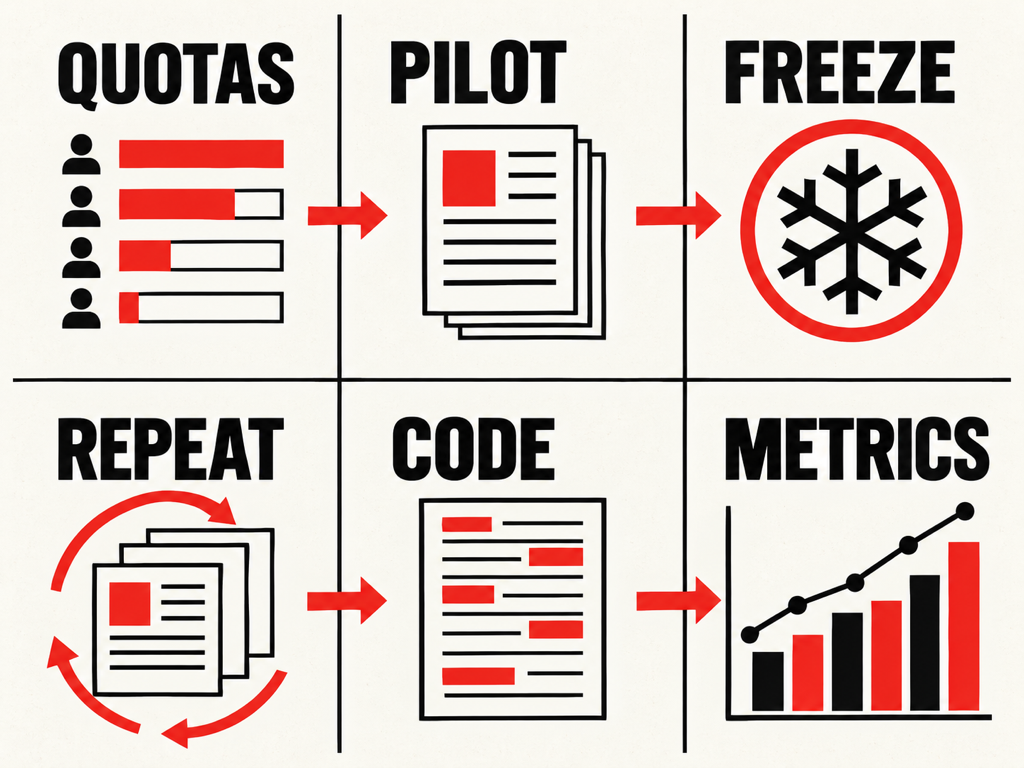
Store the raw response or permitted evidence, collection timestamp, links, follow-up path, and any error. Record refusals, unavailable experiences, and timeouts rather than silently replacing them.
If platform terms or interface constraints prevent automated collection, use a documented manual method or reduce scope. Method consistency is more important than an impressive sample claim.
Create a Coding Guide Before Analysts Score Answers
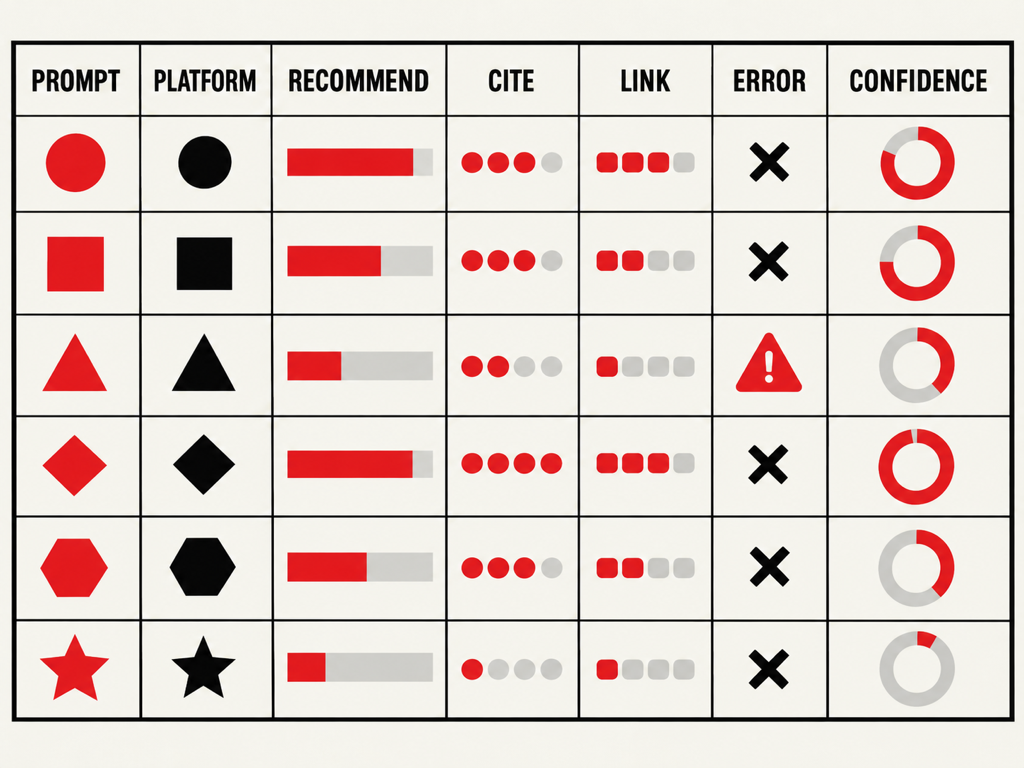
Define every outcome with examples. At minimum, distinguish mentioned, recommended, top pick, cited, and merchant-linked.
A brand mention in background context is not the same as a recommendation. A product carousel placement may differ from a written top pick. A merchant link may point to the brand, a marketplace, or an unrelated seller.
Use a structured record for each prompt-observation-brand combination:
- brand and product name as shown;
- mention present;
- explicit recommendation present;
- ordered position when meaningful;
- top-pick status;
- cited owned domain;
- cited third-party domain;
- merchant link and destination type;
- rationale and trade-offs;
- incorrect or stale claim;
- coding confidence and reviewer note.
Have a second reviewer code a sample before full production. Resolve disagreements and update the guide without changing earlier rows silently.
Calculate Metrics With Transparent Denominators
Every percentage needs an eligible denominator. Exclude or separately report failed observations; do not turn them into zeros without explanation.
| Metric | Formula | Interpretation | Limitation |
|---|---|---|---|
| Recommendation rate | observations explicitly recommending brand / eligible observations | How often the brand is selected | Depends on prompt sample and repetitions |
| Top-pick rate | observations naming brand first or best / eligible ordered observations | Frequency of leading recommendation | Not all answers are ordered |
| Prompt coverage | unique prompts recommending brand / eligible unique prompts | Breadth across buyer decisions | Ignores repeated-result stability |
| Owned citation rate | observations citing owned domain / eligible observations | Use of brand-controlled evidence | Citation does not equal recommendation |
| Merchant-link rate | observations with usable merchant link / eligible observations | Purchase-path availability | Destination quality still needs review |
| Competitor overlap | prompts where brand and competitor co-occur / eligible prompts | Shared consideration set | Does not show which brand is preferred |
| Attribute error rate | observations with material wrong fact / audited observations | Reliability of product representation | Requires current source-of-truth review |
Report counts beside rates. “18 of 60 eligible observations” is more interpretable than “30 percent” alone.
Separate Brand, Product, Platform, and Prompt Effects
A result can move because of the product assortment, platform, prompt mix, or observation timing. Break out metrics by intent family, constraint family, platform, and product where sample size permits.
Avoid ranking brands from tiny subgroups. If only four prompts represent regulated use cases, treat the result as directional. Publish the count and uncertainty rather than a false decimal precision.
When comparing platforms, keep the prompt meaning aligned while respecting different interactions. A system that asks follow-up questions and a system that returns an immediate grid are not identical test environments. Report that behavioral difference as part of the result.
Add Quality Control and an Audit Trail
Before analysis, check for duplicate prompt IDs, missing responses, inconsistent brand normalization, broken merchant links, impossible positions, and denominator drift. Keep raw evidence separate from the analysis table.
Maintain a change log for the prompt set, coding guide, product truth source, and collection scripts or procedures. Hashes or version numbers can help demonstrate that the baseline was not edited after results appeared.
Review a random sample of coded observations and every surprising outlier. A 100 percent recommendation rate for one small brand may reflect a branded prompt, entity-name collision, or coding mistake.
Protect user and customer data. Use synthetic or generalized buyer constraints unless participants explicitly consent to research use.
Publish the Method Beside the Findings
A benchmark report should disclose purpose, category, market, dates, platforms, prompt-selection method, quotas, exact or representative prompts, repetition count, account conditions, follow-up protocol, coding definitions, exclusions, and limitations.
Clearly label observations and interpretations. Do not claim causality from a cross-sectional comparison. Do not generalize one category to all AI shopping.
The report should also state what was not measured: total platform demand, private model signals, every shopper conversation, or guaranteed future recommendations.
Topify can support recurring prompt observation, competitor comparison, position, and source analysis after the exact 100-prompt set is approved. Keep any paid activation separate from the research design and confirm the platforms, regions, cadence, and credit impact before collection.
Until real observations exist, publish the method and blank scorecard only. A methodology article is more credible than percentages invented to complete a headline.
Conclusion
A 100-prompt AI shopping visibility benchmark is credible only when the sample, conditions, repetitions, coding, and denominators are fixed before results are known. The number 100 creates no rigor by itself.
Define one decision, build a quota matrix, pilot and freeze the prompts, repeat observations consistently, and code mentions, recommendations, citations, merchant links, and errors with a written guide. Publish counts, limitations, and version history beside every rate. That method produces a baseline teams can rerun and challenge without pretending to measure all AI shopping behavior.
FAQ
Why use 100 prompts for an AI shopping benchmark?
One hundred prompts can support a practical quota design across intent and constraint families. It is a planning size, not proof of statistical representativeness.
Should each prompt be run more than once?
Yes when resources and platform rules allow. Repeated observations help separate a stable recommendation pattern from normal answer variation.
What is the difference between a mention and a recommendation?
A mention names the brand or product. A recommendation explicitly selects it as suitable for the user’s decision or constraints.
Can a 100-prompt benchmark estimate total AI shopping market share?
No. It estimates outcomes within the defined prompt sample, platforms, region, and observation window. It is not total platform demand or market share.

