

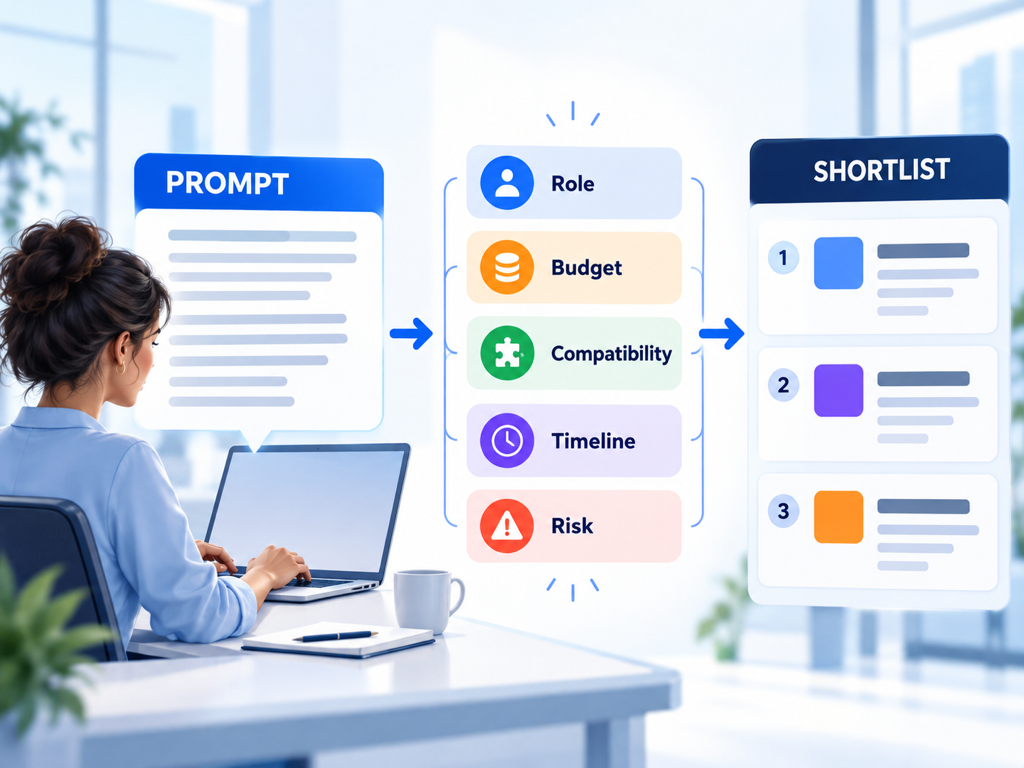
A buyer asks an AI assistant for project management software, but the category is only the starting point. Their role, budget, existing tools, security requirements, and deadline can all change the shortlist. A keyword report usually compresses those details into one phrase. The prompt preserves them.
That creates a different planning problem for SEO and content teams. Ranking for the category doesn’t tell you whether AI systems consider your product suitable for an agency, a regulated enterprise, or a budget-conscious startup. AI prompt intent signals give you a practical way to identify those differences, turn them into testable prompt groups, and decide which evidence your content still needs to provide.
Keyword Intent Is Too Coarse for Conversational Search
Traditional search intent usually sorts queries into broad groups such as informational, commercial, navigational, and transactional. That remains useful, but it loses detail when a user describes a full situation instead of typing a short query.
Consider these three prompts:
- “What is project management software?”
- “Which project management tools give agencies client-facing dashboards?”
- “Recommend project management software for a healthcare company that needs SSO, audit logs, and a fast security review.”
All three belong to the same product category. They do not represent the same decision. The first asks for an explanation, the second introduces a workflow requirement, and the third adds industry, integration, risk, and timing constraints.
OpenAI’s research on how people use ChatGPT classifies user intent with an Asking, Doing, or Expressing rubric. Asking seeks information or advice, while Doing requests an output or action. For marketers, that distinction is a useful first layer, but commercial prompts need another layer that captures the conditions determining which answer is acceptable.
A prompt can be informational in format and still contain a strong buying signal.
AI Prompt Intent Signals Are the Conditions Behind the Request
An AI prompt intent signal is a word, phrase, or contextual detail that changes the answer the user expects. It can identify the user’s role, define an acceptable price, eliminate incompatible products, or introduce a risk that must be resolved before purchase.
This is a working analysis framework, not a universal standard published by an AI platform. Its value is operational: the framework lets you group prompts by the conditions that influence recommendations rather than by superficial wording alone.
Google confirms that its generative search experiences can use query fan-out, generating multiple related searches to gather the information needed for one response. A prompt about software for a healthcare team could therefore lead the system to investigate security, integrations, pricing, usability, and industry suitability before producing one synthesized answer.
OpenAI describes a similar decision dynamic in Shopping Research. The experience asks follow-up questions about factors such as preferred brands, size, performance, style, and price, then uses those clarified constraints in a multi-step product discovery process.
The implication is straightforward: the category determines where the search starts, while the signals help determine where the answer ends.
Eight Signals Explain Why Similar Prompts Produce Different Shortlists
The most useful taxonomy is one your team can apply consistently. The eight signal types below cover many B2B and considered-purchase prompts without pretending every prompt fits perfectly into one box.
| Intent signal | What it reveals | Example phrase | Content evidence the user may need |
|---|---|---|---|
| Task or outcome | The job the buyer needs completed | “reduce manual reporting” | Workflow, use case, before-and-after process |
| Role | Who will evaluate or use the product | “for a marketing operations lead” | Role-specific benefits and responsibilities |
| Organization | Team size, industry, or business model | “for a 20-person agency” | Relevant deployment model and use-case proof |
| Budget | Price ceiling or value expectation | “under $30 per user” | Current pricing, plan limits, and total-cost context |
| Compatibility | Required tools, formats, or infrastructure | “works with HubSpot and Slack” | Integration documentation and limitations |
| Risk | Security, compliance, trust, or switching concerns | “needs SOC 2 and SSO” | Security documentation, controls, and procurement evidence |
| Timeline | Urgency, implementation window, or buying stage | “must launch this quarter” | Setup steps, dependencies, and realistic time requirements |
| Exclusion | What the buyer explicitly rejects | “not an enterprise suite” | Clear fit boundaries and credible alternatives |
These signals can appear together. “Best analytics platform” is a category-level commercial prompt. “Best analytics platform for a two-person ecommerce team that needs Shopify data and costs less than $200 a month” contains role, organization, compatibility, budget, and exclusion signals.
Counting signal density can help prioritize research, but more signals do not automatically mean more commercial value. A highly detailed troubleshooting prompt may be urgent without indicating a purchase. Intent still depends on the requested outcome.
AI Systems Use Constraints to Narrow the Answer Space
At a practical level, intent signals act like filters and evaluation criteria. The system first identifies the category or task, then looks for information that satisfies the stated conditions. Missing evidence can remove a brand from consideration even when the brand is generally relevant to the category.
Suppose three buyers ask about project management software. A founder emphasizes price, an agency leader needs client access, and an enterprise IT manager requires security controls. The system may retrieve overlapping sources, but the final recommendation sets can differ because each buyer defines success differently.
This does not mean marketers should create a separate page for every possible wording. Google’s official guidance warns against producing pages for every query variation and recommends unique, non-commodity content that genuinely helps users. The right unit is usually a meaningful decision pattern, not an isolated sentence.
Bottom line: optimize for evidence coverage across a prompt cluster, not for an exact conversational phrase.
Build a Prompt Signal Map in Five Steps
A useful signal map connects real prompts to business decisions. It should be small enough to maintain, but varied enough to reveal where recommendations change.
1. Start with one decision, not a broad topic
Define the decision you want to study, such as choosing an AI visibility platform, selecting accounting software, or finding a logistics provider. Avoid mixing education, troubleshooting, and product selection in the same initial group.
2. Collect prompt language from several sources
Use customer calls, sales objections, support tickets, site search, community discussions, AI referral data, and prompt discovery tools. Remove personal data and confidential customer details before storing prompts.
The goal is not to manufacture hundreds of variations. It is to capture the conditions real buyers use when asking for help.
3. Tag signals without rewriting the prompt
Keep the original wording for repeatable testing. Add separate fields for task, role, organization, budget, compatibility, risk, timeline, and exclusions. A prompt can have several tags in each field.
4. Create controlled variants
Change one important signal at a time. For example, keep the category and organization constant while testing three budget levels, or keep the budget constant while changing the security requirement.
Controlled variants make the result interpretable. When every detail changes at once, you cannot tell which condition altered the shortlist.
5. Freeze the test set and record context
Store the platform, model or experience, region, language, date, and exact prompt. AI answers vary, so repeat observations are more useful than a single screenshot. If you revise a prompt, treat it as a new version rather than silently replacing the baseline.
Turn Prompt Signals Into Content Decisions
Signal mapping becomes valuable when it changes what you publish. Each repeated constraint points to evidence a buyer expects an AI answer to locate and explain.
A compatibility signal may reveal that an integration page lacks setup details. A risk signal may show that security documentation is inaccessible or too vague. A role signal may expose a generic feature page that never explains the workflow for the person making the decision.
The same category can therefore require different evidence paths without requiring duplicate articles.

Use three questions to turn a signal cluster into a content assignment:
- What decision is the user trying to make?
- What evidence would let a credible adviser answer that decision?
- Does that evidence already exist in a crawlable, specific, and current form?
When the answer to the third question is no, the gap may justify a new use-case page, integration guide, methodology article, comparison, or data study. When the evidence exists but the brand still does not appear, investigate citation sources, authority, technical accessibility, and competitive coverage before publishing more pages.
Measure Signal-Level Visibility Instead of Counting Prompts
Raw prompt counts can create false confidence. Ten phrasings that express the same decision are not ten independent markets, and branded prompts can make visibility look healthy while category discovery remains weak.
Track performance at both the cluster and signal level:
- Visibility: How often does the brand appear for the cluster?
- Recommendation rate: How often is the brand explicitly recommended rather than merely mentioned?
- Competitor overlap: Which brands appear when specific constraints are present?
- Citation coverage: Which sources support the answer?
- Position: Where does the brand appear within a ranked or ordered response?
- Volatility: Does the result persist across repeated observations?
Compare controlled prompt variants. If a brand appears until “SOC 2” is added, the security signal deserves investigation. If the brand disappears only when “under $50” is added, pricing fit or pricing clarity may be the issue.
This method turns a vague visibility problem into a falsifiable question.
Use Topify to Move From Signals to a Repeatable Workflow
Topify can support the workflow after you define the decision and signal taxonomy. Its current Prompt Discoveryexperience organizes prompt demand, brand visibility gaps, competition, and opportunity scoring, while its monitoring workflow records how visibility changes over time.
In practice, start with one category and a limited set of controlled prompts. Separate broad educational prompts from comparison and decision prompts, then add fields for the signal types that matter to your market. Review the competitor set and citation sources for each cluster before assigning content.
Topify’s product page describes prompt opportunity scoring through demand, visibility gaps, commercial intent, and content readiness. Treat that score as prioritization support, not proof that a new page will rank or earn a citation. Human review still needs to decide whether the missing evidence is meaningful, supportable, and distinct from what the site already publishes.
Once the test set is stable, repeat the measurement on a fixed schedule. New prompts can enter a discovery queue, but baseline prompts should stay unchanged long enough to distinguish real visibility movement from wording drift.
Conclusion
AI prompt intent signals expose the conditions that ordinary keyword labels leave behind. Role, budget, compatibility, risk, timeline, and exclusions can all change the evidence an AI system retrieves and the brands it recommends. Mapping those signals helps you test recommendation changes without creating a separate page for every prompt variation.
Start with one buyer decision, tag the constraints in real prompt language, and create controlled variants. Then measure visibility, recommendations, competitors, and citations at the signal level. When the evidence reveals a genuine gap, use it to produce one useful, specific asset rather than another generic category article.
FAQ
What are AI prompt intent signals?
AI prompt intent signals are contextual details that change the answer a user expects, such as role, budget, compatibility requirements, risk concerns, timeline, and exclusions.
How are prompt intent signals different from search intent?
Search intent describes the broad goal behind a query. Prompt intent signals capture the specific conditions that shape which explanation, product, or recommendation will satisfy that goal.
Should every prompt variation have its own page?
No. Group prompts by meaningful decision patterns and evidence needs. Google advises against creating pages for every wording variation, especially when the pages would add little distinct value.
How can a brand track prompt intent signals?
Store the exact prompt, tag its constraint signals, create controlled variants, and repeatedly measure brand visibility, recommendation rate, competitors, citations, position, and volatility across relevant AI platforms.