A sales enablement lead opens a monitoring report and sees the brand listed first. The underlying answer recommends it only for large teams with dedicated implementation support, while the current campaign targets small teams that need a quick setup. The position looks favorable, but the recommendation may not fit the buyer the campaign is trying to reach.
An AI search rank checker becomes more useful when the review preserves the condition attached to each recommendation. Mention order, positive wording, and suitability are different observations. The task is to identify what the answer advises, for whom, and under which limitations before turning a visible first position into a business conclusion.
An AI Search Rank Checker Needs a Recommendation Unit
Define the recommendation as a statement connecting a candidate to a task under stated conditions. The useful unit includes the entity, relevant sentence, buyer or use case, and any limiting language. A name and a position number don’t contain all of that information.
Preserve the complete sentence or short surrounding passage. An excerpt that stops before “unless” or “only when” can reverse the practical meaning. Keep enough context to show the condition without copying unrelated parts of the answer into every record.
Separate appearance from recommendation status. A brand may be discussed as background, offered as one option, recommended for a particular case, or explicitly excluded. Those states deserve different labels even if the name appears early in the text.
This is a proposed analytical method, not a universal ranking formula. Its purpose is to support decisions about the answer’s advice. A team can adapt the coding labels as long as reviewers retain the underlying language and apply the same rules consistently.
Capture the Condition Attached to Each Brand
Look for conditions involving team size, budget, implementation effort, product capability, region, or compatibility. Record the condition as expressed before translating it into a normalized field. The original wording remains the evidence for the classification.
Consider an illustrative answer about fictional software: “Cedar suits teams that have an administrator; Harbor is easier for a small team without one.” Both products can receive positive language while addressing different buyers. Calling the first sentence an unconditional win would discard the advice that matters.
Capture negative and temporal conditions as well. “Avoid this option when offline access is required” differs from “this option doesn’t currently provide offline access.” One is advice; the other is a factual claim that needs current verification.
Attach each condition to the relevant entity rather than the entire answer. A shared introduction may describe the buyer, while later paragraphs give different exceptions for each product. A single answer-level sentiment label cannot preserve those relationships.
Keep unresolved references visible. If “it” could refer to two candidates, record the ambiguity rather than assigning the condition confidently. A smaller set of reviewed recommendations is more useful than a large dataset with hidden attachment errors.
Distinguish Mention Order From Endorsement Strength
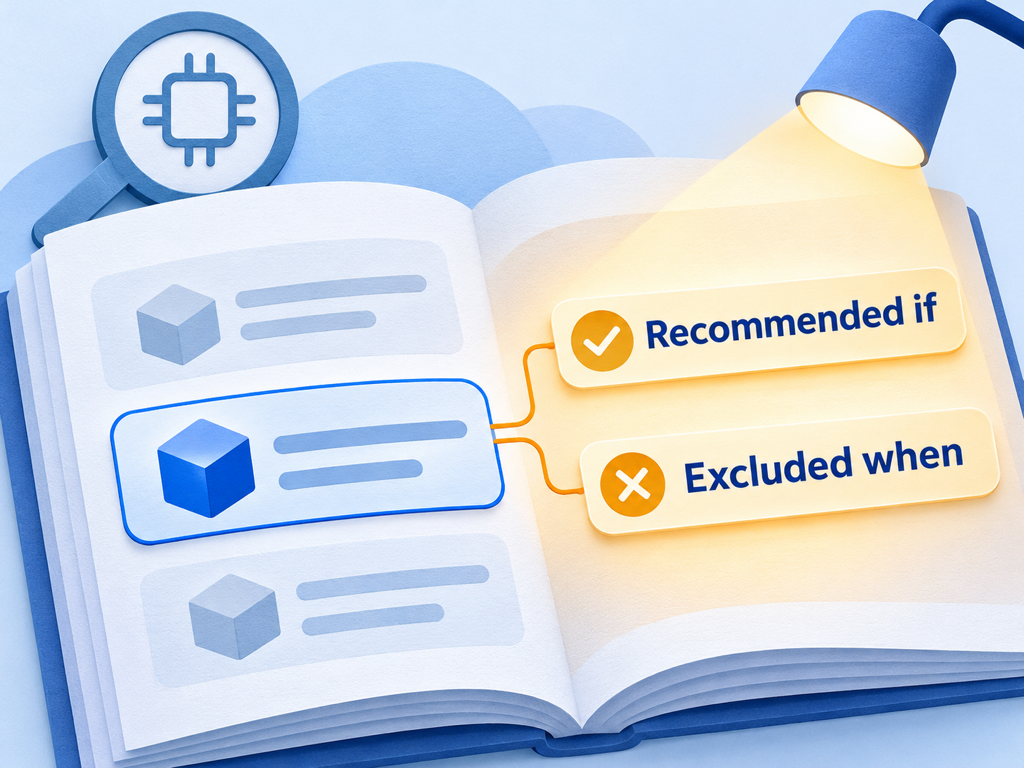
Mention order records where the entity appears. Recommendation status records what action the answer advises. Neither should be silently substituted for the other, and neither alone establishes whether the buyer’s requirements are met.
Use separate fields for position, status, condition, and factual verification. Avoid creating an arbitrary composite score that lets an early negative mention outweigh a later qualified recommendation. The business decision should determine how the fields are interpreted.
The following coding sheet is an editorial proposal. The example statements refer to fictional products and aren’t observations of any platform’s actual output.
| Illustrative answer statement | Mention interpretation | Recommendation status | Required follow-up |
|---|---|---|---|
| Cedar is a familiar option in this category | Background presence | Not established | Read the surrounding advice |
| Choose Cedar when your team has an administrator | Candidate tied to a condition | Conditional recommendation | Check buyer fit and product facts |
| Harbor may be worth evaluating | Consideration | Tentative option | Preserve uncertainty |
| Avoid Cedar if offline use is mandatory | Named but excluded for this task | Conditional exclusion | Verify the limitation |
| Cedar is strong for one team, unsuitable for another | Mixed context | Multiple conditional states | Keep both relationships |
Don’t assume that more enthusiastic language is stronger evidence. A confident answer can still misstate a feature or omit an exception. Recommendation coding and factual verification are complementary checks, rather than substitutes.
The first name in an answer isn’t automatically the best fit.
Review Mixed and Ambiguous Answers
Allow more than one conditional state for the same brand. An answer can recommend a product for one use case and discourage it for another. Forcing that result into a single positive or negative label removes the decision boundary.
Use a short review rubric with example cases. Define the difference between explicit advice, tentative consideration, factual description, and exclusion. Include what to do when the answer gives no clear recommendation at all.
Have another reviewer inspect a small set of difficult passages before scaling the process. Compare the reasons for disagreement, rather than simply choosing the majority label. The ambiguity may reveal a missing rule or a sentence that cannot support a confident classification.
Keep human review distinct from an automated judge’s output. Research on position-stable agreement in LLM evaluation shows why evaluation prompts themselves deserve scrutiny. That study concerns model judging, not a measured error rate for commercial brand recommendations.
When an automated label and a human reading differ, retain both and inspect the passage. A corrected label should have a reason and a version, so a later report can explain why its interpretation changed without pretending the answer text changed too.

Turn Qualifiers Into Evidence Tasks
A qualification should produce a specific research question. If the answer says a product requires substantial setup, verify what setup actually involves for the buyer’s scenario. Don’t respond by promising instant implementation unless current product evidence supports it.
Distinguish factual errors from positioning disagreements. A wrong compatibility claim can justify a correction task. A reasonable preference for another product may instead reveal a genuine product limitation or a buyer segment the brand doesn’t serve well.
Write the task with the condition, affected audience, observed advice, relevant source, and verification owner. That gives content, product, or sales teams a practical handoff. “Improve first position” is too vague to tell anyone which evidence should change.
The related AI Citations vs. Brand Mentions: Not the Same explains another useful signal distinction. Conditional recommendation review extends the same discipline to the relationship between a named brand and the action a buyer is advised to take.
Preserve trade-offs that are true. Useful content can explain who a product suits and when an alternative is appropriate. Removing every limitation from owned material can make it less useful for the exact decision the answer is trying to support.
Use Topify Position Data With a Qualifier Review
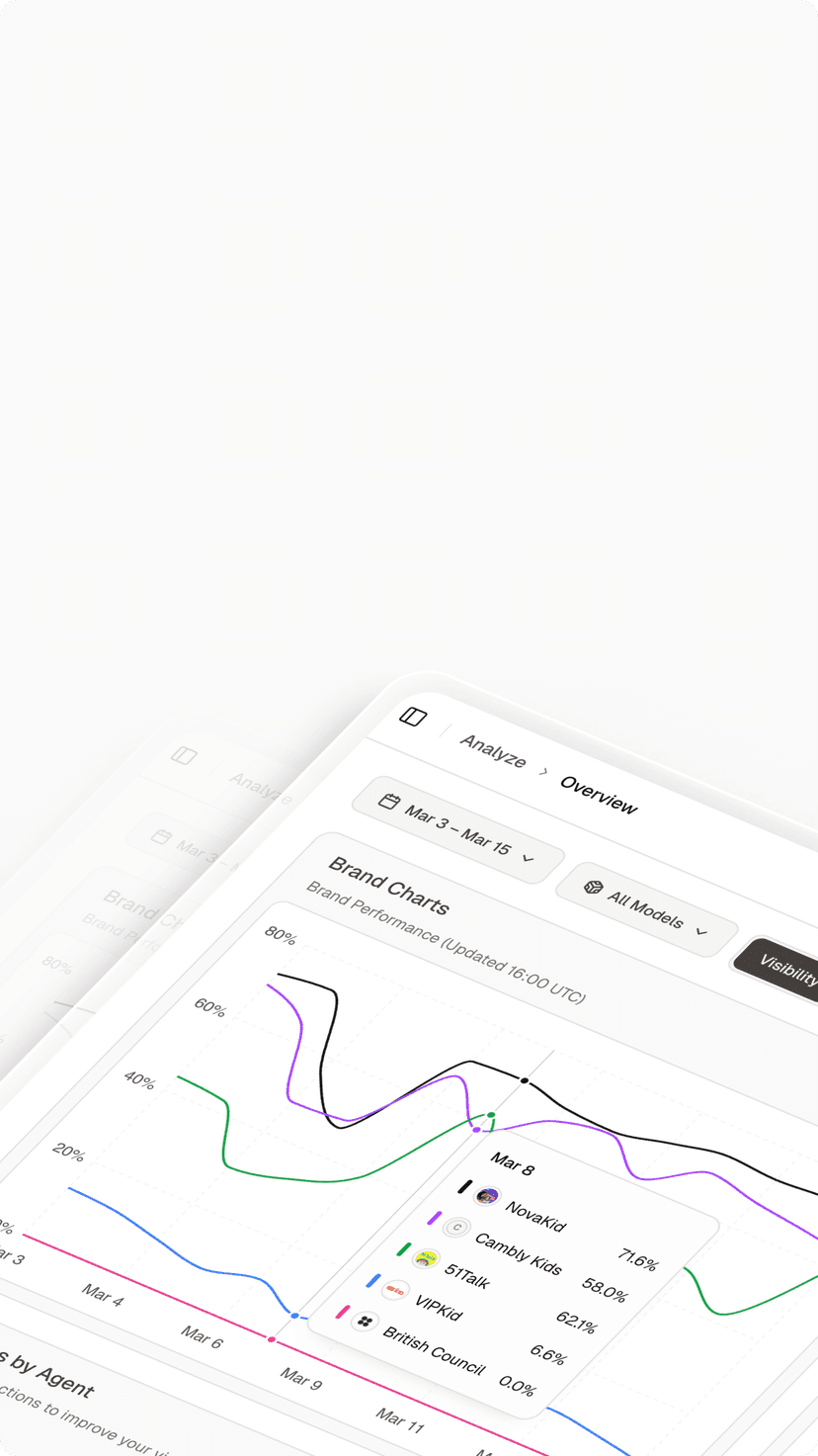
Topify defines position, visibility, and sentiment on its AI Search Analytics page. Start with the relevant brand, buyer prompts, and observed answers. Use the position result to locate passages for review, then attach the recommendation statement, condition, and verification status in a separate analyst-managed record instead of interpreting the position alone as an endorsement.
The output should distinguish favorable presence from a recommendation that actually fits the target buyer. That helps prioritize a factual correction, a clearer explanation of fit, or a product investigation. The public metrics describe appearance, tone, and relative position; they don’t establish that every conditional clause has already been attached to its entity or that every product claim has been independently verified. Preserve those review steps when using the data in sales or campaign decisions.
For tool-selection context, 7 AI Rank Checkers Tested: One Tracks Recommendations discusses recommendation-oriented measurement. The operational addition here is a traceable record of who the recommendation serves and which condition controls its meaning.
Conclusion
A useful ranking review retains the advice attached to the name. Record the sentence, buyer task, qualification, and recommendation status separately from mention order. Allow mixed outcomes, preserve ambiguity, and verify consequential product facts before turning a visible first position into a campaign claim.
Choose one important prompt and pair position and visibility context with a direct qualifier review. Identify whether the answer recommends the brand for the intended audience, excludes it under a relevant condition, or leaves suitability unresolved. The next action should address that evidence, whether it calls for clearer documentation, a factual correction, or acknowledgment of a real product trade-off.
FAQ
Is the first brand always the strongest recommendation?
No. It may be background context, a conditional option, or an explicit exclusion. Read the advice and its qualifications before interpreting position.
Does a recommendation with a limitation count as positive?
It can be favorable for one buyer and unsuitable for another. Preserve the condition and assess it against the intended task rather than forcing one universal label.
Can one brand have multiple recommendation states?
Yes. An answer can recommend it for one scenario and discourage it for another. Record the relationships separately when the text supports them.
How can conditions become useful content tasks?
Turn the condition into a factual question with an owner and evidence requirement. Verify the product behavior before deciding whether to clarify, correct, or acknowledge the limitation.