
A research operations manager writes a comparison prompt with the company’s product listed before two rivals. The resulting answer looks favorable, but a colleague reverses the candidate order and gets a different preference. The team needs to know whether the comparison is stable enough to support a positioning decision.
An AI search rank checker can help collect observations, but the experiment needs a design of its own. Candidate order is an input condition, while recommendation order is an output. Keeping those distinct lets the team investigate sensitivity without mistaking a named comparison for organic discovery or treating one reversal as proof of a universal bias. The immediate task is to build matched prompts and preserve their pairing.
Use an AI Search Rank Checker to Test a Specific Order Effect
State the hypothesis narrowly: changing the order of named candidates may change the observed recommendation under otherwise matched conditions. That is different from asking whether the brand appears when the buyer doesn’t name it at all.
Research on prompt order effects across language models examines how item ordering can influence generated responses. It motivates checking input sensitivity, but its results aren’t a measured effect size for your brand, buyer category, or search interface.
Define the decision the experiment will inform. A team may want to know whether its internal comparison brief is sensitive to candidate placement. It should not use that experiment alone to estimate market-wide recommendation share or real user demand.
Record the platform, relevant settings, session context, prompt version, and collection period. These fields help distinguish a candidate-order intervention from other changes that could affect the answer. The narrower the claim, the easier it is to collect evidence that actually addresses it.
Create Matched Prompts That Only Swap Candidates
Start with a buyer task and a fixed set of requirements. Create one prompt naming fictional candidates Cedar and Harbor, then a second with Harbor and Cedar in the opposite order. Preserve every other substantive part of the question.
Don’t rewrite the introduction to make the second prompt sound more natural. A changed adjective, budget condition, or instruction can introduce another explanation for the result. Store exact prompt text, not just an AB or BA label.
Keep candidate identity separate from position. The first slot changes between prompts, but Cedar remains Cedar. A result parser that treats “first option” as the same entity in both runs can create a false appearance of consistency.
Record whether the interface carries prior conversation context into the comparison. A previous answer can influence a follow-up, so a swapped prompt inside the same thread may test both order and conversational history. Use an appropriate matched setup and disclose its limits.
Prepare a valid-result rule before collection. Decide how to handle no recommendation, an unrelated answer, refusal, or failed collection. Those states should not be silently assigned to the brand that happens to appear first.
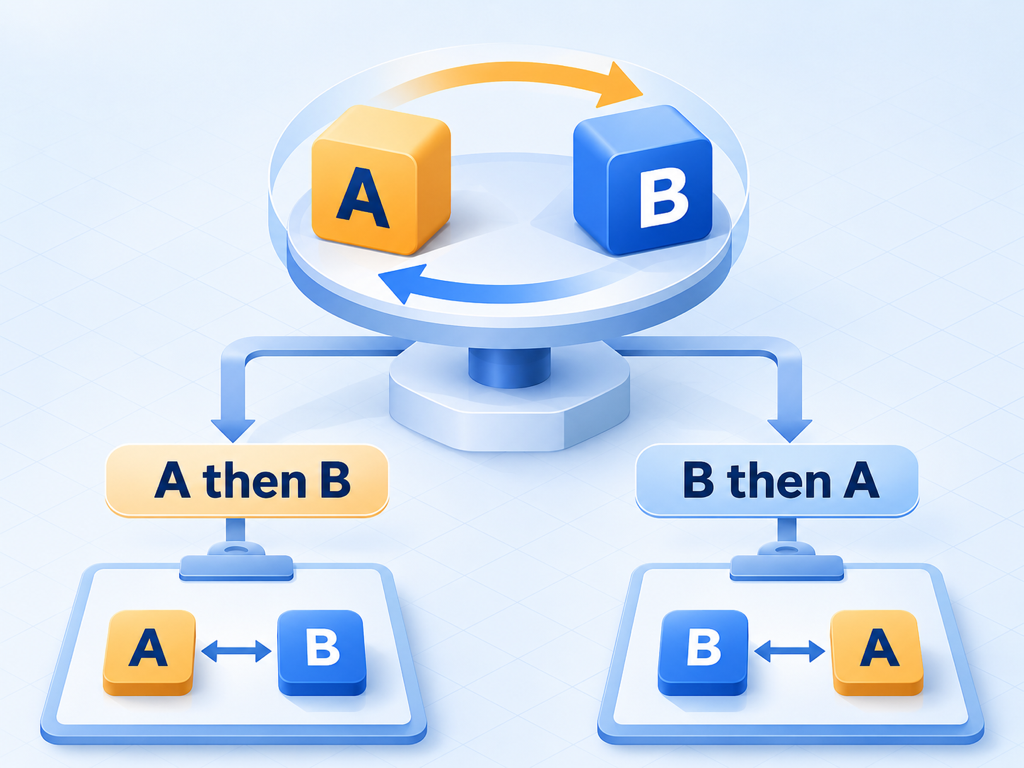
Rotate List Positions and Preserve Run Pairing
For two candidates, a paired swap is a simple starting design. With more candidates, use a balanced set of arrangements so one entity doesn’t always occupy a favorable input slot. Explain which positions and permutations were actually tested.
A balanced schedule is a design choice, not a guarantee that every possible interaction has been removed. Candidate combinations, wording, timing, and platform behavior can still matter. Keep the conclusion tied to the tested arrangements.
Assign a pair or block identifier before collecting results. Include the buyer task, candidate set, order version, run identifier, time, and result status. This allows the analysis to connect comparable observations without matching rows from memory.
Avoid selecting only the clearest examples after the experiment. Preserve every attempted pair and explain exclusions using the prewritten rule. A missing result reduces the available comparison rather than automatically counting as a loss for either candidate.
For repeated collection, interleave or otherwise balance the schedule where practical and record what was done. Running every AB observation before every BA observation can confound order with time. The method should make that risk visible even when operational limits prevent an ideal schedule.
Classify Stable Choices and Order Reversals
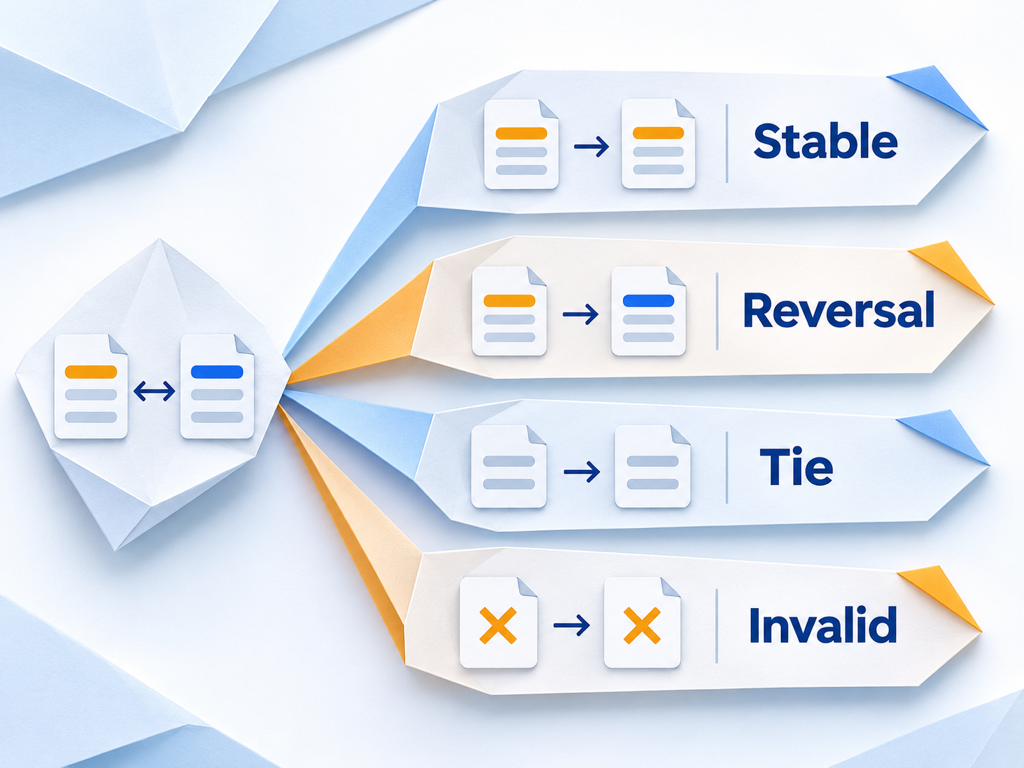
Compare candidate identity across the matched observations. A stable directional result selects the same candidate in both orders. A reversal selects different candidates. A tie or no-preference result needs its own category, as do invalid or incomplete pairs.
The position-swapped evaluation protocol described in GroundLM research provides useful methodological inspiration. Its task is LLM judging, which differs from consumer search recommendations. Borrow the transparency of paired outcomes without transferring its numerical findings to this experiment.
| AB observation | BA observation | Pair classification | What it supports |
|---|---|---|---|
| Cedar preferred | Cedar preferred | Stable Cedar choice | Consistency within this pair |
| Cedar preferred | Harbor preferred | Reversal | Sensitivity worth investigating |
| No preference | No preference | Stable non-directional result | No directional winner in this pair |
| Cedar preferred | No clear preference | Mixed or unresolved | Retain the uncertainty |
| Valid answer | Failed or unrelated result | Incomplete or invalid pair | No complete paired conclusion |
Use both counts and the eligible-pair denominator when summarizing a test. Keep invalid and missing outcomes visible alongside the valid results. A selective denominator can make an unstable or incomplete collection look more decisive than it is.
One reversal is an observation, not a universal law.
Keep Organic Discovery Outside the Swap Test
A prompt that names the brand supplies information an open discovery question doesn’t contain. It can test comparison behavior, but it cannot establish whether a buyer would encounter the brand without naming it.
Maintain a separate set of nonbranded discovery questions when that business question matters. Preserve their intent and constraints, but don’t merge their results into the paired-swap denominator. They answer a different measurement question.
Also distinguish the model’s generated recommendation from any automated judge used to classify it. A judge can introduce its own ordering or rubric sensitivity. Review ambiguous passages directly and retain the original answer so classification changes remain auditable.
The related AI Prompt Clustering: How to Group Buyer Questions Without Hiding Intent explains why superficially similar questions can require different treatment. Here, named comparison and open discovery should remain separate even when they concern the same product category.
Use the experiment to improve the reliability of a specific research workflow. If the result is sensitive, report that sensitivity and inspect the evidence behind the recommendations. Don’t publish a stable market hierarchy merely because one prompt arrangement produced a convenient winner.
Keep a brief execution log alongside the results. Record any interruption, changed session condition, or manual correction that could affect the pairing. Those notes help a later reviewer distinguish a genuine order intervention from an operational difference introduced while the test was running.
Use Topify Results to Investigate Consistency
Topify describes answer visibility and position through AI Search Analytics, with query-level brand comparisons on its Dynamic Competitor Benchmarking page. Begin with the defined buyer task and preserve the exact order variants in your experiment record. Use available observations to inspect which candidate was recommended and retain the relevant answer context for each matched run.
Perform the pairing and outcome classification in an analyst-managed sheet, keeping stable identity, timestamps, missing states, and the tested schedule. The output is a bounded assessment of consistency under the specified candidate arrangements. The public product pages don’t establish a native counterbalanced experiment runner or automatic paired-bias calculation, and the test doesn’t measure organic discovery, actual user demand, or a causal market advantage.
When the result informs a consequential positioning decision, include the limitations in the handoff. State the number of attempted and eligible pairs, observed outcome categories, and any context mismatch. A useful research report explains the conditions under which its conclusion could change.
Conclusion
Candidate-order testing works when the intervention is narrow and the observations remain paired. Preserve exact wording, keep identities stable across slots, balance the tested arrangements, and distinguish consistent choices from reversals, ties, and invalid results. Retain the full denominator so the summary reflects the collection that actually occurred.
Start with one important comparison and use query-level answer observations alongside a matched-prompt record. Keep open discovery outside the experiment and review any automated classification separately. Your next deliverable is a transparent consistency finding for the tested setup, followed by an investigation where the answer changes. That supports a research decision without overstating what a small order intervention can prove.
FAQ
Can candidate order affect a generated recommendation?
It can be worth testing, but the effect depends on the model, task, wording, and context. Research motivates the check without establishing a universal effect for commercial search.
What must stay constant in a swapped prompt?
Preserve the buyer task, requirements, wording, candidate identities, and relevant collection context. Change the intended order while recording any unavoidable difference.
Does a reversal prove that the model prefers the first option?
No. A reversal shows inconsistency in that pair. More carefully designed evidence is needed to distinguish systematic slot preference from ordinary variation or other confounding conditions.
Can named comparisons replace organic discovery tests?
No. Naming candidates supplies information the open question doesn’t. Keep the two task types and their denominators separate.