An international growth manager receives a global demand estimate for an English buyer question and uses it to rank regional publishing projects. The local teams ask whether the figure includes their countries, languages, and business users. The workbook contains a market recommendation that the underlying measurement may never have supported.
AI search volume needs a population definition before it can guide a regional decision. A translated prompt isn’t automatically a local demand estimate, and a country’s adoption ranking isn’t a count of searches for your product category. The useful comparison aligns platform, geography, language, time, and unit, while preserving missing information instead of filling it with convenient assumptions.
Match AI Search Volume to a Defined Population
Write the population definition beside the estimate. Identify the platform or platform group, account scope if known, geography, language treatment, time window, and measured unit. Record any restriction that affects who can appear in the data.
OpenAI’s Signals individual data, updated October 26, 2026, explicitly excludes enterprise and Codex usage. That boundary matters for interpreting its consumer-oriented observations. It cannot simply stand in for the demand of every professional buyer in a country.
A market comparison should preserve those limits rather than treating them as footnotes. If one source covers individual accounts and another covers organizational users, a combined ranking needs a justified common basis. Without one, keep separate views.
Define the business decision with equal care. Choosing a translation backlog, selecting a regional campaign, and estimating category demand are different tasks. The available evidence may support one while leaving another unresolved.
Keep Language and Country as Separate Fields
Language describes the expression or classification of the interaction. Country describes a geographic assignment under a dataset’s methodology. Neither field reliably substitutes for the other, so preserve both whenever the source provides them.
An English question can come from multiple markets. A country can contain buyers using several languages, and one buyer can switch languages across tasks. Assigning all English-language demand to one country would turn a linguistic observation into an unsupported geographic allocation.
Use a separate market-language record for planning. For each proposed content project, state the intended country, language, buyer task, and evidence available. That makes a local team’s objection testable instead of leaving it as a disagreement over a global number.
Translation also changes the research task. A literal translation may not preserve the terminology, product availability, or buying conditions used locally. Verify the decision and constraints with local evidence before treating two prompts as a matched pair.
Do not manufacture local volume by dividing a global figure across translations. Translation count measures your editorial choices, not the distribution of user demand. Where a provider doesn’t disclose language or geography coverage, label the estimate’s application to that market as unverified.

Align Windows and Coverage Before Comparing
Compare measurement definitions before comparing magnitudes. A recent month, a trailing annual average, and a quarterly adoption measure describe different windows. A ranking can change simply because one figure includes a seasonal period that another doesn’t.
Google’s Keyword Planner definitions show how historical search metrics depend on selected settings and close variants. Use this as a reminder to inspect metadata, not as proof that an AI-demand provider follows the same rules.
Record the snapshot date separately from the period being estimated. A figure downloaded today can describe an earlier month. Without both fields, a reviewer may mistake a recent retrieval for fresh underlying demand.
| Comparison dimension | What must be aligned | Unsupported shortcut | Safer decision |
|---|---|---|---|
| Platform scope | Included platforms and product context | Treating one platform as the whole market | Compare platform-specific views |
| Geography | Country assignment and coverage | Allocating global volume by population alone | Use verified geographic estimates |
| Language | Classification and prompt equivalence | Equating English with one country | Preserve separate language fields |
| Time | Window, averaging, and snapshot | Comparing a quarter with one peak month | Use matched windows or disclose mismatch |
| Unit | Messages, users, conversations, or estimates | Ranking unlike units together | Keep distinct metric views |
| Missing coverage | Exclusion and suppression rules | Converting unavailable data to zero | Mark unknown or not covered |
Some mismatches cannot be repaired with available data. Report that limitation rather than creating a conversion factor from intuition. A smaller comparable subset can support a better decision than an apparently comprehensive but inconsistent ranking.
Report Absolute Demand and Per Capita Context Separately
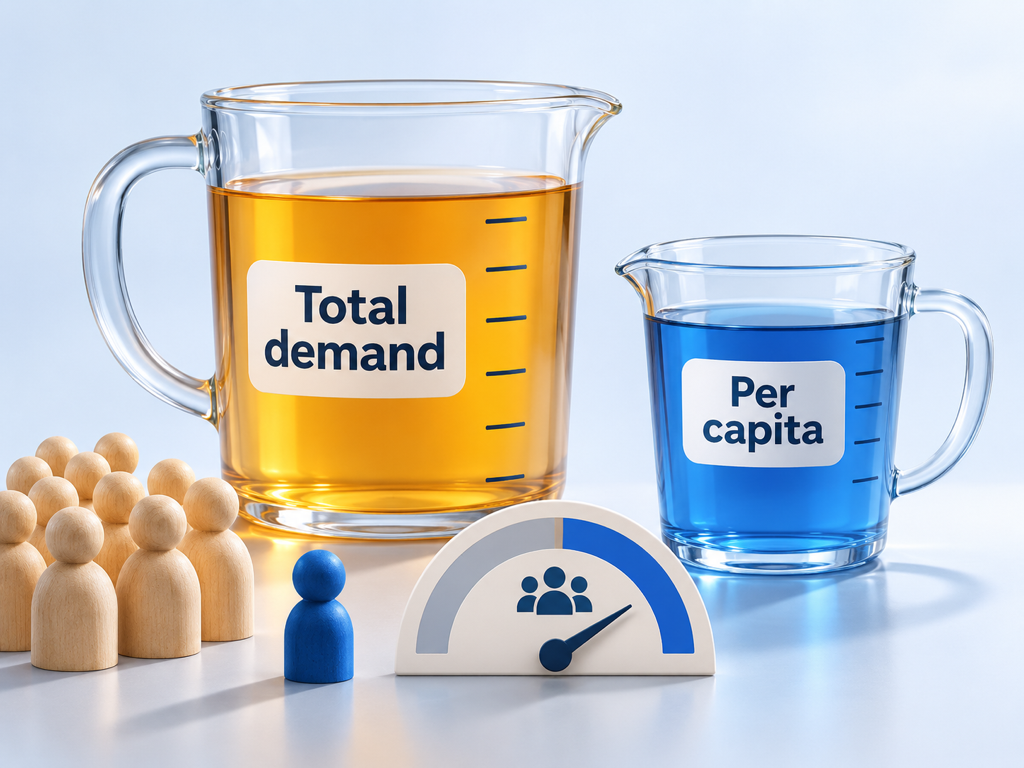
Absolute volume and per-person intensity answer different questions. A large population can produce many interactions while having lower per-capita usage. A smaller country can rank highly per person without contributing the largest total.
OpenAI’s regional usage view includes messages-per-capita rankings. A rank establishes relative order under that measure, not the absolute number of messages for an individual topic. It cannot be inverted into a prompt-level volume estimate.
For a hypothetical planning example, Market North might have higher total demand while Market South has higher per-person adoption. Neither observation alone decides where a company should publish. Product availability, addressable buyers, intent, and the evidence needed for the local decision still matter.
Keep the two measures in separately named columns. State whether a figure is a total, a percentage share, a rate, or a rank. Don’t draw a ratio from ordinal ranks or assume equal gaps between adjacent positions.
Use adoption context to ask better questions. A high-intensity market may deserve local research; it doesn’t automatically justify multiplying global category demand by its adoption rank. The local validation needs its own evidence and scope.
Flag Missing Markets Without Calling Them Zero
Missing data has several meanings. A market may be outside the product’s coverage, excluded by methodology, below a reporting threshold, or simply unavailable in the export. None of those states automatically establishes zero demand.
Use explicit status codes with readable labels. Separate not covered, insufficient evidence, not provided, and measured zero where the source actually supports that last state. This avoids a default spreadsheet zero becoming a false market conclusion.
Do not impute regional shares from population alone. That approach assumes comparable platform access, usage patterns, topic mix, and measurement coverage. Without evidence for those assumptions, it can convert an attractive map into a misleading allocation.
Build a research queue for important unknowns. A local buyer-language review, a scoped demand estimate, or an answer observation may help resolve the specific decision. Choose the next evidence source based on the gap rather than trying to complete every cell.
The related AI Search Volume Has Three Meanings. Buying the Wrong One Costs You provides metric context. A geographic comparison adds another requirement: the same named metric must still refer to compatible populations before its values can be ranked together.
Unknown markets need research, not a fabricated zero.
Use Topify to Plan a Market Specific Validation
Topify describes estimated prompt demand through its AI Search Volume Checker. Enter the buyer question and preserve the returned scope, estimate, and date. Before assigning that figure to a country-language project, verify which geographic and linguistic slices the current output actually supports. Leave any unsupported slice marked unknown rather than inferring a local estimate from the prompt’s language.
Its AI Search Analytics page describes market selection and answer monitoring that can add a separate validation layer. Use a locally appropriate question and supported settings to inspect observed brand and source coverage. The output helps identify evidence gaps in that monitored context; it doesn’t transform a sampled answer into a count of real users or establish undisclosed country-level demand coverage in the free volume tool.
Bring the planning record to the local team. Ask them to verify the task, terminology, availability assumptions, and next evidence requirement. This makes the decision review practical without pretending that a global estimate already contains every regional answer.
Conclusion
Regional demand comparisons need matching populations and explicit units. Keep country and language separate, align time windows, and distinguish absolute volume from per-person intensity. When a source excludes or doesn’t report a market, preserve that state rather than treating it as measured absence.
Begin with one proposed country-language project and record the scope behind its AI search volume estimate. Check whether the evidence supports that local application, then validate the buyer question and observed answer context where needed. The next useful output is a comparable market decision or a specific research gap. Both are more defensible than a complete-looking ranking built from incompatible figures.
FAQ
Does an English prompt represent demand in the United States?
Not by itself. Language and country are separate dimensions, and English-language interactions can originate across many markets.
Can a per-capita country rank estimate total demand?
No. A rank describes ordering under a normalized measure. It doesn’t provide an absolute topic count or a valid conversion factor for global volume.
Should an unavailable market be entered as zero?
No. Preserve the reason for missing data, such as not covered or insufficient evidence. Use zero only when the source actually supports a measured zero.
Can global estimates be allocated by population share?
Only with a justified model and disclosed assumptions. Population alone doesn’t establish platform access, usage intensity, topic mix, or local buyer demand.