

Timely stories create a difficult search problem. Facts change quickly, several publishers cover the same event, and readers need both a concise update and a route to deeper reporting. Google is expanding article carousels in AI Search to make related links more prominent for timely topics. For publishers, the opportunity is not to manufacture freshness. It is to publish a clearly scoped article, support it with original or primary evidence, maintain it as the story develops, and give the reader a compelling reason to continue from the AI answer. This guide explains how to prepare that editorial system.
What Google Announced About Article Carousels
In its October 15, 2026 AI Search update, Google said it was rolling out article carousels more broadly for trending topics. The carousels show prominent related links with images, giving users additional routes to explore coverage.
The announcement did not define a special carousel submission process. Google’s AI features documentation continues to point publishers to standard Search requirements: pages should be crawlable, indexed, eligible for snippets, technically accessible, and supported by content that serves the query.
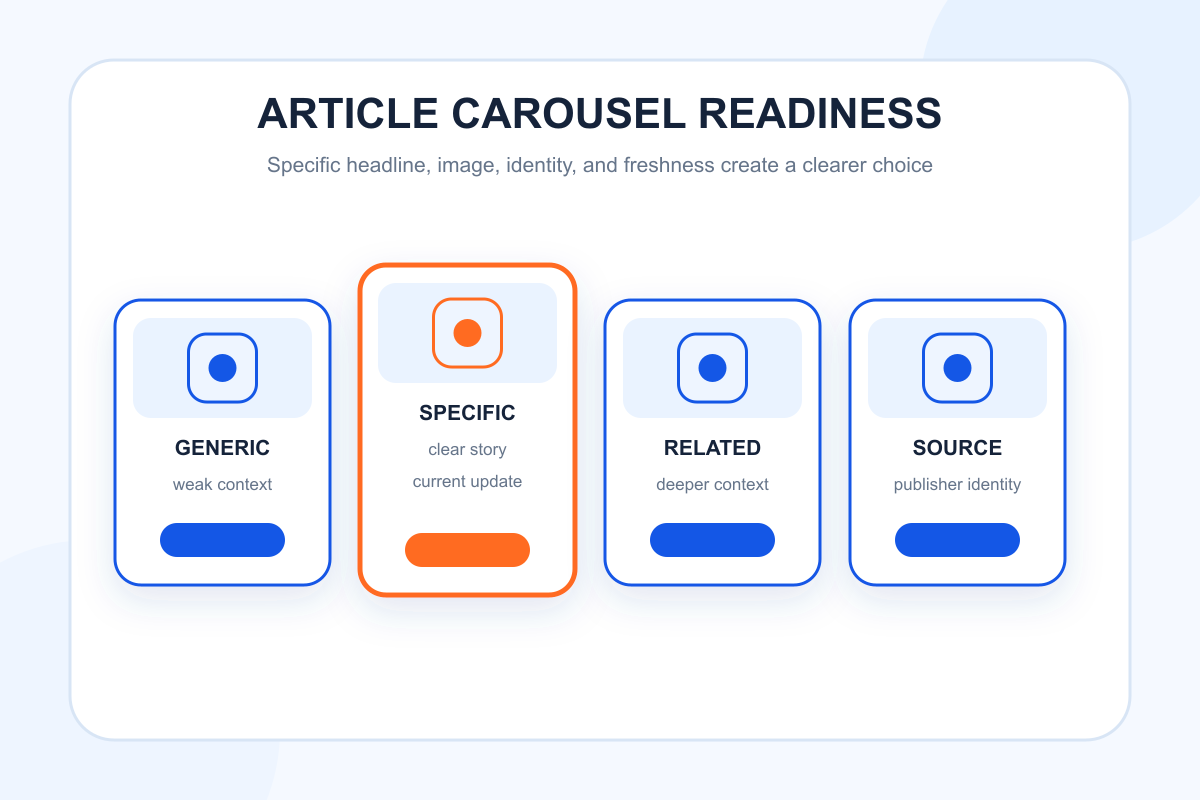
An article carousel is not simply a row of blue links. Image, headline, publisher identity, timeliness, and topical relationship all shape the user’s decision. A technically eligible article still needs editorial distinction.
Choose a Clear Editorial Contribution
Before publishing, define what the article adds to the developing topic. Rewriting the same announcement with generic commentary gives readers little reason to choose one source over another.
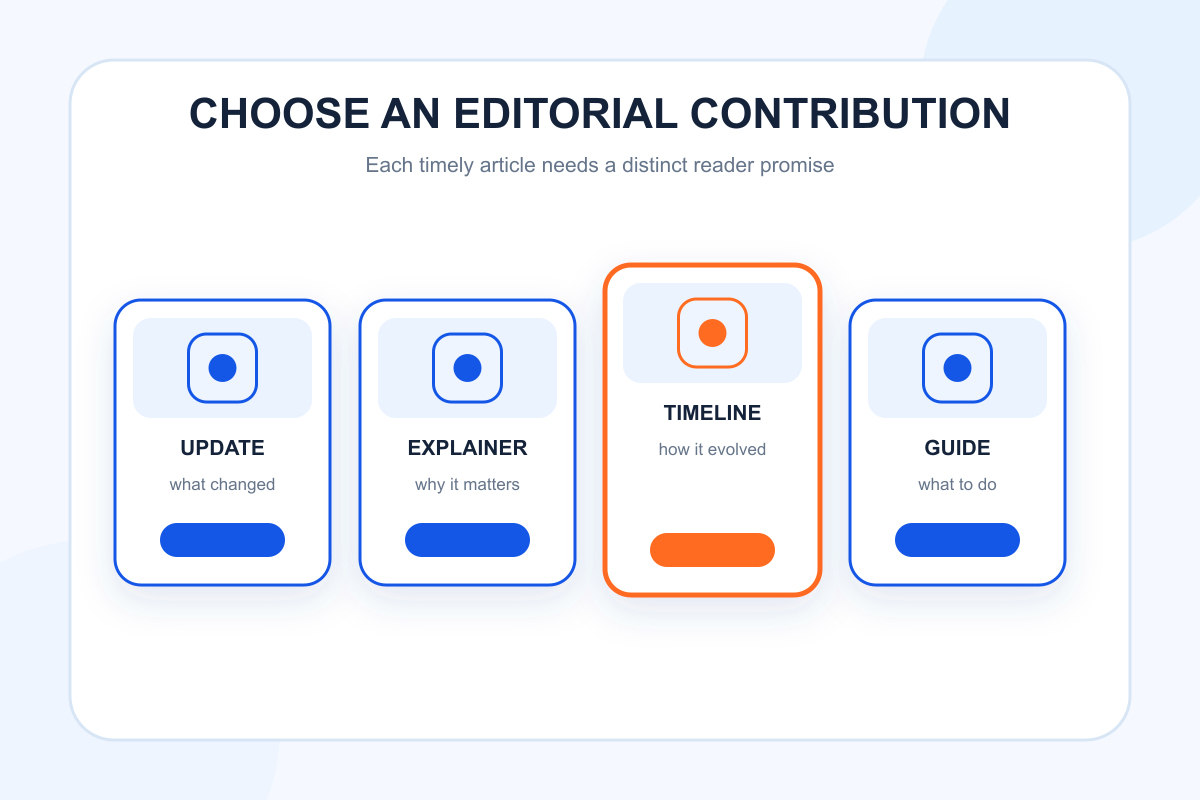
Useful contributions include:
- Original reporting or firsthand observation.
- A primary-source summary with precise context.
- A practical explanation of who is affected and what to do.
- A timeline that reconciles multiple updates.
- A comparison against previous policy or product behavior.
- A focused analysis for a specific audience.
| Article type | Reader promise | Evidence requirement |
|---|---|---|
| Breaking update | What changed and when | Primary announcement or firsthand reporting |
| Explainer | Why the change matters | Sources plus clear causal reasoning |
| Timeline | How events developed | Dated sources and correction discipline |
| Practical guide | What the reader should do | Verified steps, limits, and examples |
| Analysis | What may happen next | Separated facts and labeled inference |
Write the promise before the article. If the contribution cannot be expressed in one sentence, the scope may be too broad.
Make Timeliness Verifiable
Freshness should describe the content, not just the timestamp. Display a publication date and a modified date only when the article was meaningfully updated. When a developing story changes, add the new fact and revise affected context. Consider a short update note when the change is material.
Keep a source log with the URL, publisher, event date, publication date, and claim supported. This prevents a later update from combining facts from different stages of the story. Link to primary sources near the relevant claim whenever possible.
Do not silently rewrite predictions as facts. If an earlier statement becomes wrong, correct it transparently. If a claim is still uncertain, label it. Readers who arrive through AI Search may see only a headline and small amount of context before clicking, so the page must quickly establish its current status.
Build a Headline and Image for the Exact Story
The headline should identify the entity, change, and consequence without clickbait. A vague headline such as “A Major Search Update Is Here” loses meaning outside the publisher’s homepage. “Google Expands Inline Links and Article Carousels in AI Mode” remains understandable in a carousel.
Use an image that represents the specific story rather than a generic stock illustration. The main subject should remain legible in compact crops. Keep essential text away from edges, and avoid placing the full headline inside the image because the interface already displays a headline and may crop artwork differently.
Provide descriptive alt text when the image conveys meaningful information. Ensure the image URL is crawlable and stable. Use high-quality images that meet Google’s general image preview requirements, and verify that rights permit publication and reuse in search previews.
For Topify covers, maintain the hard safe area x=200–1000 and y=90–540 on a 1200×630 canvas. That constraint protects the subject and any short title treatment when interfaces zoom or crop the image.
Strengthen the Article’s Topical Neighborhood
A timely article should not be an isolated URL. Link it to a durable topic hub, earlier background coverage, relevant definitions, and later updates. Use descriptive anchors that explain the relationship.
For example, an article about new AI Mode links can connect to an evergreen guide on AI Mode visibility, a detailed explanation of query fan-out, and a measurement article. The timely piece captures the change; the evergreen pages help the reader understand and act on it.
Internal links also help publishers prevent duplication. Instead of repeating a full background section in every news article, summarize the necessary context and send readers to the maintained explainer. When the story evolves, publish a new article only when the event and reader need are distinct. Otherwise, update the existing page.
Preserve Search and Structured-Data Eligibility
Confirm that the article returns a successful status, is not blocked by robots rules, uses the intended canonical, and is linked from an accessible site section. Important text should be present in rendered HTML. Avoid accidental noindexsettings in newsroom templates.
Article structured data can describe the headline, image, date, author, and publisher when those values match the visible page. It does not guarantee inclusion in an AI Search carousel. Test markup for errors and keep author or organization entities consistent.
Image and page performance matter. A carousel click should not lead to a slow, shifting page covered by intrusive overlays. Optimize the primary image, reserve layout space, and make the first meaningful paragraph easy to reach on mobile.
Measure Carousel Visibility Without Overclaiming
AI-generated surfaces can vary across users, regions, and repeated queries. A single screenshot does not prove stable inclusion. Monitor a controlled set of timely prompts, record the response date and environment, and capture the linked URLs and placement type when observable.
Combine that evidence with first-party analytics:
- Article impressions and clicks from available Search reporting.
- Referral traffic to the specific URL.
- Engaged reading, scroll depth, or newsletter signup.
- Citation frequency across the tracked prompt set.
- Which headline and topic formats repeatedly attract inclusion.
Topify’s AI Search Analytics can help monitor how brands and sources appear across answer environments. Its AI Citation Analysis can help teams compare source patterns. Use those observations to guide editorial investigation, then validate business impact in first-party analytics.
Create a Newsroom Readiness Workflow
Build a reusable process before the next story breaks. Prepare article templates with correct metadata, author fields, image sizes, and internal-link modules. Maintain a list of primary sources for the beat. Assign approval thresholds for factual updates, analysis, and corrections.
At publication, verify the headline, dek, source links, dates, image, alt text, canonical, mobile layout, and structured data. After publication, monitor the primary source for changes and update the article when the reader’s understanding would materially change.
Within 24 to 72 hours, review whether the article added a distinct contribution and whether the chosen headline still reflects the story. If it overlaps another page, consolidate or clarify the separation. Durable editorial quality matters more than preserving every rapidly published URL.
Conclusion
AI Search article carousels increase the visibility of related reporting, but eligibility alone will not make an article worth choosing. Define a unique contribution, prove timeliness, use a specific headline and resilient image, connect the story to deeper coverage, and measure repeated visibility instead of celebrating one appearance. The strongest carousel candidate is also the strongest article for the reader who needs context beyond the AI summary.
FAQ
What are AI Search article carousels?
They are groups of related article links, often with images, shown in AI Search experiences to help users explore timely topics in greater depth.
Is there special markup for AI Search article carousels?
Google has not documented special carousel markup for this AI feature. Valid Article markup may describe the page, but it does not guarantee placement.
Should publishers change the modified date every day?
No. Update the date only when the article receives a meaningful editorial update, and keep the underlying content accurate.
What image works best for a carousel article?
Use a high-quality, crawlable image specific to the story, with a clear subject that remains understandable in compact or varied crops.