

A practical breakdown of AI brand monitoring: what it covers, what traditional tools miss, and how to start tracking.
Right now, someone is asking ChatGPT which brand to use in your category. The AI is generating an answer. Your brand may or may not be in it.
And you have no idea which.
That’s not a hypothetical. ChatGPT handles an estimated 2 billion queries per day, with over 5.35 billion monthly visits as of early 2026. A significant share of those queries are product research, vendor comparisons, and buying decisions. Brands that aren’t tracking what AI says about them are making strategic decisions with a structural gap in their data.
Your Monitoring Stack Has a Blind Spot the Size of ChatGPT
Google Alerts, Brandwatch, Mention: these tools were built for a specific kind of internet. One where information lives at public URLs, gets indexed by crawlers, and can be tracked when someone links to it or mentions it on a social platform.
That model still works for social media and news. It completely fails for AI.
AI platforms don’t publish their answers. There’s no URL to scrape, no API to pull from, no index to search. When ChatGPT describes your brand to a user, that response lives inside a private chat session and disappears the moment the conversation ends. Traditional monitoring tools have no mechanism to capture it.
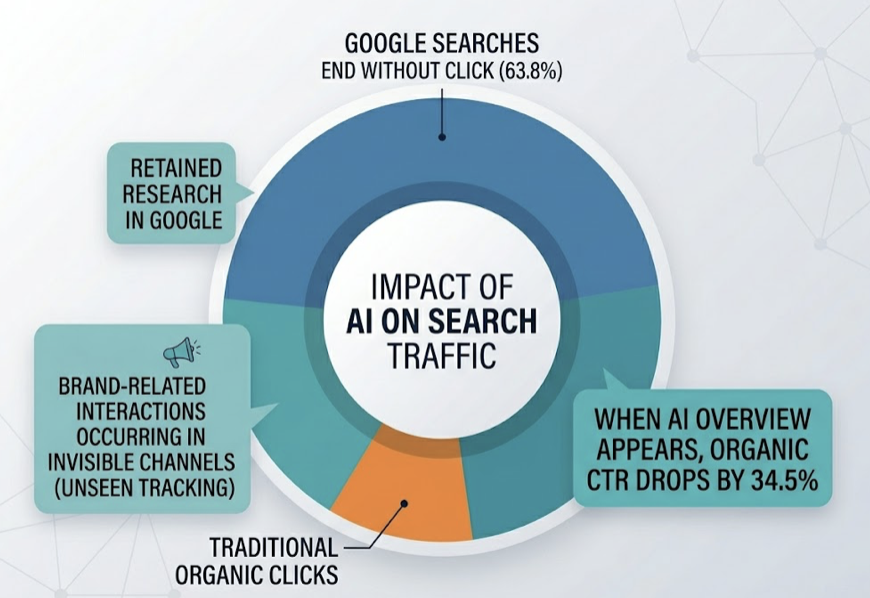
The numbers make this concrete. Nearly 64% of Google searches in the United States now end without any click to an external website. When an AI Overview appears at the top of results, organic click-through rates for traditional links drop by 34.5%. The majority of research interactions that reference your brand are happening in channels your current stack can’t see.
This isn’t a coverage gap that a new integration will fix. It’s a structural mismatch between the tools and the channel.
What AI Brand Monitoring Actually Measures
Traditional monitoring gave you a binary signal: mentioned or not mentioned. AI brand monitoring requires a different framework entirely.
There are six core metrics that matter in the generative era:
| Metric | What It Measures |
|---|---|
| Visibility | How often your brand appears when AI is asked about your category or use case |
| Sentiment | The tone and framing of how AI describes you (scored 0-100, from Endorsement to Hallucination) |
| Position | Where you appear in AI recommendations — brands mentioned in the first two sentences get 5x more consideration than those listed later |
| Mentions | Raw count of brand appearances across platforms |
| Source / Citations | Which specific domains the AI pulls from to form its view of your brand |
| CVR (Conversion Visibility Rate) | The likelihood that an AI response drives a user to engage with your brand |
CVR deserves particular attention. High-intent traffic from AI platforms converts at rates as high as 14.2%, compared to a 2.8% average for traditional search. Users who find a brand through an AI recommendation have already been pre-qualified by the model’s reasoning. They arrive further down the funnel.
The Sentiment Category You Don’t Want
AI sentiment isn’t just positive or negative. The framework breaks into five states: Endorsement, Neutral, Cautious, Negative, and Hallucination. The last one is the most damaging. When an AI confidently states something factually wrong about your brand, that error reaches users at scale before you even know it exists.
The Platforms Already Forming an Opinion About You
Most brands, when they start thinking about AI visibility, think about ChatGPT. That’s a reasonable starting point. It’s not a complete strategy.
| Platform | Scale | Why It Matters |
|---|---|---|
| ChatGPT (OpenAI) | 1B+ estimated MAU, 73% AI search market share | Dominant in both consumer and B2B query volume |
| Google Gemini | Billions via ecosystem | Integrated into Google Search; directly shapes AI Overviews that suppress organic CTR |
| Microsoft Copilot | 106M MAU, 12.8% share | Enterprise-heavy; influential in B2B procurement workflows |
| Perplexity AI | 30-45M MAU | High-intent users; explicit citation structure makes source tracking clearer |
| Doubao (ByteDance) | 155M+ MAU | China’s largest AI user base; critical for any brand with APAC exposure |
| DeepSeek | Rapidly growing | B2B and technical discovery; retrieval-first, favors documentation and industry sites |
Each platform runs on different citation logic and different user intent profiles. Gemini might surface your brand frequently because your Google Search index is strong. ChatGPT might deprioritize you because your content doesn’t appear in the sources its retrieval system weights. Perplexity might rank a competitor higher based on a single well-structured comparison article.
One platform’s data isn’t your brand’s data. It’s just one AI’s opinion.
For brands with international exposure, the Asian market gap is especially significant. Doubao’s integration within the ByteDance ecosystem makes it a primary discovery layer for hundreds of millions of Chinese consumers. Qwen (Alibaba) commands 32.1% enterprise market share but shows only a 4% visibility rate for direct brand domains in some tests, heavily favoring third-party aggregator content. Most Western brand monitoring strategies don’t account for any of this.
Why an AI Mention Hits Differently Than a Tweet
Social media monitoring matters. A negative tweet, a viral complaint, a bad review: these require real responses. But AI mentions operate on different principles.
When a user reads a tweet calling your product “clunky,” they apply skepticism. They know it’s one person’s opinion. The context is social: emotional, subjective, clearly coming from a single perspective.
When an AI tells someone your product is “not recommended for small teams,” that lands differently.
Research shows that consumers evaluate AI chatbot responses as less biased than traditional search results, primarily because the conversational interface lacks the commercial markers — ads, sponsored links — that typically trigger skepticism. The AI sounds neutral. Users default to treating its characterizations as synthesized fact.
The downstream effect compounds this. Up to 85% of B2B buyers assemble a vendor shortlist through AI conversations before ever speaking to a salesperson. If your brand is absent from that shortlist, or described in cautious terms, you’re disqualified before the conversation starts. The industry calls this “invisible disqualification.” It’s exactly what it sounds like.
There’s also a persistence problem. A negative tweet gets buried in 48 hours. An AI’s characterization of your brand, once embedded in its retrieval sources, persists until those sources are updated or overridden. Correcting a negative AI description can take weeks to months, not hours.
How to Build an AI Brand Monitoring System That Actually Works
There’s no single shortcut here. Effective AI brand monitoring requires four components working together.
Step 1: Define the Prompts That Drive Your Revenue
Don’t try to monitor every possible mention. Build a Prompt Library around the specific questions that influence buying decisions in your category.
Three prompt types matter most: category prompts (“What are the best [product type] for [use case]”), comparison prompts (“[Your brand] vs [Competitor]”), and problem-solving prompts (“How do I solve [pain point]”). These are the queries where AI recommendations translate directly into pipeline.
Step 2: Track Across All Relevant Platforms
Single-platform monitoring creates a false sense of security. Your brand’s Share of AI Voice can look strong on one platform and non-existent on another, and both readings are simultaneously true.
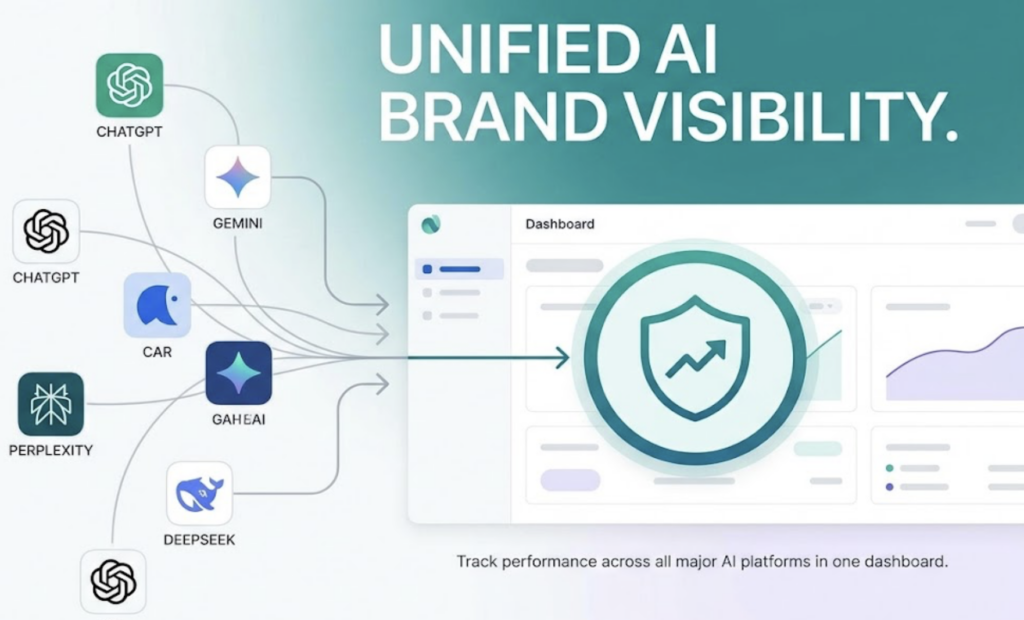
Topify tracks brand performance across ChatGPT, Gemini, Perplexity, DeepSeek, Doubao, Qwen, and other major AI platforms from a single dashboard, so teams can see platform-specific gaps without running manual queries across each one individually.
Step 3: Monitor Competitors in the Same View
In AI search, you’re always being compared. When a user asks which brand is best, the AI evaluates your brand against alternatives. Your monitoring needs to capture competitor positioning in the same prompt set.
If a competitor consistently ranks first, the next question is why. Are they cited more frequently by authoritative sources? Do they have structured data that makes their content easier for AI to parse? Competitive intelligence in AI monitoring is less about what they’re saying and more about what the AI is learning from their web presence.
Step 4: Track Your Citation Sources
The sources your AI mentions pull from are not random. They reflect which domains the model treats as authoritative for your category. Understanding your current citation structure reveals both why AI describes you the way it does and where the leverage points for change are.
A Series A fintech startup grew AI visibility from 2.4% to 12.9% in 92 days specifically by identifying and correcting factual errors across 94 citations, then restructuring documentation to be AI-readable. The intervention wasn’t ad spend. It was citation management.
What to Do With the Data Once You Have It
Monitoring without action is expensive observation. The value of AI brand monitoring is that it makes optimization specific.
If sentiment is low, the fix isn’t publishing more content blindly. It’s identifying the specific sources the AI is pulling from that contain negative or outdated characterizations, then targeting those sources with corrections or fresher, better-structured material.
If position is consistently low, analyze the structural features of top-ranked competitors. Brands that lead AI recommendations typically use clear heading hierarchies that mirror question formats, lead with direct answers rather than background context, and surface pricing and feature data in ways that retrieval systems can extract cleanly. Surfacing specific pricing data in AI answers is the third-highest click driver, because it lets buyers self-qualify before the click.
If CVR is underperforming, the issue is usually that users are seeing the brand but the AI’s description isn’t giving them a reason to act. The fix involves examining exactly what language the AI uses to describe your value proposition and adjusting the underlying sources to change it.
Topify’s platform connects monitoring data to strategy execution. The diagnostic layer feeds directly into the optimization layer, with one-click deployment of GEO strategies across relevant channels.
Data without a next step is just a report.
Conclusion
Traditional brand monitoring was built for a web where information was public, static, and linkable. That web still exists, but it’s no longer where the most consequential brand conversations happen.
AI platforms now process billions of queries per month. They influence purchasing decisions before buyers reach your website, before they read your reviews, and before they talk to your sales team. What AI says about your brand in those moments matters, and most brands currently have no visibility into it.
A two-week audit cycle is the current standard for brands that take this seriously. For categories with active competitor dynamics, more frequent tracking is worth the investment.
The brands that move on this early don’t just avoid invisible disqualification. They shape the narrative that AI presents to their market before competitors do.
FAQ
What’s the difference between AI brand monitoring and traditional brand monitoring?
Traditional monitoring tracks mentions on public, indexed channels like social media and news sites. AI brand monitoring focuses on synthetic content: real-time responses generated by LLMs in private sessions. The distinction matters because AI responses aren’t indexed, aren’t public, and don’t follow the same tracking logic as web content.
Can I monitor what AI says about my brand for free?
Manual querying of individual platforms is free but statistically unreliable for brand management. AI responses are probabilistic: a single query doesn’t represent how the model responds across thousands of similar queries. Professional tools run prompts dozens of times across multiple platforms to generate statistically valid Visibility Percentages.
What should I do if AI is saying something inaccurate about my brand?
Establish a clear Single Source of Truth on your domain, typically a dedicated company facts or brand page, and deploy Organization and Product schema markup so AI retrieval systems can anchor to canonical data. Then identify and correct the specific third-party sources the AI is currently pulling from.
How often should I track my brand on AI platforms?
A two-week audit cycle is the current standard for most brands. AI models update their retrieval layers frequently, and sentiment or position shifts can happen without warning. Real-time alerts for significant drops in Share of Voice are worth setting up regardless of your audit frequency.
How does AI brand sentiment affect actual purchasing decisions?
AI responses appear primarily in the research and evaluation phase, when buyers are assembling shortlists. Brands described in cautious or negative terms are often filtered out before the user reaches any brand-owned channel. Because users treat AI characterizations as authoritative rather than subjective, the impact is proportionally larger than equivalent negative sentiment on social platforms.

