

Your marketing team spent the last quarter building dashboards for social mentions, PR hits, and review site scores. Then a high-intent buyer asked ChatGPT to recommend a solution in your category, and the AI described your product as “dated” based on a three-year-old blog post. Your social listening tool didn’t catch it. Your media monitoring didn’t flag it. And your brand team had no idea the AI was shaping buyer perception before your website even loaded.
That gap between what you think your brand says and what AI actually tells people is growing wider every month. Closing it requires a different kind of infrastructure: one built to interrogate machines, not just monitor humans.
Most Brands Are Monitoring the Wrong Conversation
Traditional brand monitoring tools were designed for a world where humans write, share, and comment. Social listening platforms scrape X, aggregate Reddit threads, and track news mentions to produce real-time sentiment scores. That model works for crisis management and PR tracking. It doesn’t work for the channel that’s quietly replacing the Google search bar.
The shift is already measurable. Roughly 39% of consumers now use AI assistants for product discovery, and 79% say they feel more confident making purchase decisions when guided by AI. Among Gen Z, the adoption rate hits 85%. Meanwhile, traditional search volume is projected to drop 25% by 2026, and 65% of Google searches already end without a click because the AI Overview answers the question directly.
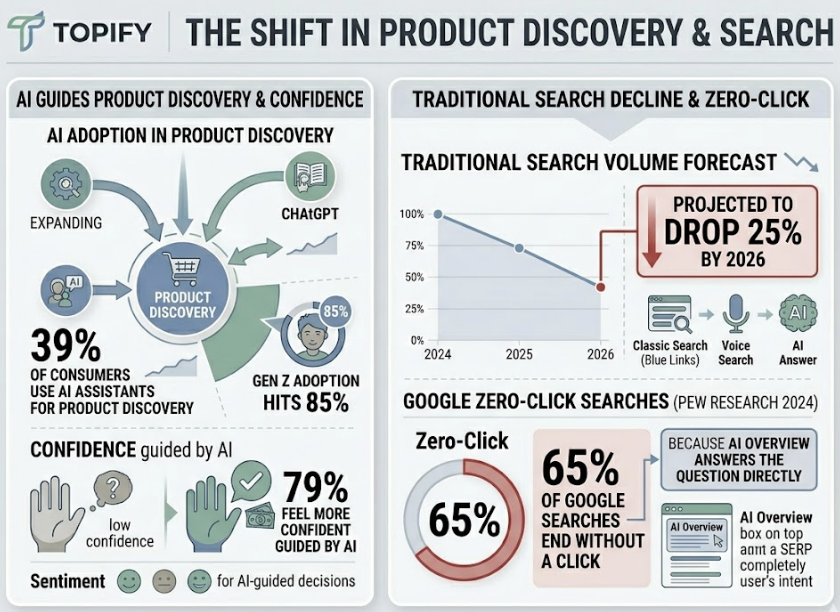
None of those AI-generated responses show up in a social listening dashboard.
That’s the blind spot. AI search engines synthesize brand narratives from training data, web retrieval, and citation patterns. They don’t just repeat what people say online. They construct a probabilistic summary of what your brand “is.” And unless you’re systematically probing those models, you have no visibility into the story they’re telling.
What an AI Brand Intelligence Platform Actually Tracks
An AI brand intelligence platform doesn’t measure “mentions” the way social tools do. It measures salience: how visible, how accurately described, and how favorably positioned your brand is inside AI-generated answers.
The core metrics break down into a structured matrix:
- Visibility (Mention Rate): How often your brand appears across a defined set of prompts. Think of it as Share of Voice, but for AI responses.
- Sentiment Integrity: Not just positive or negative, but how the AI characterizes your brand. “Innovator” and “budget alternative” are both technically neutral, but they carry very different positioning weight.
- Position (Recommendation Rank): When an AI lists three vendors, first place captures disproportionate attention. AI answers compress the consideration set far more aggressively than a Google SERP.
- Source Attribution (Citation Share): Which URLs and domains the AI retrieves to build its answer. If a competitor’s blog is the primary citation for your category, you have an authority problem.
- Fact Accuracy: Whether the AI hallucinates your pricing, features, or compliance status. High visibility paired with wrong facts is worse than invisibility.
- AI Search Volume: How many real users are actually asking the prompts that trigger your brand’s mention (or absence).
AI Brand Intelligence Analytics vs. Traditional Brand Analytics
The two disciplines measure fundamentally different layers of the information lifecycle.
| Dimension | Traditional Brand Analytics | AI Brand Intelligence Analytics |
|---|---|---|
| Data Source | Social APIs, news feeds, review sites | Training corpora, RAG pipelines, web retrieval |
| What It Analyzes | Human conversations, PR events | Machine synthesis, model outputs |
| Temporal Focus | Real-time, reactive | Longitudinal, proactive |
| Discovery Method | Keyword and hashtag tracking | Prompt matrixing, synthetic probing |
| Primary KPI | Sentiment score, Share of Voice | Share of Model, Citation Frequency |
| Actionable Output | PR response, social engagement | GEO strategy, content structure fixes |
The key difference: a social media campaign can shift human sentiment in 24 hours. But it may take weeks for that signal to reach the parametric memory or retrieval layers of an AI engine. AI brand intelligence analytics give you the roadmap for that longer-term authority building.
How an AI Brand Intelligence Platform Works Under the Hood
A serious AI brand intelligence system doesn’t just ask ChatGPT a question and screenshot the answer. It treats each AI model as a laboratory subject, using a methodology often called “Prompt Matrixing” or “Synthetic User Testing.”
The process follows four stages:
Stage 1: Prompt Monitoring and Matrixing. The platform generates thousands of prompt variations based on real customer personas. Instead of tracking “best CRM,” it tracks “best CRM for a 50-person legal firm specializing in patent law.” Specificity matters because AI responses shift dramatically with context.
Stage 2: Cross-Platform Response Capture. The platform queries multiple engines simultaneously: ChatGPT, Gemini, Perplexity, Claude, and others. Each model carries different biases based on its training data and retrieval integrations. A brand that’s visible on one platform can be invisible on another.
Stage 3: NLP Analysis and Structured Parsing. Secondary AI agents parse each response, extracting competitor entities, analyzing contextual sentiment (praised for price but criticized for support, for example), and identifying citation URLs.
Stage 4: Insight Generation and GEO Action Plans. Raw data converts into prioritized tasks. If the analysis shows a competitor winning 80% of citations because they have a specific comparison table that AI retrievers favor, the platform tells you to build one.
Topify operationalizes this pipeline through a five-step workflow: Discover high-volume prompts your buyers are asking AI. Track visibility and Share of Model across engines to establish a baseline. Understand why you’re invisible or misrepresented by diagnosing content gaps and citation weaknesses. Act on one-click optimization recommendations. Measure the lift over time to prove ROI.
5 Mistakes That Tank Your AI Brand Intelligence Strategy
Treating AI search like “SEO 2.0” leads to strategic misalignment. The probabilistic nature of LLMs requires a fundamentally different approach to reputation management.
1. Single-platform tunnel vision. A brand might score 65% visibility in ChatGPT but only 20% in Claude because the models pull from different training sets and retrieval sources. Monitoring one engine and assuming the rest follow is a dangerous bet.
2. Chasing visibility while ignoring sentiment. Being mentioned frequently is a liability if the AI is hallucinating negative facts. If a model tells users your software has a known security vulnerability that doesn’t exist, your high mention rate is accelerating a reputation crisis.
3. Not tracking competitors in AI responses. AI assistants synthesize concise answers, often excluding 90% of the brands that would appear on a traditional search results page. If you’re not tracking which competitors get “paired” with your brand in AI recommendations, you can’t build a displacement strategy.
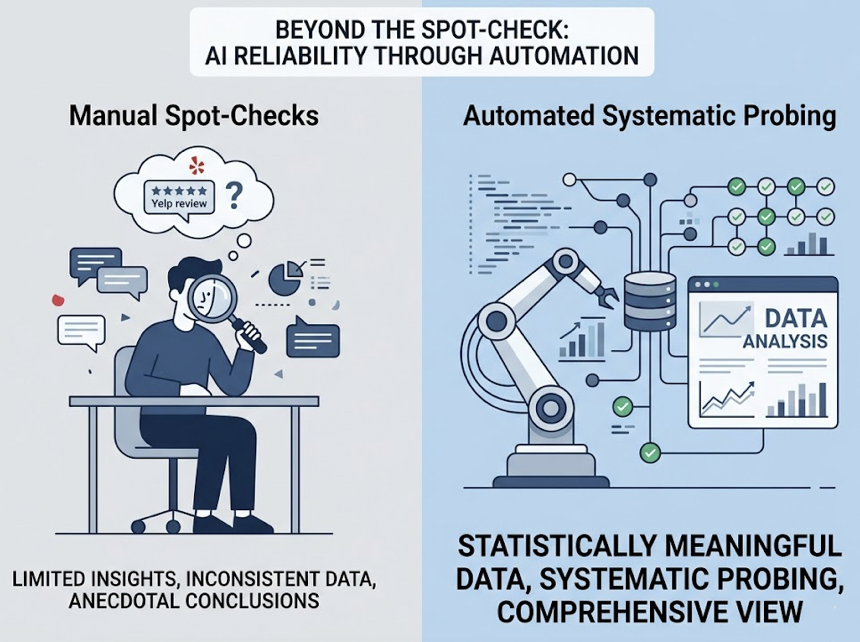
4. Relying on manual spot-checks. Asking ChatGPT a few questions from your desk and drawing conclusions is the AI equivalent of reading one Yelp review and calling it market research. AI responses vary by geography, session context, and model temperature. Only automated, systematic probing produces statistically meaningful data.
5. Collecting data without executing GEO. Many brands track their invisibility but never act on it. Research from Princeton shows that specific content techniques, such as citing authoritative sources and embedding statistics, can boost AI visibility by 30-40%. Tracking without optimizing is a cost center, not a strategy.
The Checklist for Choosing an AI Brand Intelligence Tool
The market for AI brand intelligence software is maturing fast, and not every tool delivers the same depth. Here’s what separates a real AI brand intelligence solution from a basic scraper.
Engine coverage. Look for a platform that tracks at least 5-7 major AI engines: ChatGPT, Gemini, Perplexity, Claude, Copilot, and ideally regional models like DeepSeek or Doubao if you operate in non-English markets.
Metric granularity. The AI brand intelligence dashboard should distinguish between parametric mentions (from training data) and retrieved citations (from live search). That distinction tells you whether your problem is historical brand perception or current content quality.
Competitive intelligence. Can it identify competitors outside your known set? AI models often recommend “adjacent” solutions you wouldn’t consider direct rivals. Automated competitor detection matters more in AI search than in traditional SEO.
Actionability. A tool that only shows a declining graph is a cost. An AI brand intelligence tool that tells you exactly which paragraph to rewrite, which citation source to target, and which prompt cluster to prioritize is an investment. Topify’s one-click execution model is designed specifically for this: state your goals, review the proposed strategy, and deploy without manual workflows.
Pricing transparency. AI brand intelligence platform pricing typically follows a tiered model. SMB-focused plans start around $99-$199/month for core monitoring. Enterprise plans with higher prompt volumes, more seats, and dedicated support often start from $499/month. Topify’s pricing follows this structure, scaling from 100-prompt Basic plans to custom Enterprise configurations.
How to Build an AI Brand Intelligence Strategy from Zero
You don’t need a six-figure budget to start. But you do need a structured approach that moves from observation to optimization.
Step 1: Run a manual AI reputation audit. Query ChatGPT, Gemini, and Perplexity for your brand name and core product categories. Document the gaps: Are you mentioned? Is the information accurate? Are competitors preferred? This creates your “Invisibility Baseline.”
Step 2: Set up systematic tracking. Deploy an AI brand intelligence dashboard like Topify to automate the probing. Configure a prompt matrix that reflects how your customers actually talk: “alternative to [competitor],” “best [category] for [use case],” and “is [your brand] worth it” queries tend to carry the highest conversion intent.
Step 3: Benchmark competitors and map citation sources. Identify the “source stack” each AI engine relies on. If the AI cites Reddit threads for your competitor’s recommendations, you need a community content strategy. If it cites technical documentation, your help center needs to be optimized for retrieval-friendliness.
Step 4: Execute GEO optimizations. Apply three core principles. Authority injection: add verifiable statistics and expert references to your content. Structural optimization: use “answer-first” formatting that places direct, concise statements at the top of each section. Entity clarity: implement schema markup so AI crawlers correctly identify your brand’s attributes and category.
Step 5: Measure, iterate, attribute. Track Share of Model monthly. Use GA4 to identify referral traffic from chatgpt.com or perplexity.ai. That closes the attribution loop and proves AI visibility directly drives pipeline.
Conclusion
The gap between brand monitoring and brand intelligence is no longer theoretical. With 85% of Gen Z and roughly 40% of all consumers running their discovery journey through AI assistants, the channel you can’t see is the channel that’s shaping buying decisions.
Traditional social listening still has its place. But it leaves a blind spot where a quarter of search volume is already disappearing into AI-generated answers. Closing that gap requires an AI brand intelligence platform that can probe, parse, and act on what machines are saying about your brand. The brands that build this capability now won’t just “show up” in search. They’ll be synthesized into the answer.
FAQ
Q: What is an AI brand intelligence platform?
A: It’s a specialized software category built to track, analyze, and optimize how AI search engines and large language models represent your brand. Unlike social listening, which monitors human conversations, an AI brand intelligence platform measures machine-generated narratives, including visibility, sentiment, citation sources, and recommendation rankings across engines like ChatGPT, Gemini, and Perplexity.
Q: How does an AI brand intelligence platform work?
A: It uses a method called “Synthetic Probing,” systematically querying multiple AI models with a structured matrix of prompts that mirror real buyer questions. The platform captures each response, parses it for brand mentions, sentiment, competitor references, and citation URLs, then converts the data into actionable optimization recommendations.
Q: How much does an AI brand intelligence platform cost?
A: Pricing is typically tiered based on prompt volume and platform coverage. Entry-level plans for smaller teams generally start at $99-$199/month. Mid-tier plans for growing teams run around $199-$499/month. Enterprise configurations with custom prompt volumes, dedicated account management, and expanded seat counts are priced from $499/month upward.
Q: What’s the difference between AI brand intelligence and social listening?
A: Social listening tracks what humans say about your brand on social platforms, news sites, and forums in real time. AI brand intelligence tracks what AI engines “know” and “say” about your brand based on their training data and retrieval pipelines. One measures public conversation. The other measures machine synthesis. You need both, but they answer fundamentally different questions.

