

You’ve probably done it yourself: typed your brand name into ChatGPT, scanned the response, and either felt relief or dread. That manual spot check felt productive. But it told you almost nothing. You didn’t capture what Perplexity said, what Gemini recommended, or how any of those answers changed a week later. The gap between “checking AI answers” and actually tracking them is where most marketing teams lose visibility they don’t even know they had.
AI answer tracking trackers exist to close that gap. They turn scattered, one-off queries into structured, cross-platform intelligence you can act on.
Your Brand Shows Up in AI Answers, But You Can’t Prove It
An AI answer tracking tracker is a platform built specifically to monitor how brands appear inside AI-generated responses. Unlike traditional SEO tools designed around web crawling and indexation, these trackers focus on what happens after a user asks ChatGPT, Perplexity, Gemini, or DeepSeek a question.
Traditional rank trackers tell you where your page sits in a list of ten blue links. An AI answer tracking tool tells you something different: whether your brand was mentioned at all, in what context, with what sentiment, and how often the AI cited your content as a source.
That distinction matters. AI platforms function as answer engines that synthesize, summarize, and weight sources based on proprietary LLM logic rather than PageRank alone. A brand can hold a top-three Google ranking for a keyword and still be completely absent from the ChatGPT response for the same query. Traditional SEO tools simply weren’t designed to detect that kind of visibility gap.
The shift is sometimes called “Zero-Click visibility.” The brand gets recommended or cited before a user ever clicks a link. And without an AI answer tracking system in place, you have no way to measure it.
What an AI Answer Tracking Tracker Actually Measures
Not all AI answer tracking software tracks the same things. But the platforms worth considering typically cover six to seven core dimensions. Here’s what each one captures and why it matters:
| Metric | What It Tracks | Why It Matters |
|---|---|---|
| Visibility Score | Percentage of prompts where your brand appears | Measures top-of-funnel brand awareness in AI |
| Position Rank | Order or prominence of your brand in an AI response | Directly impacts whether users notice you first |
| Sentiment Score | Emotional tone: positive, neutral, or negative | Catches AI hallucinations or reputation risks |
| Citation Frequency | How often a specific URL is cited as a source | Signals trust and authority to the AI platform |
| Competitive Benchmarking | Frequency and sentiment vs. key rivals | Identifies Share of Voice leaks to competitors |
| Prompt-Level Intent | Tracks across informational, commercial, and transactional queries | Connects tracking to specific revenue goals |
| Volume and Trend | How often users ask prompts in your category | Reveals demand shifts before they hit Google |
Topify covers all seven through a single AI answer tracking dashboard, adding a CVR (Conversion Visibility Rate) metric that estimates the likelihood of an AI response driving a user toward your brand.
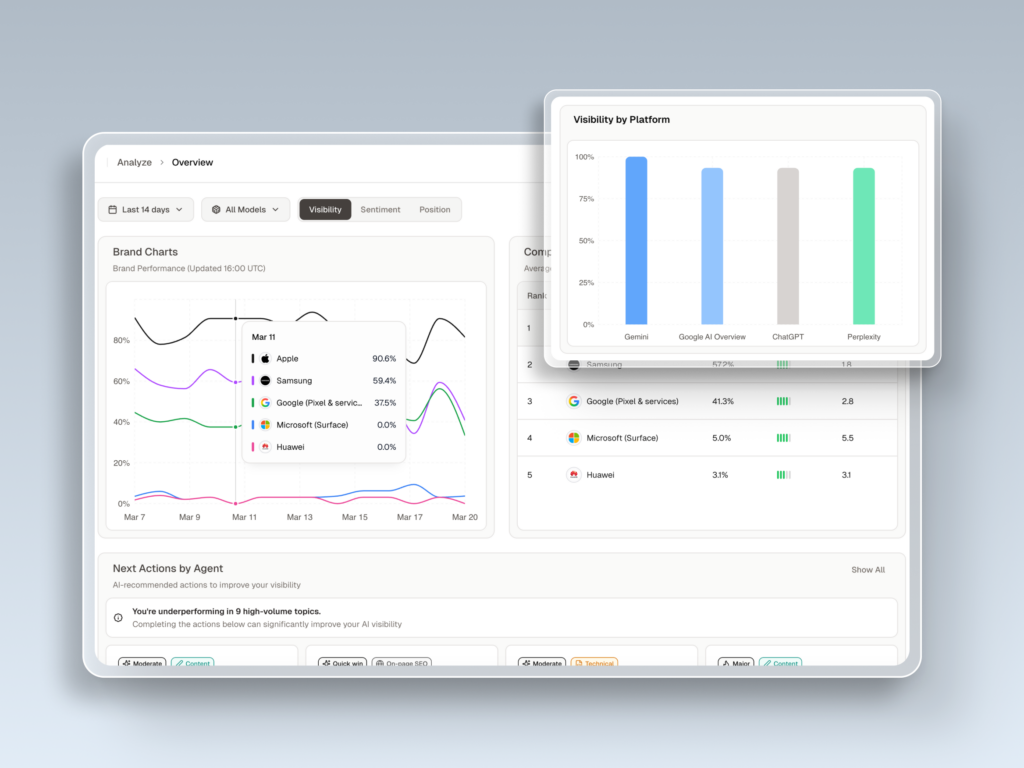
The key insight: visibility alone isn’t enough. A brand that appears in 80% of relevant prompts but with negative sentiment is worse off than a brand that appears in 40% with consistently positive framing. That’s why the best AI answer tracking platforms treat sentiment and position as equal to raw mention counts.
How an AI Answer Tracking System Works
The technical workflow behind a professional AI answer tracking tracker follows four stages. Understanding them helps you evaluate whether a tool is doing real tracking or just surface-level keyword monitoring.
Stage 1: Prompt-Level Monitoring. Instead of tracking keywords the way a traditional SERP tool does, the system executes a set of “seed prompts” representing high-value user queries across multiple LLMs. You’re not asking “where does my page rank?” You’re asking “when someone types this exact question into ChatGPT, does the AI mention my brand?”
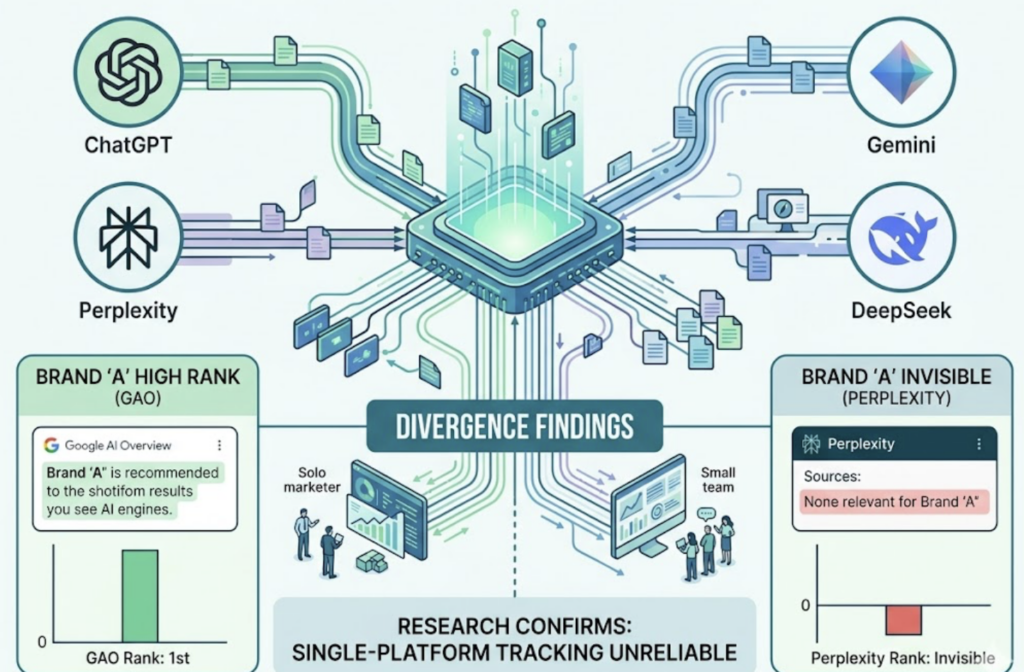
Stage 2: Cross-Platform Collection. The system aggregates output from ChatGPT, Perplexity, Gemini, DeepSeek, and other AI platforms, accounting for their unique retrieval algorithms. This is where platform divergence becomes visible. Research confirms that a brand may rank highly in Google AI Overviews but remain invisible in Perplexity, making single-platform tracking unreliable.
Stage 3: Metric Calculation. Natural Language Processing (NLP) parses each AI output to identify brand mentions, attribute them to specific URLs, and score sentiment. This is the layer that separates an AI answer tracking solution from a glorified screenshot tool.
Stage 4: Trend and Gap Analysis. Data is visualized over time to correlate content updates, such as publishing a new FAQ page or updating schema markup, with changes in citation frequency or visibility score.
Topify’s approach adds a fifth layer: High-Value Prompt Discovery, which continuously surfaces new prompts your audience is asking before competitors start tracking them.
5 Mistakes That Make AI Answer Tracking Useless
Collecting data isn’t the same as using it. These are the patterns that turn a perfectly good AI answer tracking tracker into shelf-ware.
Mistake 1: Only tracking one AI platform. Monitoring just Google AI Overviews while ignoring the rapid growth of answer-first platforms like Perplexity and ChatGPT Search leaves massive blind spots. Each platform retrieves and weights sources differently. What works on Gemini may fail on DeepSeek.
Mistake 2: Tracking your brand name but not your category. If someone asks “best project management software” and your brand doesn’t show up, that’s the acquisition funnel you’re missing. Brand-name monitoring catches reputation issues. Category-prompt monitoring catches revenue opportunities.
Mistake 3: Ignoring sentiment. Assuming visibility is always good is a trap. If the AI hallucinates or provides negative context, high visibility can actually damage brand equity. A tracker without sentiment analysis is only giving you half the picture.
Mistake 4: Monthly reporting instead of weekly review. AI answers shift faster than organic rankings. A monthly cadence means you might discover a visibility drop four weeks after it happened. Weekly review cycles catch sudden changes while there’s still time to respond.
Mistake 5: No action framework. The most common failure. Teams collect dashboards full of data but have no Standard Operating Procedure to update content, adjust schema, or address negative findings. Data without a workflow is just noise.
What Separates a Useful AI Answer Tracking Dashboard from a Vanity Panel
When evaluating an AI answer tracking platform, five dimensions separate tools that drive decisions from tools that just display charts.
Platform coverage. The tracker should cover every AI engine your audience uses. Topify monitors ChatGPT, Gemini, Perplexity, DeepSeek, Doubao, Qwen, and others, covering every major market where your customers search.
Metric depth. Look for trackers that go beyond visibility counts. Position rank, sentiment scoring, citation source analysis, and competitive benchmarking should all be native, not add-ons.
Competitive intelligence. You need to see who the AI is recommending instead of you. Dynamic Competitor Benchmarking, the kind Topify provides, auto-detects emerging rivals and shows exactly how to outrank them.
Source-level analysis. Knowing you’re visible is one thing. Knowing which URLs the AI is citing, and whether those are your pages or a competitor’s, is the layer that drives content strategy. Reverse-engineering AI citations at scale turns reactive tracking into proactive optimization.
Actionability. The dashboard should connect directly to execution. Topify’s One-Click Agent Execution lets you define goals in plain English, review the proposed strategy, and deploy it without manual workflows. That’s the difference between a tracking tool and an AI answer tracking solution that actually moves metrics.
On pricing, the range varies. Topify’s plans start at $99/month for 100 prompts and 9,000 AI answer analyses, scaling to $199/month for 250 prompts and 22,500 analyses. Enterprise plans start from $499/month with custom configurations.
How to Build an AI Answer Tracking Strategy from Scratch
A tracker is only as useful as the strategy behind it. Here’s a five-step framework for getting from zero to operational.
Step 1: Define your seed prompts. Build a library of 50 to 100 high-intent questions your customers actually ask. Categorize these into informational, comparison, and buying intent. Don’t just track “your brand name + review.” Track the category questions that drive new customer acquisition.
Step 2: Establish a baseline. Run an initial audit across platforms to capture your starting Visibility Score, Position Rank, and Sentiment. This baseline is what every future improvement gets measured against. Topify’s free GEO score check gives you a starting point without requiring a paid plan.
Step 3: Set competitive benchmarks. Identify three to five direct competitors and track their visibility in the same prompt set. You’re not just measuring whether you appear. You’re measuring whether you appear more often, higher, and more positively than the alternatives.
Step 4: Adopt a weekly review cadence. Assign someone to review AI tracking data every week. Look for sudden drops in visibility, shifts in competitor sentiment, or new prompts where your brand is absent. Weekly beats monthly because AI answers change faster than organic rankings.
Step 5: Feed data back into content. This is where most teams stall. The tracking data should directly inform your content calendar. If you’re missing from “best X for Y” prompts, that’s a content gap. If sentiment dipped after a product update, that’s a messaging fix. Integrate tracking output into your content team’s backlog so every insight becomes an action item.
The brands that win in AI search aren’t the ones with the fanciest dashboards. They’re the ones that close the loop between tracking and doing.
Conclusion
The gap between “occasionally checking ChatGPT” and running a systematic AI answer tracking tracker is the difference between guessing and knowing. Every week your brand goes unmonitored in AI responses, competitors fill that space with their own visibility, citations, and narrative.
The tools exist. The metrics are well-defined. The only variable left is whether your team builds the workflow to act on what the data reveals. Start with a free GEO score check to see where your brand stands today, then decide how deep you need to go.
FAQ
Q: What is an AI answer tracking tracker?
A: An AI answer tracking tracker is a platform that monitors how your brand appears in AI-generated responses across engines like ChatGPT, Perplexity, and Gemini. It tracks visibility, position, sentiment, citations, and competitive benchmarking at the prompt level, giving you structured data instead of manual spot checks.
Q: How do you measure AI answer tracking performance?
A: The core metrics include Visibility Score (how often your brand appears), Position Rank (where you appear relative to competitors), Sentiment Score (whether AI frames your brand positively), and Citation Frequency (how often your URLs get referenced). Effective measurement requires tracking all of these across multiple AI platforms simultaneously.
Q: What does AI answer tracking tracker pricing typically look like?
A: Pricing varies by platform coverage and prompt volume. Entry-level plans with cross-platform tracking generally start around $99/month. Mid-tier plans covering 250+ prompts and 20,000+ AI answer analyses typically run $199/month. Enterprise configurations with dedicated support start from $499/month.
Q: Can an AI answer tracking tool work alongside existing SEO dashboards?
A: Yes. AI answer tracking doesn’t replace traditional SEO monitoring. It adds a layer that traditional tools can’t cover. The most effective setup runs both in parallel: SERP tracking for organic rankings and an AI answer tracking system for generative search visibility. Some platforms, like Topify, are designed to integrate AI tracking data into your existing analytics workflow.

