

Your domain authority is solid. Your keyword rankings are holding. But none of that tells you whether Perplexity is recommending your competitor instead of you right now.
That gap isn’t a data problem. It’s a structural one. Search has quietly split into three parallel systems, each with its own logic, its own signals, and its own definition of “visible.” Running one playbook across all three doesn’t work anymore. And in 2026, the cost of that mistake is compounding fast.
Traditional SEO Still Works — Just Not for Everyone Searching
Traditional SEO is built on three pillars: crawling, indexing, and ranking. Backlink authority, keyword relevance, page speed, and mobile-friendliness are the signals that tell Google’s algorithm a page deserves to rank. That logic hasn’t changed in 20 years.
What has changed is the scope of what it covers.
Traditional SEO only captures users who go to a search engine, type a query, and click a result. That’s a shrinking slice of how people actually find information today. In 2024, 60% of US searches ended without a single click — up from just 26% in 2022. AI Overviews, featured snippets, and direct answer boxes are absorbing the query before the user ever reaches the blue links.
That said, traditional SEO isn’t dying. It’s shifting roles.
Most AI engines use traditional search indexes as their retrieval layer. ChatGPT pulls from Bing, Google AI Overviews rely on Google’s native index, and Claude uses Brave’s search infrastructure. A brand that’s technically invisible to crawlers — slow pages, broken schema, thin content — stays invisible in AI answers too. Traditional SEO is now less about rankings and more about making sure AI can find you in the first place.
The floor is still the floor. The ceiling has moved.
GEO Is About Getting Cited — Not Getting Clicked
Generative Engine Optimization (GEO) is the second layer. Its goal isn’t a ranked position. It’s getting included in the AI-generated answer itself, as a cited source, a named brand, or a referenced data point.
The mechanism is different from PageRank. When a user sends a prompt, the LLM retrieves “knowledge chunks” from across the web and synthesizes them into a response. AI systems favor content with high semantic density — specific statistics, clear structure, direct answers. A sentence like “our software is fast” has near-zero retrieval value. A sentence like “average processing time is 12ms, 40% faster than the industry baseline” is exactly what gets pulled.
Citation patterns in 2025 make this concrete. Reddit accounts for 46.5% of Perplexity’s citations and 21% of Google AI Overviews references. Wikipedia holds 47.9% of ChatGPT’s citations. YouTube drives roughly 23% of citations across all major AI platforms. The pattern is clear: AI systems trust third-party voices over brand-owned content.
Here’s the counterintuitive upside. GEO traffic converts at a different rate. Visitors arriving from AI citations convert 23x higher than traditional organic traffic. By the time a user clicks through from an AI answer, they’ve already done the research, made the comparison, and largely made the decision. You’re not at the top of the funnel. You’re at the bottom.
That changes how you should value GEO mentions. A brand cited twice in a Perplexity answer may be worth more than ranking third on Google.
Agentic SEO Is a Different Game Entirely
Agentic SEO is where the model breaks from everything familiar. It’s not about ranking. It’s not about being cited. It’s about being selected by an AI agent that’s executing a task without a human in the loop.
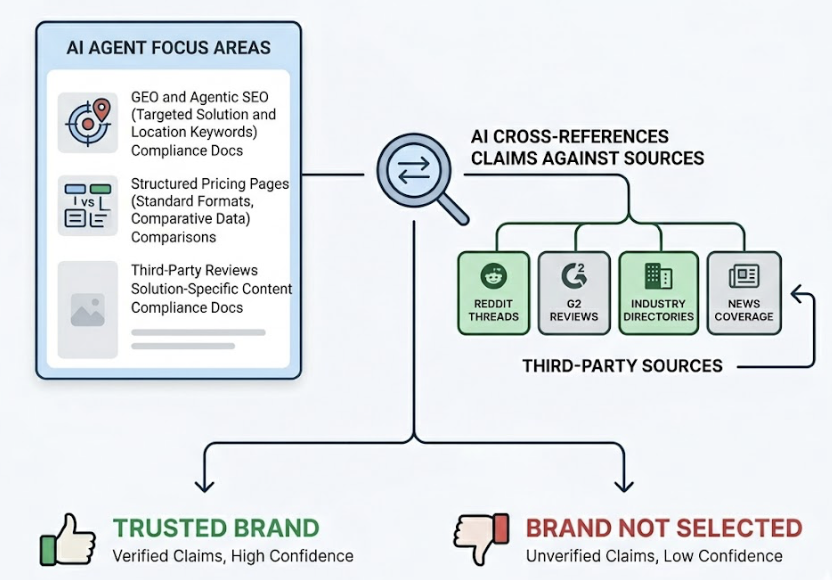
When someone asks an AI agent to “find the best CRM for a 50-person B2B team under $200/month with SOC 2 compliance,” the agent doesn’t browse websites. It makes API calls, reads structured data, cross-references entity records across LinkedIn, G2, government registrations, and review platforms, then builds a shortlist. There’s no search results page. There’s no article to click. There’s a decision brief — and your brand is either on it or not.
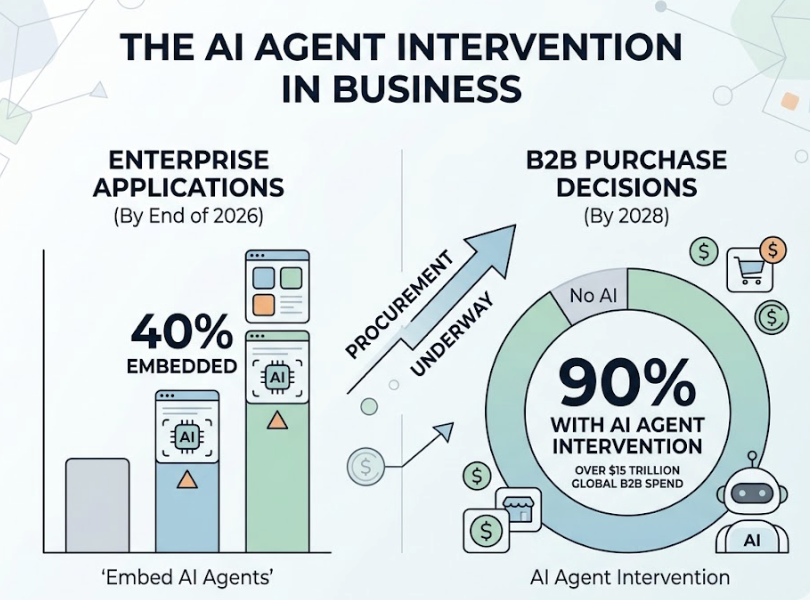
Gartner projects that 40% of enterprise applications will embed AI agents by end of 2026. In B2B specifically, 90% of purchase decisions are expected to involve AI agent intervention by 2028, covering more than $15 trillion in global B2B spend. That’s not a future scenario. That’s a procurement shift already underway.
Winning in agentic SEO requires three things most brands haven’t built yet.
First, entity consistency. Every data point about your brand across your website, G2, LinkedIn, and third-party databases needs to match exactly. Conflicting information — different founding years, different headcounts, different pricing — lowers an agent’s confidence score in your brand.
Second, API accessibility. Agents prefer structured data they can query directly over HTML they have to parse. Pricing pages, spec sheets, and compliance documentation that’s machine-readable give agents a reason to include your brand without extra effort.
Third, schema depth. Using Schema.org @id as a global identifier connects your discrete web pages into a knowledge graph an agent can navigate logically, not just crawl.
This is less about content and more about infrastructure.
The Three Models, Side by Side
| Dimension | Traditional SEO | GEO | Agentic SEO |
|---|---|---|---|
| Trigger | Keyword search | Conversational prompt | Autonomous goal execution |
| Core goal | Rank and earn clicks | Get cited in AI answers | Enter the agent’s decision brief |
| Key signals | Backlinks, keyword relevance, authority | Semantic density, structured content, third-party citations | API compatibility, schema completeness, entity consistency |
| Metrics | Rankings, CTR, organic traffic | Citation frequency, Share of Voice, sentiment | Selection rate, decision-chain participation |
| Typical tools | Semrush, Ahrefs, GSC | Perplexity, Topify, Frase | API managers, LangChain, MCP |
| How you win | Build authority, own the first page | Become the source AI can’t skip | Be machine-readable and directly transactable |
The three aren’t competing. They’re sequential. Without traditional SEO, AI can’t find you. Without GEO, AI agents can’t verify your authority. Without agentic SEO, you can’t complete the transaction when no human is watching.
Which One Should You Prioritize in 2026?
The honest answer: it depends on who’s buying from you and how they search.
For SaaS brands, GEO and agentic SEO should take the lead. Pricing pages and solution-specific content get 4 to 9 times more AI traffic than other site sections. Buyers are already asking AI to compare tools before they book a demo. Optimizing for that moment — through third-party reviews, structured pricing, and compliance documentation — matters more than chasing one more ranking.
For e-commerce brands, GEO is the most immediate lever. AI-driven retail recommendations grew 693% during the 2025 holiday season. Consumers are asking ChatGPT for product recommendations the same way they used to ask Google. YouTube and Reddit, which together drive close to half of retail AI citations, are your new distribution channels.
For professional services and content-driven brands — legal, financial, medical — traditional SEO and GEO carry equal weight. These are YMYL categories where AI systems heavily reference indexed, authoritative sources. The play is structuring content for AI extractability: lead with a 40-60 word direct answer at the top of each piece, then build out the detail below.
One thing is true across all categories: GEO is the highest-ROI opportunity most teams haven’t acted on yet. Agentic SEO is the most important thing most teams aren’t ready for.
Start with GEO. Build toward agentic.
You Can’t Optimize What You Can’t See
Here’s the problem none of this solves on its own. Traditional SEO has Google Search Console. GEO and agentic SEO have almost nothing built for measurement.
AI answers are a black box. A brand might be getting cited in Perplexity 40 times a day without knowing it. A competitor might have quietly overtaken them in ChatGPT responses while their Google rankings held steady. Without visibility into what AI is actually saying, any optimization effort is essentially guesswork.
That’s the gap Topify was built to close.
Topify tracks brand visibility across ChatGPT, Gemini, Perplexity, and Google AI Overviews, measuring seven metrics per platform: visibility, sentiment, position, volume, mentions, intent, and CVR. In practice, this means a team can see not just whether they’re being mentioned, but whether the sentiment is positive, where they rank relative to competitors, and which types of prompts are driving those mentions.
The Source Analysis feature is particularly useful for GEO strategy. It reverse-engineers AI citations: which third-party domains are being referenced when a competitor gets recommended? That tells you exactly where to publish, pitch, or place content next — not based on assumption, but on the actual retrieval patterns of the AI systems.
A common scenario: a brand’s official site ranks higher than a competitor’s domain in Google. But in Perplexity, the competitor keeps appearing because a third-party review site with highly structured comparison tables is getting cited instead. Topify surfaces that gap. Without it, the brand keeps optimizing the wrong asset.
AI Volume Analytics adds another layer. It identifies which prompt categories are growing in your space — so a content team can build for queries that are gaining traction before competitors do. It’s less about reacting to existing rankings and more about positioning for where AI search volume is heading.
Conclusion
Traditional SEO, GEO, and agentic SEO aren’t three versions of the same thing. They’re three separate games running simultaneously, each with different rules, different signals, and different definitions of winning.
Traditional SEO is still the foundation — skip it and AI can’t find you at all. GEO is the highest-leverage opportunity in 2026 for most brands, with citation-driven traffic converting far beyond what organic ever did. Agentic SEO is the long game: the infrastructure decisions made now will determine whether your brand appears in automated purchasing decisions two years from now.
The starting point for all three is knowing where you actually stand. Before you restructure content, build schema, or pitch review sites, check what AI systems are saying about your brand today. That answer tends to be more surprising than most teams expect.
Get started with Topify to see where your brand stands across AI platforms before optimizing for any of the three models.
FAQ
Q: What’s the difference between GEO and Agentic SEO?
A: GEO focuses on getting your brand cited in AI-generated answers to human prompts — someone types a question and the AI pulls your content as a source. Agentic SEO is about being selected by AI agents operating without human prompts at all. The agent has a goal, executes a multi-step research process, and makes a recommendation or decision. GEO is about citation. Agentic SEO is about selection.
Q: Does traditional SEO still matter in 2026?
A: Yes, but its role has shifted. Google still holds 89.6% of the global search market and handles billions of queries daily. More importantly, most AI engines — ChatGPT, Claude, Google AIO — rely on traditional search indexes to retrieve real-time content. A brand that’s technically broken or invisible to crawlers won’t appear in AI answers either. Traditional SEO is now the prerequisite layer, not the end goal.
Q: How do AI agents discover brands?
A: Agents don’t browse websites the way humans do. They make API calls, pull structured data, and cross-reference entity records across multiple platforms — your website, G2, LinkedIn, government registries, review databases. Brands with consistent entity data, accessible APIs, and clean schema markup are far more likely to make it into an agent’s shortlist. Inconsistent information across platforms lowers an agent’s confidence score in your brand.
Q: What metrics should I track for Agentic SEO?
A: Traditional metrics like rankings and CTR don’t apply. The relevant signals are entity consistency scores across platforms, API response quality, schema coverage depth, and — where trackable — selection rate in agent-driven tasks. On the monitoring side, tracking AI citation frequency, Share of Voice across AI platforms, and sentiment trends gives you a proxy for how agents are likely to perceive your brand when they do their own research.

