

Traditional SEO gets you ranked. Agentic SEO gets you chosen, by AI agents acting on users’ behalf before they ever open a search box.
Here’s a scenario that’s playing out more often than most marketers realize. A user types into ChatGPT: “Find me reliable cloud storage for a 50-person agency, under $20 per seat.” The agent calls a search tool, crawls a dozen sites, cross-references G2 reviews, checks Reddit threads, and outputs one recommendation with a clear explanation of why. The user says “sounds good” and signs up.
Your brand’s Google ranking? Never entered the picture.
This is what Agentic SEO is actually about. Not rankings, not even AI citations. The question is whether autonomous agents, the ones making decisions on your users’ behalf, include you in their final answer.
The Search Box Is No Longer the Front Door
For two decades, the path was predictable. User types a query, a ranked list of links appears, user clicks through to a brand website. That website was the decision environment. Every conversion test, every landing page, every headline variant was designed for that moment.
AI agents break that path entirely.
Systems like OpenAI’s Operator, Microsoft Copilot, and Google’s Gemini don’t return a list of links. They take an instruction, execute a multi-step research process, and deliver a singular recommendation. They browse on the user’s behalf, synthesize across dozens of sources, and often complete the entire task, including purchase, without the user ever visiting a brand website.
The brand website is no longer the decision environment. The agent’s reasoning engine is.
For commercial brands, the stakes compound quickly. With the Universal Commerce Protocol (UCP), developed by Google and Shopify, agents can now complete transactions directly inside conversational interfaces. A user asks for a weekender bag under $250 and checks out without ever landing on a storefront. If your brand isn’t in the agent’s selection set, you don’t just lose a click. You lose the sale entirely.
Agentic SEO, Defined (Without the Jargon)
The industry uses a lot of terms loosely. AEO, GEO, Agentic SEO. They’re not interchangeable.
| Optimization Type | What You’re Optimizing For | Typical Platforms |
|---|---|---|
| Traditional SEO | Search engine rankings, human clicks | Google, Bing |
| GEO | Citation in AI-generated answers | ChatGPT, Perplexity, AI Overviews |
| Agentic SEO | Selection by autonomous agents acting on users’ behalf | AI Operator, Copilot, agent workflows |
GEO gets you mentioned. Agentic SEO gets you chosen.
The difference matters because an agent’s goal isn’t to summarize information. It’s to complete a task. When an agent is booking, comparing, or purchasing, it’s making a judgment call about which brand to act on. That judgment runs on a different set of signals than keyword relevance or backlink authority.
Agentic SEO is the practice of ensuring your brand is structured, verified, and consistent enough to be selected at the end of that judgment process.
How AI Agents Actually Decide What to Recommend
This is the part most SEO guides skip over. The mechanics matter.
An agent doesn’t search. It executes. When a user hands it a task, it breaks that task into sub-tasks, calls tools (web search APIs, the Model Context Protocol), crawls pages that offer structured and machine-readable information, then verifies.
That last step is where most brands get filtered out.
The agent cross-references what your site claims against what third-party sources say. It checks Reddit threads, G2 reviews, industry directories, and news coverage. If your site says “enterprise-grade security” but no credible third-party source corroborates that claim, the agent’s confidence in your brand drops. You don’t get selected because the agent can’t verify you.
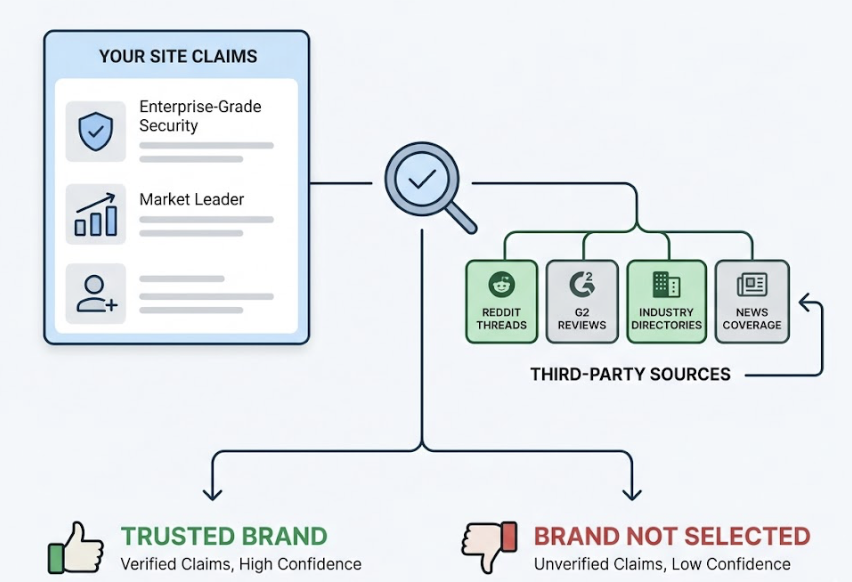
Three dimensions drive agentic selection:
Brand Clarity: Can the agent build a coherent picture of what you offer? If your website says “premium” but Yelp says “budget,” the mixed signal creates ambiguity the agent won’t resolve in your favor.
Brand Authority: Do independent sources validate your claims? Third-party sources are cited 6.5 times more often by AI engines than a brand’s own owned media. That’s not a minor factor.
Brand Trust: Is your brand credible enough for an agent to build a plan around? For high-stakes actions like booking or purchasing, trust is the decisive threshold, and it’s earned externally, not declared internally.
You Can Rank #1 on Google and Still Be Invisible to Agents
Traditional SEO tools track the ten-blue-links world. Ahrefs and Semrush tell you where you rank on SERPs, how many backlinks you have, what keywords you’re targeting. Useful data, built for a model that agents are increasingly bypassing.
The gap is structural. An agent may ignore the top organic result entirely if it detects a contradiction on a high-authority third-party site, or if the top result sits behind a login wall. No traditional SEO tool tracks that. None of them measure Share of Model, how often a brand appears and gets recommended across LLMs relative to its competitors.
There’s also a decay problem that most teams aren’t accounting for. A Google ranking can hold for years. AI citations in platforms like ChatGPT Search or Perplexity decay in roughly 13 weeks if the content isn’t updated to reflect new data or industry shifts. The cadence required for agentic visibility is fundamentally different from what most SEO workflows are built for.
Most content strategies compound this gap by optimizing for human readers. Persuasive copy, emotional hooks, conversion-focused layout. Agents are bot-readers. They prioritize neutral, fact-dense, structurally clear content. If your site is heavy on narrative and light on machine-readable structure, an agent will pass you over for a competitor that’s easier to process.
3 Signals That Determine Whether Agents Select Your Brand
Signal 1: Third-Party Consensus
Agents verify before they recommend. That means earned media, review platform presence, and forum mentions aren’t just brand awareness plays anymore. They’re the grounding data agents use to calibrate trust.
Strategic digital PR, getting your brand referenced on Reddit, G2, or in credible industry publications, now directly influences whether agents include you in their recommendation set. If the consensus says you’re credible, the agent treats you as credible. It’s that direct.
Signal 2: Cross-Platform Narrative Consistency
Inconsistency is a red flag for AI reasoning systems. If your core value proposition reads differently on your website, your LinkedIn profile, and your G2 listing, the agent’s confidence in your brand drops. Standardize descriptions, pricing context, and positioning across your entire digital footprint.
Category leaders typically hold 35–40% Share of Model on high-intent prompts. That level of presence doesn’t happen by accident. It’s built on consistent, reinforced brand signals across multiple platforms over time.
Signal 3: Machine-Readable Infrastructure
This is the technical layer most marketing teams overlook. Agents favor content that’s structured for machine consumption: FAQPage schema, Product schema, pricing tables, feature comparison tables, and clear instructional guides. Content buried in complex JavaScript or locked behind paywalls is effectively invisible to most research agents.

For e-commerce brands, UCP compliance is becoming non-negotiable. It lets agents see real-time pricing, inventory, and discounts, and complete transactions without human navigation. For SaaS and data-heavy products, exposing data through APIs or the Model Context Protocol allows agents to answer highly specific user questions with live data, a meaningful trust signal that pushes you ahead of competitors who don’t offer it.
How to Start Measuring Your Agentic Visibility
You can’t optimize what you can’t see.
The first step is establishing a baseline for your brand’s current presence across AI systems. How often does your brand appear when a relevant prompt is submitted to ChatGPT, Perplexity, or Gemini? When it appears, is it being recommended or just listed as a footnote? How does that compare to your direct competitors?
This is where Topify becomes practically useful. Topify tracks brand visibility across major AI platforms, monitoring seven key metrics: visibility rate, sentiment, position, volume, mentions, intent, and conversion visibility rate (CVR). It surfaces which sources AI engines are pulling from, which competitors are being recommended over you, and where gaps in your content strategy are creating blind spots.
Brands with a visibility rate below 10% are effectively invisible to AI systems. The benchmark for market leaders runs at 80% or higher. Knowing where you sit is the starting point for knowing what to fix.
Because LLMs generate probabilistic outputs (the same prompt can return different results), measuring agentic visibility requires sampling across prompt variations: “best CRM,” “top CRM for startups,” “CRM with the best security.” Topify handles this probabilistic sampling automatically, giving you a statistically grounded picture of your Share of Model rather than a single-point snapshot that might not reflect typical agent behavior.
Conclusion
The shift to agentic discovery isn’t coming. It’s already running in the background of how users make decisions about products, services, and brands.
The brands that’ll have an advantage aren’t necessarily the ones with the biggest content budget. They’re the ones with the cleanest data, the most consistent narrative, and the strongest third-party validation. The ones that have made it easy for an agent to read, verify, and trust them.
Establishing your baseline AI visibility now, before agentic traffic becomes the majority, is the highest-leverage move most marketing teams can make. The window for early positioning is open. It won’t stay that way.
FAQ
Q: Is Agentic SEO the same as GEO?
No. GEO focuses on being cited in AI-generated answers. Agentic SEO covers the full autonomous workflow: research, verification, decision, and action. GEO is one component of an agentic strategy, but the latter also requires technical infrastructure like UCP and MCP that GEO doesn’t necessarily address.
Q: What types of content do AI agents actually prioritize for crawling?
Agents favor content that’s machine-readable and fact-dense: schema markup, pricing tables, feature comparisons, and clear How-To guides. They tend to skip content that’s conversational without supporting facts, hidden behind login walls, or rendered in complex JavaScript that’s difficult to parse.
Q: Should I focus on GEO first or Agentic SEO?
For most brands, starting with GEO builds visibility in current AI summary systems like Google AI Overviews. If you’re in e-commerce, travel, or software, layer in Agentic SEO primitives (UCP, MCP, structured data) in parallel. The technical investments overlap significantly, so there’s no reason to treat them as sequential.
Q: Does Agentic SEO require a dedicated technical team?
Not to get started. Adding schema markup, improving cross-platform consistency, and monitoring AI visibility don’t require engineering resources. A full-scale implementation with live API connections and MCP integrations does benefit from technical involvement. But the strategic groundwork is accessible to most marketing teams today.

