

Agentic SEO isn’t about ranking pages. It’s about being discoverable before a user types a single query.
Most marketers still think brand discovery starts with a search box. It doesn’t anymore. AI agents don’t wait for a query. They crawl, reason, and synthesize across dozens of sources before a user even realizes they have a question.
That changes everything about how brands need to show up.
The shift from search engine to decision engine is already here. An AI agent evaluating “the best project management tool for a remote-first SaaS team” won’t just return a list of links. It’ll pull structured product data, cross-reference third-party reviews, check Reddit for consensus, and consult what it already knows from training. If your brand isn’t present across all five of these discovery layers, it doesn’t exist in that decision.
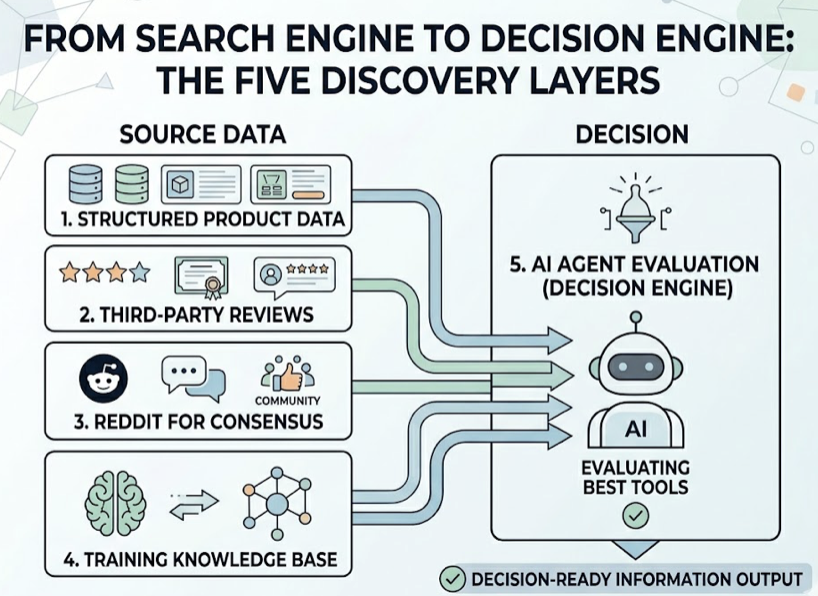
Miss one channel, and you’re invisible to a system that never asks twice.
AI Agents Don’t Search. They Decide.
Traditional search engines rank pages. AI agents make recommendations. That’s not a subtle difference — it’s a complete restructuring of how brand visibility works.
A search engine responds to a query with a list. An AI agent responds to a goal with a synthesized answer and, increasingly, a direct action. The path from “user intent” to “brand selected” has collapsed from five steps to one.
| Dimension | Search Engines | AI Decision Engines |
|---|---|---|
| Starting point | User types keyword | User states a goal or ongoing task |
| Output | Ranked list of links | Synthesized recommendation or direct execution |
| Core logic | Index + keyword match + link authority | Fetch + reasoning + multi-source synthesis |
| Brand visibility | Ranking on page one | Being cited or directly recommended in the answer |
| User path | Search → Browse → Compare → Choose | Ask → Shortlist → Verify → Done |
This is the core insight behind agentic SEO. You’re not optimizing for a position on a results page. You’re optimizing for inclusion in a reasoning chain. And that reasoning chain pulls from five distinct discovery channels — each with its own logic, its own signals, and its own playbook.
Way 1: Real-Time Web Crawling
The first way AI agents discover brands is the most direct: they fetch your pages live.
Agents like those powering Perplexity and ChatGPT Search use dedicated crawlers (PerplexityBot, GPTBot) to pull real-time content during a query. Unlike traditional SEO crawlers that build indexes over weeks, agent crawlers often act in the moment — triggered by a specific task, not a scheduled index run.
That means your page has milliseconds to prove its value.
Schema markup has moved from optional to essential. Data shows that pages using three or more Schema.org types are cited in AI answers roughly 13% more often than pages with no structured data. The reason is straightforward: structured data tells agents exactly what a piece of content means, not just what words it contains.
| Schema Type | Value for AI Agents | Key Fields |
|---|---|---|
| Organization | Defines your brand entity and official identity | Name, logo, social profiles, contact info |
| Product | Enables precise product matching for specific queries | Price, SKU, material, features, availability |
| FAQ | Feeds directly into conversational answer patterns | Question text, answer text |
| HowTo | Supports procedural queries step-by-step | Steps, tools required, expected output |
| Review | Adds third-party validation signals | Rating, review content, date, reviewer |
Freshness matters here too. Content updated in the past 30 days is cited far more often than older material, particularly in fast-moving industries like tech, finance, and SaaS. If your product pages haven’t been touched in six months, an agent treating freshness as a trust signal will deprioritize them.
One often-overlooked issue: many AI crawlers can’t execute JavaScript. If your site relies on client-side rendering, agents may be fetching empty pages. Server-side rendering isn’t just a performance optimization — in agentic SEO, it’s a baseline requirement.
Way 2: LLM Training Data (The Slow Channel Nobody Talks About)
Real-time crawling gets the attention. But there’s a slower, deeper channel that shapes how agents perceive your brand before a query even runs.
Large language models are trained on massive datasets — Common Crawl, Wikipedia, academic publications, industry media. That training data forms the model’s background assumptions. When an agent is asked which CRM has the strongest enterprise integration, its initial reasoning draws on patterns baked into its weights, not just live search results.
If your brand doesn’t appear in that training data, or appears in the wrong context, you’re fighting an uphill battle every time.
Wikipedia is the clearest example. Research indicates that roughly 47.9% of top citations in ChatGPT’s general knowledge queries originate from Wikipedia. A brand without a Wikipedia entry — or with an outdated one — risks being classified as an obscure or unverified entity by the model.
The same dynamic applies to industry reports, analyst coverage, and media mentions. Gartner Magic Quadrant placements, deep-dive features in trade publications, and citations in academic research all contribute to what models “know” about your brand at a foundational level. These signals build slowly, but they compound. A brand consistently mentioned in authoritative sources trains future models to treat it as a default reference point.
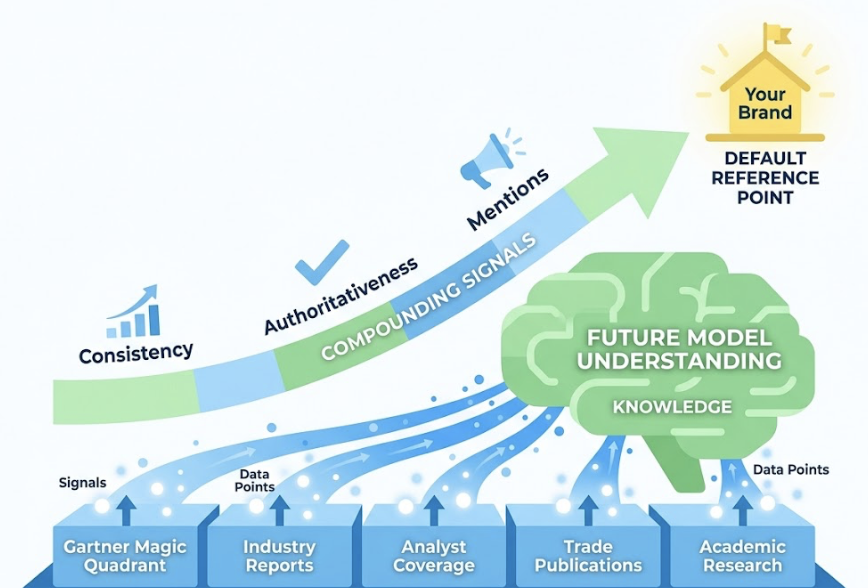
Narrative drift is the hidden risk here. If your brand was heavily associated with a specific use case three years ago, models trained on that data will reproduce that framing — even if your product has evolved. The only fix is sustained presence in authoritative, updated sources. That means maintaining Wikipedia accuracy, publishing original research that gets cited, and using Organization Schema to establish clear entity relationships that prevent models from generating hallucinated attributes.
This is the long game. And most brands aren’t playing it.
Way 3: RAG and AI-Native Search (The Fast Channel)
Retrieval-Augmented Generation is the engine behind ChatGPT Search, Perplexity, and Google AI Overviews. It’s what makes these platforms feel current: instead of relying solely on trained weights, they retrieve live content and generate answers grounded in real sources.
This is where content strategy and agentic SEO converge directly.
In a RAG pipeline, a user’s query gets converted into a numerical vector. The system finds content chunks with the closest semantic match. The model then synthesizes an answer from those chunks. If your content isn’t structured to match the way queries are phrased — not just in keywords, but in intent — it won’t surface.
The practical implication: content that leads with a clear, direct answer performs significantly better in RAG retrieval than content that buries the point. Think BLUF (Bottom Line Up Front) — a 50-word summary at the top of your article that directly answers the core question, followed by supporting evidence. Agents don’t read linearly. They extract.
Each AI platform weighs sources differently:
| Platform | Source Preference | Key Data |
|---|---|---|
| ChatGPT Search | Bing-indexed content, Wikipedia, local authority media | Wikipedia accounts for ~47.9% of top citations |
| Perplexity | Highly recency-weighted, heavy social consensus signals | Reddit citations account for ~46.7% of references |
| Claude | Technical precision, official docs, academic sources | Strong preference for structured specs and formal citations |
| Google AIO | Deep Google ecosystem integration, EEAT signals | Favors traditionally authoritative domains with strong backlinks |
The gap between these preferences is significant. A brand that dominates in ChatGPT’s citation pool might barely appear in Perplexity’s answers. You can’t optimize for “AI” as a category. You need to understand platform-specific logic.
Topify’s Source Analysis lets you see exactly which domains are being cited in AI answers for the prompts that matter to your brand. That data reveals not just where you appear, but which sources your competitors are leveraging — and what content gaps you need to close.
Way 4: Third-Party Databases and Tool Integrations
This channel is growing fastest, and most brands aren’t paying attention to it yet.
AI agents don’t just browse the web. Increasingly, they call external APIs and databases directly through protocols like MCP (Model Context Protocol). A purchasing agent evaluating B2B software might query G2’s API for intent scores and competitive data, check Crunchbase for funding stage, or pull Yelp ratings for local service providers — all without loading a single web page.
In this context, your G2 profile isn’t just a review platform. It’s your brand’s identity card in the agent ecosystem.
If that profile has incomplete integration listings, outdated feature descriptions, or no recent customer case studies, an agent reasoning through a vendor shortlist will encounter what the research calls a “data void.” Incomplete data doesn’t get a benefit of the doubt. It gets deprioritized or excluded.
The social layer matters here too. Agents consistently use Reddit, industry forums, and community platforms to source “authentic, non-promotional” signals. Perplexity’s 46.7% Reddit citation rate isn’t accidental — it reflects a deliberate preference for peer consensus over brand-controlled content.
Data consistency across platforms is non-negotiable. Agents perform cross-source verification. If your Crunchbase lists 50 employees, your LinkedIn shows 200, and your own site claims “global team,” the inconsistency triggers a reliability penalty in the agent’s reasoning. It treats conflicting signals the same way a diligent analyst would: with skepticism.
The practical checklist for this channel:
- Maintain an accurate, complete G2/Capterra profile with recent reviews and current feature parity.
- Keep Crunchbase data updated, especially funding stage and headcount.
- Build genuine Reddit presence in relevant communities — not promotional posts, but actual participation in category discussions.
- Ensure all third-party data sources agree on the same core facts about your company.
Way 5: Agent Memory and Personalization Layers
The fifth channel is the one that creates the most durable competitive advantage — and the hardest to recover from if you’re not in it.
Modern AI agents, including ChatGPT’s Memory feature, store interaction history across sessions. They build a layered understanding of user preferences that informs future recommendations. A brand that earns a positive first mention in an agent’s memory doesn’t just win one recommendation. It enters a compounding feedback loop.
Agent memory operates across three cognitive layers:
Episodic memory stores specific interactions: “User was frustrated with Brand X’s delivery speed last month.” Semantic memory accumulates preference patterns: “User consistently prioritizes sustainable materials and mid-range pricing.” Procedural memory learns interaction rules: “User always wants local suppliers considered first.”
When an agent draws on these layers to make a recommendation, recency matters — but established positive associations carry disproportionate weight. The agent is trying to minimize the risk of a bad recommendation. A brand it already “knows” is positive is safer than a new entrant, even one with a better objective profile.
First impression compounds.
This is why agentic SEO front-loads so heavily on the other four channels. You need to ensure your brand is present and accurate across crawling, training data, RAG, and third-party databases — so that when an agent encounters your brand for the first time in a zero-state query, the signals are strong enough to earn memory placement.
Brands that miss the first wave of agent recommendations don’t just fall behind. They face an exponentially higher barrier to entry as agent memories become more established.
You Can’t Optimize What You Can’t See — Track All 5 Channels
Here’s the practical problem: manually testing these five channels isn’t feasible. You can’t query thousands of prompts daily across ChatGPT, Perplexity, Gemini, and Google AIO to check where your brand appears, how it’s framed, and whether competitors are outpacing you.
That’s where purpose-built agentic SEO platforms change the calculation.
Topify provides a unified GEO (Generative Engine Optimization) dashboard that converts these five discovery channels into trackable, actionable metrics. It monitors not just whether your brand name appears, but the context and sentiment of those appearances across major AI platforms.
| Topify Feature | Problem It Solves | Application |
|---|---|---|
| Visibility Tracking | Eliminates the blind spot of “am I being recommended?” | Daily Share of Model monitoring across ChatGPT, Perplexity, Gemini |
| Source Analysis | Reveals which third-party domains are speaking for your brand | Identifies which media or Reddit threads competitors are leveraging for AI citations |
| Sentiment Analysis | Tracks shifts in how AI frames your brand | Issues early warnings when AI begins generating negative framing before it hits sales |
| Competitor Monitoring | Maps competitor positions across AI platforms | Compares AI-generated strength/weakness analysis across your competitive set |
The platform’s Source Analysis feature is particularly relevant to channels 3 and 4. When Topify detects that an AI platform is consistently citing a specific domain or URL when recommending your competitors, you can identify the exact content gap and act on it — whether that’s a piece of research, a review profile update, or a Reddit engagement strategy.
Topify’s one-click execution layer closes the loop. When the platform surfaces a specific optimization opportunity — an outdated citation, a missing Schema type, a competitor dominating a key prompt — it doesn’t just show you the data. It proposes and deploys a targeted response.
That’s the difference between monitoring visibility and actually moving it.
Conclusion
Agentic SEO isn’t an upgrade to traditional SEO. It’s a different game with different rules.
In the search engine era, you optimized for the probability of being selected. In the agent era, you’re optimizing for the inevitability of being recommended. That means building entity clarity, not just keyword density. Cross-channel signal consistency, not just page rankings. Content structures that agents can parse at extraction speed, not just text that reads well to humans.
The five channels — real-time crawling, training data, RAG, third-party databases, and agent memory — aren’t independent levers. They’re interconnected layers of a single discovery architecture. Strength in one amplifies the others. A gap in one creates drag across all of them.
The brands showing up everywhere in AI recommendations aren’t lucky. They’re structured for it.
FAQ
What is Agentic SEO?
Agentic SEO is the practice of optimizing brand presence across the discovery channels that AI agents use to find, evaluate, and recommend brands. It goes beyond traditional SEO (ranking on search results pages) and GEO (appearing in generative AI answers) to address the full decision-making logic of autonomous AI systems. This includes structured data, training data presence, RAG-optimized content, third-party database accuracy, and agent memory signals.
How is Agentic SEO different from GEO?
GEO (Generative Engine Optimization) focuses on getting your content cited in AI-generated answers. Agentic SEO is broader: it treats AI agents as autonomous decision-makers with tool access, memory, and reasoning capabilities — and optimizes for every layer those agents use. GEO is one component of agentic SEO, specifically addressing the RAG and training data channels.
Which AI platforms should I prioritize for brand visibility?
Start with ChatGPT Search, Perplexity, Google AI Overviews, and Gemini — these four cover the majority of AI-driven discovery today. For B2B brands, prioritize platforms with MCP integrations, as agents in enterprise workflows increasingly query G2, Crunchbase, and similar databases directly. Monitor Perplexity for social consensus signals and ChatGPT for entity authority. Visibility data across all platforms varies significantly by brand category, so tracking at the prompt level — rather than assuming platform-wide presence — gives you an accurate picture.

