

Three categories. Three different problems. Here’s how to tell them apart.
You sat through three vendor demos last week. One platform promised to automate keyword-targeted content at scale. Another claimed to audit your brand mentions inside ChatGPT. A third offered to restructure your site’s source code for “semantic extractability.” All three called themselves an “AI search agent.”
You left more confused than when you started. That’s not a knowledge gap on your end. It’s a taxonomy problem in the market. The term “agent” has been stretched so thin it now covers tools that solve fundamentally different problems, for different teams, using different data.
The cost of buying the wrong category isn’t just wasted budget. It’s months of optimizing for a layer of search that wasn’t your actual bottleneck.
Every Vendor Says “Agent.” They Don’t Mean the Same Thing.
Here’s the short version of what each category actually does:
SEO automation optimizes your pages to rank higher in Google’s organic results. It targets the traditional index of blue links.
A GEO agent monitors and improves your brand’s overall visibility, sentiment, and recommendation share across AI platforms like ChatGPT, Perplexity, Gemini, and Claude.
An AEO agent structures your on-page content so that LLMs extract and cite your specific passages as the primary source of truth.
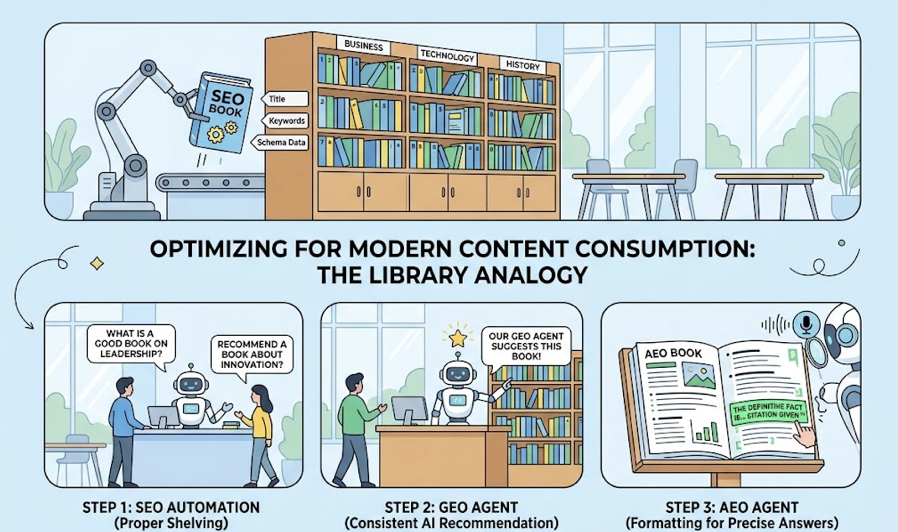
Think of it this way. SEO automation makes sure your book is properly shelved in the library catalog. A GEO agent ensures the AI librarian consistently recommends your book when patrons ask category-level questions. An AEO agent formats the pages inside your book so the librarian can read aloud and cite a precise paragraph as the definitive answer.
These aren’t three stages of the same product. They’re parallel systems that solve different problems simultaneously.
The Comparison Matrix: What Each Tool Type Actually Optimizes
The clearest way to see where these categories diverge is side by side. This matrix maps the core operational dimensions that matter for a procurement decision.
| Dimension | SEO Automation | GEO Agent | AEO Agent |
|---|---|---|---|
| Optimization Target | Google SERPs and organic blue-link click-throughs | Brand visibility, Share of Model, and sentiment across AI-generated responses | Micro-content extraction and explicit source citation rates in AI answers |
| Core Metrics | Domain Authority, keyword rankings, page speed, crawl budget | Share of Model, Sentiment Score, Mention Rate, Recommendation Position | Citation Rate, Extraction Likelihood, Schema Coverage, 30/44 Rule Alignment |
| Input Data | Search volumes, backlink profiles, SERP metadata, log files | Simulated prompt outputs, citation lists, semantic competitor logs | Content structure (H2/H3 hierarchy), JSON-LD schemas, expert quotes, factual statistics |
| Output Actions | Keyword clustering, meta-tag updates, content drafts, tech audits | Multi-platform auditing, competitive alerts, citation network reverse-engineering | Answer Capsule injection, custom schema deployment, expert quote embedding |
| Typical Buyer | SEO Manager, Content Marketing Lead | CMO, Brand Manager, Digital PR Director | Technical SEO Specialist, Content Architect, Editorial Director |
| Representative Scenario | Publishing hundreds of landing pages to capture high-volume keywords | Benchmarking how often ChatGPT recommends your brand vs. competitors | Structuring a product comparison table so Perplexity cites your exact data |
The key takeaway from this matrix: SEO automation measures Domain Authority and keyword position. GEO agents measure Share of Model, the probability your brand is recommended across a prompt matrix. AEO agents measure citation rate, the percentage of times an engine provides a clickable link back to your domain.
Different metrics. Different dashboards. Different teams.
What SEO Automation Does Well, and Where It Stops
SEO automation is the most mature segment of search technology. Modern tools handle keyword clustering, technical auditing, XML sitemap maintenance, programmatic meta-description generation, redirect monitoring, and automated CMS publishing. For teams managing hundreds or thousands of pages, this layer is non-negotiable.
But its boundaries are defined by its architecture. SEO automation tools are built for search indexes that crawl, rank, and display documents based on keyword matching, semantic proximity, and backlink authority. They can’t track how a brand is described inside a ChatGPT session. They can’t diagnose why Google’s AI Overview summarizes a competitor’s page instead of yours, even when your page ranks first organically.
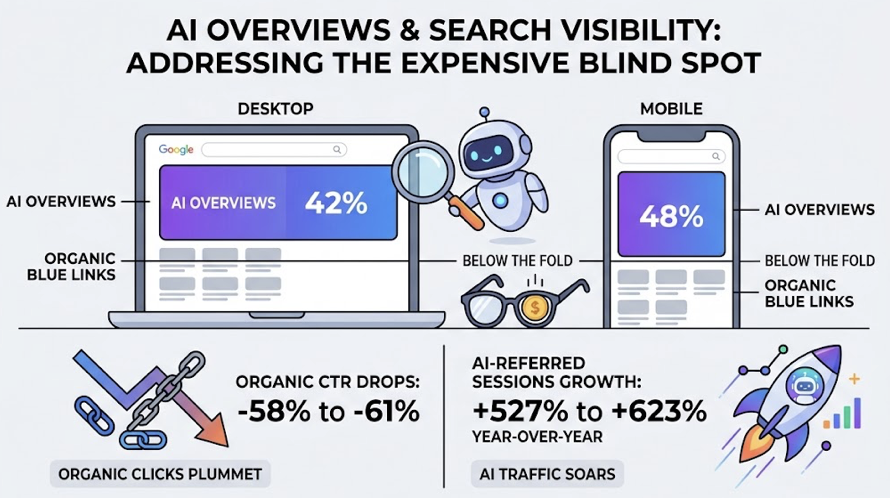
That blind spot is becoming expensive. Google’s AI Overviews now take up 42% of screen real estate on desktop and 48% on mobile, pushing classic blue links below the fold. Organic click-through rates on top results have dropped by 58% to 61% as a result. Meanwhile, AI-referred sessions are growing at 527% to 623% year-over-year. Shopify reported that AI-referred orders grew nearly 13x in Q1 2026, with those visitors converting at 50% higher rates and carrying 14% higher average order values.
Standard SEO automation can’t capture, monitor, or optimize for that traffic. If your Google rankings are stable but your referral pipeline is shifting toward conversational interfaces, SEO automation alone won’t explain why.
What a GEO Agent Tracks That SEO Tools Can’t See
GEO agents operate in a fundamentally different data layer. Instead of querying search engine APIs for static keyword rankings, they run browser-based simulations across ChatGPT, Gemini, Perplexity, Claude, and emerging engines like DeepSeek to track how AI platforms describe, recommend, and position your brand.
One reason this matters: analysis of 30 million LLM citations shows that 80% of URLs cited by large language models don’t even rank in Google’s top 100 organic results for the same query. Traditional metrics like Domain Authority are poor predictors of AI source retrieval. LLM retrieval algorithms instead prioritize signals like brand search volume (0.334 correlation with citation probability) and YouTube mentions (0.737 correlation), which build what researchers call “Entity Confidence” in the model’s parametric memory.
That’s a gap most SEO dashboards can’t show you.
GEO agents track multi-dimensional metrics across this layer. Share of Model (SoM) measures how frequently a brand is recommended across a targeted prompt library. Real-time Sentiment Scoring captures how the AI frames the brand, whether as an industry leader or a cautioned alternative. Retrieval Gap analysis identifies specific conversational pathways where competitors are cited but your brand is omitted.
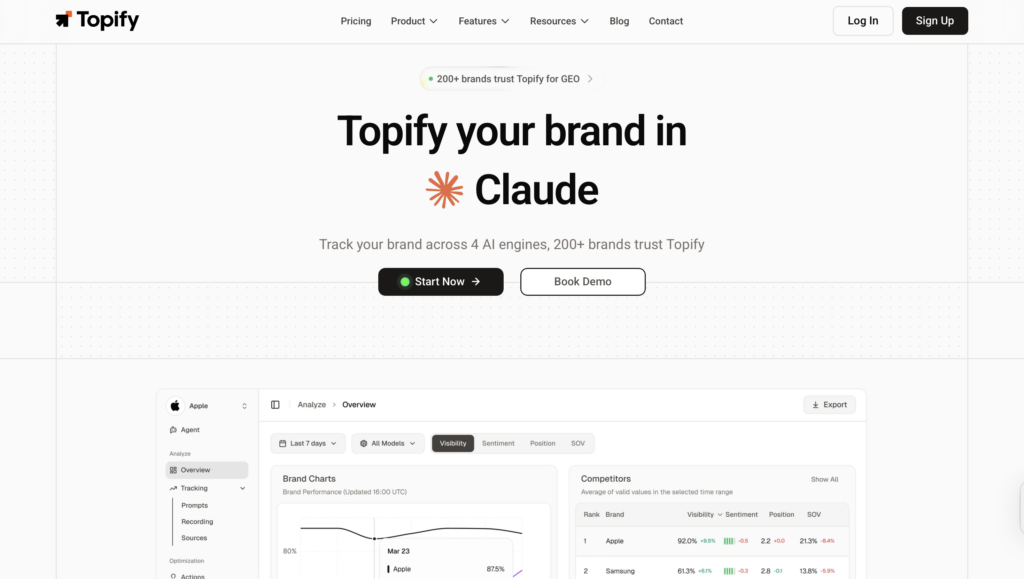
Topify is one example of how dedicated GEO platforms approach this. Topify tracks across 7+ AI engines, including both Western platforms and the Mandarin AI ecosystem (DeepSeek, Doubao, Qwen). Its intelligence framework accounts for a key structural reality: research suggests only 30% of brands maintain consistent visibility across multiple regenerations of the same AI query. Visibility in conversational search is probabilistic, not static. A GEO agent treats it accordingly.
Where the AEO Agent Fits: Optimizing the Answer, Not Just the Mention
GEO tells you whether AI platforms are recommending your brand. AEO goes one layer deeper: it tells you whether AI is citing your content as the actual source behind its answers.
The distinction is precise. A brand might appear in a ChatGPT recommendation list (that’s GEO visibility), but the hyperlink citation at the bottom of the answer points to a competitor’s page (that’s an AEO problem). Being mentioned and being cited are two different outcomes, driven by two different sets of on-page signals.
AEO agents focus on content formatting and structural engineering for Retrieval-Augmented Generation (RAG) systems. Peer-reviewed research from Princeton University, Georgia Tech, and the Allen Institute for AI quantified how specific on-page optimizations affect generative engine visibility:
| Optimization Tactic | Measured Visibility Impact |
|---|---|
| Quotation Addition (expert quotes) | +41% |
| Statistics Addition | +31% to +37% |
| Citing Established Sources | +28% to +40% |
| Fluency Optimization | +28% |
| Entity Density (~20.6%) | Significant boost |
| JSON-LD Schema Markup | +67% |
AEO strategies also leverage what’s known as the 30/44 rule. LLMs process web documents top-down and chunk content into modular fragments. Data shows that 44% of all LLM citations are extracted from the first 30% of a page’s content. This means AEO agents implement “Answer Capsules,” concise 40-to-60-word declarative summaries positioned directly beneath H2 headings, designed for RAG scrapers to digest and attribute.
If your brand is visible in AI recommendations but competitors are getting the citation links, you have an AEO problem, not a GEO problem. The fix isn’t more brand monitoring. It’s restructuring your content for extractability.
The Overlap Zone: Why Most Teams Need More Than One Tool
These three categories aren’t sealed boxes. Their boundaries are permeable, and the interdependencies are real.
Traditional SEO authority remains a baseline requirement. Research shows that 76.1% of URLs cited in Google AI Overviews also rank in Google’s organic top 10. Technical health, backlink structures, and crawlability (all SEO fundamentals) directly affect the retrieval pool that AI Overviews draw from.
GEO monitoring identifies where the gaps are. AEO provides the formatting playbook to close them. Buying one tool and assuming it covers the full stack is a common and costly mistake.
Here’s a quick diagnostic:
| Your Problem | Recommended Tool Path |
|---|---|
| Google organic rankings are declining | SEO Automation (crawlability, indexation, sitemaps, meta-tags) |
| You don’t know if ChatGPT or Perplexity recommend your product | GEO Agent (Share of Model, mention baseline, sentiment tracking) |
| AI mentions your brand, but cites competitor pages as the source | AEO Strategy + GEO Agent (audit citation sources, then deploy structural rewrites) |
Topify’s Source Analysis feature sits at this intersection. It addresses a reality that often surprises marketing teams: 82% to 85% of AI citations originate from third-party websites like directories, trade media, and Reddit, not from the brand’s owned domain. By reverse-engineering competitor citation networks, Source Analysis shows exactly where to build digital PR and external citation presence. Its Conversion Visibility Rate (CVR) metric then connects that visibility data to projected downstream revenue, giving C-suite stakeholders the ROI narrative they need.
Five Questions to Clarify Your Next Purchase
If you’re evaluating tools right now, run through this framework before booking another demo.
1. Are your Google rankings stable, but overall referral traffic is dropping? If yes, informational queries are likely being captured by AI Overviews or standalone AI engines. You need a GEO agent first, not more SEO automation.
2. Do you have quantitative proof of your brand’s presence across ChatGPT, Perplexity, and Gemini? If no, you have a brand blind spot. Standard keyword trackers can’t query LLM vector spaces. A GEO agent with browser-based simulation is the starting point.
3. Is your brand mentioned in AI outputs, but competitors get the citation links? If yes, your content lacks the structural markers RAG systems prioritize. You need AEO workflows: expert quotes, verifiable statistics, JSON-LD schemas, and Answer Capsules.
4. Do you need to demonstrate AI search ROI to the C-suite? If yes, simple mention counters won’t cut it. You need a platform with a CVR dashboard that connects conversational tracking to down-funnel conversion data.
5. Does your team have dedicated content architects for schema and structural rewrites? If no, passive reporting tools will create dashboard fatigue. Look for an agent with autonomous execution capabilities that can push optimizations directly to your CMS.
Conclusion
The search stack in 2026 isn’t one thing. It’s three parallel systems, each addressing a different layer of how users discover brands. SEO automation keeps your pages indexed and technically sound. GEO agents track whether AI platforms recommend you. AEO agents ensure your content gets cited as the source.
The vendors calling all three “AI agents” aren’t wrong about the label. They’re just skipping the part where each solves a different problem for a different team with a different set of metrics. Your job is to match the tool to the bottleneck.
For teams ready to start with the layer most organizations are missing, Topify’s Free GEO Score Checker offers a fast baseline across the conversational search landscape. It won’t replace a full-stack strategy, but it’ll show you where you stand before you sign anything.
FAQ
Q: What is the difference between AEO and GEO?
A: GEO is a broad strategy focused on tracking and improving a brand’s overall presence, recommendation probability, and sentiment across generative AI engines. AEO is a technical subset focused on structuring on-page content so RAG systems extract and cite your text as the primary source. GEO asks “does AI mention us?” AEO asks “does AI link to us as the source?”
Q: Can one tool handle both AEO and GEO?
A: Some advanced platforms bridge this gap. Topify, for instance, monitors brand sentiment and positioning across 7+ AI engines (GEO layer) while also diagnosing citation gaps and offering content restructuring to optimize for direct extraction (AEO layer). That said, teams with heavy technical SEO needs will typically still run a separate SEO automation tool alongside.
Q: Is SEO automation still necessary if I have a GEO agent?
A: Yes. Traditional SEO and GEO are complementary. 76.1% of URLs cited in Google AI Overviews also rank in Google’s organic top 10. SEO technical optimization and link building establish the crawlable authority that allows AI models to find and trust your content in the first place.
Q: What metrics should I track for AEO vs GEO?
A: For GEO, focus on Share of Model, brand mention frequency, real-time sentiment scoring, and competitive recommendation positioning. For AEO, track citation rates (how often a mention includes a link), 30/44 rule alignment, schema validation, and Conversion Visibility Rate (CVR) to connect citations to revenue impact.

