

Your marketing team spends Monday morning the same way every week: opening ChatGPT, typing in 50 brand-relevant prompts, copying the results into a spreadsheet, then repeating the whole process on Perplexity, Gemini, and DeepSeek. By Wednesday, somebody’s still logging citation URLs. By Friday, the data’s already stale.
That’s not Answer Engine Optimization. That’s data entry with a strategy label on it. And the gap between what teams think they’re doing and what the workflow actually demands is growing faster than anyone’s headcount.
Your AEO Workflow Looks Like a Second Full-Time Job
Here’s what a “standard” manual AEO cycle actually costs. A mid-market brand tracking 50 high-intent prompts across four AI platforms generates 200 distinct manual queries every single week. Each query needs to be typed, results captured, citations logged, and changes compared to the previous week’s baseline.
The time adds up fast. Prompt execution alone takes roughly 5 hours. Data logging eats another 6.6 hours. Comparative analysis against last week’s results runs about 3 hours. And content remediation, the part where you actually fix what’s broken, takes 10 to 15 hours of drafting, schema updates, and CMS uploads.
That’s 24 to 30 hours per week. For one brand. On one set of prompts.
This isn’t a setup cost that shrinks over time. It’s a recurring operational tax that compounds every time your team adds a new platform, a new product line, or a new geographic market to the tracking index.
AI Answers Change Weekly. Your Spreadsheet Can’t Keep Up.
The deeper problem isn’t just volume. It’s volatility.
Unlike traditional search engines that return stable ranked pages, generative answer engines synthesize responses at runtime using Retrieval-Augmented Generation. The retrieval indexes, vector databases, and model weights behind those answers shift continuously. Your brand can go from “top recommendation” to “not mentioned” in a matter of days, with zero changes on your end.
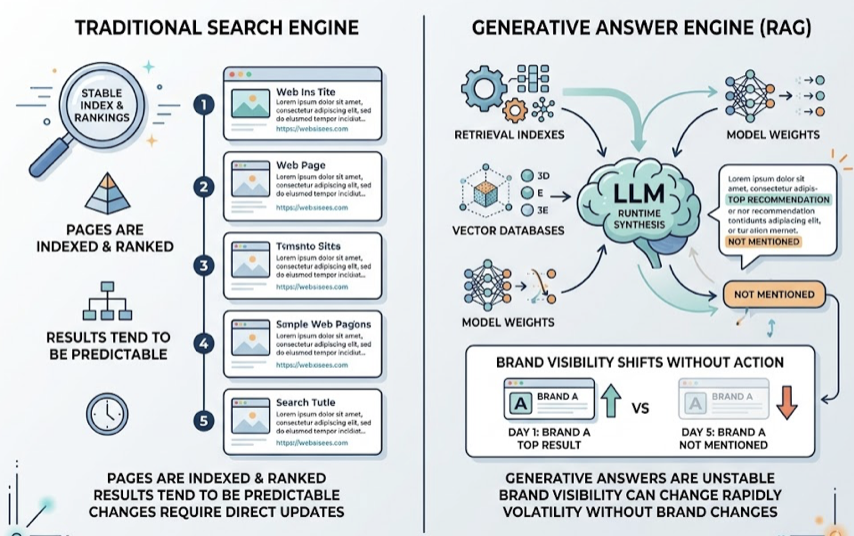
The numbers confirm this. ChatGPT rotates 74% of its cited domains on a weekly basis. Google AI Mode churns 56% weekly. Google AI Overviews hit roughly 46% weekly churn on volatile queries. Across the generative ecosystem as a whole, citation drift runs 40% to 60% per month and can reach 70% over a 90-day window.
What does that mean in practice? The spreadsheet your analyst finishes on Friday reflects a reality that’s already shifted by Monday. The content fix you publish next week targets a visibility gap that may have already mutated into something else entirely.
That’s the core tension of AEO. It’s not a one-time optimization project. It’s a continuous monitoring and response system. And spreadsheets weren’t built for continuous anything.
Three Forces Making Manual AEO Mathematically Impossible
Manual tracking doesn’t just fall behind. It hits a wall. Three compounding pressures make the math unworkable.
Platform Proliferation
Comprehensive AI visibility requires monitoring ChatGPT, Gemini, Perplexity, Claude, and Google AI Overviews at a minimum. For global brands, add DeepSeek, Qwen, and Doubao. Each platform runs a distinct retrieval architecture with different data sources. Only 11% of domains are cited consistently across both ChatGPT and Perplexity. Adding one more platform to your tracking index doesn’t add a task. It multiplies the analytical permutations.
The Prompt Space Is Effectively Infinite
Traditional SEO queries average 3 to 4 words. Conversational AI prompts average 23 words. That difference isn’t just linguistic. It’s mathematical. The permutation space for a 23-word prompt drawn from a working vocabulary of 10,000 terms is 10^92. The traditional keyword space is 10^16. The gap between them is a factor of 10^76.
In practical terms: almost every AI prompt is structurally unique. There’s no “head” query to anchor your tracking. The entire space is long-tail. A regional enterprise with 5 products, 10 target regions, and 4 core intent types faces 2,000 unique prompt permutations from just 10 base queries. Tracking 2,000 prompts across 5+ engines weekly is operationally impossible for human teams.
Compressed Content Velocity
Real-time retrieval crawlers like OAI-SearchBot and PerplexityBot continuously ingest forum discussions, reviews, and news articles. If a competitor acquires high-authority mentions on platforms like Reddit, which accounts for 1.8% of ChatGPT’s citation share, or G2 at 1.1%, they can displace your brand’s citation within hours. Manual content workflows, which typically take weeks from data logging to draft publication, can’t match that tempo.
These three forces don’t add up. They multiply. Platform count times prompt volume times content velocity equals an operational load that scales exponentially while your team scales linearly.
What an AEO Agent Actually Replaces in Your Workflow
The question isn’t “what is an AEO agent.” It’s “which parts of my team’s weekly grind does it eliminate.”
An autonomous AEO agent maps directly onto the manual workflow and replaces it step by step. Topify‘s AI Agent, for example, operates as an end-to-end execution system rather than a passive analytics dashboard. Here’s what that looks like in practice.
Automated prompt auditing replaces manual query execution. The agent runs real-time checks across ChatGPT, Gemini, Perplexity, and Google AI Overviews 24/7, mapping crawl gaps and competitor positions without human inputs.
Programmatic data harvesting replaces the master spreadsheet. Performance data flows into a unified dashboard tracking seven core metrics: Visibility Score, Sentiment Score, Position Rank, Search Volume, Mention Rate, Intent Analysis, and Conversion Visibility Rate.
Causal source analysis replaces manual backlink checking. The agent reverse-engineers each AI response, identifies the exact third-party domains driving a competitor’s recommendation, and flags precisely where your citation chain broke.
Automated content execution replaces manual copywriting and CMS uploads. The agent drafts structured, citation-ready content optimized for machine extraction, including answer-first FAQs, schema markup, and simplified sentence structures. Approved content publishes directly to WordPress, Shopify, or Framer via API in under one minute.
The speed difference is stark. Research takes 2 to 5 minutes instead of hours. Drafting takes 3 to 8 minutes instead of days. Publishing happens in under a minute instead of weeks. Overall, manual research time drops by 80% to 90%.
That’s not incremental improvement. It’s a different operational model.
From “Doing AEO” to Running It as a System
The shift from manual to agentic AEO isn’t about speed alone. It’s about changing what your team actually spends time on.
Think of it like the transition from manual email lists to marketing automation platforms like HubSpot or Marketo. Before automation, someone hand-built every send list, formatted every email, and tracked every open rate in a spreadsheet. Automation didn’t just make those tasks faster. It made them disappear from the team’s daily workflow entirely, freeing up capacity for strategy.
AEO is at the same inflection point.
When an agent handles data gathering, logging, content drafting, and CMS publishing, the marketing team shifts from execution to three strategic levers. First, prompt prioritization: directing the agent toward high-value prompt clusters that map to your ideal customer profile. Second, knowledge asset curation: structuring internal brand guidelines and product case studies so the agent can draw on them accurately. Third, conversion visibility analysis: evaluating which AI platforms yield the highest downstream revenue impact.
This isn’t guesswork. Topify’s High-Value Prompt Discovery surfaces new prompt opportunities as AI recommendations evolve, and prioritizes them using a weighted scoring formula: 30% query volume, 25% visibility gap, 25% commercial intent, and 20% content readiness. The agent systematically matches your content footprint with the questions users are asking across ChatGPT, Gemini, Perplexity, and DeepSeek.
The competitive question in AEO has already shifted. It’s no longer about who starts optimizing first. It’s about who can maintain a continuous, automated tracking and response loop. With traditional search volume projected to decline 25% by 2026, the brands that build this infrastructure now will own the AI consensus layer that replaces it.
Conclusion
Your team isn’t failing at AEO because they lack skill or effort. They’re failing because the manual approach was never designed to handle a retrieval ecosystem where citations rotate 74% weekly, prompt spaces are effectively infinite, and every new AI platform multiplies the workload.
The fix isn’t hiring more analysts. It’s shifting from episodic manual execution to a continuous, agent-driven system. Start by auditing your current AEO workflow: count the hours, measure the lag between data collection and content deployment, and ask whether your spreadsheet can keep up with a landscape that changes faster than you can update it. If the answer is no, that’s exactly what an AEO agent is built to solve.
FAQ
Q: What is an AEO agent?
A: An AEO agent is an autonomous system that handles the full lifecycle of AI answer optimization: monitoring brand visibility across generative platforms, identifying prompt-level trends, drafting structured content optimized for machine extraction, and publishing directly to your CMS. Unlike passive tracking dashboards, it executes the entire optimization loop without manual intervention.
Q: How is AEO different from traditional SEO?
A: Traditional SEO optimizes pages to rank in search engine results and drive click-through traffic. AEO focuses on structuring content so conversational AI engines like ChatGPT and Perplexity can parse, trust, and synthesize it into direct answers. AEO prioritizes passage-level semantic density, structured schema like FAQPage and HowTo, and placing the answer in the first 40 to 60 words of a section.
Q: How often do AI search answers change?
A: Frequently. ChatGPT rotates 74% of cited domains weekly. Google AI Mode rotates 56%. Across the full generative ecosystem, citation drift averages 40% to 60% per month and can hit 70% over 90 days. This volatility is a structural feature of dynamic RAG systems, not a temporary anomaly.
Q: Can small teams automate AEO without hiring more people?
A: Yes. An autonomous AEO agent reduces manual research time by 80% to 90%, enabling small teams to scale optimization across hundreds of prompts without adding headcount. The automation covers site auditing, data logging, content generation, and CMS publishing, so the team can focus on strategy rather than execution.

