

A crypto investor opens ChatGPT and types: “What are the safest DeFi lending protocols right now?” They get a confident, structured answer — three protocol names, a brief safety assessment, and a recommendation. Your protocol isn’t one of them. Not because it’s unsafe. Not because it lacks TVL. Because the AI has no reliable way to read your site, parse your documentation, or verify your authority signals.
That gap is measurable. Run your protocol through the GEO Score Checker — a free tool that evaluates your AI search readiness across four dimensions in under 60 seconds, no signup required.
✅ Free ⚡ Results in 60 seconds 🔒 No signup required
GEO Score Checker
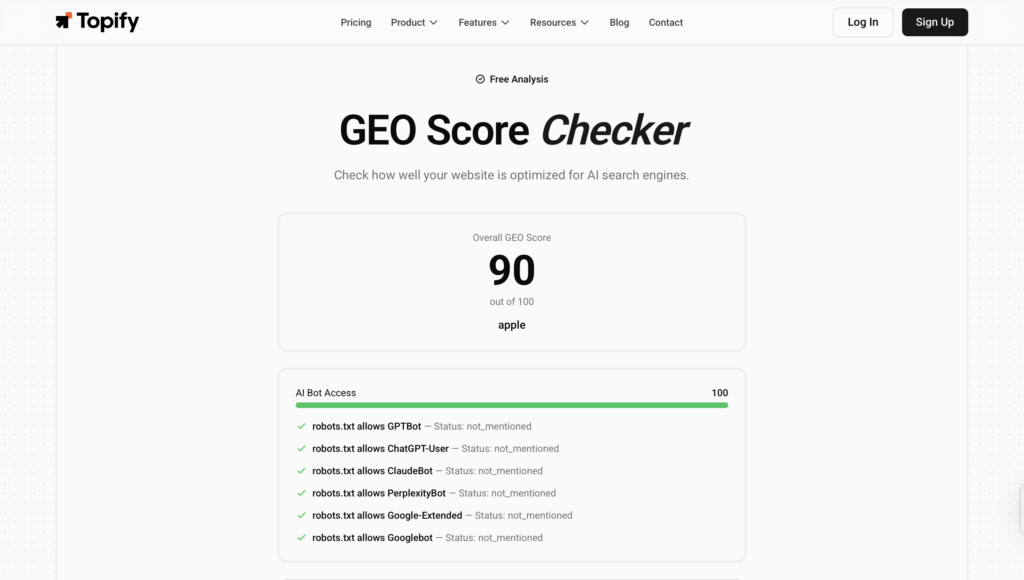
The Four GEO Scores That Expose Your Web3 Brand’s AI Blind Spots
Web3 projects face a specific structural problem: the content that proves your credibility — whitepapers, tokenomics pages, audit reports, technical documentation — is often the content that AI systems can’t access, parse, or trust. The GEO Score Checker surfaces exactly where those failures happen.
| Score Dimension | What It Measures | Web3 / Crypto Impact |
|---|---|---|
| Bot Access | Whether AI crawlers (GPTBot, ClaudeBot, PerplexityBot) can reach your site | Token pages rendered in JavaScript, PDF whitepapers, and wallet-gated content are typically invisible to AI crawlers |
| Structured Data | Whether your content is marked up in a way AI can interpret | Most DeFi protocol sites lack Schema markup; AI can’t distinguish your tokenomics page from a generic finance article |
| Content Signals | Whether your content meets the authority thresholds AI uses to evaluate trust | Audit report summaries, security track records, and technical depth are all content signals — but only if they’re formatted for AI indexing |
| Visibility Score | How often your brand surfaces across ChatGPT, Perplexity, Gemini, and Google AI Overviews | A protocol can rank on page one of Google and score near zero in AI platform visibility — these are completely separate measures |
A score of 0-40 means AI systems are largely unable to recognize or recommend your protocol. 41-60 means basic crawlability, but competitors with better structured signals have a clear advantage. 61-80 is solid but leaves real recommendation opportunities on the table. 81-100 puts you in the tier AI actively draws from when answering protocol questions.
Token Pages That Block the Bots Meant to Recommend Them
Most token landing pages are built for visual impact: animated backgrounds, wallet connect prompts, JavaScript-rendered price data. Those design choices make sense for human visitors. They’re a systematic problem for AI crawlers.
GPTBot and PerplexityBot are not browsers. They can’t execute JavaScript, connect wallets, or wait for dynamic content to load. If your token page renders its core content in JS, those crawlers see a blank page — or close to it. A low Bot Access score on the GEO Checker is often the first signal that this is happening.
Whitepapers AI Can’t Read
The whitepaper is the single most credibility-dense document a crypto project produces. It contains tokenomics, security models, protocol mechanics, governance structures. It’s also, in most cases, a PDF hosted on a subdomain or IPFS link — two formats that AI crawlers either can’t access or won’t prioritize.
A whitepaper that no AI system can read is a whitepaper that contributes zero to your Structured Data or Content Signals score. The content exists. The authority signal doesn’t.
Authority Trapped in the Wrong Format
Tier-one crypto media coverage — CoinDesk, Cointelegraph, The Block — is genuinely valuable authority signal. The problem is how most projects use it: a press page with logo tiles, or a “As Seen In” strip with no actual links or structured context.
AI systems don’t infer authority from logo placement. They look for structured signals: cited mentions, schema-tagged content, clean entity relationships between your brand and the publications covering it. If those signals aren’t present, the coverage doesn’t register as trust.
How to run the check:
- Go to the GEO Score Checker
- Enter your protocol’s domain or brand name
- Get four dimension scores in under 60 seconds
- Identify the lowest-scoring dimension — that’s your first fix
What Crypto Buyers and Investors Actually Ask AI
The shift is already underway. Retail investors, institutional allocators, developers evaluating infrastructure, and founders researching competitors — they’re all using AI platforms as a first-pass research layer before they read a whitepaper or visit your site.
Here’s what those queries look like in practice:
| AI Prompt Example | Platform | Search Intent | What It Reveals |
|---|---|---|---|
| “What are the most audited DeFi lending protocols?” | ChatGPT | Security due diligence | Projects with audit reports in AI-readable format get cited; PDF-only audits are ignored |
| “Compare Layer-2 rollup solutions for low transaction fees” | Perplexity | Technical evaluation | Protocols with structured comparison content and clear technical documentation surface first |
| “Which DEXs have the best liquidity for altcoin pairs?” | Gemini | Trading research | Visibility Score determines whether your DEX appears in this answer at all |
| “Is [protocol name] safe to use for yield farming?” | ChatGPT | Trust and safety check | Content Signals score directly predicts whether AI can answer this question about your brand |
| “What Web3 wallets support Solana and EVM chains?” | Perplexity | Product discovery | Bot Access failures mean wallet features never reach the AI’s knowledge base |
| “Explain the tokenomics of [project] before I invest” | ChatGPT | Investment research | If your tokenomics page is JS-rendered or PDF-gated, AI can’t answer — and users move on |
A 2025 analysis of TON ecosystem DeFi protocols found that ChatGPT failed to mention any of them in 87% of DeFi-related queries — despite strong Google rankings and genuine TVL.
That’s not a content quality problem. It’s a GEO infrastructure problem.
Why Strong Google Rankings Don’t Protect You in AI Search
This is the assumption that costs Web3 teams the most time. A protocol builds solid backlinks, ranks on page one for its core keywords, and assumes that means AI platforms will surface it too. They typically don’t — and the reasons are structural.
Google’s algorithm evaluates links, anchor text, and domain authority. AI systems evaluate whether they can physically access your content, whether it’s marked up in a parseable way, and whether the signals around your brand form a coherent, trustworthy entity profile. A site can score well on one system and near-zero on the other.
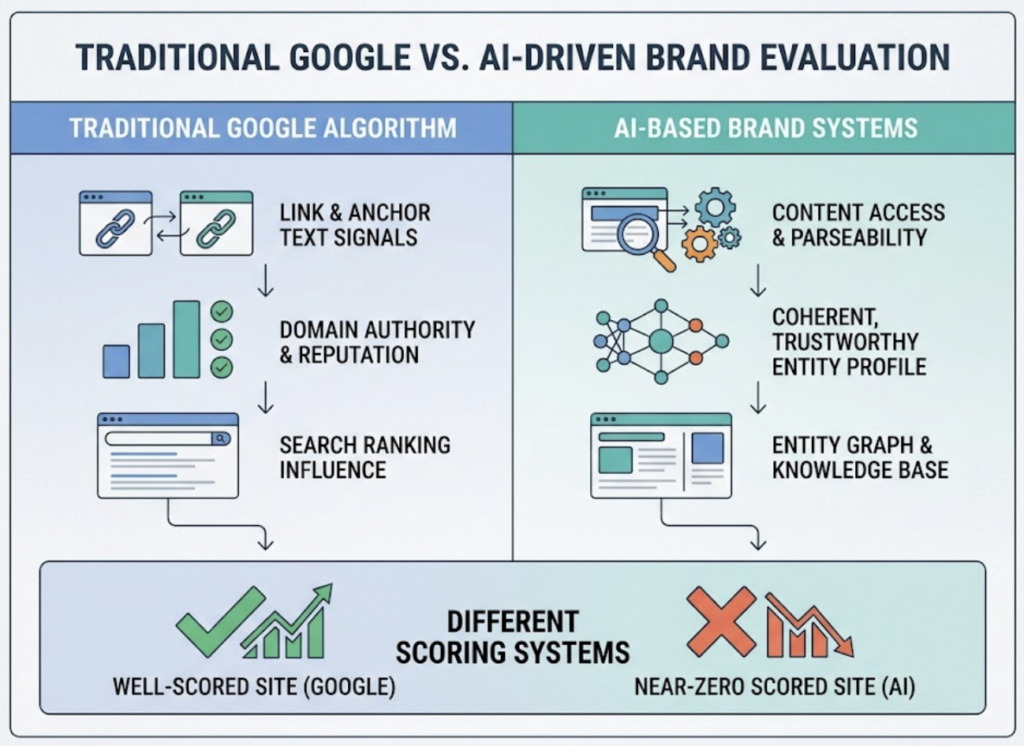
The disconnect is especially sharp in Web3 for three reasons.
First, most crypto projects optimize their content for token discussion — price action, community sentiment, launch announcements. That content drives social engagement and short-term traffic. It does very little for Content Signals score, which rewards technical depth, protocol-specific authority, and E-E-A-T structure.
Second, the security and audit information that would most improve an AI’s ability to recommend your protocol is typically buried in PDFs, GitHub READMEs, or third-party security platforms — none of which contribute to your site’s Structured Data score.
Third, platform fragmentation is common and almost never measured. A protocol that earned coverage in Perplexity’s training data may surface there while being completely absent from ChatGPT responses. Without checking Visibility Score across platforms, you have no way to know which gaps exist or where to address them first.
| Web3 Scenario | GEO Score Signal | Likely Cause | Direction |
|---|---|---|---|
| Protocol ranks on Google but isn’t cited in ChatGPT DeFi answers | Visibility Score: below 35 | AI hasn’t indexed enough structured brand signals | Build structured content pages (not PDFs) around protocol mechanics |
| Audit report exists but AI can’t reference your security record | Content Signals: below 40 | Audit is PDF-only, no HTML summary with schema | Convert audit summary to structured web content |
| Token page looks great but Bot Access score is low | Bot Access: below 30 | JavaScript rendering blocking AI crawlers | Add server-side rendering or static HTML fallback for core pages |
| Covered by CoinDesk but Structured Data is near zero | Structured Data: below 35 | No schema markup connecting brand entity to coverage | Add Organization schema and structured citation markup |
From One Score to Continuous Protocol Monitoring
The GEO Score Checker gives you a snapshot: where your protocol stands across four AI visibility dimensions, right now. That’s genuinely useful — especially if you’ve never measured it before.
The snapshot has one limitation. GEO signals don’t stay fixed. AI platforms update their knowledge bases, competitor protocols publish new structured content, and your Visibility Score shifts as citation patterns change across ChatGPT, Perplexity, and Gemini. A score you checked last month may not reflect where you stand today.
Topify‘s Comprehensive GEO Analytics is built for that ongoing layer. Where the free checker gives you a one-time read, the platform tracks all four GEO dimensions continuously, with trend history, per-platform breakdowns, and competitor benchmarking.
| Capability | Free GEO Score Checker | Topify Platform |
|---|---|---|
| Check frequency | One-time snapshot | Continuous monitoring |
| Dimensions tracked | 4 GEO scores | Full GEO analytics + sentiment + citations |
| Historical trends | None | Full trend history with alerts |
| Competitor benchmarking | Not included | Real-time competitor tracking |
| Platform breakdown | Aggregated | Per-platform (ChatGPT, Perplexity, Gemini, AI Overviews) |
| Optimization actions | Directional guidance | Specific, prioritized execution steps |
For protocols in active growth phases — fundraising, mainnet launches, ecosystem expansion — the difference between a snapshot and continuous tracking is the difference between knowing where you stood and knowing where you’re moving.
Plans start at $99/month. All plans include a 7-day free trial, no credit card required. See full pricing details.
Conclusion
Web3 projects spend months on tokenomics design, security audits, and community building. Most spend zero time checking whether AI systems can actually read any of it. That’s the gap the GEO Score Checker closes in 60 seconds.
Check your protocol’s GEO score now — free, no signup, results in under a minute.
Frequently Asked Questions
Why does my Web3 project rank on Google but not appear in AI answers?
Google and AI search systems evaluate different signals. Google measures backlinks, anchor text, and domain authority. AI platforms look for crawlable content, structured markup, and parseable entity signals. A JavaScript-heavy token page or a PDF whitepaper can rank well in Google while contributing nothing to your AI visibility — because AI crawlers can’t read them the same way Googlebot can.
What’s the most common GEO weakness for DeFi and crypto projects?
Bot Access and Structured Data tend to score lowest for Web3 sites. Token pages built with heavy JavaScript frameworks often block AI crawlers entirely. Whitepapers in PDF format don’t contribute to structured data scores. Fixing those two dimensions — server-side rendering for key pages and converting core documentation to structured HTML — typically produces the fastest GEO improvement.
Is GEO Score the same as SEO score?
No. GEO Score measures AI search readiness across four specific dimensions: crawler access, structured data quality, content authority signals, and AI platform visibility. These are distinct from traditional SEO metrics like domain authority or keyword rankings. A site can score highly on SEO tools and still have a GEO Score below 40, particularly common in Web3 where content architecture prioritizes visual design over AI indexability.
How often should a crypto project re-check its GEO Score?
At minimum, after any major site change — a redesign, new documentation section, or whitepaper update. In practice, AI platform citation patterns shift regularly as these platforms update their knowledge bases and competitors publish new structured content. For protocols in active growth phases, continuous GEO monitoring gives a more accurate picture than periodic manual checks.
Read More:
- The Complete Guide to Generative Engine Optimization (GEO)
- AI Search Visibility: What It Is and How to Improve It
- 7 Best Tools to Track AI Search Visibility in 2026

