

A resident types “Am I eligible for rental assistance in my county?” into ChatGPT. The answer cites a nonprofit blog, a news article from 2023, and a Reddit thread. The actual program page, the one with current eligibility criteria, application deadlines, and a working portal, doesn’t appear anywhere in the response.
That’s not a content quality problem. It’s a technical visibility gap between public service websites and the AI platforms citizens are turning to for answers. And it’s diagnosable.
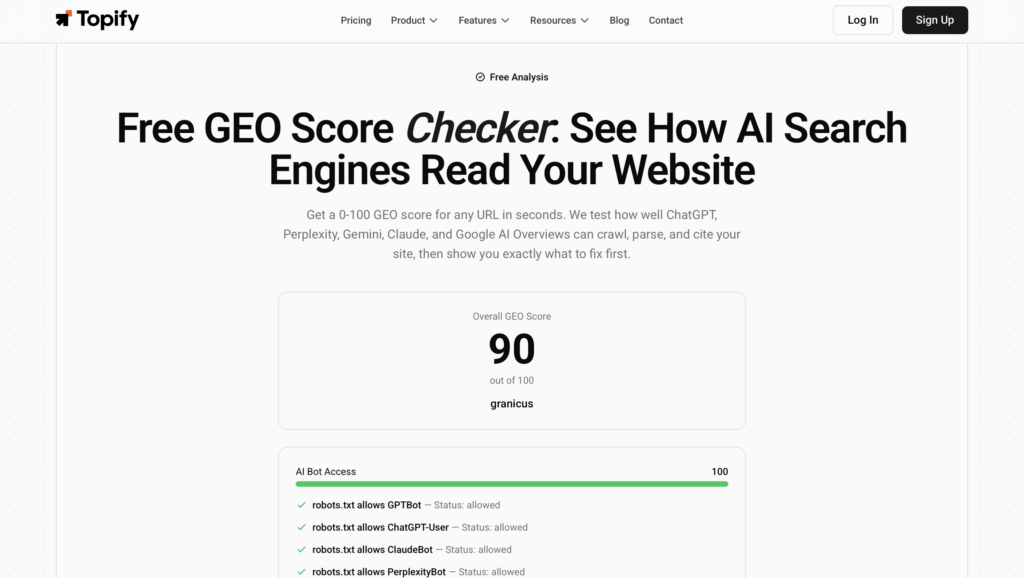
Topify‘s GEO Score Checker measures exactly where that gap sits, scoring your site across four dimensions that determine whether AI search engines can find, read, trust, and recommend your public service content.
✅ Free ⚡ Results in 60 seconds 🔒 No signup required
GEO Score Checker
The Four Scores That Reveal Why AI Skips Your Public Service Website
Public service organizations invest heavily in making information accessible to citizens. Plain language rewrites, multilingual pages, mobile-responsive design. But none of that matters to ChatGPT or Perplexity if their crawlers can’t reach the page in the first place.
The GEO Score Checker evaluates four dimensions. Each one maps to a specific breakdown point in how AI platforms process public service content.
| Score Dimension | What It Measures | Public Sector Impact |
|---|---|---|
| Bot Access | Whether AI crawlers (GPTBot, ClaudeBot, PerplexityBot) can reach your pages | Many public service sites block AI crawlers by default, making program pages invisible to AI search |
| Structured Data | Whether your content uses schema markup that AI can parse | Without GovernmentService or FAQPage schema, AI can’t distinguish a benefits page from a blog post |
| Content Signals | Whether AI considers your content authoritative and semantically clear | Bureaucratic language, PDF-heavy publishing, and thin program descriptions weaken authority signals |
| Visibility Score | How often your organization appears in AI-generated answers | Measures actual presence across ChatGPT, Perplexity, Gemini, and Google AI Overviews |
A Benefits Portal That Ranks on Google but Doesn’t Exist in ChatGPT
A social services organization maintains a comprehensive benefits eligibility page. It ranks in the top three on Google for multiple high-intent queries. But when a citizen asks ChatGPT the same question, the page doesn’t appear at all. The GEO Score Checker reveals a Bot Access score below 20: the site’s robots.txt blocks GPTBot and ClaudeBot entirely. Google’s traditional crawler gets through. AI search crawlers don’t.
A Public Health Site with Strong Content but No Structured Data
A public health department publishes detailed, plain-language guides on immunization schedules, clinic hours, and community health programs. The content is high quality. But its Structured Data score is 15. There’s no JSON-LD markup identifying the organization, its services, or the factual claims on each page. AI systems can’t verify what the content represents, so they pull from sources that do provide that machine-readable context.
Emergency Service Information Trapped in PDF Documents
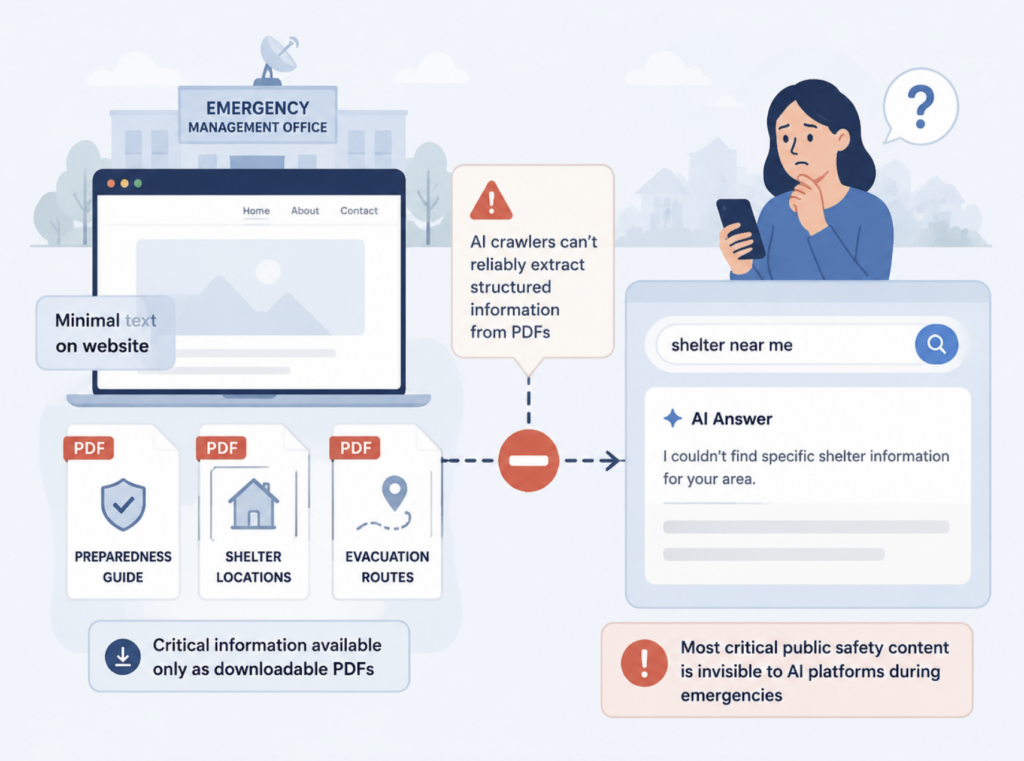
An emergency management office publishes its preparedness guides, shelter locations, and evacuation routes exclusively as downloadable PDFs. The website itself has minimal text. Content Signals score: 22. AI crawlers can’t reliably extract structured information from PDF files, which means the most critical public safety content is invisible to the AI platforms citizens use during emergencies.
How to Run the Check
- Go to GEO Score Checker.
- Enter your organization’s domain or brand name.
- Get your four-dimension score breakdown in under 60 seconds.
- Compare dimensions to identify your weakest point. That’s where citizens are losing access.
What Citizens Ask AI Before They Ever Visit Your Website
The shift isn’t theoretical. Citizens are already using AI search to navigate public services. They don’t type keyword strings. They ask full questions, the same way they’d ask a caseworker or a neighbor.
| AI Prompt Example | Platform | Search Intent | What It Reveals |
|---|---|---|---|
| “Am I eligible for food assistance if I work part-time?” | ChatGPT | Benefits eligibility screening | Whether AI cites the official program page or a third-party summary |
| “What documents do I need to renew my driver’s license?” | Perplexity | Process navigation | Whether the issuing authority’s site provides parseable, step-by-step content |
| “Free mental health services near me for uninsured adults” | Gemini | Service discovery | Whether local public health providers appear in AI recommendations |
| “How do I apply for small business permits in [city]?” | ChatGPT | Regulatory navigation | Whether the permitting office’s own content surfaces over generic legal blogs |
| “What are the income limits for childcare subsidies?” | Perplexity | Eligibility verification | Whether AI returns current figures from the program source or outdated third-party data |
| “Where is the nearest emergency shelter during a hurricane?” | ChatGPT | Crisis response | Whether emergency management content is AI-accessible when it matters most |
When AI answers these prompts with outdated, incomplete, or third-party information instead of official program content, the accuracy problem becomes a trust problem. Pew Research reported public trust at 19% in 2025. Every inaccurate AI answer about a public service reinforces that distrust.
This isn’t a marketing metric. It’s an accessibility gap with real consequences.
Where Public Service Websites Consistently Lose GEO Points
The visibility failures in public services aren’t random. They follow patterns tied to how these organizations build, manage, and publish web content.
AI Crawler Blocking as a Default Security Posture
Many public service IT teams treat AI crawlers the same way they treat unknown bots: block by default. A blanket Disallow: / for GPTBot and ClaudeBot in robots.txt keeps the site secure from an infrastructure perspective. But it also prevents AI search platforms from indexing public-facing program pages that citizens need to find.
Here’s the thing: AI providers now separate their training crawlers from their search crawlers. Blocking GPTBot (training) doesn’t require blocking OAI-SearchBot (search). The same applies to ClaudeBot versus Claude-SearchBot. A nuanced robots.txt policy can protect sensitive infrastructure while keeping public service content visible to AI search.
PDF-Heavy Content Strategies
Public service organizations publish a disproportionate amount of critical information as PDFs: application forms, eligibility guidelines, program handbooks, emergency preparedness guides. AI crawlers can access some PDF content, but they can’t reliably extract structured data, tables, or conditional eligibility logic from document files. If your most important citizen-facing information exists only in downloadable documents, your Content Signals score will reflect that gap.
Missing Service-Level Schema Markup
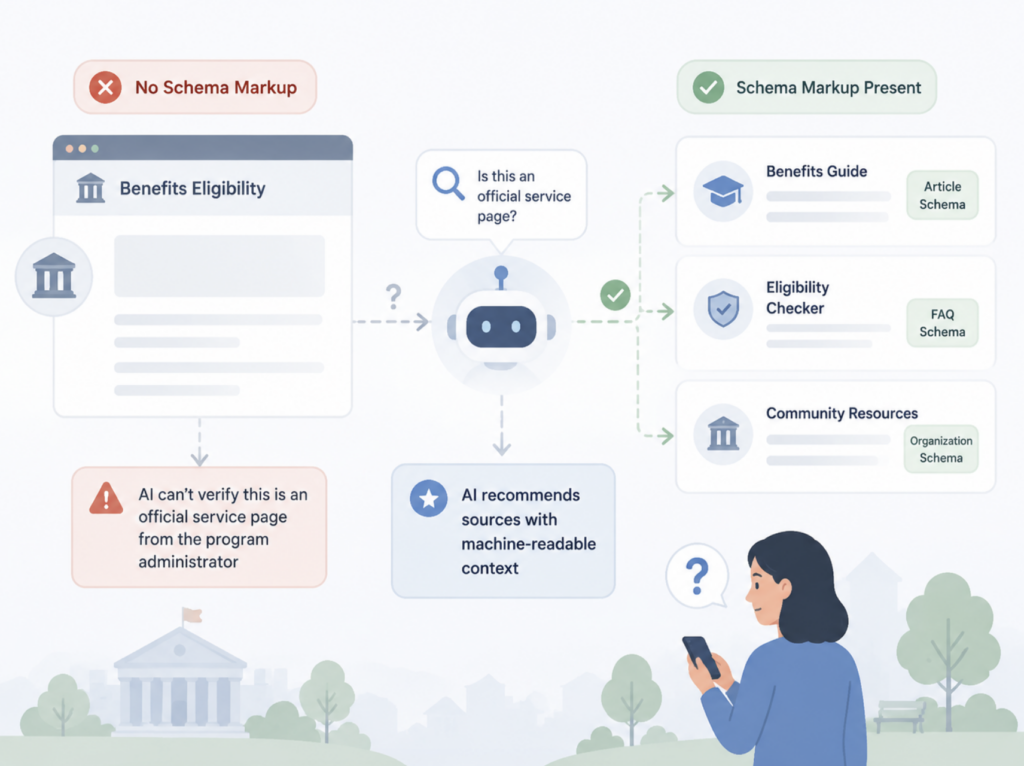
Most public service websites lack GovernmentService, GovernmentOrganization, or even basic Organization schema. Without structured data, AI systems treat a benefits eligibility page the same as any other text on the web. They can’t verify that this is an official service page from the organization that administers the program. The result: AI recommends sources that do provide machine-readable context, even when those sources are less authoritative.
Cross-Platform Visibility Gaps
A public transit authority might appear in Google AI Overviews (because Google already indexes its search results) but be completely absent from ChatGPT and Perplexity. Each AI platform crawls and indexes independently. A GEO Score Checker Visibility Score below 40 often reveals this fragmentation, where citizens get different answers depending on which AI platform they use.
| Public Service Scenario | GEO Score Signal | Likely Cause | Priority Action |
|---|---|---|---|
| Benefits page invisible to ChatGPT | Bot Access: < 25 | robots.txt blocks GPTBot and OAI-SearchBot | Update robots.txt to allow AI search crawlers on public pages |
| AI cites third-party sites over your program page | Structured Data: < 20 | No GovernmentService or FAQPage schema | Add JSON-LD markup identifying services, eligibility, and contact info |
| Emergency info can’t be found during a crisis | Content Signals: < 30 | Critical content locked in PDFs | Publish HTML versions of all citizen-facing emergency content |
| Visible on Google AI Overviews but absent from Perplexity | Visibility Score: < 35 | Inconsistent crawler access across platforms | Audit robots.txt for each AI search bot independently |
From a One-Time Score to Continuous AI Visibility Monitoring
The GEO Score Checker gives you a snapshot: here’s where your public service site stands right now across four dimensions. That’s the starting point.
But AI search visibility isn’t static. Platforms update their crawling behavior, structured data standards evolve, and your content changes with every program update, budget cycle, or policy revision. A score that’s adequate today can slip within weeks.
A single score tells you where you stand. Continuous monitoring tells you which direction you’re moving.
| Capability | Free GEO Score Checker | Topify Platform |
|---|---|---|
| Check frequency | One-time snapshot | Continuous monitoring |
| Dimensions tracked | 4 GEO scores | Full GEO analytics + sentiment + citations |
| Historical trends | None | Full trend history with alerts |
| Competitor benchmarking | Not included | Real-time competitor tracking |
| Platform breakdown | Aggregated | Per-platform (ChatGPT, Perplexity, Gemini, AI Overviews) |
| Optimization actions | Directional guidance | Specific, prioritized execution steps |
Topify’s Comprehensive GEO Analytics tracks all four GEO dimensions continuously, with per-platform breakdowns that show exactly where citizen-facing content is gaining or losing AI visibility. For public service organizations managing hundreds of program pages across multiple departments, the platform-level view replaces guesswork with data.
You can start a free trial with no credit card required, or review pricing to find the right fit for your organization’s scale.
Conclusion
AI search is becoming a primary channel for citizens navigating public services. When your program pages aren’t visible in AI-generated answers, citizens don’t just miss your website. They miss accurate information about services they may be entitled to. That’s an accessibility failure, not a marketing problem.
Start by running your organization’s domain through the GEO Score Checker. The four-dimension breakdown will tell you exactly where the gap sits: crawler access, structured data, content authority, or platform visibility.
From there, you can check specific crawler configurations with the AI Robots Checker, verify whether AI models hold current information about your services using the Knowledge Freshness Checker, or get a cross-platform visibility snapshot through the AI Visibility Report.
Frequently Asked Questions
Why would a public service website score low on GEO when it already ranks well on Google?
Google Search and AI search engines use different crawling and ranking systems. A site can rank #1 on Google while being completely invisible to ChatGPT or Perplexity, typically because robots.txt blocks AI-specific crawlers or the site lacks structured data that AI platforms rely on to verify and cite content. The GEO Score Checker identifies exactly which dimension is causing the disconnect.
Does publishing content as PDFs hurt AI visibility for public services?
In most cases, yes. AI crawlers can access some PDF content, but they can’t reliably parse tables, conditional eligibility criteria, or structured service information from document files. Public service organizations that publish critical citizen-facing information exclusively as PDFs typically score below 30 on Content Signals. Publishing HTML versions alongside PDFs is the most direct fix.
Is AI search visibility relevant for public services that don’t sell anything?
AI search visibility for public services isn’t a commercial metric. It’s an accessibility indicator. When citizens ask AI about benefits eligibility, permit processes, or emergency resources, the organizations that score higher on GEO dimensions are the ones AI cites. For public services, that means the difference between citizens finding accurate program information and citizens acting on outdated or incorrect third-party content.
How does the GEO Score Checker differ from a traditional SEO audit for a public service website?
Traditional SEO audits measure how well your pages perform in Google’s link-based ranking system. The GEO Score Checker measures four AI-specific dimensions: whether AI crawlers can access your site, whether your content has machine-readable structure, whether AI considers your content authoritative, and whether you actually appear in AI-generated answers. These are different systems with different technical requirements. A site can pass every SEO audit and still score below 40 on GEO.
Read More:

