

A donor opens ChatGPT and types: “Best nonprofits working on clean water access in East Africa.” Three organizations come back. Yours isn’t one of them.
Your programs are strong. Your impact data is real. But the AI never saw any of it.
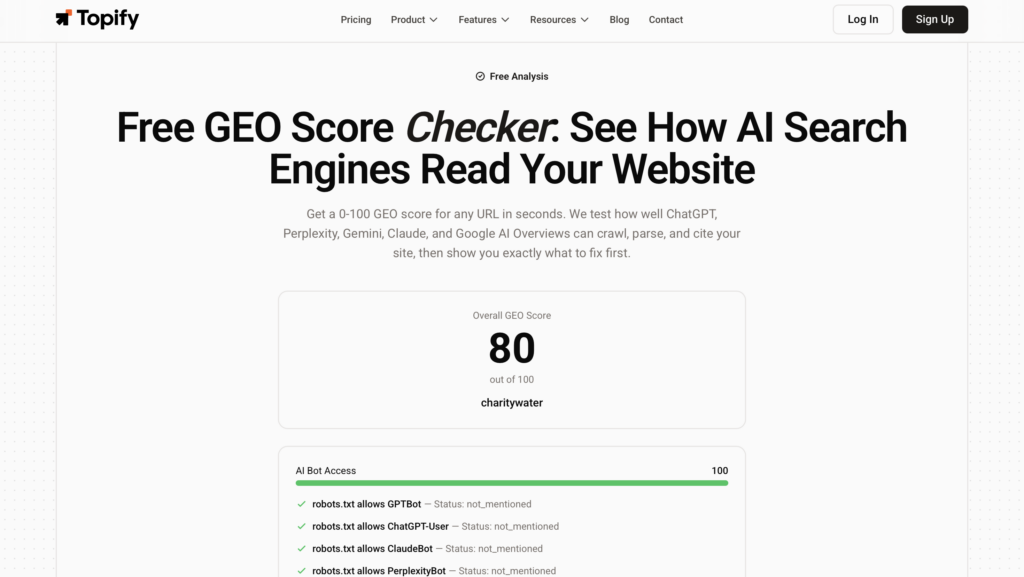
That gap between mission quality and AI visibility is a GEO problem, not a marketing problem. And it’s measurable. Topify’s free GEO Score Checker scans your nonprofit’s website across four dimensions that determine whether AI platforms recommend you or skip you entirely.
✅ Free ⚡ Results in 60 seconds 🔒 No signup required
GEO Score Checker
The Four Numbers That Tell You Why AI Skips Your Nonprofit
AI platforms don’t read your mission statement and decide you’re worthy. They look for technical signals, structured data, content authority, and cross-platform presence. The GEO Score Checker breaks this into four scores, each one diagnosable and fixable.
Here’s how those four dimensions translate to nonprofit-specific outcomes:
| Score Dimension | What It Measures | Nonprofit Impact |
|---|---|---|
| Bot Access | Whether AI crawlers (GPTBot, ClaudeBot, PerplexityBot) can reach your content | If your annual reports sit behind login walls or in unindexable PDFs, AI never processes your impact data |
| Structured Data | Whether your site uses schema markup (JSON-LD, Organization, NGO types) to tell AI what you are | Without it, AI can’t confirm you’re a registered nonprofit, what cause you serve, or where you operate |
| Content Signals | Whether AI considers your content authoritative enough to cite | Thin program pages with vague language score lower than pages with specific outcomes, methodology, and third-party validation |
| Visibility Score | How often your brand appears across ChatGPT, Perplexity, Gemini, and AI Overviews | A nonprofit visible on Perplexity but absent from ChatGPT loses different donor segments on each platform |
Your Annual Report Is a 40-Page PDF. AI Can’t Read It.
Many nonprofits publish their strongest evidence of impact inside downloadable PDF reports. Those documents are often blocked from AI crawlers or too complex for AI to parse. The result: a Bot Access score under 30, and your most persuasive content is invisible to every AI platform.
No Schema Means AI Guesses What You Are
A PR News analysis found that most charity websites lack the structured data AI engines need to classify them accurately. Without NGO or Organization schema, your site asks AI to guess your cause area, your geographic scope, and your legitimacy. That guessing usually favors organizations that did the markup work.
Strong Mission, Weak Authority Signals
Your “About Us” page says you’ve served 200,000 families. But if that claim isn’t backed by structured content with named programs, published evaluation data, and external citations from rating platforms, AI treats it as unverified. Content Signals scores below 40 typically mean AI can’t distinguish your site from a less established organization.
How to Run a GEO Check on Your Nonprofit Website
- Go to the GEO Score Checker
- Enter your nonprofit’s domain or brand name
- Get your four-dimension score breakdown in under 60 seconds
- Identify which dimension is pulling your overall score down
The weakest score is usually the one that matters most. For nonprofits, that tends to be Bot Access or Structured Data.
What Donors and Grant-Makers Ask AI Before They Choose a Partner
Donors aren’t the only ones querying AI about your organization. Grant-makers, corporate CSR teams, and potential program partners are using AI platforms to shortlist collaborators. These prompts carry real budget decisions behind them.
| AI Prompt Example | Platform | Search Intent | What It Reveals |
|---|---|---|---|
| “Best nonprofits for youth education in Sub-Saharan Africa” | ChatGPT | Individual donor discovery | Whether AI includes your org in cause-specific recommendation lists |
| “Top-rated charities for disaster relief with low overhead” | Perplexity | Donor due diligence | Whether your financial transparency data reaches AI through structured signals |
| “Nonprofit partners for corporate water sustainability program” | Gemini | Corporate partnership sourcing | Whether AI surfaces your org for B2B collaboration queries |
| “Which NGOs have the highest impact per dollar in maternal health” | ChatGPT | Foundation grant screening | Whether AI can extract and cite your cost-effectiveness data |
| “Compare environmental nonprofits working on reforestation with verified outcomes” | Perplexity | Comparative evaluation | Whether your impact verification is structured enough for AI to rank you |
GoFundMe Pro reports that more than 900 million people now use ChatGPT weekly. The search behavior shift is structural: donors type a question, get a direct AI answer, and often never visit a website at all. NonProfit PROdocumented donors telling ChatGPT to donate directly on their behalf, bypassing the organization’s website entirely.
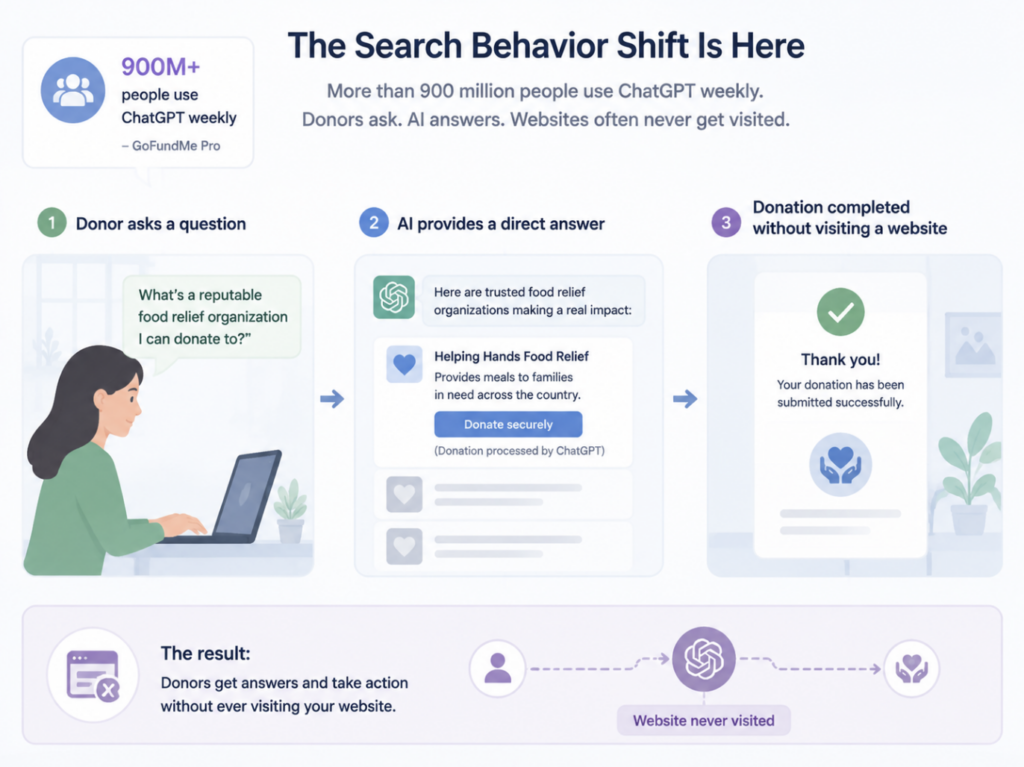
If your nonprofit isn’t in those AI-generated answers, you’re not losing a click. You’re losing the donation.
Where Nonprofit Websites Consistently Lose GEO Points
Three patterns show up repeatedly when nonprofit sites run through a GEO audit. Each one is tied to how the sector traditionally builds and manages digital content.
Impact Data Locked Behind Walls AI Can’t Open
Nonprofits often gate their best content. Donor portals, password-protected dashboards, and downloadable PDFs full of outcome data are standard practice. The problem is that GPTBot, ClaudeBot, and PerplexityBot can’t log in. They can’t open most PDFs. And they can’t index what they can’t access.
A nonprofit with a rich donor portal and a thin public website will score well on internal stakeholder satisfaction and poorly on Bot Access. The fix isn’t to open everything. It’s to publish a public-facing summary of key impact data in crawlable HTML, with structured markup.
Trust Signals That Don’t Connect
Charity Navigator scores, GuideStar Platinum seals, and independent evaluation reports are exactly the kind of third-party trust signals AI engines rely on when recommending nonprofits. But most organizations treat these as badge images in a website footer, not as structured data AI can parse.
The disconnect matters. AI can pull your Charity Navigator rating from Charity Navigator’s own site. But if your website doesn’t reinforce that signal with matching schema markup and consistent entity data, AI has weaker confidence that the charity it found on the rating site is the same entity on your domain. Structured Data scores below 40 often trace back to this gap.
Visible on One Platform, Missing on Another
Cross-platform fragmentation hits nonprofits harder than most sectors. Perplexity cites web sources in real time, so a nonprofit with strong blog content might appear there. But ChatGPT draws more heavily from training data and structured knowledge, where many smaller nonprofits have limited presence. Gemini leans on Google’s own index, which favors schema-rich sites.
The result: an organization can have decent visibility on one platform and near-zero on another. Donors who use different AI tools get different recommendation lists. A single GEO score check can reveal this split, but fixing it requires understanding which dimension is weakest on each platform.
From a One-Time Score to Continuous Visibility Tracking
A GEO Score Checker result tells you where you stand right now. That’s valuable for diagnosis. But donor behavior, AI model updates, and competitor activity change your visibility position week to week. A score that looks acceptable today can drop after a model retraining cycle without any change on your end.
That’s the difference between a snapshot and a monitoring system.
| Capability | Free GEO Score Checker | Topify Platform |
|---|---|---|
| Check frequency | One-time snapshot | Continuous monitoring |
| Dimensions tracked | 4 GEO scores | Full GEO analytics + sentiment + citations |
| Historical trends | None | Full trend history with alerts |
| Competitor benchmarking | Not included | Real-time competitor tracking |
| Platform breakdown | Aggregated | Per-platform (ChatGPT, Perplexity, Gemini, AI Overviews) |
| Optimization actions | Directional guidance | Specific, prioritized execution steps |
Comprehensive GEO Analytics tracks all four GEO dimensions continuously, flags drops before they become donor-visible, and shows exactly where competitors are gaining citation share. For nonprofits managing multiple programs or regional chapters, per-platform breakdowns show which AI engine is surfacing which part of your organization.
You can start a free trial with no credit card required, or review pricing to see which plan fits your team size.
Conclusion
Donors, grant-makers, and corporate partners are making giving decisions based on what AI tells them. If your nonprofit’s website can’t pass the technical signals AI uses to select recommendations, your impact data never enters the conversation.
Check your GEO score now. It takes 60 seconds, costs nothing, and shows you exactly which of the four dimensions is keeping your organization out of AI-generated answers.
For a deeper dive into GEO strategy, read The Complete Guide to Generative Engine Optimization (GEO), AI Search Visibility: What It Is and How to Improve It, or Free vs Paid AI Visibility Trackers: What You Actually Get.
If your Bot Access score is low, the AI Robots Checker can pinpoint which crawlers your robots.txt is blocking. For a broader snapshot across platforms, the AI Visibility Report shows where your brand appears and where it doesn’t. And the Knowledge Freshness Checker reveals whether AI models are working with current information about your programs or outdated data from years ago.
Frequently Asked Questions
Does GEO scoring work differently for nonprofits than for commercial brands?
The four scoring dimensions are the same, but the inputs that drive each score differ. Nonprofits typically struggle with Bot Access because impact data lives in PDFs and gated portals, and with Structured Data because few charity websites implement NGO-specific schema markup. Commercial brands more often struggle with Content Signals. Running the GEO Score Checker reveals which dimension is weakest for your specific site.
Why does our nonprofit score low on Content Signals when we publish annual impact reports?
Content Signals measure whether AI considers your published content authoritative enough to cite. If your reports are PDFs that crawlers can’t index, or if your public web pages summarize outcomes in vague terms without named programs, specific numbers, or external validation, AI treats that content as low-authority. The fix is publishing key findings in crawlable HTML with concrete data points.
How do charity rating profiles on Charity Navigator or GuideStar affect our AI visibility?
AI engines pull data from those platforms when generating nonprofit recommendations. But your own website needs to reinforce those signals with matching structured data. If Charity Navigator lists your 4-star rating and your site doesn’t confirm that entity relationship through schema markup, AI has lower confidence connecting the two. A strong rating profile plus weak on-site structured data still produces a mediocre Structured Data score.
Our organization appears in Perplexity results but not in ChatGPT. Why the difference?
Each AI platform sources information differently. Perplexity searches the live web in real time, so strong blog content and recent press coverage can surface there. ChatGPT relies more on training data and structured knowledge bases, where smaller or newer nonprofits have less representation. Comprehensive GEO Analytics breaks down your visibility per platform so you can target the specific gaps.
Read More:

