

A procurement engineer opens ChatGPT and types: “Best suppliers of food-grade stainless steel tubing with FDA and 3-A certification, under 12-week lead time.” Thirty seconds later, three manufacturers appear. Yours isn’t one of them. No lost RFQ lands in your CRM. No missed call shows up in your log. The deal simply happened somewhere your sales team couldn’t see.
This isn’t a product quality problem. It’s a GEO problem. Your technical content, your certifications, your decades of capability data are sitting in places AI can’t reach. And right now, 68% of manufacturing procurement professionals use ChatGPT, Perplexity, or Google AI features during their vendor search process.
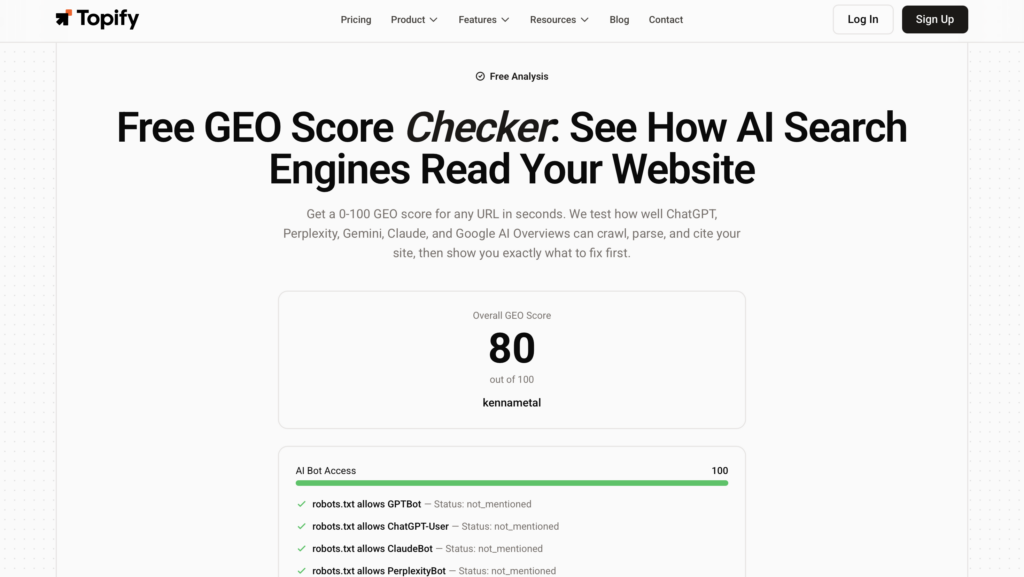
The GEO Score Checker tells you exactly where your manufacturing brand stands in AI search, across four diagnostic dimensions, in under 60 seconds.
✅ Free ⚡ Results in 60 seconds 🔒 No signup required
GEO Score Checker
The Four Numbers That Tell You Why AI Skips Your Manufacturing Brand
The GEO Score Checker returns a composite score from 0 to 100, built on four dimensions. Each one measures a different layer of your brand’s AI readiness. Here’s what they mean for a manufacturing company:
| Score Dimension | What It Measures | Manufacturing Impact |
|---|---|---|
| Bot Access | Whether AI crawlers (GPTBot, ClaudeBot, PerplexityBot) can reach your site | Many industrial sites block these bots via robots.txt or WAF rules without realizing it. If crawlers can’t get in, your specs don’t exist to AI. |
| Structured Data | Whether your content carries machine-readable markup (JSON-LD, schema.org) | Product pages without schema markup for part numbers, materials, certifications, and tolerances are invisible to AI’s structured understanding. |
| Content Signals | Whether AI considers your content authoritative enough to cite | Technical depth, E-E-A-T signals, named-author expertise, and semantic relevance to procurement queries all factor in. |
| Visibility Score | How often your brand actually appears in AI platform responses | Measures real presence across ChatGPT, Perplexity, Gemini, and Google AI Overviews for queries relevant to your capabilities. |
A score below 40 means AI essentially doesn’t know your brand exists. Between 41 and 60, you’re visible but losing ground to competitors who’ve optimized. Above 80, AI is likely to recommend you when procurement teams ask.
Your Specs Are Locked in PDFs That AI Can’t Read
This is the most common failure mode in manufacturing. You’ve invested years building detailed spec sheets, tolerance tables, material certificates, and capacity documents. The problem: they’re all in downloadable PDFs behind contact forms.
PDFs don’t support schema markup. AI crawlers can’t reliably parse tables inside them. An audit of 500 industrial supplier websites found that only 12% had implemented basic AI optimization elements like structured data for specifications. That’s a Bot Access and Structured Data problem rolled into one.
Your Product Pages Don’t Speak AI’s Language
A procurement engineer asks for “CNC vertical machining center, 40 taper, 12K RPM spindle, 40x20x20 work envelope, ±0.0002 repeatability.” AI needs to match that query against structured, indexable data on your website. If your spindle speed, work envelope dimensions, and repeatability specs only exist as text inside a PDF catalog, AI will recommend the competitor whose specs live in crawlable HTML with Product schema markup.
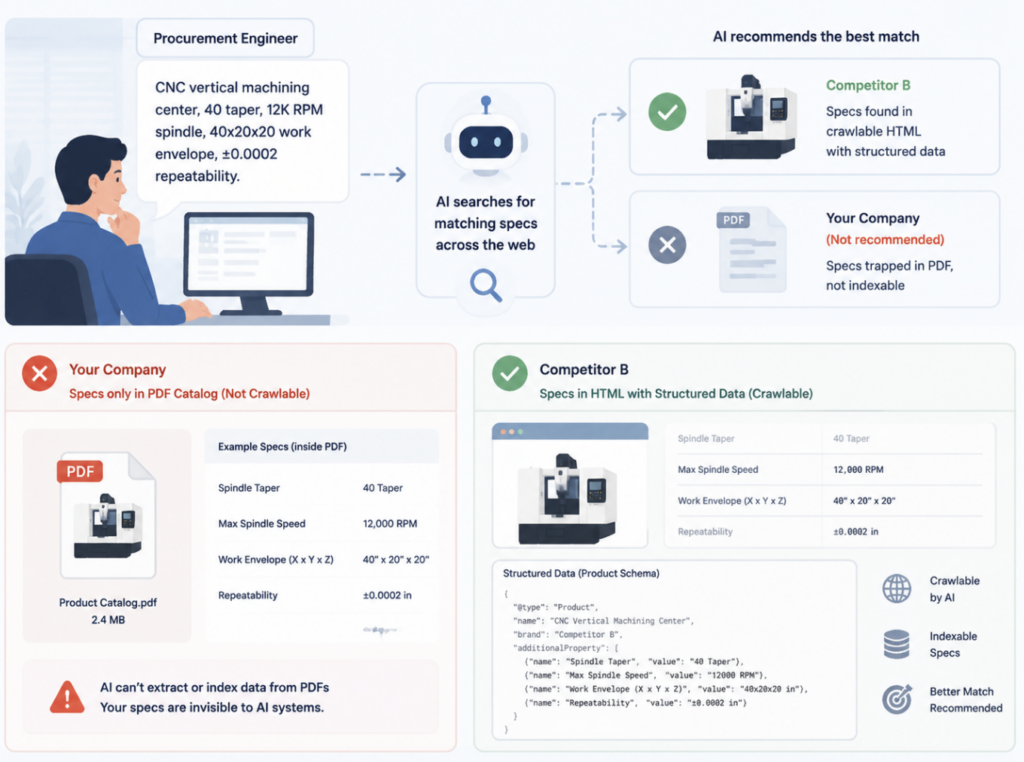
That gap between what you know and what AI can read is measurable. The Structured Data dimension of the GEO Score Checker catches it directly.
You Show Up on Perplexity but Not ChatGPT
Platform fragmentation is a hidden risk. Perplexity indexes the live web in real time, so it may surface your brand from a recent trade publication mention. ChatGPT relies more heavily on its training data and structured web content. A manufacturing brand can score well on one platform and be completely absent on another. The Visibility Score dimension breaks this down.
How to run your check:
- Go to the GEO Score Checker
- Enter your brand name or domain
- Get your four-dimension score in 60 seconds
- Identify which dimension is pulling your overall score down
What Procurement Teams Actually Ask AI Before They Send an RFQ
The shift isn’t theoretical. Procurement engineers, plant managers, and sourcing leads are typing highly specific, technical queries into AI platforms and treating the responses as their initial shortlist. Forrester’s 2026 survey of 18,000 global business buyers confirmed that 94% used AI during their most recent purchase process.
Here’s what those queries look like in manufacturing:
| AI Prompt Example | Platform | Search Intent | What It Reveals |
|---|---|---|---|
| “Best suppliers of precision CNC machining for aerospace aluminum parts with AS9100 certification” | ChatGPT | Supplier shortlisting with certification filter | AI needs to match capability + certification + material in structured form |
| “Compare injection molding manufacturers in the Midwest that handle short runs under 5,000 units” | Perplexity | Regional sourcing with volume filter | Brands without crawlable capacity and location data won’t appear |
| “Who makes custom hydraulic manifolds with lead times under 8 weeks?” | Gemini | Urgency-driven procurement | AI prioritizes suppliers whose lead time data is explicitly stated on-page |
| “Top sheet metal fabrication companies with ISO 9001 and ITAR compliance” | ChatGPT | Compliance-gated vendor search | Certification pages must be in crawlable HTML with Organization schema |
| “Reliable suppliers of food-grade conveyor belts for pharmaceutical packaging lines” | Perplexity | Application-specific sourcing | AI matches industry application language, not just product categories |
| “Industrial coating services for corrosion protection on offshore oil and gas components” | Gemini | Environment-specific capability search | Brands that publish application case studies with measurable results get cited |
The average B2B shortlist has shrunk to roughly 2.5 vendors, down from 3.2 a few years earlier. If your brand isn’t in that first AI-generated answer, the procurement engineer may never know you exist.
That’s the core risk. You don’t lose a deal. You never enter the process.
Where Manufacturing Brands Consistently Lose GEO Points
Manufacturing has a unique AI visibility problem. Most industrial companies sit on deep technical expertise, but the way that expertise is packaged online actively prevents AI from finding it. Three patterns show up repeatedly.
The PDF Trap: Rich Content in a Format AI Can’t Index
A manufacturer’s most valuable content, detailed spec sheets, tolerance charts, material certifications, test reports, often lives exclusively in downloadable PDFs. These documents are comprehensive and accurate. They’re also functionally invisible to AI.
PDFs can’t carry schema markup. They don’t build internal linking authority. Image-based PDF scans of older documents are completely unreadable to both Google and AI crawlers. The result: a distributor page with an HTML specification table will get cited over your original manufacturer documentation every time. A low Bot Access score on the GEO Score Checker often traces back to this exact issue.
The Terminology Gap: Engineering Shorthand vs. AI Comprehension
Your industry speaks its own language. ASTM standards, alloy grades, tolerance classes, surface finish callouts like “Ra 0.8.” But AI models trained on general web content don’t always connect “Ra 0.8 surface finish” to “suitable for hydraulic sealing applications.”
This doesn’t mean dumbing down your content. It means bridging the gap. The Content Signals dimension of the GEO Score Checker evaluates whether your content carries enough semantic context for AI to match it against the natural-language queries procurement teams actually type.
The Accidental Block: WAF and Robots.txt Misconfiguration
Here’s a pattern that shows up in nearly every manufacturing site audit. Somewhere in the robots.txt file or Cloudflare WAF settings, a rule blocks GPTBot, PerplexityBot, or ClaudeBot. Nobody on the current team remembers adding it. Nobody realizes the consequence: your entire domain is invisible to one or more AI platforms.
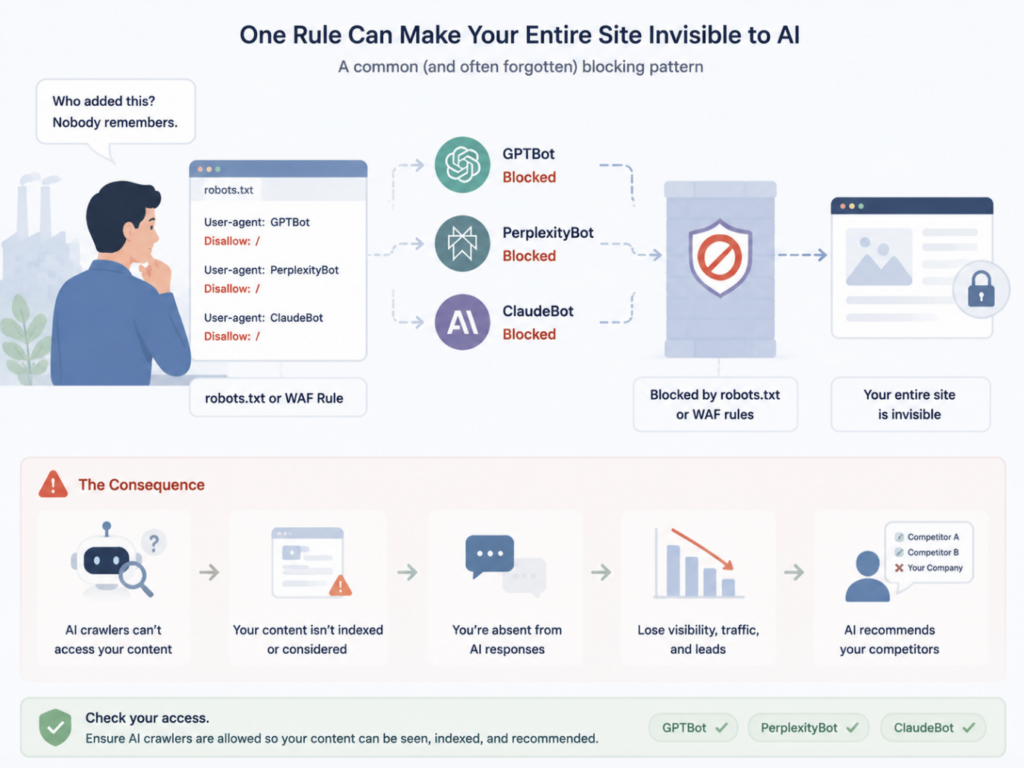
Topify‘s AI Robots Checker can identify these blocks instantly. But the GEO Score Checker’s Bot Access dimension is your first signal that something is wrong at the infrastructure level.
From a One-Time Score to Continuous GEO Monitoring
Running the GEO Score Checker gives you a snapshot of where your manufacturing brand stands today. That’s the right starting point. But AI visibility isn’t static. Crawl policies change. Competitors publish new structured content. AI models update their training data and indexing behavior.
A single score tells you where you stand. Continuous monitoring tells you which direction you’re moving.
Topify‘s Comprehensive GEO Analytics platform picks up where the free checker leaves off:
| Capability | Free GEO Score Checker | Topify Platform |
|---|---|---|
| Check frequency | One-time snapshot | Continuous monitoring |
| Dimensions tracked | 4 GEO scores | Full GEO analytics + sentiment + citations |
| Historical trends | None | Full trend history with alerts |
| Competitor benchmarking | Not included | Real-time competitor tracking |
| Platform breakdown | Aggregated | Per-platform (ChatGPT, Perplexity, Gemini, AI Overviews) |
| Optimization actions | Directional guidance | Specific, prioritized execution steps |
For manufacturing brands tracking multiple product lines, certifications, and regional capabilities, per-platform visibility data matters. A brand might score well in Perplexity’s live-web results but remain absent from ChatGPT’s synthesized answers, and only continuous tracking catches that divergence over time.
You can explore pricing or start a free trial with no credit card required. All plans cover ChatGPT, Perplexity, Gemini, and Google AI Overviews.
Conclusion
In manufacturing, the first stage of vendor discovery has quietly moved off the search engine and into a conversation with an AI model. The brands that show up in those conversations aren’t necessarily the most capable. They’re the ones whose capabilities are structured, crawlable, and machine-readable.
The gap between what you can do and what AI can see is the gap the GEO Score Checker is built to measure. Run your manufacturing brand through it now and find out which of the four dimensions is costing you procurement visibility.
If your Bot Access score comes back low, the AI Robots Checker can pinpoint exactly which crawlers you’re blocking. For a deeper look at how current AI models perceive your brand’s authority, the Brand Authority Checker adds another layer of diagnosis. And the Knowledge Freshness Checker tells you whether the information AI has about your brand is up to date or months behind.
Frequently Asked Questions
Why do manufacturing websites score lower on GEO than other industries?
Most manufacturing sites were built as digital brochures. Critical specifications, certifications, and capability data live inside downloadable PDFs or behind contact forms, making them inaccessible to AI crawlers. The GEO Score Checkerquantifies this gap across all four dimensions so you can see exactly where AI loses access to your content.
Does adding schema markup to product pages actually help AI recommend my brand?
Yes. AI platforms rely on structured data to match technical queries (materials, tolerances, certifications, capacities) to specific suppliers. Without Product and Organization schema in crawlable HTML, AI has no structured way to verify that your brand meets a buyer’s spec requirements. The Structured Data dimension measures this directly.
How is GEO different from traditional SEO for manufacturing companies?
Traditional SEO optimizes for ranking in a list of search results. GEO optimizes for being named in an AI-generated answer. In manufacturing, that distinction matters because procurement engineers increasingly ask AI for supplier shortlists rather than scrolling through ten blue links. A high Google ranking doesn’t guarantee AI citation, and vice versa.
Can I track whether my GEO score improves after making changes?
The free GEO Score Checker provides a point-in-time snapshot you can re-run manually. For ongoing tracking with historical trend data, competitor benchmarks, and per-platform breakdowns, Comprehensive GEO Analytics monitors your scores continuously and alerts you to changes.
Read more:

