

A senior procurement director at a Fortune 500 company opens ChatGPT and types: “Which boutique strategy consulting firms specialize in supply chain transformation?” The AI responds with three names. None of them are yours — even though you’ve published twelve thought leadership pieces on exactly that topic in the past year.
That’s not a reputation problem. It’s a GEO problem.
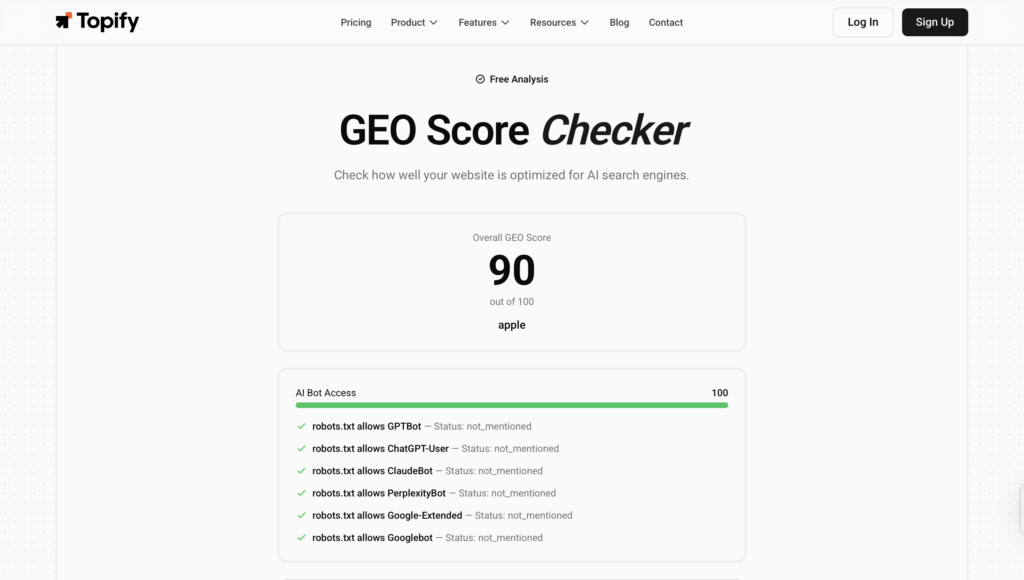
Your content exists. Your expertise is real. But the structural signals that AI engines use to discover, parse, and recommend consulting firms are broken at the technical level. The GEO Score Checker from Topify surfaces exactly where those signals break down — in 60 seconds, no signup required.
✅ Free ⚡ Results in 60 seconds 🔒 No signup required
GEO Score Checker
The Firm With Award-Winning Case Studies That AI Has Never Read
Management consulting firms live and die by thought leadership. The business case for publishing is clear: demonstrate expertise, attract inbound interest, build authority. The problem is that most consulting content is structured for human readers and PDF downloads — not AI crawlers.
Scenario 1: Gated Thought Leadership, Blocked Crawlers
A mid-size operations consulting firm publishes a 40-page supply chain resilience report. It’s genuinely good research. It goes behind a form gate on the website. Within 48 hours, GPTBot, ClaudeBot, and PerplexityBot attempt to index it. They hit a robots.txt disallow rule set up years ago to protect premium content. The report is invisible to every AI engine from day one.
This is far more common than most firms realize. A low Bot Access score in the GEO Checker is often the first signal that a consulting firm’s most valuable content has been quietly excluded from AI training and retrieval pipelines.
Scenario 2: Expert Profiles With No Structured Schema
A consulting firm’s website lists its partners: names, bios, practice areas, speaking engagements. It reads well. But without Person schema markup and JSON-LD, AI engines can’t reliably connect “Sarah Chen, Managing Director, Digital Transformation” to the domain expertise that schema would confirm. When a buyer asks Perplexity for a “digital transformation expert with manufacturing experience,” Sarah’s profile doesn’t surface as a structured entity — it surfaces as unattributed text, if at all.
Structured Data quality is where consulting websites consistently underperform. Most firm websites were built for visual credibility, not machine readability.
Scenario 3: Strong Perplexity Presence, Zero ChatGPT Visibility
Platform fragmentation hits consulting firms harder than most B2B categories. Perplexity favors community sources, expert reviews, and third-party citations — the kind of signals that consulting firms naturally generate through conference appearances and media coverage. ChatGPT leans heavily on direct source authority and structured content. A firm that scores well on Perplexity because of its published research can still have near-zero ChatGPT visibility if its own website blocks crawlers or lacks entity-level schema.
That gap is measurable. The GEO Checker surfaces it.
The Four GEO Scores That Expose Your Consulting Firm’s AI Blind Spots
Run your firm’s domain through the GEO Score Checker and you’ll receive four scores. Here’s what each one means in the context of a consulting practice:
| Score Dimension | What It Measures | Management Consulting Impact |
|---|---|---|
| Bot Access | Whether AI crawlers (GPTBot, ClaudeBot, PerplexityBot) can access your site | Gated whitepapers, login-walled case studies, and legacy robots.txtrules that silently exclude your best content from AI indexing |
| Structured Data | Quality of schema markup and JSON-LD across your pages | Without Organization, Person, and Article schema, AI engines can’t reliably associate your partners’ expertise or case study outcomes with your firm as an entity |
| Content Signals | Depth, semantic relevance, and E-E-A-T authority signals in your content | Long-form PDFs and gated reports don’t contribute to on-page content signals; ungated, structured web content does |
| Visibility Score | How often your brand surfaces in responses from ChatGPT, Perplexity, Gemini, and AI Overviews | The direct measure of whether procurement teams and C-suite buyers encounter your firm when they ask AI for vendor recommendations |
Score interpretation:
- 0-40: AI engines largely can’t identify or recommend your firm
- 41-60: Partial visibility, but competitors with stronger signals are getting the shortlist spots
- 61-80: Solid foundation, meaningful gaps remain
- 81-100: AI engines have enough signal to proactively surface your firm
To run the diagnostic:
- Go to GEO Score Checker
- Enter your firm’s domain or brand name
- Get your four-dimension score in under 60 seconds
- Identify which dimension is your biggest gap — that’s where to start
What Procurement Teams and C-Suite Buyers Ask AI Before They Call You
Consulting buyers have always done research before engaging a firm. What’s changed is where that research happens. A growing share of initial shortlisting now happens in AI chat interfaces — before any website visit, before any RFP.
According to a March 2026 analysis covering 680 million AI citations, 73% of B2B buyers now use AI tools in their purchase research process. AI-referred traffic converts at 5.1x the rate of Google organic. The buyer who arrives at your website via an AI recommendation is already further along in the decision process.
Here are the prompts those buyers are actually running:
| AI Prompt Example | Platform | Search Intent | What It Reveals |
|---|---|---|---|
| “Best boutique strategy consulting firms for post-merger integration” | ChatGPT | Vendor shortlisting | Whether your firm’s PMI practice area is structured for AI entity recognition |
| “Which consulting firms have published research on supply chain resilience in 2025?” | Perplexity | Thought leadership discovery | Whether your ungated content is crawlable and citable by AI engines |
| “Top management consultants for digital transformation in financial services” | Gemini | Expertise + vertical matching | Whether your sector pages have the schema and content depth to surface as authoritative |
| “Consulting firms with experience in AI governance and compliance frameworks” | ChatGPT | Specialized practice discovery | Whether new service lines are indexed with sufficient content signals to be recommended |
| “Who are the leading independent management consultants for organizational restructuring?” | Perplexity | Individual expert discovery | Whether partner profiles are structured with Person schema and third-party validation |
Each of these prompts has a decision on the other side. If your firm isn’t in the answer, you’re not on the shortlist.
Where Consulting Firms Consistently Lose AI Visibility Points
The two core reasons consulting firms underperform on GEO aren’t strategy failures — they’re structural patterns that developed before AI search mattered.
The PDF trap is real. Consulting firms invest heavily in research reports, white papers, and case studies. In many cases, that content represents the highest-quality signal available to prove expertise to an AI engine. But the default distribution model — gate the content behind a form, measure leads captured — makes that content structurally invisible to AI crawlers. GPTBot doesn’t fill out forms. PerplexityBot doesn’t accept cookies. The result: your most authoritative content generates zero AI citation value.
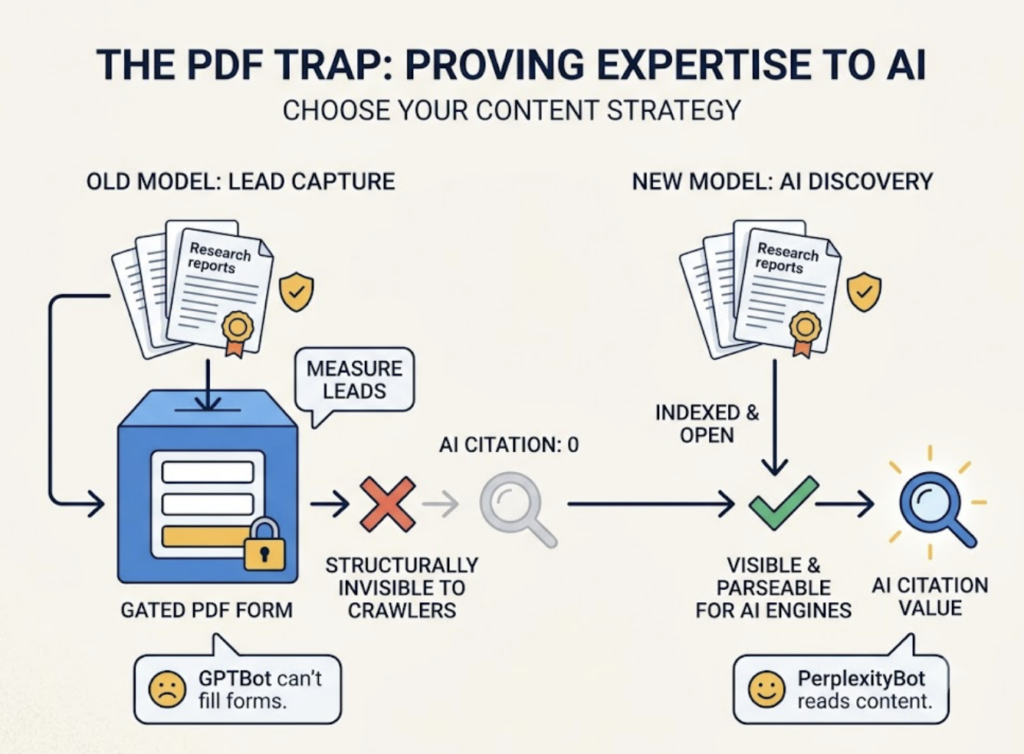
That’s the gap between a Bot Access score of 25 and a score of 75.
Trust signals are unstructured. The factors that make a consulting firm credible to a human reader — partner credentials, client outcomes, methodology descriptions, published research — are exactly what AI engines need to recommend that firm in response to a buyer query. But most consulting websites present those signals as flowing prose and visual design, not machine-readable schema. A case study that says “we reduced operating costs by 23% for a global manufacturer” is powerful to a reader. Without structured markup connecting it to an industry, a service line, and an outcomes type, it’s largely noise to an AI retrieval system.
| Consulting Scenario | GEO Signal | Likely Cause | Action Direction |
|---|---|---|---|
| Firm not appearing in “top strategy consultants” queries | Visibility Score: <30 | Low third-party citations; no entity-level brand presence in AI training data | Increase ungated content, build external citations via PR and industry publications |
| Thought leadership indexed by Google but not cited by AI | Content Signals: <40 | Content lives in PDFs behind gates; ungated pages lack semantic depth | Convert key reports to ungated HTML pages with structured headings and entity markup |
| Partner expertise not surfacing in specialist queries | Structured Data: <35 | Missing Person schema on partner profiles; no sameAs links to LinkedIn or speaking profiles | Implement Person and Article JSON-LD across all partner and practice pages |
| Visible in Perplexity, absent in ChatGPT | Bot Access: variable | robots.txt blocking GPTBot while allowing other crawlers | Audit bot-specific access rules; selectively open key content to GPTBot and ClaudeBot |
Platform fragmentation is the quiet multiplier. A consulting firm might get reasonable Perplexity visibility because of third-party coverage in industry publications. That same firm can have a Visibility Score near zero in ChatGPT if its own web properties are structurally blocked or content-thin. Since only 11% of domains are cited by both ChatGPT and Perplexity, optimizing for one platform doesn’t transfer automatically to another.
From a One-Time Score to a Firm-Wide AI Visibility Program
The GEO Score Checker gives you a snapshot of where your firm stands right now. That’s genuinely useful — most consulting firms have never seen these four numbers for their own domain.
But GEO signals shift. You publish new content. Competitors build citation profiles. AI models update their retrieval logic. A score you ran in January tells you nothing about where you stand in June.
That’s what Comprehensive GEO Analytics is built for. It tracks all four GEO dimensions continuously, surfaces citation trends across ChatGPT, Perplexity, Gemini, and Google AI Overviews, and lets you benchmark your firm against competitors in real time.
| Capability | Free GEO Score Checker | Topify Platform |
|---|---|---|
| Check frequency | One-time snapshot | Continuous monitoring |
| Dimensions tracked | 4 GEO scores | Full GEO analytics + sentiment + citations |
| Historical trends | None | Full trend history with alerts |
| Competitor benchmarking | Not included | Real-time competitor tracking |
| Platform breakdown | Aggregated | Per-platform (ChatGPT, Perplexity, Gemini, AI Overviews) |
| Optimization actions | Directional guidance | Specific, prioritized execution steps |
The checker gives you a snapshot. Topify’s platform tracks the trajectory.
For consulting firms serious about AI visibility, start a free trial — 7 days, no credit card required. If you want to evaluate plan options first, the pricing page breaks down what each tier covers.
Conclusion
Management consulting firms have spent years building content credibility. The problem in 2026 isn’t the quality of that content — it’s that AI engines were never given structural permission to read it.
A low GEO score in Bot Access or Structured Data isn’t a judgment on your expertise. It’s a technical gap with a technical fix. And you can’t fix what you haven’t measured.
Start with a GEO Score Checker run on your firm’s domain. The four numbers you get back will tell you exactly where your AI visibility breaks down.
For deeper diagnosis, the AI Robots Checker maps which specific bots your robots.txt is blocking. The Brand Authority Checker surfaces how AI engines currently perceive your firm’s domain authority. And the Knowledge Freshness Checkertells you how current the AI models’ information about your firm actually is.
The shortlist starts before the first website visit. Make sure your firm is on it.
Frequently Asked Questions
Why does my consulting firm rank on Google but still score low on the GEO Checker?
Google and AI engines use fundamentally different authority signals. Google rewards backlinks, page speed, and keyword relevance. AI engines weight structured data quality, bot accessibility, and whether your content is directly citable as a source — not just indexable. A firm can hold page-one Google rankings for “management consulting” while scoring below 40 on AI Visibility because its website blocks GPTBot or lacks the entity-level schema that AI retrieval systems rely on. The two channels require separate optimization strategies.
Does ungating our research reports actually make a difference for AI visibility?
It’s one of the highest-impact changes a consulting firm can make. Gated content contributes zero to Bot Access scores and minimal to Content Signals — AI crawlers don’t fill out forms. Ungating a well-structured, in-depth report and publishing it as an HTML page with proper headings and schema markup can meaningfully improve both dimensions. That said, you don’t have to ungate everything. Prioritize the content that best demonstrates your practice area expertise and is most likely to be cited in response to buyer queries. Run the GEO Score Checker before and after to measure the delta.
How often should we re-check our GEO score?
The free checker is useful for point-in-time audits — after a website migration, after ungating a batch of content, or after implementing schema changes. For ongoing tracking, a one-time score isn’t sufficient. AI models update their retrieval logic, competitors build citation profiles, and your own content mix shifts over time. Comprehensive GEO Analyticshandles continuous monitoring so you’re not flying blind between manual checks.
Our firm appears in some AI responses already. Does that mean our GEO score is fine?
Not necessarily. Appearing in AI responses for branded queries — someone searching your firm by name — is a different signal than appearing in category queries like “top strategy consultants for healthcare.” Most firms have some branded visibility. The GEO score measures whether you’re surfacing for the non-branded, high-intent queries that drive actual new business. A firm can score 70+ on Visibility Score for branded searches while scoring below 30 for competitive category queries. The Checker’s four-dimension breakdown tells you which type of visibility you actually have.
Read More:

