


A restaurant chain’s procurement lead types a prompt into ChatGPT: “Which broadline food distributors in the Southeast offer next-day delivery on frozen proteins with FSMA-compliant cold chain tracking?” The AI returns three names, a brief comparison, and a confidence note for each. Your company, the one with 5,000 SKUs and 40 years of regional coverage, isn’t mentioned.
The problem isn’t your service. It’s the technical signals your website sends to AI platforms. And the gap is measurable.
Topify‘s GEO Score Checker breaks your AI readiness into four scored dimensions, so you can see exactly where the breakdown starts. It takes 60 seconds and costs nothing.
✅ Free ⚡ Results in 60 seconds 🔒 No signup required
GEO Score Checker
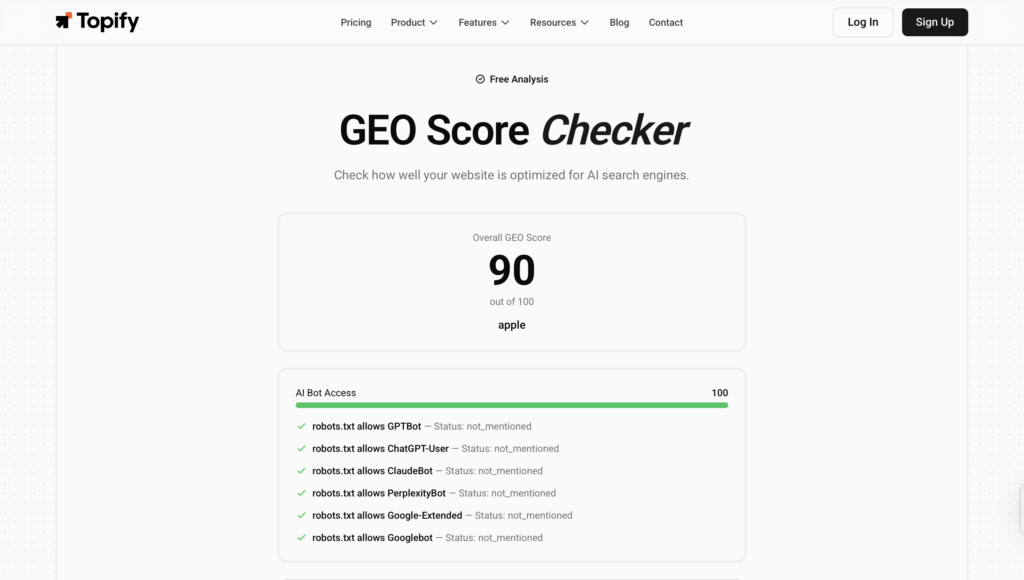
The Four Numbers That Tell You Why AI Skips Your Distribution Brand
GEO stands for Generative Engine Optimization. It measures how well your website communicates with AI platforms like ChatGPT, Perplexity, Gemini, and Google AI Overviews. For food and beverage distributors, each of the four scored dimensions maps to a specific business risk.
| Score Dimension | What It Measures | F&B Distribution Impact |
|---|---|---|
| Bot Access | Whether AI crawlers (GPTBot, ClaudeBot, PerplexityBot) can reach your site | Gated order portals and login walls often block crawlers from indexing product pages, service area info, and compliance documentation |
| Structured Data | Whether your site uses schema markup AI can parse | Product specs, certifications (SQF, FSMA 204), temperature requirements, and case sizes need to be machine-readable, not buried in PDF catalogs |
| Content Signals | Whether AI views your content as authoritative | Thin product listings without context lose to distributors publishing category guides, sourcing transparency pages, and operator-facing thought leadership |
| Visibility Score | How often your brand appears in AI-generated answers | The composite measure of whether AI platforms actually name your company when operators ask for distributor recommendations |
Those four scores, each on a 0-100 scale, tell a complete story. A distributor scoring 75 on Bot Access but 25 on Structured Data knows exactly where to focus: the crawlers can reach the site, but once there, they can’t make sense of the product data.
Your Product Catalog Has 5,000 SKUs. AI Sees Zero.
This is the most common failure mode for food distributors. The catalog exists as a downloadable PDF, or behind a login gate that requires an active account. GPTBot doesn’t have a customer number. Neither does ClaudeBot. Every SKU page locked behind authentication is a page AI will never index.
A distributor with a rich, open product taxonomy scores higher on Bot Access and Structured Data than a competitor with twice the product range but everything behind a portal. That’s the paradox: the distributor with the deepest catalog can be the least visible to AI.
The Distributor That Wins the “Strategic Partner” Label
AI platforms don’t just decide whether to mention you. They decide how to describe you. A distributor with published case studies, operator testimonials, and category expertise content gets framed as a “strategic partner.” One with only transactional product pages gets labeled a “logistics provider.”
That framing difference shows up in your Content Signals score. If it’s below 40, AI likely doesn’t have enough editorial evidence to position you as anything more than a commodity supplier.
How to Run the Check
- Go to GEO Score Checker
- Enter your brand name or domain
- Get your four-dimension score breakdown in under 60 seconds
- Compare dimensions to find your weakest signal
The score won’t tell you everything, but it will tell you which of the four areas is costing you the most AI visibility right now.
What Operators and Procurement Teams Ask AI Before They Send an RFQ
The foodservice vendor switching window is narrow. Only about 20% of operators change distributors in a given year, according to industry estimates reported by NRN. AI search is compressing the discovery phase into that window. If your brand isn’t visible during the brief period when a buyer is actively evaluating, you don’t get a second chance until next cycle.
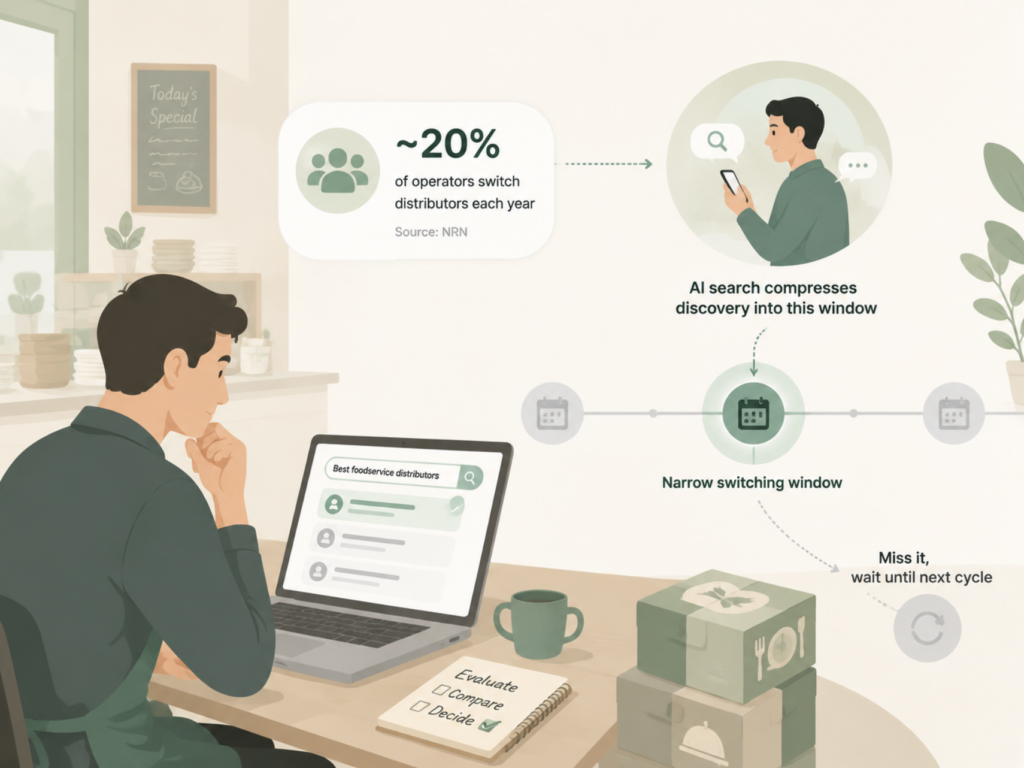
Here’s what those buyers are actually typing:
| AI Prompt Example | Platform | Search Intent | What It Reveals |
|---|---|---|---|
| “Best regional food distributors for independent restaurants in the Midwest” | ChatGPT | Vendor discovery | Operators want AI to narrow a broad category by geography and customer type |
| “Which food distributors offer next-day delivery on fresh produce with lot-level traceability?” | Perplexity | Capability filtering | Compliance and logistics speed are decision criteria AI checks against structured evidence |
| “Compare broadline vs. specialty food distributors for a 12-unit fast casual chain” | Gemini | Model comparison | AI builds a side-by-side using whatever structured data it can extract from each distributor’s site |
| “Food distribution companies with strong sustainability sourcing programs” | ChatGPT | Values alignment | ESG and sourcing transparency content directly feeds Content Signals scores |
| “Who are the top cold chain food distributors with FSMA 204 compliance documentation?” | Perplexity | Regulatory verification | AI looks for structured compliance data, not a PDF buried three clicks deep |
| “Alternatives to [major national distributor] for mid-size restaurant groups” | ChatGPT | Competitor displacement | The highest-intent prompt: the buyer is actively looking to switch, and AI decides who makes the shortlist |
That last prompt type is where the stakes are highest. A buyer asking for alternatives has already decided to move. AI will recommend whichever distributors have the strongest combination of third-party mentions, structured product data, and authoritative content. If your GEO signals are weak, you miss the one moment the buyer was ready to find you.
Three GEO Blind Spots That Keep F&B Distributors Off AI Shortlists
Most food and beverage distributors invest heavily in the systems their existing customers use: order portals, EDI integrations, account management dashboards. Those investments are critical for retention. They do nothing for AI-mediated acquisition.
PDF Catalogs and Gated Portals Block the Crawlers
A distributor’s product catalog is often its most valuable content asset, and the one most thoroughly hidden from AI. PDF catalogs are functionally invisible to AI crawlers. Gated ordering portals that require login block GPTBot, ClaudeBot, and PerplexityBot entirely.
The fix isn’t to make your ordering system public. It’s to create a parallel layer of open, crawlable product information: category pages with structured data markup (Product schema with attributes like brand, weight, temperature class, certifications), service area descriptions, and capability summaries. This is the layer AI evaluates. Without it, your Bot Access and Structured Data scores stay low regardless of how comprehensive your actual catalog is.
Regional Coverage Without Third-Party Corroboration
AI platforms weight third-party mentions heavily when building supplier recommendations. A distributor that’s well-known in its region but has minimal coverage in trade publications, industry directories, or operator forums will score low on Content Signals.
Here’s the thing: AI doesn’t take your word for it. If your website says “We serve the entire Southeast with next-day delivery,” but no third-party source confirms that claim, AI treats it as unverified. Distributors with mentions in trade media, foodservice buying guides, and industry association directories get stronger corroboration signals.
Platform Fragmentation: Visible on Perplexity, Absent from ChatGPT
Regional distributors often show an uneven visibility pattern across AI platforms. Perplexity retrieves live web data and may surface your site directly. ChatGPT leans more on training data and corroborated mentions, so a distributor without broad editorial coverage can be completely absent.
This fragmentation is measurable. Your Visibility Score in GEO Score Checker reflects aggregate presence, but the real diagnostic comes from checking whether your brand appears consistently across platforms or only on one or two.
From a One-Time Score to Continuous Distribution Visibility Tracking
Running your GEO Score Checker gives you a snapshot: here’s where you stand today across four dimensions. That snapshot is useful for identifying your weakest signal and prioritizing fixes.
But GEO signals aren’t static. AI platforms update their indexes, competitors publish new content, and your own site changes with seasonal catalogs, new service area announcements, and compliance updates. A score that’s accurate today may not reflect your position next quarter.
That’s the gap Comprehensive GEO Analytics fills. It tracks all four GEO dimensions continuously across ChatGPT, Perplexity, Gemini, and Google AI Overviews, with historical trends and alerts when your visibility shifts.
| Capability | Free GEO Score Checker | Topify Platform |
|---|---|---|
| Check frequency | One-time snapshot | Continuous monitoring |
| Dimensions tracked | 4 GEO scores | Full GEO analytics + sentiment + citations |
| Historical trends | None | Full trend history with alerts |
| Competitor benchmarking | Not included | Real-time competitor tracking |
| Platform breakdown | Aggregated | Per-platform (ChatGPT, Perplexity, Gemini, AI Overviews) |
| Optimization actions | Directional guidance | Specific, prioritized execution steps |
The checker tells you where you stand. The platform tells you which direction you’re moving, and whether your competitors are gaining ground.
Plans start at $99/month with a 7-day free trial, no credit card required. See pricing or start a free trial.
Conclusion
Food and beverage distributors have spent decades building service networks, product depth, and operator relationships. None of that matters to an AI platform that can’t crawl your catalog, can’t parse your certifications, and can’t find a third-party source that corroborates your coverage claims.
The distributors that show up in AI-generated shortlists over the next two years will be the ones that close the gap between what they actually offer and what AI can verify.
Start with a free GEO Score Checker scan to see which of the four dimensions needs attention first. For deeper diagnostics, Topify’s AI Robots Checker can pinpoint exactly which AI crawlers your site is blocking, and the Knowledge Freshness Checker shows whether AI models are working with current or outdated information about your brand.
Frequently Asked Questions
Why does my food distribution website score low on Structured Data even though we list thousands of products?
Product listings alone don’t generate a strong Structured Data score. AI crawlers look for schema markup (JSON-LD Product, Organization, and Service types) that explicitly tags attributes like certifications, temperature classes, and delivery capabilities. If your specs exist only in PDF catalogs or image-based line sheets, AI treats those pages as if they have no product data at all.
How does the vendor switching cycle in foodservice affect my GEO strategy?
Only about 20% of foodservice operators evaluate new distribution partners in any given year. That makes the timing of your AI visibility critical. If your GEO scores are low during the quarter when a prospect is actively searching, you won’t appear on their AI-generated shortlist, and there’s no second window until the next evaluation cycle. Continuous monitoring through Comprehensive GEO Analytics ensures you’re not blind to visibility drops during peak switching periods.
Can a regional distributor compete with national broadliners in AI search results?
Yes, but through different signals. National distributors have brand recognition and broad editorial coverage. Regional distributors can win on specificity: detailed service area pages, local operator case studies, and structured data that highlights niche capabilities (organic sourcing, allergen-free handling, same-day metro delivery). AI platforms recommend based on relevance to the buyer’s query, not brand size alone.
What’s the difference between a GEO score and a traditional SEO ranking?
SEO measures where your website appears in a Google search results page. Your GEO score measures whether AI platforms can access, understand, and recommend your brand when buyers ask questions in ChatGPT, Perplexity, or Gemini. A distributor can rank well on Google for “food distribution services” but score below 30 on GEO because its site blocks AI crawlers or lacks the structured data those platforms need to generate a recommendation.
Read More:

