


A CISO opens ChatGPT. She types: “What are the best EDR solutions for a mid-market company without a dedicated SOC?” Within seconds, she gets a shortlist of three vendors, each with a brief rationale. Your product isn’t on it.
That’s not a brand awareness problem. It’s a GEO problem.
Your SEO ranking doesn’t travel into AI search. Your Google traffic doesn’t tell you whether ChatGPT knows your product exists. And the technical content you’ve invested in — threat intelligence reports, CVE advisories, compliance documentation — may be formatted in ways that AI engines can’t parse, cite, or trust.
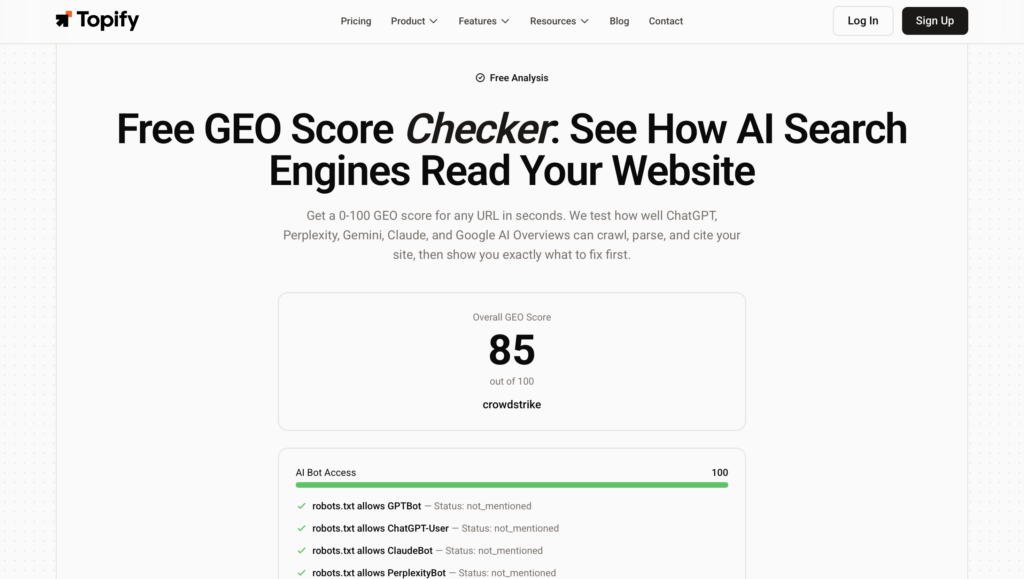
Check your GEO score in under 60 seconds. No signup required.
✅ Free ⚡ Results in 60 seconds 🔒 No signup required
GEO Score Checker
The CISO’s AI Research Session That Didn’t Include You
A February 2026 benchmark by GrackerAI tested 100 cybersecurity vendors across six AI platforms using 250 buyer-intent prompts. The result: 73% of those vendors received zero citations from ChatGPT when buyers searched for their category.
Not a low ranking. Zero citations.
What made the finding harder to ignore: the invisible vendors weren’t weak brands. Several had strong domain authority, active blogs, and 50,000+ monthly Google visitors. One enterprise security firm with dominant organic rankings received zero ChatGPT citations, while a competitor with far less traffic appeared consistently across multiple platforms because their content was structured for AI consumption.
The disconnect comes down to how AI search works differently from keyword search. Buyers in Google search for brand names and product categories. Buyers in AI search ask questions: “Which SIEM is easiest to deploy for a company with three IT staff?” “What’s the difference between XDR and MDR for retail?” These are use-case-driven, role-specific prompts that most cybersecurity vendors never wrote content to answer — at least not in a format AI can extract and cite.
That gap is measurable. That’s exactly what the GEO Score Checker diagnoses.
The Four GEO Scores That Decide If AI Recommends Your Security Brand
Topify‘s GEO Score Checker evaluates your site across four dimensions, each one scoring a different layer of your AI visibility. For cybersecurity brands, each dimension maps to a specific structural problem that’s common in the industry.
| Score Dimension | What It Measures | Cybersecurity Impact |
|---|---|---|
| Bot Access | Whether AI crawlers (GPTBot, ClaudeBot, PerplexityBot) can access your site | Many security vendors restrict crawlers in robots.txt as a security posture — inadvertently blocking AI indexing |
| Structured Data | Quality of schema markup and JSON-LD for AI comprehension | CVE pages, product datasheets, and compliance docs often lack the structured markup AI needs to extract key claims |
| Content Signals | Depth, semantic relevance, and E-E-A-T authority signals | Technical whitepapers are authoritative but often formatted as dense PDFs — formats that AI can’t reliably cite |
| Visibility Score | Actual presence and citation frequency across ChatGPT, Perplexity, Gemini, and AI Overviews | A vendor may appear in Perplexity but be absent in ChatGPT, a platform-specific gap most audits never surface |
Scores run from 0 to 100. In practice, a score below 40 means AI engines can’t reliably identify or recommend your brand. A score between 41 and 60 means you’re discoverable but likely losing ground to competitors with better-structured content. Above 61, you’re in a position to start capturing AI-referred traffic consistently.
Bot Access: Your CVE Pages Might Be Blocking GPTBot
Cybersecurity teams often restrict external crawlers by default. It’s a reasonable instinct from a security standpoint. But GPTBot, ClaudeBot, and PerplexityBot are not threats — they’re the agents that decide whether your content gets cited. If your robots.txt blocks them, your entire site is invisible to the AI index.
This is one of the most common Bot Access failures in the security sector. A vendor can publish detailed research and threat analysis, but if the crawler can’t reach the page, the content doesn’t exist from the model’s perspective.
Structured Data: Compliance Docs That AI Can’t Parse
Most cybersecurity brands produce content that looks authoritative: SOC 2 audit summaries, NIST framework alignments, penetration testing methodologies. The problem is format. These documents are frequently published as PDFs, image-heavy HTML, or plain text without structured markup.
AI engines rely on schema markup and JSON-LD to understand what a piece of content is about. Without it, a detailed comparison of two firewall architectures looks identical to a blog post about company culture. The content authority is there. The signal isn’t.
Content Signals: Technical Depth Doesn’t Equal AI-Readable Authority
Security vendors produce deep, expert content. That’s not the issue. The issue is that depth written for a human expert reads differently than depth structured for AI extraction. Semantic relevance, E-E-A-T signals, clear entity definitions, and FAQ-style answer structures all improve how AI models evaluate and cite content.
A threat intelligence report that starts with methodology context, clearly defines the adversary group being analyzed, and includes structured comparison tables will outperform an equally rigorous report that buries its key claims in paragraphs of narrative.
Visibility Score: ChatGPT and Perplexity Are Different Problems
Each AI platform cites content differently. ChatGPT leans on Wikipedia, established tech outlets, and broad authority signals. Perplexity surfaces detailed comparison content and expert reviews. Gemini tends to favor brand-owned content that’s clearly structured.
A security vendor might score well in Perplexity by publishing detailed product comparisons but have near-zero presence in ChatGPT because their content doesn’t appear in the authoritative third-party sources ChatGPT relies on. The Visibility Score dimension in the GEO Score Checker surfaces this platform-level gap — something a single-platform audit can’t show.
Here’s how to run the check:
- Go to the GEO Score Checker
- Enter your brand name or domain
- Get your four-dimensional score in under 60 seconds
- Identify the lowest-scoring dimension — that’s where your AI visibility is breaking down first
How Cybersecurity Buyers Actually Use AI to Evaluate Vendors
The buyers using AI search in cybersecurity aren’t asking vague questions. They’re asking the kinds of questions they used to ask a trusted peer or a Gartner analyst. Role-specific, use-case-driven, and often comparison-focused.
| AI Prompt Example | Platform | Search Intent | What It Reveals |
|---|---|---|---|
| “Best EDR for a 500-person company with no dedicated SOC” | ChatGPT | Vendor shortlisting | Buyers filter by org size and team capacity before they ever visit a website |
| “XDR vs MDR for retail financial data protection” | Perplexity | Category evaluation | Comparison intent — vendors absent here lose before the demo request |
| “Which SIEM tools have native SOAR integration?” | Gemini | Feature-specific research | Technical buyers validating product claims through AI before talking to sales |
| “SOC 2 Type II certified endpoint security vendors for healthcare” | ChatGPT | Compliance filtering | Compliance requirements are used as a first-pass filter; if your content doesn’t surface it, you’re out |
| “Alternatives to [category leader] for a company under 1,000 employees” | Perplexity | Competitive displacement | High-intent buyers actively looking to switch — and AI is now the starting point |
According to Forrester’s 2026 State of Business Buying report, generative AI has become the top buyer research interaction, ahead of Google and peer referrals. And Bain research found that 95% of B2B purchases go to a vendor already on the buyer’s initial shortlist.
The AI response determines the shortlist. If your brand isn’t in the answer, you’re not in the evaluation.
Where Cybersecurity GEO Scores Consistently Break Down
The two most common GEO failure modes in cybersecurity both trace back to content format, not content quality.
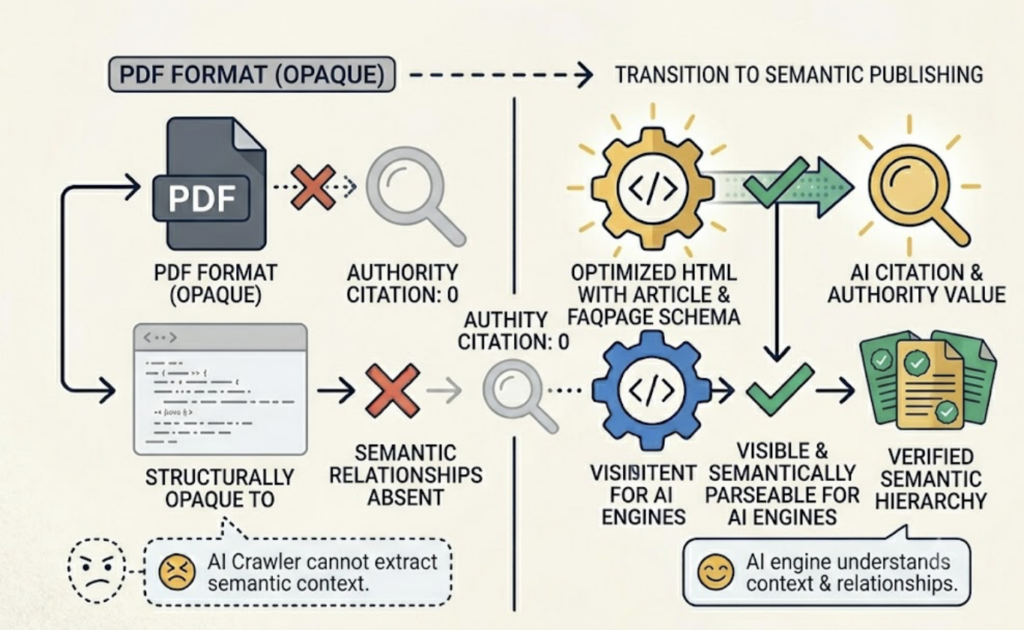
The first is the PDF problem. Security vendors produce genuinely authoritative material: compliance guides, threat landscape reports, architecture whitepapers. These are exactly the kinds of documents AI models would cite — if they could access and parse them. But PDFs are structurally opaque to AI crawlers. The text may be extractable, but the context, hierarchy, and semantic relationships that schema markup provides are absent. A whitepaper published as an HTML page with proper Article schema and FAQPage markup will outperform the same content as a PDF nearly every time.
The second failure is the crawler restriction pattern. Unlike most industries, cybersecurity vendors have operational reasons to be cautious about external bots. But AI search crawlers aren’t threat actors — and blanket restrictions in robots.txt that were set years ago may still be blocking GPTBot, ClaudeBot, and PerplexityBot today. Most teams haven’t audited this.
| Cybersecurity Scenario | GEO Score Signal | Likely Cause | Action Direction |
|---|---|---|---|
| Threat intelligence reports not cited by Perplexity | Content Signals: below 40 | Reports published as PDFs without HTML versions or schema markup | Convert key reports to HTML with Article schema and FAQ sections |
| Product pages absent from ChatGPT shortlists | Bot Access: below 30 | GPTBot blocked in robots.txt | Audit robots.txt and explicitly allow AI crawlers |
| Compliance certifications not surfaced in buyer queries | Structured Data: below 40 | Certification claims in plain text, not structured with schema | Add Organization and Product schema with certification details |
| Strong Perplexity presence, zero ChatGPT citations | Visibility Score: uneven | Content earns expert citations but lacks broad third-party distribution | Build presence in established security publications and analyst coverage |
There’s also a platform-consistency gap that’s specific to cybersecurity. Because security vendors often focus their content marketing on Google rankings, they optimize for keyword density and backlinks — signals that don’t translate cleanly to AI citations. A vendor can have 10,000 backlinks and still not appear in a ChatGPT response if those links come from sources the model doesn’t weight as authoritative for a buyer-intent query.
That’s the structural misalignment the GEO Score Checker surfaces. Strong SEO doesn’t predict strong GEO.
From a One-Time Score to Continuous GEO Monitoring
The GEO Score Checker gives you a snapshot. A fast, useful one — but a snapshot.
GEO signals change. A competitor publishes a well-structured threat report and starts capturing ChatGPT citations in your category. An algorithm update shifts how Perplexity weights security content. Your own site’s structured data breaks after a template migration. A one-time score won’t catch any of that.
That’s the gap Comprehensive GEO Analytics is built to close. It tracks all four GEO dimensions continuously, monitors citation trends across platforms, and flags changes before they compound into visibility losses.
| Capability | Free GEO Score Checker | Topify Platform |
|---|---|---|
| Check frequency | One-time snapshot | Continuous monitoring |
| Dimensions tracked | 4 GEO scores | Full GEO analytics + sentiment + citations |
| Historical trends | None | Full trend history with alerts |
| Competitor benchmarking | Not included | Real-time competitor tracking |
| Platform breakdown | Aggregated | Per-platform (ChatGPT, Perplexity, Gemini, AI Overviews) |
| Optimization actions | Directional guidance | Specific, prioritized execution steps |
The checker tells you where you stand. The platform tracks which direction you’re moving.
Plans start at $99/month with a 7-day free trial and no credit card required. See pricing or start a free trial to set up continuous monitoring across all four GEO dimensions.
Conclusion
Cybersecurity brands that rank well in Google are routinely invisible in AI search — not because their content is weak, but because it’s structured for the wrong audience. The CVE advisories, compliance documentation, and technical whitepapers that demonstrate real expertise are often locked in formats that AI crawlers can’t access, can’t parse, or can’t cite.
That’s a solvable problem. But you can’t solve what you haven’t measured.
Start with the GEO Score Checker. It takes 60 seconds, costs nothing, and shows you exactly which of the four GEO dimensions is holding your brand back from AI search visibility.
Frequently Asked Questions
What is a GEO Score for cybersecurity vendors?
A GEO Score is a 0-100 composite rating that measures how visible your cybersecurity brand is to AI search engines like ChatGPT, Perplexity, and Gemini. It evaluates four dimensions: whether AI crawlers can access your site (Bot Access), whether your content has structured markup AI can interpret (Structured Data), whether your content carries the authority signals AI models trust (Content Signals), and how frequently your brand actually appears in AI-generated responses (Visibility Score). A score below 40 typically means AI engines can’t reliably recommend you, regardless of your Google rankings.
Why do cybersecurity vendors often score low on GEO, even with strong SEO?
Two structural reasons. First, many security teams restrict external crawlers in robots.txt as a default security posture — unintentionally blocking GPTBot, ClaudeBot, and PerplexityBot. Second, the content assets cybersecurity brands invest most in — compliance documentation, CVE advisories, threat intelligence reports — are frequently published as PDFs or plain HTML without schema markup. AI engines can’t extract structured claims from these formats the way they can from properly marked-up web pages. Strong SEO rankings don’t solve either problem.
Does my cybersecurity brand need to appear on all AI platforms?
Yes, and each platform requires a different approach. ChatGPT leans on Wikipedia, established tech media, and broad authority signals. Perplexity surfaces detailed comparison content and expert reviews. Gemini tends to favor brand-owned content that’s clearly structured. A security vendor might appear consistently in Perplexity but receive zero citations in ChatGPT — a platform-specific gap that a single-platform audit won’t surface. The GEO Score Checker’s Visibility Score dimension measures your aggregated cross-platform presence and helps identify where the gaps are largest.
Can I improve my GEO score without rebuilding my entire content strategy?
Often, yes. The highest-impact fixes in cybersecurity are technical, not editorial. Auditing and updating robots.txt to allow AI crawlers, converting key PDF assets into structured HTML pages, and adding Article and FAQPage schema markup to existing content can meaningfully improve Bot Access and Structured Data scores without requiring new content production. Content Signals improvements typically require more editorial work — restructuring technical content to lead with clear definitions, comparison tables, and direct answers — but the structural fixes alone can produce measurable GEO score gains.
Read More:

