


A real estate developer sits down with ChatGPT and types: “Recommend architecture firms experienced in mixed-use healthcare facilities with LEED certification in the Southeast.” The response names three firms. None of them is yours.
Your portfolio includes exactly that project type. You’ve won regional AIA awards for it. But the AI never saw your work, because your website speaks in images and the AI reads code.
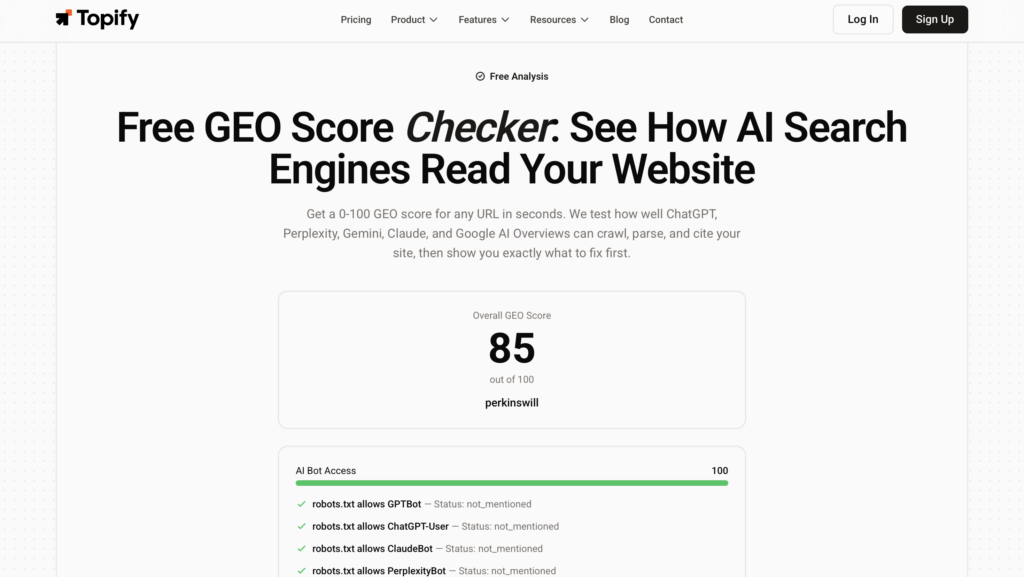
That gap between what you’ve built and what AI can see is measurable. Topify’s GEO Score Checker quantifies it across four dimensions in under a minute, showing you exactly where the breakdown happens.
✅ Free ⚡ Results in 60 seconds 🔒 No signup required
GEO Score Checker
The Four Numbers That Tell You Why AI Skips Your Design Firm
GEO stands for Generative Engine Optimization. It’s the discipline of making your brand visible inside AI-generated answers, not just on Google’s first page. The GEO Score Checker evaluates your site against four dimensions that AI platforms use to decide whether to recommend you.
For architecture and engineering firms, each dimension translates into a specific business risk.
| Score Dimension | What It Measures | Architecture & Engineering Impact |
|---|---|---|
| Bot Access | Whether AI crawlers (GPTBot, ClaudeBot, PerplexityBot) can reach your site | Many AEC firm sites block these bots by default or use JavaScript rendering that returns empty pages to crawlers |
| Structured Data | Quality of schema markup and machine-readable metadata | schema.org includes a dedicated Architect type, yet most firms don’t use it. Project types, specialisms, and certifications remain invisible to AI |
| Content Signals | Depth, authority, and semantic relevance of your written content | Portfolio pages with 14 images and three words of body copy give AI nothing to index or cite |
| Visibility Score | How often your brand appears in AI-generated answers across platforms | Measures actual presence in ChatGPT, Perplexity, Gemini, and Google AI Overviews |
Here’s the thing: a firm can score well on one dimension and fail on another. That pattern is especially common in AEC.
Award-Winning Portfolio, Blocked Crawlers
A mid-size firm redesigns its website with a gallery-first layout. The photography is editorial quality. But the site runs on a JavaScript framework that renders beautifully in browsers and returns an empty <div> to AI crawlers. Bot Access score: below 20. The AI literally cannot enter the building.
Deep Project Experience, No Machine-Readable Specialisms
A structural engineering practice has completed 200+ healthcare projects across three states. Their “Projects” page lists them with thumbnails and one-line captions. No schema markup tags these as healthcare projects. No structured data communicates LEED certifications, MEP coordination capabilities, or project scale. Structured Data score: below 30. When a procurement team asks AI for a structural engineer with healthcare experience, the model has no structured evidence to work with.
Strong ArchDaily Presence, Zero ChatGPT Visibility
A design studio gets featured regularly on ArchDaily and Dezeen. Perplexity, which retrieves heavily from web sources, occasionally surfaces the firm. But ChatGPT and Google AI Overviews rely more on structured site data and entity-level signals. Without that anchor on the firm’s own domain, the third-party citations float unattached. Visibility Score: 55 on Perplexity, under 15 on ChatGPT.
That cross-platform fragmentation is the norm, not the exception, in this industry.
How to Run Your Firm’s GEO Check
- Go to GEO Score Checker.
- Enter your firm’s brand name or domain.
- Get your four-dimension score in 60 seconds.
- Compare dimensions to find the weakest signal.
The weakest dimension is where you start. A firm with strong Content Signals but a failing Bot Access score has a technical fix, not a content problem. A firm with good Bot Access but low Structured Data needs schema implementation, not more blog posts.
What Project Owners Ask AI Before They Issue an RFQ
The procurement shift isn’t theoretical. Forrester’s 2026 Buyers’ Journey Survey of nearly 18,000 global business buyers found that 94% used generative AI during their most recent purchase process. G2’s 2026 study found that 51% of B2B buyers now start research in an AI chatbot, up from 29% a year earlier.
In architecture and engineering, the prompts are specific. They reflect how owners, developers, and facilities managers actually think about project procurement.
| AI Prompt Example | Platform | Search Intent | What It Reveals |
|---|---|---|---|
| “Architecture firms specializing in K-12 school design in the Midwest” | ChatGPT | Vendor shortlisting by typology + region | Whether your firm’s school projects are tagged and described in machine-readable format |
| “Best structural engineering consultants for high-rise residential in Miami” | Perplexity | Specialist capability search | Whether third-party citations (ENR, local press) connect back to a structured entity on your site |
| “Compare MEP engineering firms with healthcare facility experience” | Gemini | Competitive comparison | Whether AI can pull your project types, certifications, and team size from structured data |
| “Sustainable architecture firms with Passive House certification” | ChatGPT | Credential-filtered search | Whether your certifications exist in schema markup or only as a line in a PDF brochure |
| “Landscape architecture firms that have worked on urban resilience projects” | Perplexity | Niche specialism search | Whether your project narratives include semantic keywords AI can match to the query |
The average B2B vendor shortlist has contracted from roughly 3.2 names to about 2.5 in 2026. Fewer slots, higher stakes. And AI chatbots are now the single biggest influence on which vendors make that list, ahead of review platforms, vendor websites, and sales teams.
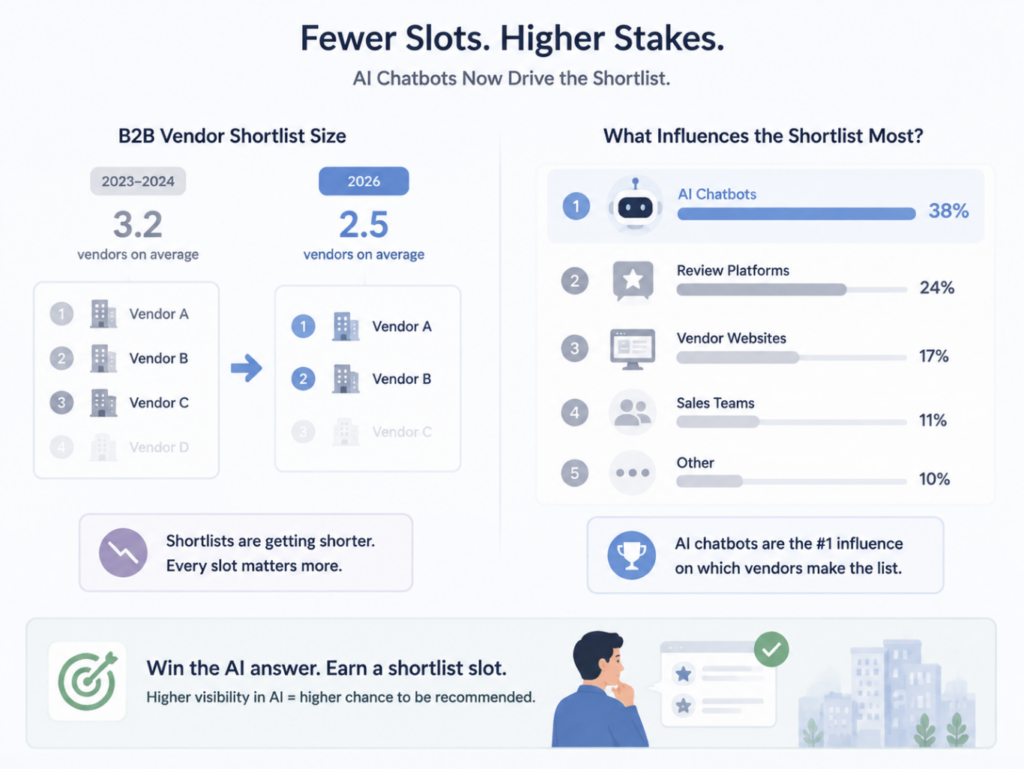
If your firm isn’t surfacing in these prompts, you’re not losing a click. You’re losing the chance to be considered at all.
Where Architecture & Engineering Firms Consistently Lose GEO Points
AEC firms face a set of AI visibility problems that are structurally different from SaaS companies or e-commerce brands. Three patterns show up repeatedly.
The Portfolio Paradox
Architecture is a visual discipline. Firms invest heavily in photography, renderings, and gallery layouts. The result is websites that impress human visitors and starve AI crawlers.
AI crawlers parse HTML, text, metadata, and structure. They do not take a screenshot and give you credit for how the rendering looks. A project page with editorial photography but no project description, no location data, no typology tags, and no challenge-and-solution narrative is functionally invisible. The work exists. As far as AI is concerned, the page says almost nothing.
This isn’t a design problem. It’s a translation problem. The firms that solve it don’t strip their visual identity. They add the text layer that AI needs alongside the visuals that clients expect.
The Structured Data Gap
Schema.org includes a dedicated Architect type. It’s not a workaround or generic classification. Combined with Service, CreativeWork, and Organization schemas, it creates a complete structured profile that AI platforms can read, categorize, and recommend.
In practice, very few AEC firms implement it. Project specialisms, geographic reach, certifications, team credentials, and completed project types live in PDFs, image captions, or unstructured “About” text. None of that is machine-readable.
When a procurement team asks AI for “an architect experienced in Victorian terrace extensions in Didsbury,” the model needs structured data to match that query to your firm. Without it, the model either skips you or guesses wrong.
Unanchored Authority
AEC firms earn authority through channels that AI models do recognize: features in ArchDaily, Dezeen, and Architectural Record, listings in AIA directories, awards from regional and national bodies, mentions in contractor and developer portfolios.
But AI models treat these third-party signals as trust evidence only when the firm’s own site provides a structured entity that anchors them. Think of it as a hub-and-spoke model. The spokes (external mentions) need a hub (your site’s structured data) to connect to. Without the hub, the mentions float in the model’s training data without being reliably linked to your brand entity.
That’s why a firm can have strong press coverage and still score below 40 on Visibility. The coverage exists. The connection to your brand doesn’t.
From a One-Time Score to Continuous GEO Monitoring
The GEO Score Checker gives you a snapshot. It tells you where your firm stands right now across four dimensions. That’s the starting point.
But GEO signals change. AI platforms update their retrieval systems. Competitors add structured data. Your new project pages either strengthen or weaken your content signals. A single score can’t track that trajectory.
| Capability | Free GEO Score Checker | Topify Platform |
|---|---|---|
| Check frequency | One-time snapshot | Continuous monitoring |
| Dimensions tracked | 4 GEO scores | Full GEO analytics + sentiment + citations |
| Historical trends | None | Full trend history with alerts |
| Competitor benchmarking | Not included | Real-time competitor tracking |
| Platform breakdown | Aggregated | Per-platform (ChatGPT, Perplexity, Gemini, AI Overviews) |
| Optimization actions | Directional guidance | Specific, prioritized execution steps |
A single score tells you where you stand. Continuous monitoring tells you which direction you’re moving.
Topify’s Comprehensive GEO Analytics tracks all four GEO dimensions over time, breaks down visibility by platform, and benchmarks you against competitors in your market. You can start a free trial with no credit card, or review pricing to find the plan that fits your firm’s size.
Conclusion
The AEC industry runs on reputation, relationships, and proven project experience. None of that has changed. What’s changed is where project owners start their research. When 94% of B2B buyers use AI in their procurement process, your firm’s digital signals need to be as strong as your built work.
Run your GEO Score Checker now. It takes 60 seconds, costs nothing, and shows you exactly which of the four dimensions is holding your firm back from AI-generated shortlists.
For deeper diagnostics, Topify’s AI Robots Checker can identify whether specific AI crawlers are being blocked by your robots.txt configuration. The Brand Authority Checker measures how AI models assess your firm’s overall authority signals, and the Knowledge Freshness Checker tests whether AI platforms have up-to-date information about your practice.
Frequently Asked Questions
Why do architecture firms with strong portfolios still score low on GEO?
Most architecture websites are built around high-resolution images with minimal supporting text. AI crawlers can’t interpret visual quality. They need descriptive project narratives, typology tags, and structured metadata to understand what a firm has built and where its expertise lies. A stunning gallery with no text context produces a near-zero Content Signals score.
Does schema markup actually affect whether AI recommends my firm?
Yes. Schema.org provides a dedicated Architect type that lets AI platforms categorize your practice by specialism, project type, and service area. Without it, AI models have to infer your capabilities from unstructured text, and they frequently get it wrong or skip you entirely. Implementing schema is one of the fastest ways to improve your Structured Data score in the GEO Score Checker.
How is GEO different from SEO for architecture firms?
SEO optimizes for Google’s link-based ranking algorithm. GEO optimizes for AI answer engines (ChatGPT, Perplexity, Gemini, Google AI Overviews) that assemble recommendations from structured data, entity signals, and corroborated third-party mentions. An AEC firm can rank well on Google for branded searches but remain invisible in AI-generated shortlists if its site lacks structured data and machine-readable project details.
Can a one-time GEO score check really help, or do I need ongoing monitoring?
A one-time check identifies your weakest dimension and gives you a clear starting point. For firms actively improving their digital presence, Comprehensive GEO Analytics adds trend tracking, per-platform breakdowns, and competitor benchmarking so you can measure whether changes are actually moving your visibility scores.
Read More:

