

A procurement manager at a mid-size employer typed into ChatGPT: “Best digital insurance platforms for small business group health coverage.” Five brands showed up. Yours, with state-of-the-art underwriting automation and partnerships across 30 states, wasn’t one of them. The problem isn’t your product. It’s that AI doesn’t trust your brand enough to recommend it.
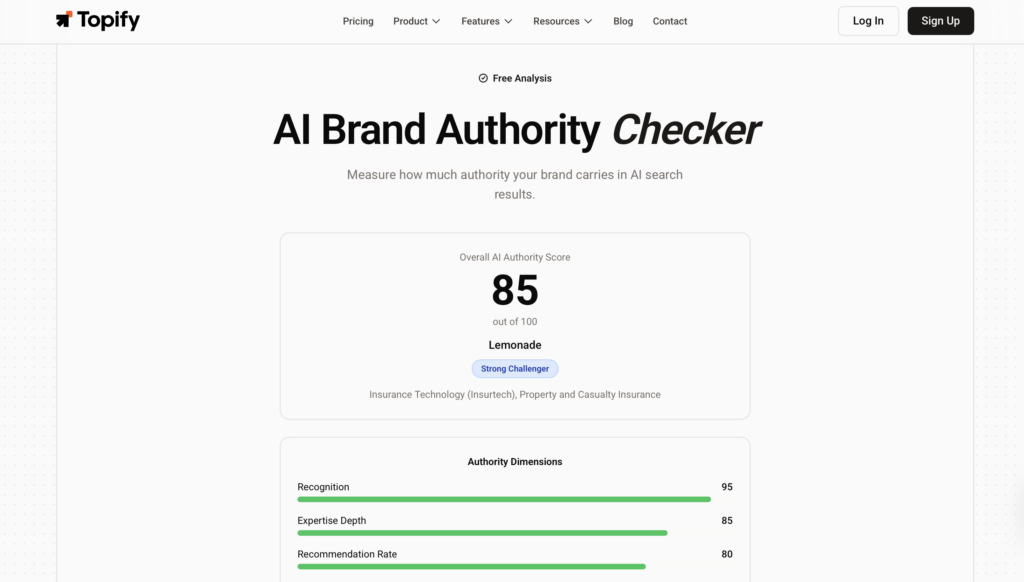
The gap is measurable, and the check takes 60 seconds. Topify‘s Brand Authority Checker scores how AI models perceive your InsurTech brand’s authority across four dimensions that directly determine whether you get recommended or skipped.
✅ Free ⚡ Results in 60 seconds
AI Brand Authority Checker
What AI Actually Knows About Your InsurTech Brand
The Brand Authority Checker doesn’t give you a single number and leave you guessing. It breaks your AI-perceived authority into four distinct metrics, each one mapping to a specific challenge InsurTech companies face in AI-driven discovery.
The Four Authority Scores, Translated for InsurTech
| Metric | What It Measures | What It Means for InsurTech |
|---|---|---|
| Recognition (0-100) | How consistently AI identifies your brand in your category | Below 40: AI doesn’t associate you with your core insurance vertical (P&C, life, health, embedded) |
| Expertise Depth (0-100) | How well AI understands your capabilities and differentiators | Below 50: AI may describe your underwriting model or claims process incorrectly |
| Recommendation Rate (0-100) | How often AI includes you when users ask for options | Below 30: you’re losing distribution opportunities before your sales team even gets a chance |
| Trust Signals (0-100) | External validation AI detects from media, reviews, and citations | Below 40: AI can’t find enough third-party evidence to vouch for your compliance or reliability |
Here’s the thing. An InsurTech brand with a Recognition score of 80 but a Trust Signals score of 25 has a very specific problem: AI knows you exist, but it doesn’t have enough external validation to recommend you over an established carrier. That’s a common pattern for InsurTech companies that invest heavily in product but underinvest in third-party visibility.
What You Might Discover When You Run Your Brand
A digital-first P&C InsurTech might find that AI describes its product as a “comparison tool” instead of a licensed carrier. That’s an Expertise Depth problem. The AI hasn’t ingested enough structured content to understand the difference between an aggregator and an underwriter.
An embedded insurance startup could see a high Recognition score (AI knows the brand) but near-zero Recommendation Rate. The likely cause: AI recognizes the company from funding news and press coverage, but can’t find enough product-level detail to recommend it for specific coverage questions.
A claims automation platform might score well on Expertise Depth but poorly on Trust Signals. AI understands what the product does, but can’t locate independent reviews, analyst reports, or regulatory filings that validate the claims.
How to Run Your Check
Go to the Brand Authority Checker, enter your brand name or domain, and get your four-dimensional authority breakdown in under 60 seconds. No signup, no credit card. Read the per-metric scores, note which ones fall below 50, and you’ll have a clear map of where AI perception doesn’t match reality.
The Insurance Questions AI Gets Asked Every Day
Insurance buyers don’t search the way they used to. J.D. Power found that 41% of consumers already use AI tools when shopping for or researching insurance, and 80% said the experience was helpful. That traffic converts at a 6x higher ratethan traditional search, because AI has already pre-vetted the brands it recommends.
The prompts your buyers are typing into AI platforms are specific, high-intent, and often product-category-level. Here’s what that looks like for InsurTech:
| AI Prompt Example | Platform | Search Intent | What Your Brand Needs |
|---|---|---|---|
| “Best digital insurance platform for small business health coverage” | ChatGPT | Purchase decision | High Recommendation Rate + Expertise Depth in group health |
| “Is [InsurTech brand] licensed in California?” | Perplexity | Trust verification | Accurate Trust Signals + structured regulatory data |
| “Embedded insurance API for e-commerce checkout” | Gemini | Technical evaluation | Deep Expertise Depth in embedded distribution |
| “Compare cyber insurance for startups under 50 employees” | ChatGPT | Competitive comparison | Recognition in the cyber insurance sub-category |
| “Claims automation platform with fastest payout time” | Perplexity | Feature-specific research | Expertise Depth that reflects actual processing speed |
Each of these prompts is a decision point. If AI doesn’t mention your brand in the answer, you’re not losing a click. You’re losing a warm lead that was ready to buy.
Different AI Platforms Recommend Different InsurTech Brands
This is where most InsurTech marketing teams get it wrong. They check one platform, see a decent result, and assume the job is done.
It doesn’t work that way. Brandlight data from Q1 2026 shows that Perplexity had a 60% brand mention rate for insurance-related queries, while Google AI Overviews mentioned brands only 35% of the time. On the same customer support queries, Aetna dominated Perplexity while UnitedHealthcare led on Google AIO. ChatGPT offered the most balanced representation across the competitive set.
The same divergence applies to InsurTech. Your embedded insurance product might appear consistently in ChatGPT answers (which tends to surface brands with clear product documentation) but be completely absent from Perplexity (which leans heavily on citation-rich sources and analyst coverage). Or you might rank well in Google AI Overviews thanks to strong traditional SEO, yet get zero mention from Gemini.
That’s why a single-platform check isn’t a strategy. It’s a coin flip.
The Brand Authority Checker gives you an aggregated view, but the pattern it reveals, especially the gap between Recognition and Recommendation Rate, often signals platform-level inconsistency. If AI knows your brand but won’t recommend it, the friction is usually concentrated on specific platforms where your external signals are weakest.
The practical move: run the Brand Authority Checker to identify your weakest dimension, then map that weakness to the platforms where your buyers are most active. If your InsurTech primarily serves enterprise buyers, ChatGPT and Perplexity matter most. If you’re in direct-to-consumer P&C, Google AI Overviews and Gemini carry more weight.
Your Compliance Investment Is Invisible to AI
InsurTech companies spend enormous resources on regulatory compliance. State-by-state licensing. SOC 2 certifications. NAIC model bulletin alignment. Over 30 states have now adopted some form of the NAIC AI governance guidelines, and InsurTech companies that operate across multiple jurisdictions have compliance infrastructures that rival major carriers.
Here’s the disconnect. AI doesn’t know any of that unless it can find the evidence.
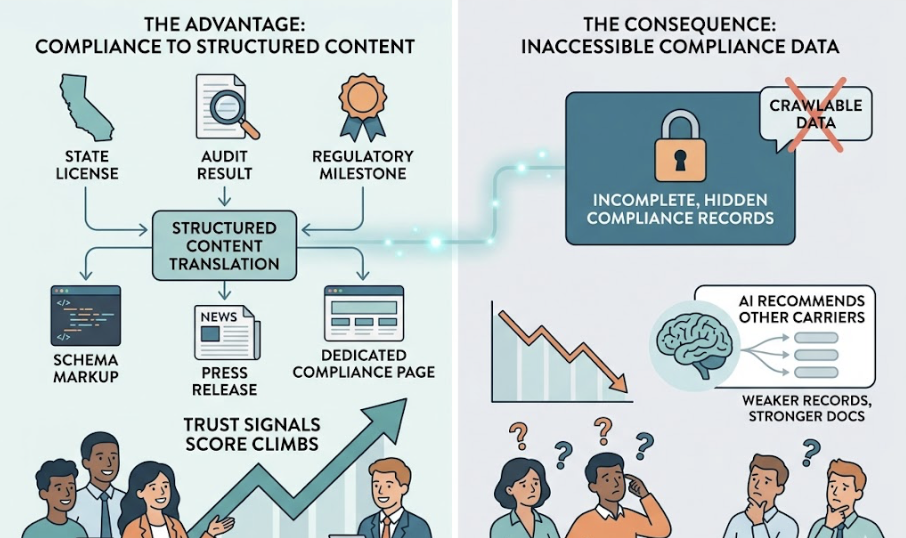
LLMs don’t read your compliance dashboard. They don’t check state DOI filings. They build trust profiles from what’s publicly available: structured data on your website, third-party mentions in industry publications, regulator press releases, and independent reviews. If your compliance achievements live exclusively in internal documentation and PDF filings that AI crawlers can’t access, your Trust Signals score will reflect a brand with no verifiable compliance story.
This is where InsurTech brands have an underused advantage. Every state license, every audit result, every regulatory milestone is a trust signal waiting to be surfaced. The companies that translate compliance into publicly indexed, structured content (schema markup for licenses, press releases for regulatory approvals, dedicated compliance pages with crawlable data) will see their Trust Signals scores climb. The ones that don’t will keep wondering why AI recommends carriers with weaker compliance records but stronger public-facing documentation.
Run your brand through the Brand Authority Checker and look specifically at the Trust Signals dimension. If it’s significantly lower than your other scores, compliance visibility is likely the gap.
One Score Is a Starting Point. Tracking It Over Time Is the Strategy.
Your Brand Authority Checker results tell you where you stand today. But AI models update their training data, adjust ranking signals, and shift recommendations on a rolling basis. A score of 72 today could drop to 55 next quarter without any change on your end. Model updates from OpenAI, Google, and Anthropic happen regularly, and each one can reshuffle which InsurTech brands get recommended.
Topify‘s platform picks up where the free tool leaves off. The Comprehensive GEO Analytics dashboard tracks your authority, sentiment, and visibility scores continuously across ChatGPT, Perplexity, Gemini, and Google AI Overviews. You’ll see trend lines, get alerts when scores shift, and receive specific recommendations for what to fix.
Here’s how the free check compares to the full platform:
| Capability | Free Brand Authority Checker | Topify Platform |
|---|---|---|
| Check frequency | One-time snapshot | Continuous daily/weekly monitoring |
| AI platforms covered | Aggregated score | Per-platform breakdown (ChatGPT, Perplexity, Gemini, AI Overviews) |
| Historical trends | None | Full trend history with alerts |
| Competitor tracking | Not included | Real-time InsurTech competitor benchmarking |
| Action recommendations | General | Specific, one-click GEO optimization |
| Team collaboration | No | Multi-seat access for marketing + compliance teams |
Every plan starts with a 7-day free trial, no credit card required. The Starter plan begins at $99/month.
Conclusion
AI is already influencing how buyers, employers, and brokers choose insurance products. The InsurTech brands that show up in those AI-generated answers will capture high-intent leads at 6x the conversion rate of traditional search. The ones that don’t will keep competing on channels where their advantages are harder to demonstrate.
Start with a free Brand Authority Checker scan to see where AI perception doesn’t match your actual capabilities. Focus on the lowest-scoring dimension first, whether that’s Recognition, Expertise Depth, Recommendation Rate, or Trust Signals.
While you’re assessing your brand authority, a few other free checks can round out the picture. Topify‘s AI Visibility Report shows how often your brand gets mentioned across major AI platforms. The Competitor Analysis tool reveals who AI considers your competition, which may not match your internal competitive set. And the AI Robots Checker confirms whether AI crawlers can actually access your site’s content.
FAQ
Is the Brand Authority Checker free? Do I need to create an account?
Yes, it’s completely free. No account, no signup, no credit card. Enter your brand name or domain and get your authority breakdown in under 60 seconds.
What’s the difference between the free tool and the Topify platform?
The free Brand Authority Checker gives you a one-time snapshot of your four authority scores. The Topify platformprovides continuous monitoring across all major AI platforms, historical trend data, competitor benchmarking, and actionable optimization recommendations. Plans start at $99/month with a 7-day free trial.
How often should InsurTech brands check their AI visibility?
At minimum, after every major product launch, funding announcement, or regulatory milestone. AI models update frequently, and your visibility can shift without any change on your end. For continuous coverage, the Topify platform monitors daily.
Can strong traditional SEO rankings guarantee AI visibility for InsurTech?
No. AI visibility and Google rankings operate on different signals. AI platforms prioritize entity authority, structured data, third-party validation, and content clarity over traditional backlink profiles. An InsurTech brand ranking first on Google for a target keyword can still be absent from ChatGPT’s recommendations for the same query.

