

A shopper opened ChatGPT and typed, “Best probiotic for gut health after antibiotics.” The AI responded with three brand recommendations, dosage guidance, and links to clinical studies. Your probiotic, the one with NSF certification and 12,000 five-star reviews, wasn’t mentioned. Not ranked low. Not mentioned at all.
The issue isn’t your product. It’s that AI doesn’t recognize your brand’s authority in the way it needs to in order to recommend you.
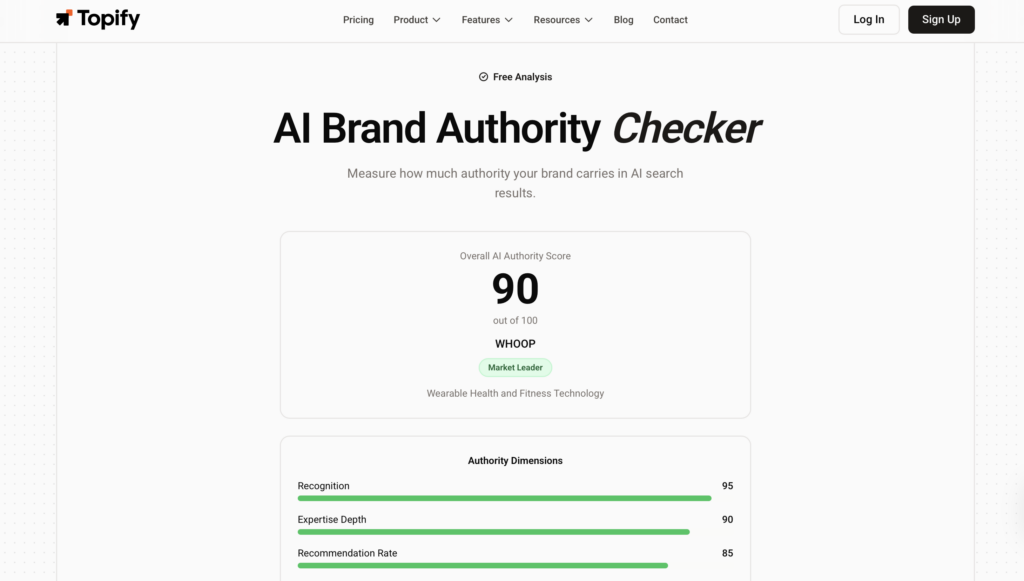
The gap is measurable, and the check takes 60 seconds. Topify‘s Brand Authority Checker scores how AI models perceive your wellness brand’s authority across four dimensions that directly determine whether you get recommended or filtered out.
✅ Free ⚡ Results in 60 seconds
AI Brand Authority Checker
Wellness Buyers Ask AI for Recommendations. Your Authority Score Decides If You’re in the Answer.
Health and wellness sits in a category AI treats differently from almost everything else. Google classifies health content as YMYL (Your Money or Your Life), and AI engines inherit that scrutiny. That means every recommendation an AI makes about supplements, fitness programs, or functional foods passes through an additional trust filter before it reaches the consumer.
The Brand Authority Checker breaks your brand’s AI-perceived authority into four scores. Each one maps to a specific challenge wellness brands face.
The Four Scores That Tell You If AI Trusts Your Wellness Brand
| Metric | What It Measures | What It Means for Wellness Brands |
|---|---|---|
| Recognition (0-100) | How often AI identifies your brand in your category | Below 40: AI doesn’t associate you with your product category, even if you’ve been selling for a decade |
| Expertise Depth (0-100) | How well AI understands your formulations and claims | Below 50: AI may misrepresent your ingredients, certifications, or clinical backing |
| Recommendation Rate (0-100) | How often AI recommends you vs. alternatives | Below 30: you’re invisible at the exact moment a buyer is making a purchase decision |
| Trust Signals (0-100) | External validation AI detects (reviews, media, expert citations) | Below 40: AI can’t find enough third-party evidence to clear the YMYL trust bar |
A supplement brand with a Recognition score of 80 but Trust Signals at 25 has a specific, fixable problem: AI knows the brand exists, but doesn’t have enough external validation to feel safe recommending it for a health-related query. That’s the YMYL filter in action.
Where Wellness Brands Typically Find Gaps
Supplement brands often discover strong Recognition but weak Expertise Depth. AI knows the brand name, but can’t accurately describe the difference between their magnesium glycinate and magnesium citrate products. The result: generic mentions without specific product recommendations.
Functional beverage companies tend to see the reverse pattern. Expertise Depth scores well because ingredient innovation generates media coverage, but Recommendation Rate stays low because AI doesn’t connect the brand to the buying prompts consumers actually use.
Yoga studios and wellness practitioners frequently score below 30 across all four metrics. Local and service-based wellness businesses generate minimal structured data for AI to consume, making them nearly invisible in AI-driven discovery.
How to Run Your Check
Go to Brand Authority Checker, enter your brand name or domain, and get your four-dimensional authority breakdown in under 60 seconds. No signup, no credit card.
Look at the gap between your highest and lowest scores first. That spread tells you where AI’s perception of your brand breaks down.
The Prompts Wellness Consumers Type Into AI, and What Your Score Reveals
The prompts people use when asking AI about wellness products aren’t casual. They’re high-intent, decision-stage queries that carry real purchasing power. Here’s what those prompts look like, and what AI evaluates before answering.
| AI Prompt Example | Platform | What AI Evaluates | Authority Signal Required |
|---|---|---|---|
| “Best magnesium supplement for sleep” | ChatGPT | Third-party testing, clinical evidence, user reviews | Trust Signals above 60 |
| “Is ashwagandha safe to take daily?” | Perplexity | Medical citations, expert consensus, brand credibility | Expertise Depth above 55 |
| “Top-rated collagen powder that actually works” | Gemini | Review volume, ingredient transparency, repeat-purchase data | Recommendation Rate above 40 |
| “Wellness brands recommended by doctors” | Google AI Overview | Practitioner endorsements, clinical partnerships, media authority | Trust Signals above 70 |
| “Best probiotic for IBS, doctor recommended” | ChatGPT | Clinical trial data, FDA compliance signals, practitioner citations | All four metrics above 50 |
Notice the pattern. Every wellness-related prompt triggers YMYL evaluation. AI isn’t just matching keywords. It’s checking whether your brand has enough authority signals to justify a health recommendation.
A brand scoring below 40 on Trust Signals won’t appear in any of these results, regardless of how good the product is. That’s the invisible filter most wellness brands don’t know exists.
YMYL Is the Invisible Filter Wellness Brands Can’t See
Here’s the thing. In categories like fashion or home decor, a brand with moderate authority can still get mentioned in AI answers. The stakes are lower, so the trust bar is lower. Wellness doesn’t get that flexibility.
YMYL classification means AI engines apply a higher standard before recommending anything related to health, nutrition, or physical wellbeing. If a supplement brand’s Trust Signals score sits at 35, AI treats that as insufficient evidence to risk a health-related recommendation. The brand gets filtered out before the ranking even happens.
Research from Moz’s 2026 analysis found that 88% of AI Mode citations don’t overlap with the organic top-10 search results. For wellness brands, this disconnect is even more pronounced. You might rank on page one of Google for “best vitamin D supplement” and still be completely absent from ChatGPT’s answer to the same question.
The practical impact is measurable. Health and wellness products convert at 4.68% from AI-referred traffic. That’s the second-highest conversion rate across all ecommerce categories. And 74% of users follow AI recommendations without checking alternatives. When your brand isn’t in the AI answer, the sale goes to whoever is, with no second chance.
Consumers Are Already Using AI to Make Health Decisions. Most Brands Haven’t Caught Up.
A Vitamin Shoppe-commissioned survey of 2,000 U.S. adults found that 35% of Americans already use AI to manage or learn about their health and wellness. Not for general browsing. For actual purchasing decisions. 63% said they find AI reliable for health guidance, and a quarter use AI to fact-check advice from their own doctors.
This isn’t a future trend. It’s current behavior.
And the numbers skew harder with younger demographics. One in six adults aged 18-29 uses AI tools several times a week. For wellness brands targeting millennial and Gen Z consumers, the AI discovery channel is already as important as Instagram or Google.
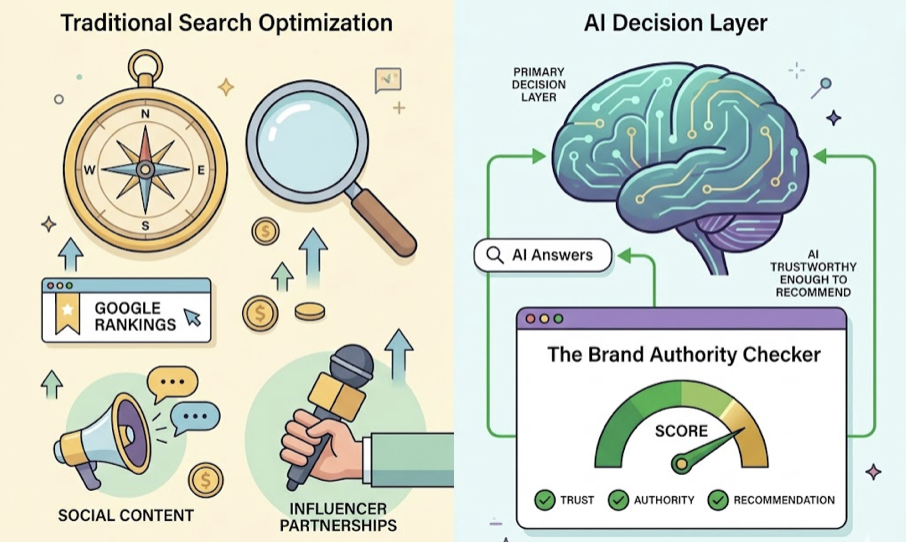
On the flip side, most wellness brands are still optimizing exclusively for traditional search. They’re investing in Google rankings, social content, and influencer partnerships while AI quietly becomes the primary decision layer. The Brand Authority Checker gives you a 60-second read on whether AI considers your brand trustworthy enough to recommend. If your scores are low, no amount of SEO investment will put you in those AI answers.
You can check your brand’s authority score right now and see exactly where the gap is.
One Score Is a Starting Point. Tracking It Over Time Is the Strategy.
Your Brand Authority Checker results tell you where you stand today. But AI models update their training data, adjust ranking signals, and shift recommendations on a rolling basis. A score of 72 this month could drop to 55 next quarter without any change on your end. A competitor’s new clinical study or a wave of negative reviews about your brand on Reddit could shift your position overnight.
Topify‘s platform picks up where the free tool leaves off. The Comprehensive GEO Analytics dashboard tracks your authority, sentiment, and visibility scores continuously across ChatGPT, Perplexity, Gemini, and Google AI Overviews. You’ll see trend lines, get alerts when scores shift, and receive specific recommendations for what to fix.
Here’s how the free check compares to the full platform:
| Capability | Free Brand Authority Checker | Topify Platform |
|---|---|---|
| Check frequency | One-time snapshot | Continuous daily/weekly monitoring |
| AI platforms covered | Aggregated score | Per-platform breakdown (ChatGPT, Perplexity, Gemini, AI Overviews) |
| Historical data | None | Full trend history with shift alerts |
| Competitor comparison | Not included | Real-time competitor benchmarking |
| Action recommendations | General direction | Specific, data-driven GEO optimization |
| YMYL signal tracking | Not included | Ongoing trust signal monitoring |
Every plan starts with a 7-day free trial, no credit card required. The Starter plan begins at $99/month.
Conclusion
Wellness consumers are asking AI which brands to trust with their health. The YMYL filter means AI won’t recommend you unless it has enough evidence that you’re credible. Most wellness brands don’t know their authority scores, and they’re losing high-converting traffic to competitors who do.
Start with the Brand Authority Checker. It takes 60 seconds, it’s free, and it shows you exactly how AI perceives your brand’s trustworthiness. If the scores reveal gaps, you’ll know precisely where to focus.
While you’re assessing your brand authority, a few other free checks can round out the picture. Topify‘s GEO Score Checker evaluates whether AI crawlers can actually access your site’s wellness content. The AI Visibility Report shows how often your brand gets mentioned across major AI platforms. And the Brand Sentiment Checker reveals whether AI describes your products positively or flags outdated concerns.
FAQ
Is the Brand Authority Checker free? Do I need to create an account?
Yes, it’s completely free. You don’t need to sign up, provide an email, or enter payment information. Just enter your brand name or domain and get results in under 60 seconds.
What’s the difference between the free tool and the Topify platform?
The free Brand Authority Checker gives you a one-time snapshot of your current authority scores. The Topify platform provides continuous monitoring across all major AI platforms, historical trend data, competitor benchmarking, and actionable optimization recommendations. Think of the free tool as a diagnostic, and the platform as ongoing treatment.
How often should a wellness brand check its AI visibility?
Given the YMYL sensitivity of health content, wellness brands should check at minimum once per quarter. AI models update their training data frequently, and a single negative review cluster or a competitor’s new clinical partnership can shift your scores. Brands running active campaigns or launching new products should monitor weekly.
Why does my brand rank well on Google but not appear in AI answers?
AI engines and traditional search use different ranking signals. Google relies heavily on backlinks and on-page SEO. AI engines prioritize authority signals, cross-source consistency, and editorial citations. Moz’s 2026 analysis found 88% of AI citations don’t overlap with Google’s top 10 results. Your Google rankings and your AI visibility are essentially separate channels.

