

46% of Students Ask AI Where to Apply. Is Your School in the Answer?
A high school junior opens ChatGPT and types: “Best nursing programs in California with clinical rotations.” The AI lists five schools. Yours isn’t one of them. Not because your program is weak, but because the model doesn’t surface it.
This is happening across higher ed right now. 46% of high school students used AI in their college search by late 2025, up from 26% just months earlier. And most institutions have no idea how AI platforms describe, rank, or ignore them.
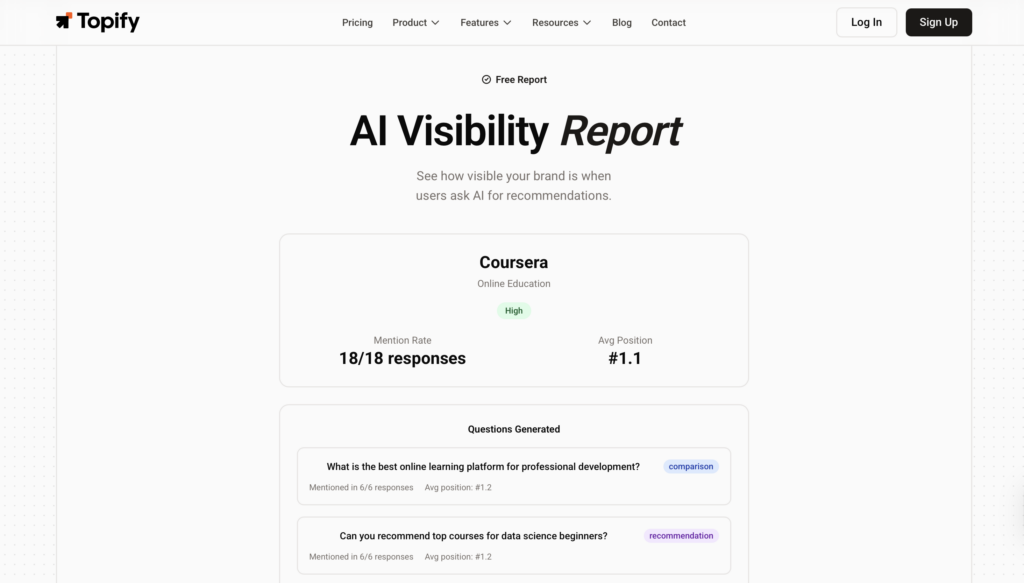
There’s a fast way to find out. Topify‘s AI Visibility Report shows how often your institution gets mentioned across ChatGPT, Perplexity, Gemini, and Google AI Overviews, with a breakdown by platform, ranking position, and mention rate.
✅ Free ⚡ Results in 60 seconds 🔒 No signup required
AI Visibility Report
What Your Institution’s AI Visibility Report Actually Reveals
The Three Metrics That Define Your AI Presence
The AI Visibility Report doesn’t give you a single vanity score. It breaks your institution’s AI presence into three dimensions that map directly to how prospective students discover you.
Here’s what each metric means in an education context:
| Metric | What It Measures | What It Means for Education Brands |
|---|---|---|
| Mention Rate | How often AI includes your brand in relevant answers | Low rate = students asking “best online MBA programs” never see your name |
| Ranking Position | Where you appear within AI-generated lists | Position 4-5 gets scanned. Position 8+ gets ignored. Not listed = invisible |
| Provider Breakdown | Which AI platforms mention you and which don’t | You might show up in Gemini but be completely absent from ChatGPT, where most students search |
These three numbers tell you something your Google Analytics dashboard can’t: whether AI is sending students toward you or away from you before they ever visit your website.
Three Scenarios Where the Report Exposes Hidden Problems
Scenario 1: The “strong brand, weak AI signal” gap. Your institution has solid U.S. News rankings, a 90%+ placement rate, and thousands of alumni. But when someone asks Perplexity “best online programs for working adults,” you don’t appear. The report shows a mention rate near zero on that platform, revealing a gap between your offline reputation and your AI footprint.
Scenario 2: The platform blind spot. Your marketing team optimized for Google. You rank on page one for your target keywords. But AI Overviews pull from different signals than organic search. The Provider Breakdown might show strong Gemini visibility but zero presence in ChatGPT, where 28% of Gen Z users launch their first search.
Scenario 3: The inaccurate recommendation. AI mentions your institution, but for programs you discontinued two years ago. Or it places you in the wrong state. The report flags that you’re being mentioned, but further investigation reveals the mentions are doing more harm than good.
How to Run Your First Report
Getting your baseline takes three steps:
- Go to the AI Visibility Report tool page.
- Enter your institution’s brand name (e.g., “Northeastern University” or “Western Governors University”).
- Review the output: mention rate, ranking position across platforms, and provider-level breakdown.
The whole process takes under a minute. What you do with the data is where the real work begins.
The Prompts Prospective Students Are Typing Into ChatGPT
Students don’t type your institution’s name into AI. They type questions. And the answer AI gives is often the first filter in their decision process.
EAB’s survey of over 5,000 high school students found that 62% of those using AI did so to find colleges that fit their needs. About half used it to discover schools they hadn’t heard of before. These are non-branded, intent-driven queries, and they’re the ones that determine whether you make the shortlist.
Here’s a sample of what education-related AI prompts look like:
| AI Prompt Example | Search Intent | If You Don’t Appear |
|---|---|---|
| “Best online MBA programs for working professionals 2026” | Program comparison | Student builds a shortlist without you on it |
| “Cheapest accredited nursing programs in Texas” | Cost-driven decision | Price-sensitive students default to whichever schools AI recommends |
| “Is [your institution] worth the tuition?” | Trust verification | AI may give a vague or outdated answer that pushes the student elsewhere |
| “Top computer science programs with co-op opportunities” | Outcome-driven research | High-value applicants never discover your program |
| “Best colleges for first-generation students with financial aid” | Fit-based discovery | Underserved students miss institutions specifically built for them |
Each of these prompts is a moment where AI either includes your institution or doesn’t. The AI Visibility Report lets you check which of these conversations you’re part of, and which ones you’re missing entirely.
What the Data Says About AI and Enrollment Decisions
Students Remove Schools from Their List Based on AI Answers
This is the stat that should keep enrollment leaders up at night: 18% of high school students have removed a college from their list because of an AI-generated response. On the flip side, 34% said AI increased their interest in a particular institution.
That’s not a minor influence. That’s a shortlist filter.
And it’s getting worse for schools that aren’t visible. A quarter of students are now having ongoing, multi-turn conversations with AI about their college search. They’re not browsing ten tabs. They’re talking to one chatbot and trusting its output.
If your institution isn’t in that conversation, you’ve lost the student before your admissions team even knows they exist.
Ad Spend Can’t Buy an AI Recommendation
Here’s a data point that illustrates the disconnect: 5WPR’s Online Universities AI Visibility Index found that Western Governors University leads with roughly 14% AI citation share. University of Phoenix, despite category-leading paid search spending, captures just 1.5%.
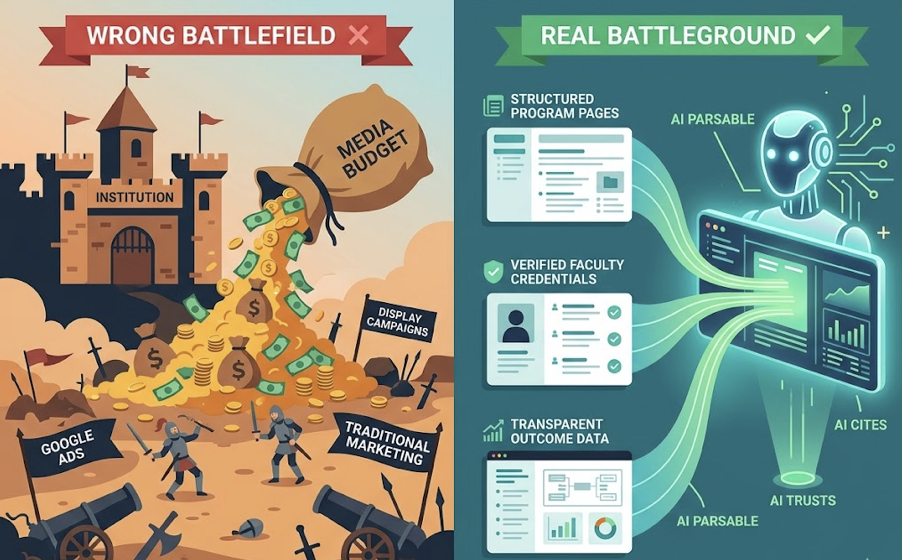
AI doesn’t care about your media budget. It cares about content structure, third-party authority signals, and whether your information is accurate and extractable. Institutions pouring money into Google Ads and display campaigns are fighting a war on the wrong battlefield. The new battleground is whether your program pages, faculty credentials, and outcome data are structured in a way AI models can parse, trust, and cite.
Most Institutions Don’t Know Their AI Visibility Score
Ask your enrollment marketing team how you rank on Google for “best online MBA.” They’ll probably know. Ask them how often ChatGPT recommends your institution when a student asks that same question. Silence.
Research from UPCEA and Search Influence confirms that most institutions aren’t tracking AI citation frequency or brand mentions in AI-generated answers. They’re measuring clicks, impressions, and CPC, but none of those metrics capture the moment a student asks AI for a recommendation and your school doesn’t appear.
The AI Visibility Report exists to close that gap. It takes 60 seconds to run. And it gives you a baseline that no amount of Google Analytics data can replicate.
From a One-Time Snapshot to Continuous AI Monitoring
The AI Visibility Report gives you a clear picture of where you stand today. But AI search results aren’t static. Models update, content freshness signals shift, and your competitors’ visibility changes week to week. A strong mention rate today doesn’t guarantee the same result next month.
That’s where Topify’s AI Visibility Checker picks up. It turns the one-time snapshot into a continuous monitoring system: daily tracking across ChatGPT, Perplexity, Gemini, and Google AI Overviews, with historical trend data, automated alerts, and side-by-side competitor benchmarking.
| Capability | Free AI Visibility Report | Topify Platform |
|---|---|---|
| Check frequency | One-time snapshot | Continuous daily/weekly monitoring |
| AI platforms covered | Single check | ChatGPT + Perplexity + Gemini + AI Overviews |
| Historical trends | No | Full trend history with change alerts |
| Competitor tracking | No | Real-time competitor benchmarking |
| Actionable recommendations | Manual interpretation | Data-driven optimization suggestions |
| Team collaboration | No | Shared dashboards for enrollment + marketing teams |
Plans start at $99/month with a 7-day free trial and no credit card required. For institutions managing multiple program brands or campuses, the Pro and Enterprise tiers offer multi-brand tracking and dedicated support. You can start a free trial to see how continuous monitoring compares to a single report.
Conclusion
Prospective students are making enrollment decisions inside AI conversations that most institutions can’t see, measure, or influence. The data is clear: nearly half of high school students use AI in their college search, and one in five has already dropped a school from their list based on what a chatbot told them.
The first step is knowing where you stand. Run your institution through the AI Visibility Report to see your mention rate, ranking position, and platform coverage. It’s free, takes under a minute, and gives you a baseline that traditional analytics can’t provide.
Once you have that baseline, a few other Topify free tools can round out your diagnosis:
- The Brand Authority Checker scores how AI models perceive your institution’s credibility across recognition, expertise, and trust dimensions.
- The Prompts Researcher reveals the exact questions prospective students are asking AI in the education category.
- The Knowledge Freshness Checker flags whether AI is working with outdated information about your programs, tuition, or accreditation.
FAQ
Is the AI Visibility Report free? Do I need to create an account?
Yes, it’s completely free and requires no signup. Enter your institution’s name, get your report in under 60 seconds.
What’s the difference between the free report and Topify’s paid platform?
The free report is a one-time snapshot. The paid platform provides continuous monitoring, historical trends, competitor benchmarking, and optimization recommendations. Plans start at $99/month with a 7-day free trial.
How often should an education brand check its AI visibility?
At minimum, once per enrollment cycle. Ideally, you’d monitor continuously since AI models update frequently, and your visibility can shift without warning. The free report is a good starting point. Continuous tracking through the platform is the long-term play.
Can AI visibility actually affect enrollment numbers?
The evidence points that direction. When 34% of students say AI increased their interest in a school and 18% say AI caused them to remove a school from their list, AI visibility is directly tied to the top of your enrollment funnel.

