

A district technology director typed into ChatGPT: “Best AI tutoring platform for middle school math.” Five brands came back. Yours wasn’t one of them. Your platform has 200,000 active students, FERPA compliance, and a peer-reviewed efficacy study. None of that mattered because AI didn’t recognize your authority.
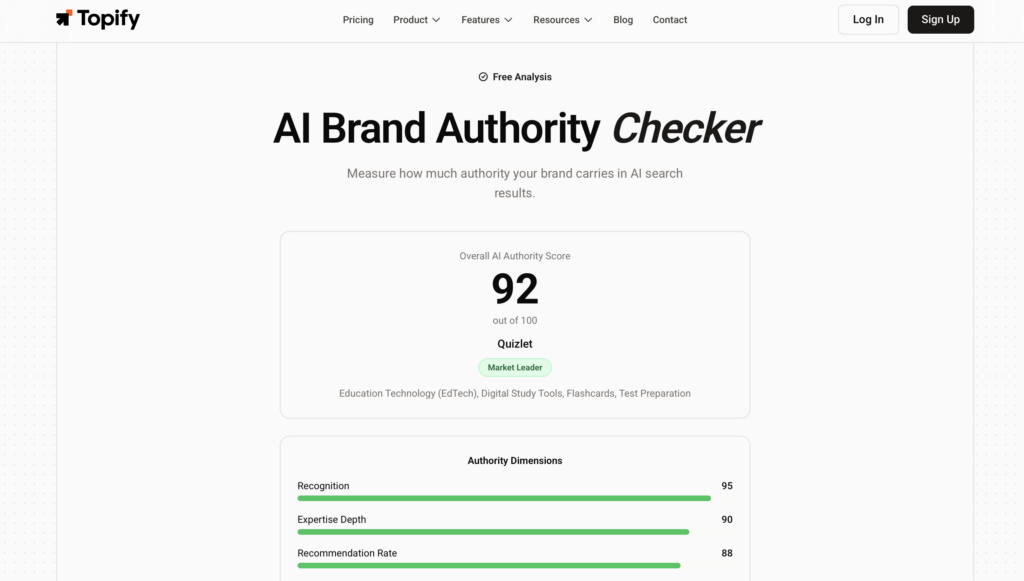
The gap is measurable, and the check takes 60 seconds. Topify‘s Brand Authority Checker scores how AI models perceive your EdTech brand’s authority across four dimensions: recognition, expertise depth, recommendation rate, and trust signals. Each one maps directly to whether AI recommends you or skips you entirely.
✅ Free ⚡ Results in 60 seconds
AI Brand Authority Checker
The Four Scores That Tell You If AI Trusts Your EdTech Brand
Every time an educator, parent, or procurement officer asks an AI model for a recommendation, the model makes a split-second judgment about which brands to surface. That judgment isn’t based on your Google ranking or ad spend. It’s based on authority signals the model has absorbed from training data, web structure, and third-party references.
The Brand Authority Checker breaks that judgment into four scores. Here’s what each one means for EdTech.
Each Metric, Translated for Education Technology
| Metric | What It Measures | What It Means for EdTech Brands |
|---|---|---|
| Recognition (0-100) | How often AI identifies your brand in your category | Below 40: AI doesn’t associate you with your product category when educators ask “best [tool type]” questions |
| Expertise Depth (0-100) | How well AI understands your capabilities | Below 50: AI may describe your platform’s features incorrectly or omit key differentiators like adaptive learning or LMS integrations |
| Recommendation Rate (0-100) | How often AI recommends you vs. alternatives | Below 30: you’re invisible in the consideration set before an RFP even gets written |
| Trust Signals (0-100) | External validation AI detects (research, reviews, media) | Below 40: AI can’t find enough third-party evidence to back up a recommendation |
An EdTech brand with a Recognition score of 80 but a Trust Signals score of 25 has a specific problem: AI knows who you are, but won’t vouch for you. That’s the difference between appearing in a response and being recommended in one.
What Your Scores Reveal About Your EdTech Brand’s AI Position
Here’s what these scores look like when they hit real EdTech scenarios.
Scenario 1: High recognition, low expertise depth. AI mentions your brand in answers about “online learning platforms” but describes you as a generic course marketplace. Your adaptive learning engine, your standards-aligned content library, your AI tutor feature: none of it shows up. The model has heard of you but doesn’t understand what you actually do.
Scenario 2: Strong expertise depth, weak recommendation rate. AI accurately describes your features when asked directly, but never surfaces your brand in “best of” or comparison responses. You’re known but not preferred. This often means AI has found stronger trust signals for your competitors.
Scenario 3: Low trust signals across the board. Your brand has thin external coverage: few third-party reviews, limited media mentions, no research citations. AI treats you as unverified. In EdTech, where procurement committees check multiple sources before shortlisting, this is a dealbreaker.
How to Run Your Check
Go to Brand Authority Checker, enter your brand name or domain, and get your four-dimensional authority breakdown in under 60 seconds. No signup, no credit card, no email required. The output gives you a specific starting point for every dimension, not a vague “improve your SEO” directive.
EdTech Buyers Are Asking AI. Your Brand Isn’t in the Answer.
The shift isn’t coming. It’s already here. Half of prospective graduate students now use AI tools weekly to research education programs and platforms. 82% are more likely to consider programs and tools that appear in their first search results. When AI is the first search, first results mean AI’s answer.
Here’s what these searches actually look like:
| AI Prompt Example | Platform | Search Intent | What It Reveals |
|---|---|---|---|
| “Best AI tutoring app for high school students” | ChatGPT | Purchase decision | Whether your brand gets recommended to parents and students |
| “Which LMS has the best FERPA compliance?” | Perplexity | Trust verification | How AI evaluates your compliance and security posture |
| “Top EdTech tools for personalized learning 2026” | Gemini | Competitive research | Where you rank against alternatives in AI’s mental model |
| “Is [your brand] good for K-12 districts?” | ChatGPT | Brand validation | What AI says about you when someone checks your name directly |
| “Affordable online learning platforms for workforce training” | Google AI Overview | Budget evaluation | Whether you appear in cost-conscious buyer searches |
| “Best alternatives to [competitor category]” | Perplexity | Switching intent | Whether AI positions you as a viable replacement option |
The pattern is consistent: when AI doesn’t recognize your brand’s authority in a category, you don’t appear in these answers. And 69% of Google searches now end without a click, with AI Overviews reducing clicks to the top-ranking page by 58%. If you’re not in the AI answer, there’s no second chance to be found through organic results.
The Chegg Collapse, the Trust Gap, and the Technical Debt Most EdTech Brands Don’t Know They Have
The Chegg warning is not hypothetical. Chegg’s entire business model depended on Google SEO routing students to paywalled homework help. ChatGPT delivered the same answers for free, and Google AI Overviews captured search intent before any click happened. The result: non-subscriber traffic dropped 49% year-over-year. Chegg cut 22% of staff in May 2025 and another 45% in October 2025. Over 636 positions gone in twelve months.
Any EdTech company that relies on Google search traffic to fill its funnel is exposed to the same structural risk. The question isn’t whether AI will disrupt your acquisition channel. It’s whether you’ve measured how much it already has.
Most EdTech brands don’t track the metrics that actually determine AI visibility. Recognition, expertise depth, recommendation rate, trust signals: these four dimensions are quantifiable. But the majority of EdTech companies monitor none of them. They track Google rankings, domain authority, and backlinks. Those metrics don’t tell you whether ChatGPT recommends you when a district IT director asks for options.
Here’s the thing. The 5W EdTech AI Visibility Index tracked 60+ prompts across ChatGPT, Claude, Perplexity, and Google AI Overviews in Q1 2026. The top brands (Khanmigo, Duolingo, Coursera, MagicSchool) dominate citation share. Dozens of established brands, including Codecademy, edX, Skillshare, and Quizlet, fall into the long tail with minimal or zero citation presence. Brand age and user count don’t guarantee AI visibility.
The technical foundation matters more than most EdTech marketers realize. Content with statistics, citations, and quotations achieves 30-40% higher visibility in AI responses. Pages updated within 60 days earn 28% more citations than older content. Websites with author schema are 3x more likely to appear in AI answers. And 80% of URLs cited by AI models don’t even rank in Google’s top 100 for the same query. That last data point is critical: traditional SEO rankings are not predictive of AI citation behavior.
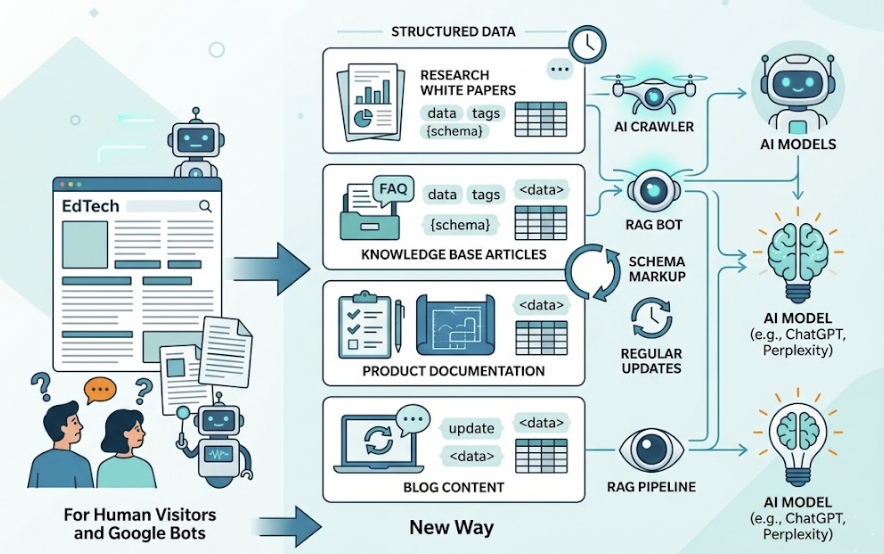
For EdTech brands, this means your knowledge base articles, your research white papers, your product documentation, and your blog content all need structured data, regular updates, and schema markup to be readable by AI crawlers. Most EdTech websites were built for human visitors and Google bots, not for the retrieval-augmented generation pipelines that power ChatGPT and Perplexity.
From a One-Time Score to Continuous AI Visibility Tracking
Your Brand Authority Checker results give you a clear snapshot of where you stand today. But AI models update their training data, adjust ranking signals, and shift recommendations continuously. A Recognition score of 75 today could drop to 50 next quarter after a model update, without any change on your end.
Topify‘s Comprehensive GEO Analytics dashboard tracks your authority, sentiment, and visibility scores across ChatGPT, Perplexity, Gemini, and Google AI Overviews on a continuous basis. You’ll see trend lines, get alerts when scores shift, and receive specific recommendations for what to fix. For EdTech brands managing long procurement cycles, this means you can catch a visibility drop before it costs you a district deal.
Here’s how the free check compares to the full platform:
| Capability | Free Brand Authority Checker | Topify Platform |
|---|---|---|
| Check frequency | One-time snapshot | Continuous daily/weekly monitoring |
| AI platforms covered | Aggregated score | Per-platform breakdown (ChatGPT, Perplexity, Gemini, AI Overviews) |
| Historical trends | None | Full trend history with alerts |
| Competitor tracking | Not included | Real-time benchmarking against EdTech competitors |
| Action recommendations | General direction | Specific, data-driven optimization steps |
| Team collaboration | Single user | Share dashboards with marketing, product, and leadership |
Every plan starts with a 7-day free trial, no credit card required. The Starter plan begins at $99/month.
Conclusion
AI search is already the first filter EdTech buyers use. If your brand doesn’t pass the authority check that AI models run silently on every query, you don’t get recommended. And in a category where procurement decisions take months and involve multiple stakeholders, being invisible at any stage of that process means losing deals you never knew existed.
Start with the data. Run your brand through the Brand Authority Checker and see exactly where AI positions you across recognition, expertise, recommendation rate, and trust signals. From there, you’ll know whether the problem is awareness, credibility, technical access, or all three.
While you’re assessing your brand authority, a few other free checks can round out the picture. Topify’s GEO Score Checker evaluates whether AI crawlers can actually access and parse your site. The AI Visibility Report shows how often your brand gets mentioned across major AI platforms. And the Prompts Researcher reveals the exact questions educators, parents, and administrators are asking AI in your category.
FAQ
Is the Brand Authority Checker free? Do I need to sign up?
Yes, it’s completely free. No account, no email, no credit card required. Enter your brand name or domain, and you’ll get your four-dimension authority score in under 60 seconds.
What’s the difference between the free tool and the Topify platform?
The free Brand Authority Checker gives you a one-time snapshot of your current authority scores. The Topify platformprovides continuous monitoring across all major AI platforms, historical trend data, competitor benchmarking, and actionable optimization recommendations. Think of the free tool as a diagnostic and the platform as an ongoing treatment plan.
How often should EdTech brands check their AI visibility?
At minimum, monthly. AI models update their training data and ranking signals regularly, and EdTech is a category where new tools and platforms launch frequently. If you’re in the middle of a major product launch, a rebranding, or a content push, checking weekly is worth the investment.
Why does my EdTech brand rank well on Google but not get recommended by AI?
Google rankings and AI recommendations use different signals. 80% of URLs cited by AI models don’t rank in Google’s top 100 for the same query. AI models prioritize structured data, content freshness, third-party validation, and entity recognition over traditional SEO factors like backlinks and keyword density. The Brand Authority Checker can show you exactly which authority signals you’re missing.

