

An institutional investor typed into Perplexity: “Top commercial real estate firms for industrial acquisitions in the Southeast.” Your brokerage closed $2.1 billion in industrial deals last year. You weren’t in the answer. The investor never called.
The problem isn’t your deal record. It’s that AI’s information about your firm is stale.
There’s a way to find out exactly how outdated it is. Topify‘s Knowledge Freshness Checker scans what AI models currently know about your CRE brand and flags every piece of information that’s behind the curve, from old portfolio descriptions to discontinued service lines.
✅ Free ⚡ Freshness audit in 60 seconds
Knowledge Freshness Checker
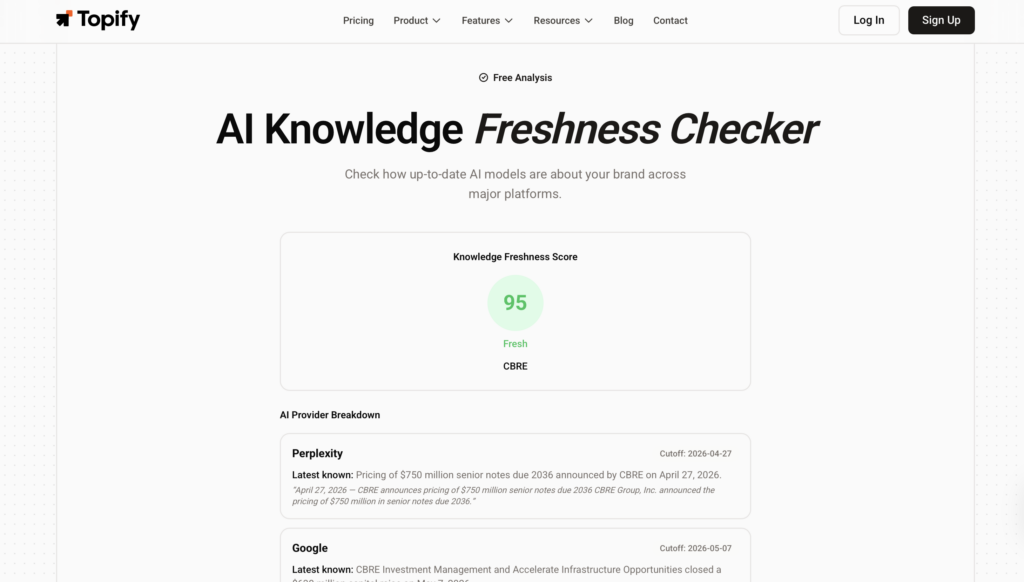
What the Knowledge Freshness Checker Reveals About Your CRE Brand
The tool doesn’t just tell you whether AI knows your name. It tells you whether AI knows the right version of your name.
The Freshness Dimensions, Decoded for CRE
Each dimension of the freshness audit maps to a specific risk that CRE firms face when AI models rely on outdated training data.
| Freshness Dimension | What It Checks | What It Means for CRE Brands |
|---|---|---|
| Brand Description Accuracy | Whether AI’s summary of your firm matches your current positioning | If your firm pivoted from retail to industrial 18 months ago, AI may still describe you as a retail specialist |
| Service Line Currency | Whether AI lists your current capabilities | A development firm that added debt advisory in 2025 might not show that service in AI answers |
| Market Focus Accuracy | Whether AI associates you with your active markets | If you exited the Denver office market last year, AI may still recommend you for Denver deals |
| Leadership and Team Data | Whether AI references current leadership | A new CEO or managing director won’t appear in AI recommendations if the model’s data is stale |
| Recent Activity Recognition | Whether AI reflects your recent deals, publications, or thought leadership | Closed a landmark deal last quarter? AI may not know about it yet |
A CRE firm that scores well on Brand Description Accuracy but poorly on Recent Activity Recognition has a specific problem: AI knows who you were, but not who you are now. That’s the kind of gap that sends investor inquiries to your competitors.
Three Scenarios Where Stale AI Data Costs CRE Firms Deals
Scenario 1: The ghost portfolio. A multifamily investor asks ChatGPT to recommend asset managers with experience in Class A multifamily in the Sun Belt. Your firm manages 12,000 units across six Sun Belt markets. But AI’s training data still references a portfolio you divested two years ago, and it misses the 4,000 units you acquired since. You don’t appear in the recommendation.
Scenario 2: The wrong specialization. A developer searching Perplexity for “CRE brokers specializing in life sciences lab space” gets a list that doesn’t include your firm. You launched a dedicated life sciences practice 14 months ago. AI still categorizes you under general office leasing.
Scenario 3: The outdated market narrative. An LP asks Gemini about top CRE investment firms in logistics and warehousing. AI references your firm’s 2023 market outlook, not your 2025 report that identified cold storage as a major growth vertical. The LP sees a firm that’s behind the curve, not ahead of it.
Each of these scenarios is detectable. And each starts with running a single check.
How to Run Your CRE Brand’s Freshness Audit
The process takes less than a minute. Go to the Knowledge Freshness Checker, enter your firm name or domain, and get your freshness breakdown. No signup required, no credit card, no strings. You’ll see exactly where AI’s version of your brand has fallen behind reality.
The AI Blind Spots Costing CRE Firms Leads and Deals
CRE buyers, investors, and tenants are asking AI questions that directly influence where capital flows. Here’s what those queries look like across platforms.
| AI Prompt Example | Platform | Search Intent | What It Reveals About Your Visibility |
|---|---|---|---|
| “Best CRE firms for NNN lease investments” | ChatGPT | Investment decision | Whether AI recommends your firm for your core product type |
| “Top property management companies for Class A office” | Perplexity | Vendor selection | Whether AI associates you with premium asset classes |
| “What’s the average cap rate for industrial in [metro]?” | Gemini | Market research | Whether AI cites your market reports or your competitor’s |
| “Commercial real estate firms specializing in 1031 exchange” | ChatGPT | Tax strategy | Whether AI connects your advisory capabilities to buyer-side tax needs |
| “Best markets for multifamily investment 2026” | Google AI Overview | Capital allocation | Whether AI surfaces your thought leadership when LPs are deciding where to deploy |
The data behind this shift is hard to ignore. A joint report by 5WPR and Haute Residence found that real estate ranks last among all industries in AI search visibility. 82% of agents use AI daily, but almost none are optimizing to be found by AI. That’s a disconnect with real financial consequences.
The buyer discovery path has already shifted. The same report documents a new five-stage funnel: AI query, AI synthesis, click-through, agent contact, tour and offer. CRE firms that aren’t visible in step one don’t exist in step two through five.
Research from Starmorph shows AI referral traffic grew 527% year-over-year in 2025 and converts at 4.4 to 5x the rate of traditional organic search. The volume is still smaller than Google, but the intent is sharper. When someone asks ChatGPT for a CRE firm recommendation, they’re closer to a transaction than someone browsing a directory.
CRE Firms Spend Millions on AI Adoption but Zero on AI Visibility
Here’s the thing. 76% of CRE firms are exploring or implementing AI, according to Deloitte’s 2026 CRE Outlook. That spending goes toward lease abstraction, underwriting automation, deal pipeline management, and property operations. 92% of commercial real estate occupiers and investors have started or plan to start AI pilots.
Almost none of that investment addresses a basic question: when a buyer, investor, or tenant asks an AI search engine about your market, does AI know who you are?
The asymmetry is striking. Firms deploy AI internally to gain an edge in operations, but they’re invisible to the AI systems their clients use to find them. A brokerage using AI to generate lease abstracts in minutes still loses the deal if the investor never discovered them in the first place, because Perplexity recommended a competitor instead.
The Knowledge Freshness Checker makes this asymmetry visible. If AI’s description of your firm references a fund you closed two years ago, a market you’ve exited, or a service line you’ve sunset, you now have a specific data point to act on.
CRE’s Knowledge Freshness Problem Is Structural, Not Incidental
Most industries have a knowledge freshness challenge with AI. CRE has it worse.
The reason is structural. CRE information lives in places AI crawlers struggle to reach: proprietary databases like CoStar, password-protected deal rooms, PDF-based offering memorandums, and fragmented MLS systems. Unlike SaaS companies that publish pricing pages and feature updates on their website, CRE firms store their most valuable information behind walls that AI can’t penetrate.
That creates a compounding problem. When AI models update, they pull from what’s publicly available. For a CRE brokerage, that often means a two-year-old press release, an outdated LinkedIn company page, or a third-party directory listing that hasn’t been refreshed since 2024. The result: AI’s portrait of your firm drifts further from reality with each update cycle.
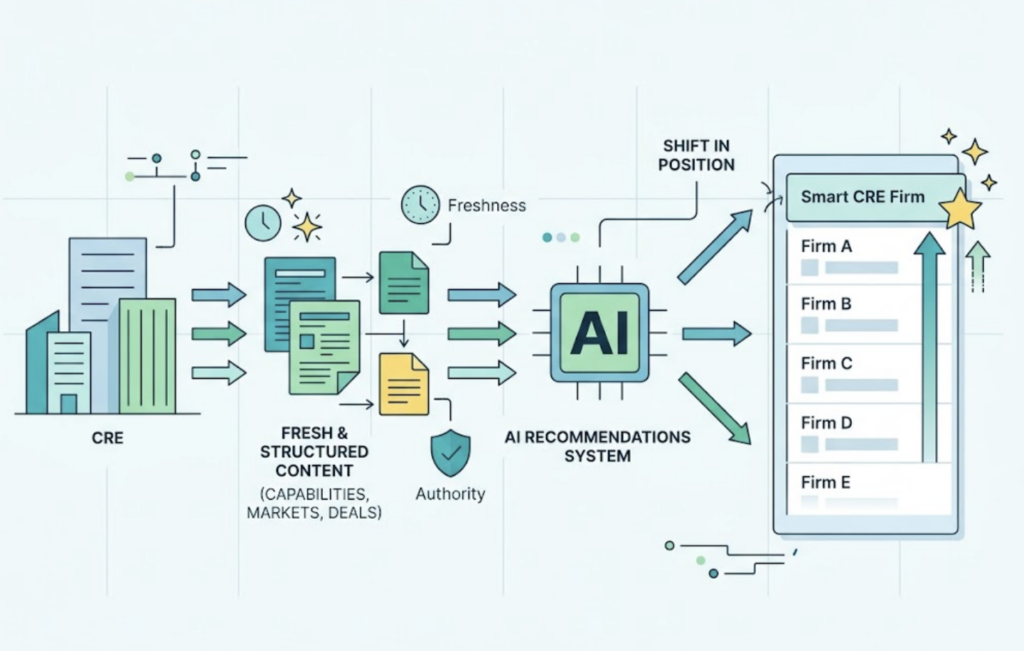
On the flip side, this structural gap creates an opportunity. CRE firms that publish structured, crawlable content about their current capabilities, markets, and deal activity are building a moat. AI systems favor fresh, authoritative sources. In an industry where most firms give AI nothing current to work with, even basic freshness improvements can shift your position in AI recommendations.
Research on AI citations backs this up. By February 2026, only 38% of AI-cited URLs came from the organic top 10 in Google, down from 76% in July 2025. AI is actively seeking out authoritative content from across the entire web, not just repeating what ranks first on Google. A mid-size CRE firm with fresh, well-structured content can win AI citations without dominating traditional search rankings.
Start by checking what AI currently knows. The Knowledge Freshness Checker shows you the gap between your firm’s reality and AI’s perception. That gap is your action plan.
From a One-Time Freshness Audit to Continuous AI Visibility
Your Knowledge Freshness Checker results give you a snapshot. But AI models don’t stand still. They update training data, adjust citation signals, and shift recommendations on a rolling basis. A freshness score that looks acceptable today could deteriorate next quarter without any change on your end.
Topify‘s platform picks up where the free tool leaves off. The Reverse-Engineer AI Citations feature goes deeper: it identifies the specific sources AI models are pulling from when they describe your firm, flags citation gaps, and shows you exactly which content needs updating to keep your AI profile current.
Here’s how the free check compares to the full platform:
| Capability | Free Knowledge Freshness Checker | Topify Platform |
|---|---|---|
| Check frequency | One-time snapshot | Continuous daily/weekly monitoring |
| AI platforms covered | Aggregated freshness score | Per-platform breakdown (ChatGPT, Perplexity, Gemini, AI Overviews) |
| Historical trends | None | Full trend history with alerts |
| Citation source analysis | Not included | Identifies exact sources AI cites about your brand |
| Competitor tracking | Not included | Real-time competitor benchmarking |
| Action recommendations | General freshness flags | Specific content update priorities |
Every plan starts with a 7-day free trial, no credit card required. The Starter plan begins at $99/month.
Conclusion
CRE firms are spending heavily on AI to optimize internal operations. The firms that pull ahead will be the ones that also optimize for how AI sees them from the outside. When an investor, tenant, or LP asks an AI search engine about your market, the answer is only as good as the data AI has about you. If that data is stale, you’re losing deals you never knew existed.
Start with the free Knowledge Freshness Checker to see exactly where AI’s version of your firm has fallen behind. Then build a strategy to keep it current.
While you’re assessing your freshness, a few other free checks can round out the picture. Topify’s AI Visibility Reportshows how often your CRE brand gets mentioned across major AI platforms. The Brand Authority Checker scores how AI models perceive your firm’s expertise and trustworthiness. And the Competitor Analysis tool reveals which firms AI recommends instead of yours, and why.
FAQ
Is the Knowledge Freshness Checker really free? Do I need to create an account?
Yes, it’s completely free. No account, no signup, no credit card. Enter your brand name or domain and get your results in under 60 seconds.
What’s the difference between the free tool and Topify’s paid platform?
The free tool gives you a one-time freshness snapshot. Topify’s platform provides continuous monitoring across ChatGPT, Perplexity, Gemini, and Google AI Overviews, with historical trends, citation source analysis, competitor benchmarking, and specific action recommendations. Plans start at $99/month with a 7-day free trial.
How often should a CRE firm check its AI visibility?
AI models update regularly, and CRE data changes faster than most industries (new deals, market shifts, personnel changes). A quarterly manual check with the free tool is a minimum. For firms actively marketing to investors or tenants, continuous monitoring through a platform provides the most reliable signal.
Why does CRE have a bigger AI freshness problem than other industries?
CRE data is disproportionately locked behind proprietary databases, PDF deal documents, and password-protected platforms. AI crawlers can’t easily access or update this information, so AI’s knowledge about CRE firms degrades faster than in industries where information is more publicly available.

