
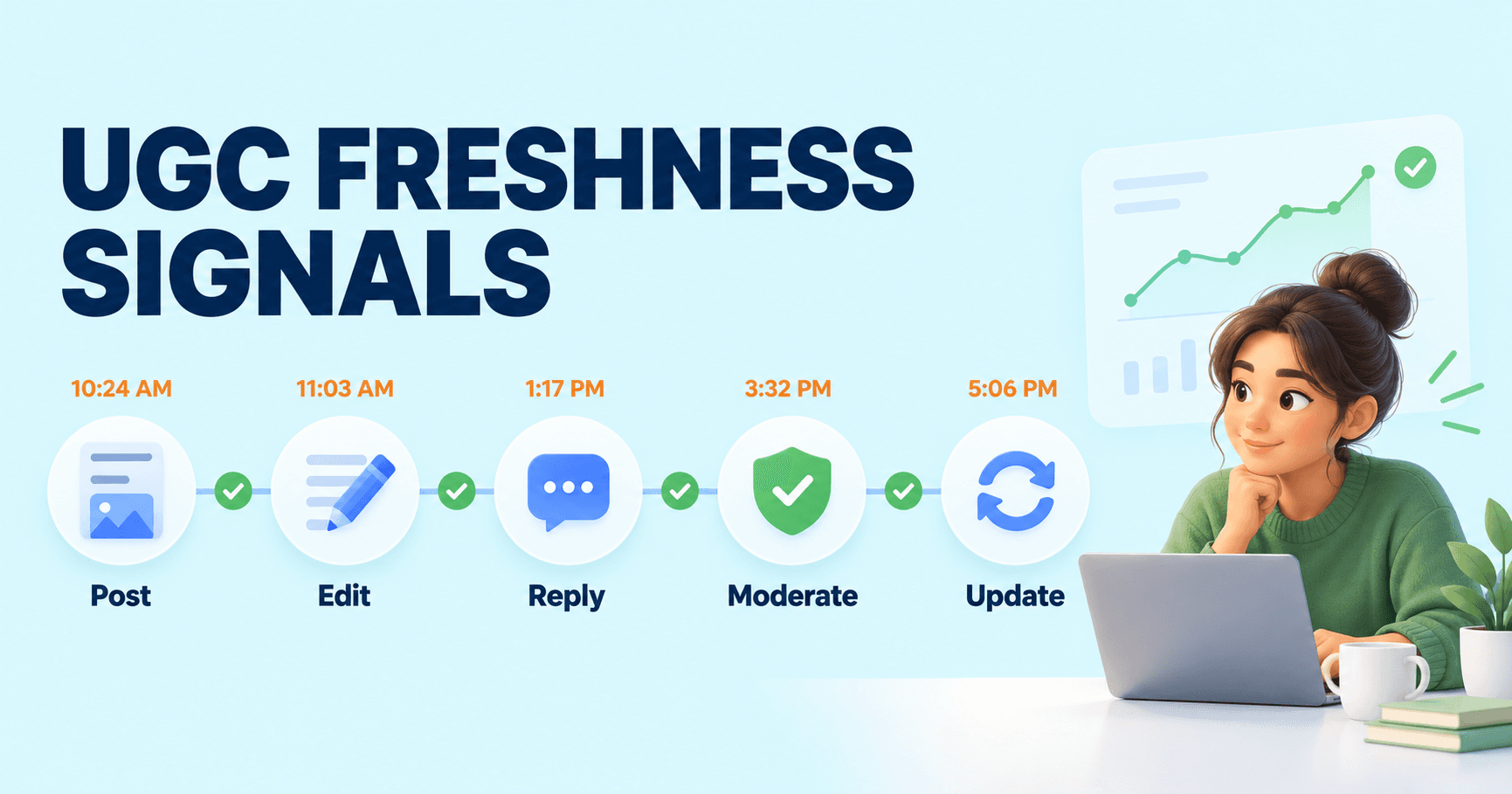
A community manager finds an outdated answer still circulating after the original author corrected it. The thread URL is stable and the new text is public, but engagement counts, structured data, search snippets, and AI citations continue to reflect different moments in the conversation.
The problem is not simply crawl speed. User-generated content changes through posts, edits, replies, votes, moderation, and deletion, and each event carries a different urgency and trust requirement. A useful UGC freshness signals workflow keeps those states synchronized without treating the newest or most popular version as automatically reliable.
UGC Freshness Signals Are Useful Only When the State Is Trustworthy
Freshness describes how closely a published representation matches the current source state. It does not mean that recent content is accurate, safe, or important.
For UGC, the source state includes more than text. A thread may be public, edited, disputed, locked, deleted, or restored. Its creator profile may be active or suspended. Interaction counts may be genuine, delayed, or manipulated.
Define freshness across four layers:
- Content state: current post and comment text, attachments, and timestamps.
- Interaction state: supported likes, dislikes, replies, views, and shares.
- Trust state: moderation, reports, restrictions, deletions, and appeals.
- Discovery state: crawlability, canonical URL, structured data, feed status, and downstream representations.
A workflow fails when one layer moves and the others do not. For example, deleting harmful content from the page while leaving it in a feed creates a fresh moderation action but a stale discovery state.
Map the Events That Make a Thread Change Meaningfully
Start with an event inventory rather than a generic “last updated” field. Each event should identify what changed, which downstream systems need the change, and whether it can wait.
| Event | Meaning | Urgency | Downstream action |
|---|---|---|---|
| Post created | New public item exists | Minutes after safety checks | Publish page, schema, sitemap or eligible feed event |
| Material edit | Claim or context changed | Minutes to hours | Update visible page, dateModified, feed payload, caches |
| Reply added | Discussion gained new context | Minutes to hours | Add comment state and supported counters |
| Vote or view changed | Engagement changed | Batch within defined window | Refresh supported interaction statistics |
| Post deleted | Content should no longer be presented as active | Urgent | Remove or mark deleted, update feeds and caches |
| Moderator lock | Conversation state changed | Urgent for abuse cases | Show lock state, stop new replies, retain needed context |
| Profile suspended | Creator trust state changed | Risk-based | Apply policy without inventing identity claims |
| URL or thread merge | Canonical relationship changed | Urgent | Redirect or canonicalize, preserve thread references |
Do not assign the same service level to every counter update and every legal removal. The event model should encode consequence.
Keep the event payload small but traceable. Include a stable object identifier, version, event time, source-of-truth timestamp, moderation state, and affected URL. Idempotent processing prevents duplicates when a queue retries.
Choose Update Latency by Event Risk
Google’s UGC Fresh Data Program offers a useful benchmark for qualified platforms: fresh content should ideally be submitted within minutes, while engagement counters should receive regular updates within 72 hours of creation.
That does not mean every platform or channel uses the same requirement. It demonstrates that content and interaction state can have different timing expectations.
Create service levels by risk:
- Immediate: illegal content removal, privacy action, credential exposure, dangerous misinformation, and incorrect access state.
- Near real time: new public posts, material edits, thread moves, and corrections with active discovery demand.
- Scheduled batch: interaction counters, low-risk profile statistics, and aggregation updates.
- Manual hold: suspected manipulation, contested identity, unresolved legal request, or failed moderation review.
Measure the oldest unprocessed event, not only average latency. A system can report a healthy average while one high-risk deletion remains stuck for hours.

Keep Stable URLs While the Conversation Evolves
Stable URLs give search systems, users, moderators, and internal tools one durable reference. The content behind that reference can change without creating a new URL for every edit.
Use version history internally and, where appropriate, show readers that a post was edited. Preserve the canonical thread relationship when pages are paginated, filtered, translated, or merged.
Deletion needs a deliberate policy. Removing all context can break a discussion and leave replies unintelligible. Keeping the full deleted text can violate the user’s rights or moderation decision. Google’s DiscussionForumPosting documentation supports a creativeWorkStatus of Deleted when a removed post must remain represented for threading context.
Choose the smallest retained representation that preserves necessary structure. That may be a tombstone such as “post removed,” a timestamp, and a stable identifier, without the original content.
Avoid changing the canonical URL simply to signal freshness. Dates in a URL make maintenance harder and can split citations across versions. Use content state, visible timestamps, sitemaps, feeds, and supported markup instead.
Treat Creator Attribution as a Data Contract
Creator attribution connects content with an accountable public profile. It should remain stable enough for systems to distinguish contributors, while respecting privacy and the platform’s identity policy.
Use an internal creator identifier and a durable public profile URL. Display names can change, so do not use the visible name alone as the key. When a profile is removed or suspended, update the public relationship consistently across threads, markup, and feeds.
Google’s forum schema guidance recommends author.url as a unique link to the author’s profile. The UGC Fresh Data Program also requires submitted UGC to be attributable to a creator with a public profile.
Do not expose private email addresses, phone numbers, legal names, or internal trust scores as part of attribution. A public profile is a platform identity, not an invitation to publish sensitive account data.
Document how renamed, deleted, memorialized, banned, and merged accounts affect historical posts. Inconsistency here can create false authorship signals.
Prevent Engagement Metrics From Becoming Spam Signals
Interaction statistics help represent community activity, but raw counts can be manipulated. A freshness pipeline that updates counters quickly without trust controls may distribute a misleading picture faster.
Separate raw events from trusted public counters. Apply deduplication, rate limits, bot detection, abuse investigations, and delayed confirmation where the threat model requires them.
Use only interaction types supported by the destination schema or feed. Google’s current DiscussionForumPosting guidance lists likes, dislikes, views, comments or replies, and, for comments, shares among supported interaction types. Do not invent a property mapping because two metrics sound similar.
Keep the visible count, structured data, and feed value synchronized from the same trusted aggregate. When they disagree, users and machines receive conflicting authority cues.
Popularity is not quality. A controversial or manipulated thread can accumulate more engagement than a careful answer.
Monitor Freshness Gaps in Search and AI Answers
Build a small set of current-state assertions for monitoring. Examples include a corrected product fact, an active policy, a current availability statement, and the canonical source URL.
Check the page, structured data, eligible feed output, search result, and representative AI answer separately. Record when each layer reflects the new state. Different systems update on different schedules, so do not mark a pipeline failure before confirming the documented processing window.
Topify provides a Knowledge Freshness Checker that can help identify whether selected AI platforms reflect current brand facts. Citation analysis can also reveal which public URLs are supplying an answer. Use these as investigation signals, not as a universal measure of the UGC pipeline.
When a stale answer persists, examine:
- whether the current page is crawlable and canonical;
- whether deleted or old URLs still resolve without clear redirects;
- whether schema or feed data remains stale;
- whether third-party pages repeat the earlier claim;
- whether the answer system has refreshed its source set;
- whether the prompt actually asks for the current state.

Conclusion
UGC freshness signals work only when content, interactions, trust state, and discovery outputs move together. A recent timestamp cannot compensate for a stale deletion, manipulated counter, broken author relationship, or feed that disagrees with the public page.
Map meaningful events, assign latency by consequence, keep stable URLs, preserve privacy-aware attribution, and build trusted aggregates before sending engagement updates downstream. Then monitor each representation separately and investigate stale answers through evidence rather than guesswork. Review the oldest failed event as carefully as the average processing time. The result is not merely faster distribution. It is a community state that remains understandable and defensible as the conversation changes.
FAQ
What are UGC freshness signals?
They are changes that describe the current state of user content, including creation, edits, replies, interaction counts, moderation actions, deletion, attribution, and discovery availability.
How often should engagement counts be updated?
The cadence depends on the destination. Google’s UGC Fresh Data Program expects regular updates within 72 hours of creation, while urgent content and moderation events may need much faster handling.
Do edits reset content freshness?
An edit should update the content version and dateModified when supported, but it should not automatically be treated as a new post or erase the original publication context.
How do moderation actions affect search visibility?
Moderation can change whether content remains public, active, restricted, deleted, or available to crawlers. Pages, markup, feeds, and caches should reflect the same decision.