
A forum operator watches a first-hand product report spread across the community within minutes. By the time ordinary crawling processes the thread, the original post has gained hundreds of replies, several details have been corrected, and a moderator has removed a misleading claim. Search may encounter an incomplete snapshot of a conversation that is already different.
The Google UGC Fresh Data Program creates a dedicated ingestion path for qualified platforms to send trending user-generated content and interaction updates. It is not a faster Indexing API, an open feed for any publisher, or a guarantee of visibility. Before applying, a platform needs to test its content model, technical capacity, moderation health, and ability to deliver trustworthy updates on a demanding schedule.
The Google UGC Fresh Data Program Speeds Ingestion but Does Not Guarantee Visibility
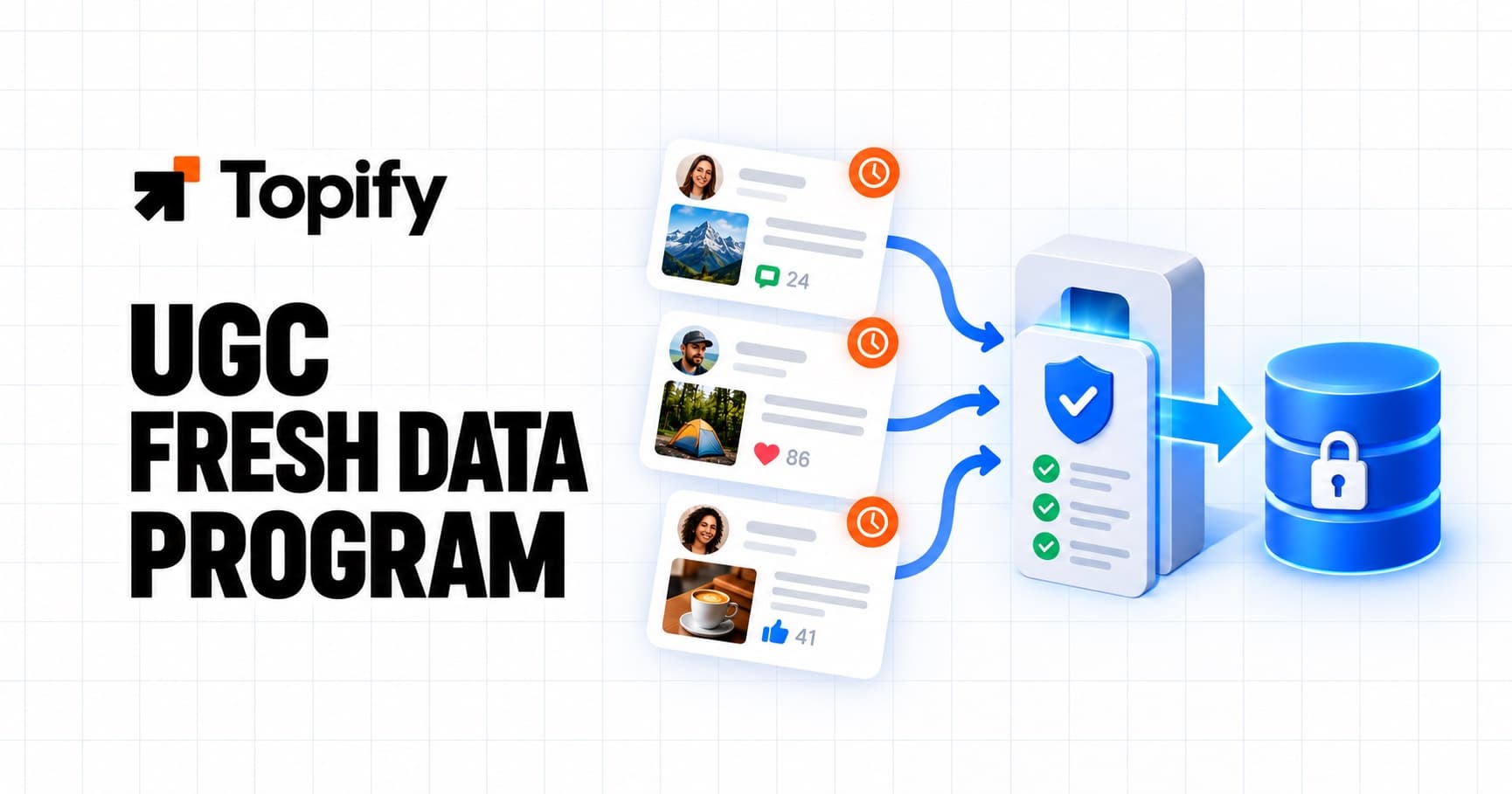
Google describes the UGC Fresh Data Program as a specialized pipeline for fresh, high-quality, authentic user-generated content. Approved platforms can send content and interaction signals proactively rather than relying only on traditional crawling.
The documented boundary is just as important: the program is independent of the Google Indexing API and ordinary crawling, and participation does not guarantee that submitted content will appear in Search.
That means the business case should not be “join and rank faster.” A defensible case is narrower:
- reduce the delay between important UGC events and Google’s ability to process them;
- provide updated interaction and content state through a defined pipeline;
- create stronger operational controls around authorship, moderation, and freshness;
- measure whether eligible pages are discovered and represented more accurately over time.
Treat ingestion, indexing, ranking, feature selection, and user engagement as separate stages. The program addresses the first stage directly. Google still decides what to index and show.
Only UGC-First Platforms Fit the Eligibility Model
Eligibility begins with the platform’s primary purpose. Google says applicants should primarily host UGC, social posts, or forum discussions created by independent users rather than the platform itself.
The content must live on dedicated pages with stable URLs. A transient feed or profile page is not enough. The program also expects high UGC volume and a significant user base, though the public documentation does not publish numeric thresholds.
Use a candid self-assessment:
| Eligibility area | Evidence to collect | Likely blocker |
|---|---|---|
| Content focus | Share of pages and activity created by independent users | Publisher-authored library with a small comment section |
| Stable pages | Canonical, durable URL for each eligible post or thread | Content visible only in feeds, profiles, or ephemeral views |
| Volume and audience | Monthly post volume, active users, engagement distribution | Small or sporadic community without trending scale |
| Public access | Crawl tests without login, paywall, or session state | Gated community or private group content |
| Creator attribution | Public profile URL and accountable author identity | Anonymous content with no durable profile relationship |
| Technical readiness | OAuth 2.0, JSON-LD validation, event pipeline, monitoring | No secure feed architecture or schema coverage |
| Content health | Moderation policy, reporting, removal, escalation | No user reporting path or illegal-content response process |
Do not stretch the definition of UGC to fit. Product reviews have their own structured data rules, and publisher articles with comments are not automatically forum posts.
Public Access and Creator Attribution Are Non-Negotiable
The program requires submitted content to be available on public pages accessible to Googlebot and users. Login walls and paywalls make the content ineligible under the published criteria.
This requirement creates a governance decision for communities built around privacy. Do not weaken an appropriate access control merely to qualify. Instead, define whether a public subset can exist without exposing sensitive discussions or violating user expectations.
Each piece of UGC must also be attributable to a creator with a public profile. Attribution supports accountability and helps systems understand who contributed the material.
A public profile does not justify publishing private identity data. Use a stable platform identity, clear display name, profile URL, and content history that matches community policy. Keep private email addresses, legal names, and account-security details outside the public page and feed unless the user has chosen to publish them.

The Technical Lift Includes OAuth and Validated JSON-LD
Google’s public criteria require secure OAuth 2.0 authentication and strictly validated JSON-LD payloads. Applicants must already use, or be ready to implement, valid on-page schema.org markup across their URLs.
Examples include SocialMediaPosting and DiscussionForumPosting with interactionStatistic fields. The feed should not become a separate version of reality. Values in the payload, on-page markup, visible page, and internal source of truth need to agree.
Build a canonical event model before writing the integration. At minimum, distinguish:
- post created, edited, deleted, or restored;
- comment created, edited, deleted, or moderated;
- creator profile changed or suspended;
- supported interaction count changed;
- visibility changed from public to restricted;
- canonical URL or thread relationship changed.
Create idempotent processing so a retried event does not duplicate content or counters. Log payload version, event time, source record, response state, and retry decision without exposing access tokens.
Validate at three levels: schema syntax, business rules, and visible-page consistency. A payload can be valid JSON-LD while publishing an outdated count or pointing to a page that now requires login.
Freshness Means Minutes, Not the Next Crawl
Google says content should be sent as fresh as possible, ideally within minutes. It also expects regular engagement-counter updates within 72 hours of creation.
That standard changes architecture and staffing. A nightly export is unlikely to satisfy a minute-level content path, while a live stream without moderation controls can accelerate harmful or false material.
Set different service levels by event:
- publish events can enter the queue quickly after baseline safety checks;
- edits should replace or update the same stable item;
- deletions and legal removals need urgent propagation;
- interaction counters can be batched within the documented window;
- suspected manipulation may require a hold until trust checks finish.
Monitor end-to-end latency from database commit to accepted submission. Average latency can hide serious misses, so track percentiles, failures, and the oldest unprocessed event.
The fastest pipeline is not useful when it sends the wrong state.
Moderation Is Part of Search Readiness
The eligibility criteria require active moderation, a user-reporting mechanism, and controls against illegal content. Moderation is therefore not a policy appendix. It is part of the data-quality system.
The ingestion workflow should consume moderation state. Removed or quarantined content should not continue to appear as an ordinary active post in downstream payloads. Edited threads should preserve context without reviving deleted material.
Define the relationship among moderators, trust and safety, SEO, engineering, and legal teams. Each group owns a different failure mode, but the feed publishes one result.
Audit high-engagement anomalies before treating them as authority signals. Coordinated voting, spam replies, and automated accounts can make a low-quality thread appear important. Engagement counters are observations, not proof of quality.
Keep an appeals and correction path. Authentic UGC changes, and users need a way to fix mistakes without losing the continuity of the discussion.
Measure Citation and Discovery Changes Without Claiming Causality
Establish a baseline before the integration: crawl discovery time, index coverage, eligible feature appearances, search impressions, cited pages in representative AI answers, and the age of content when it first appears.
After launch, compare cohorts rather than selecting a few successful threads. Separate submitted content from non-submitted content where the program rules permit, and account for topic popularity, link acquisition, seasonality, and moderation events.
Topify can support an answer-level observation layer. Its Knowledge Freshness Checker focuses on whether AI systems reflect current brand events, while citation monitoring can help identify which public sources appear in selected answers. These tools do not expose Google’s ingestion decision or prove that program participation caused an inclusion.
Use cautious language:
- “Google accepted the payload” is an observed integration state.
- “The page appeared sooner after submission” is an observed timing relationship.
- “The program caused the page to rank” is unsupported without a design that isolates other causes.

Conclusion
The Google UGC Fresh Data Program is a specialized integration for qualified, high-volume UGC platforms, not a shortcut for ordinary publishers. The strongest candidates already have stable public pages, creator attribution, active moderation, structured data coverage, secure engineering capacity, and event-driven update systems.
Start with an eligibility and data-health audit. Confirm that the public-content decision is appropriate, define canonical events, connect moderation state to the feed, and measure latency without confusing ingestion with ranking. If those foundations are weak, an application is premature. If they are strong, the program can become a disciplined way to send fresher, more accurate community state while leaving Google’s indexing and selection decisions intact.
FAQ
What is Google’s UGC Fresh Data Program?
It is a dedicated ingestion program that lets approved UGC platforms send fresh public posts and interaction signals to Google through a specialized pipeline.
Who is eligible for the UGC Fresh Data Program?
Google lists UGC-first platforms with high content volume and a significant audience, stable public URLs, attributed creators, technical readiness, active moderation, and strong freshness capabilities.
Does the program replace Google crawling or the Indexing API?
No. Google says the program is independent of traditional crawling and the Indexing API. Participation also does not guarantee appearance in Search.
How quickly must UGC and engagement updates be submitted?
Google says fresh content should ideally be sent within minutes, and engagement counters should receive regular updates within 72 hours of creation.