A measurement lead compares two answer collections and sees fewer source links in the second batch. One colleague calls it a citation decline; another says the assistant probably didn’t search. Neither interpretation is supported by the spreadsheet, which records question text and brand mentions but leaves the collection mode unexplained.
A prompt tracking tool becomes more useful when search availability, visible search activity, and displayed citations occupy separate fields. Those fields answer different questions about how an observation was collected. Your next decision is whether the batches represent comparable conditions, require separate reporting, or need additional evidence before anyone explains the change to a client.
Define Search Activation in a Prompt Tracking Tool
Search activation is an observed event or a documented collection condition, depending on what your interface exposes. Define those two meanings separately. A setting that allows access to web search establishes an available capability; it doesn’t by itself document what happened during every response.
OpenAI’s current search guidance says ChatGPT may search automatically when current information would help, and describes selecting Search manually. That makes the collector’s selected mode relevant evidence. It still leaves a separate task: recording the visible activity and sources associated with the specific answer.
Use a synthetic example to clarify the distinction. A category question may receive a general response in one run and an answer with visible search activity in another. Before comparing brand presence, identify whether the collection record can establish a common search condition.
A source link isn’t a complete execution trace.
Avoid defining activation from your preferred outcome. A well-cited answer shouldn’t automatically be marked as a better search run, and an uncited answer shouldn’t automatically be classified as a collection failure. First record the evidence; interpret its relevance afterward.
Separate Available Tools From Observed Search Events
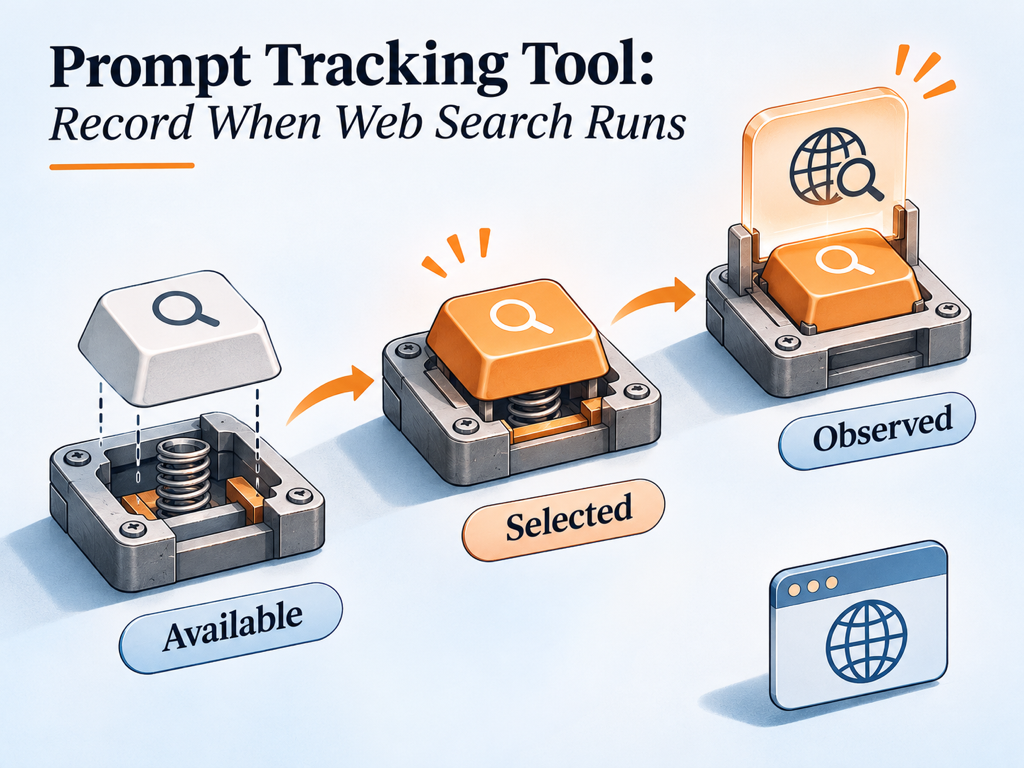
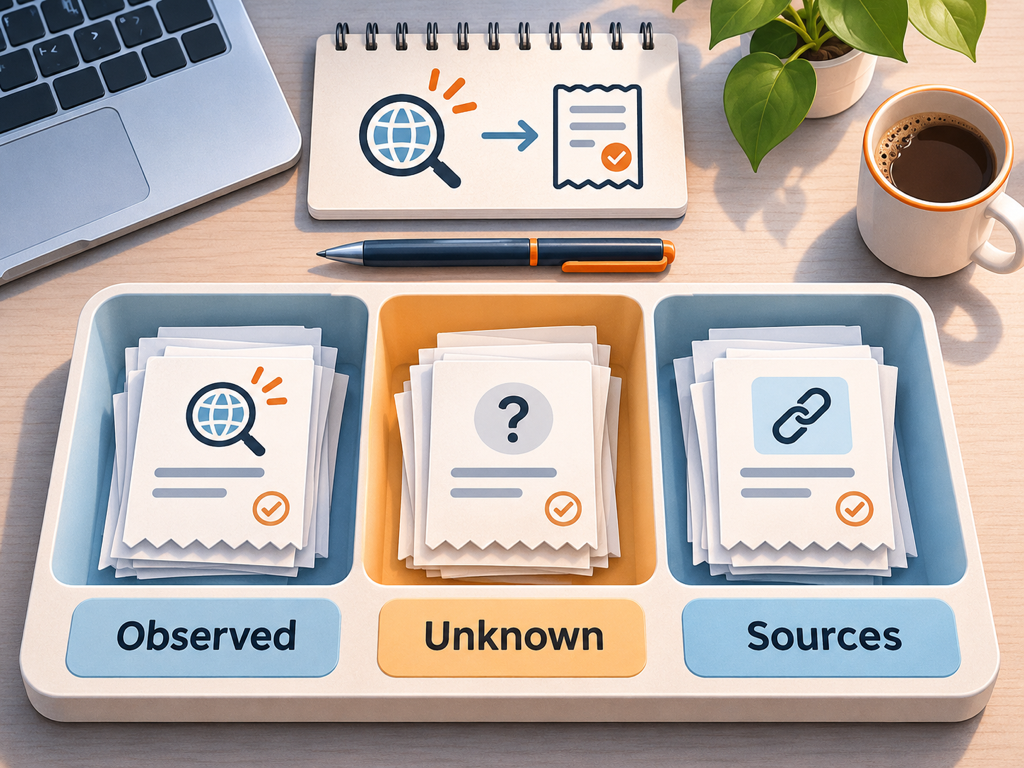
Create three fields: search available, search selected, and search observed. The available field describes the visible setup. The selected field records an explicit collector choice or an automatic mode; the observed field describes activity the interface actually exposed for the run.
Record citations separately from those fields. Citations can help a reviewer inspect linked sources, but their presence doesn’t demonstrate that every assertion in the answer was individually searched. Their absence also doesn’t establish that no retrieval happened behind an interface.
Keep the evidence rule interface-specific. A browser interface may expose activity differently from another client or collection method. Document the visible indicator your team accepts instead of treating a screenshot from one environment as proof of behavior everywhere.
| Record | Allowed observation | Reporting boundary |
|---|---|---|
| Search available | Tool or mode visible in setup | Capability was available |
| Search selected | Collector selected Search or automatic mode | Intended collection configuration |
| Search observed | Run-specific activity visibly recorded | Observed activity in that interface |
| Sources displayed | Answer includes inspectable source links | Links were displayed with the answer |
| Search unknown | Run-specific evidence unavailable | No conclusion about activation |
Keep contradictory observations rather than forcing them into one field. For instance, search selected and search activity unknown can coexist. That combination is a useful description of the record’s limitation, not an error to erase.
Build a Search Activation Record
Start with a stable run identifier that connects the question, answer, and collection conditions. Add timestamp and timezone, interface, visible model selection, question version, market or language, and conversation context. These fields give another analyst enough information to understand the observation without guessing from the answer’s style.
Then record the three search fields and the evidence supporting each. A short note such as visible search activity captured is more useful when paired with a stored screenshot or other permitted visible record. Don’t turn an analyst’s impression into a factual event label.
Preserve source links as displayed, including any passage fragments relevant to later review. Keep the raw answer beside the coded outcomes so a reviewer can distinguish a recommendation from a passing brand reference. A spreadsheet containing only a total mention count loses that distinction.
Set the evidence-retention procedure before collection. Use approved storage and avoid capturing unrelated account details in screenshots. The objective is to retain enough information to support the monitoring claim, rather than collecting every available piece of interface content.
Make the record practical enough to use consistently. Require the fields that determine comparability, offer an explicit unknown state, and identify the person responsible for resolving missing evidence. An elaborate schema that collectors skip creates less trustworthy data than a smaller completed one.
Compare Like Search Conditions
Group observations by the conditions relevant to the question you’re answering. A study of search-enabled recommendations should not silently combine those answers with results collected under an unverified mode. Conversely, a study of the broader user experience may deliberately include multiple conditions, provided the report explains the mixture.
Compare the same question family within a documented collection window. Language, conversation context, and model selection can also change the answer, so holding the search field constant doesn’t make every remaining difference irrelevant. Treat activation as one comparability dimension within the larger protocol.
A synthetic comparison illustrates the reporting choice. Suppose one batch contains twelve observed-search runs and another contains eight observed-search runs plus four unknowns. You can compare the observed subsets, but you must show the reduction in comparable coverage instead of presenting both as equivalent twelve-run samples.
Don’t simply discard unknowns and describe the result as complete. Exclusion can change which questions or interfaces remain in the analysis. Report the eligible count and explain whether the excluded observations cluster around particular conditions.
The team should also distinguish discovery from follow-up investigation. Asking an assistant to search again after an unsatisfactory answer creates a new observation with a different intervention. Keep it linked to the original run without overwriting what the initial collection showed.
Handle Unknown Search Status
Unknown is the appropriate state when the visible record cannot establish activation. It is not interchangeable with no search. Write that rule into the collection instructions so analysts don’t fill gaps differently according to their expectations.
Choose an explicit handling policy for the report. You can retain unknown observations as a separate group, exclude them from a narrowly defined comparison while disclosing coverage, or schedule a new collection with better evidence. The right choice depends on the business decision and the amount of information missing.
A repeat run supplements the original observation; it doesn’t reconstruct its hidden history. Save the original result and connect the replacement to it with a new identifier. Otherwise, your archive can make a later, better-documented answer look like evidence about an earlier event.
Uncertainty should survive aggregation.
For example, report that brand presence changed within the observed-search subset while activation remained unverified for part of the broader sample. That statement is less sweeping than a claim about all search answers, but it gives stakeholders a comparison they can actually inspect.
Use the distinction between citations and brand mentions as a separate coding reminder. Whether a source link appears and whether a brand is recommended remain different observations, even after the search condition has been documented.
Review Search Evidence Alongside Visibility Results
Topify describes monitoring brand visibility across AI answers and examining relevant prompts. Its prompt discovery workflow can help your team choose questions whose recommendations matter to a buying decision. Use that question set as the input to a focused review, then keep the manual activation register alongside the resulting observations.
The analyst’s action is to compare brand outcomes within documented collection conditions, rather than inferring a search event from a favorable citation pattern. The resulting decision might be to investigate a visibility gap, improve collection evidence, or separate incompatible batches. This is a combined workflow, not a claim that Topify exposes a complete execution trace for every interface. Verify which run-level fields your actual setup provides, and retain manual evidence for anything the product output doesn’t establish. A useful tool comparison should test that boundary explicitly before the team commits to a reporting promise.
Assign a reviewer to inspect a small sample before scaling collection. They should be able to find the answer, its condition record, and the evidence behind every activation label. Fix unclear field definitions at this stage, when correcting the protocol is easier than revising months of reporting.
Conclusion
A search setting, a visible search event, and a citation describe different parts of an answer collection. Keep them separate, use an explicit unknown state, and compare observations only within a documented scope. That gives your team a defensible explanation when source links or brand mentions change between batches.
Start with a small question family from your prompt discovery review and add the three activation fields to its collection record. Have another analyst inspect the evidence before expanding the workflow. The immediate success criterion is simple: a reader should be able to tell what was configured, what was observed, and what remains unverified without reverse-engineering the answer’s appearance.
FAQ
Does enabling web search prove that a search happened?
No. It records an available or selected capability. Preserve run-specific evidence separately when the interface exposes it.
Do citations prove that every statement was searched?
No. Displayed source links help readers inspect references, but they don’t establish a separate search event for every statement in the response.
How should an unknown search state be recorded?
Use an explicit unknown label with a reason. Keep it separate from observed absence and explain how those observations affect comparable coverage.
Can search-enabled and ungrounded answers be compared?
They can be studied as different collection conditions. Avoid silently treating them as interchangeable observations of one controlled process.