A marketing operations manager receives a promising buyer scenario from a sales call. It includes a named customer, a personal email address, an unusual migration deadline, and a budget that would help explain the recommendation. Copying the entire note into a monitoring workflow would preserve detail, but it would also submit information the test doesn’t need.
A prompt tracking tool should receive an approved scenario with a clear information boundary. The difficult part is preserving the constraints that change the buyer’s choice while removing details that identify the people or organization involved. Your team needs a review process that protects that distinction before the question becomes a reusable monitoring asset.
Set a Redaction Boundary for a Prompt Tracking Tool
Define the purpose of the test before editing the source note. A question about software suitable for a regional distributor may need operational scale and deployment requirements. It may not need the distributor’s name, an employee’s email, or a quotation from a confidential negotiation.
Treat redaction as a submission decision. The safest place to remove unnecessary detail is before it enters the destination workflow. This article proposes an operational editing method, rather than a legal determination that a particular prompt is anonymous or compliant.
Use synthetic scenarios when they can answer the same measurement question. You can describe a fictional buyer with an approved set of requirements without carrying a real customer’s history into the test. Document that choice so later analysts don’t mistake the scenario for observed market demand.
Removing a name doesn’t automatically remove identifiability.
An unusual combination of geography, headcount, project date, and specialized requirement can still point to a specific organization. Ask the reviewer to consider the combination of retained details, especially when the intended audience already knows the account.
Separate Identifiers From Decision Constraints
Review each detail according to its role in the test. Direct identifiers describe who the buyer is; decision constraints describe what a suitable answer must satisfy. Some details can serve both roles, which means the reviewer must choose a useful level of generalization.
A precise office address might be unnecessary when country-level availability is enough. Conversely, replacing a supported region with anywhere can remove the very condition that makes the recommendation meaningful. Generalize only as far as the measurement question allows.
The synthetic examples below demonstrate editing choices. They don’t describe real customers or establish a universal rule for every organization.
| Source detail | Candidate replacement | Semantic check |
|---|---|---|
| Named employee and email | Procurement lead | Does role affect the recommendation? |
| Exact customer name | Regional distributor | Is the relevant business model preserved? |
| Precise office address | Required service region | Is availability still testable? |
| Confidential budget figure | Approved budget band | Does the band cross a pricing threshold? |
| Unique contract date | Approved implementation window | Does timing still exclude unsuitable options? |
| Internal system nickname | Required integration category | Is compatibility described accurately? |
Keep the business reason beside each retained constraint. That makes it easier to review whether a detail is necessary rather than arguing abstractly about whether more specificity is always better. It also helps a second editor understand why a generalized replacement was accepted.

Replace Sensitive Details With Controlled Placeholders
Use a small approved vocabulary for replacement fields. Labels such as procurement lead, regional distributor, and implementation window are easier to review than improvised aliases that accidentally resemble real people or companies. Avoid generating a realistic identity merely to fill a blank.
Preserve relationships that affect the decision. A team supporting several branches may need different software from a single-site operation, even after the organization’s name is removed. The replacement should keep that operational distinction without retaining unnecessary account detail.
Store any mapping back to the original material separately, only when your organization needs one. A prompt followed by a replacement key can recreate the sensitive context you intended to remove. The published or submitted scenario should stand on its own for measurement purposes.
Check free text as carefully as structured fields. A quoted support complaint, product codename, or copied email signature can preserve identifiers after the obvious name column has been cleared. Read the final prompt as a complete sentence, rather than checking only a list of replaced tokens.
Also review attachments and conversation history in the actual collection workflow. Editing the visible question doesn’t help when the same private material is still present in an attached note. Keep the submission boundary explicit and assign someone to inspect the entire approved input.
Check Whether the Redacted Scenario Still Means the Same Thing
Run a semantic review independently of the privacy edit. Ask a second reviewer to identify the buyer’s decision, mandatory constraints, and evidence needed from the redacted version. Compare that interpretation with the approved test objective.
Budget bands need particular care. In a synthetic example, changing an exact ceiling to a broad range could admit products the original buyer couldn’t afford. Either retain an approved threshold that preserves the decision or acknowledge that the rewritten scenario now tests a different question.
Timing can change meaning in the same way. Replacing a near-term deadline with this year may remove implementation urgency and expand the shortlist. A less specific prompt is useful only if its broader scope is intentional and clearly labeled.
Don’t use answer similarity as the only equivalence test. Two versions can produce similar recommendations while describing different buying situations, and an assistant can vary its wording even when the scenario is unchanged. Review the meaning directly before treating output differences as evidence.
A clean prompt can still be the wrong test.
Use the prompt clustering framework to check whether the edited question preserves the decision and evidence need. A meaningful change may justify a new scenario identifier rather than another version of the same test.
Keep Review Records Without Recreating the Sensitive Prompt
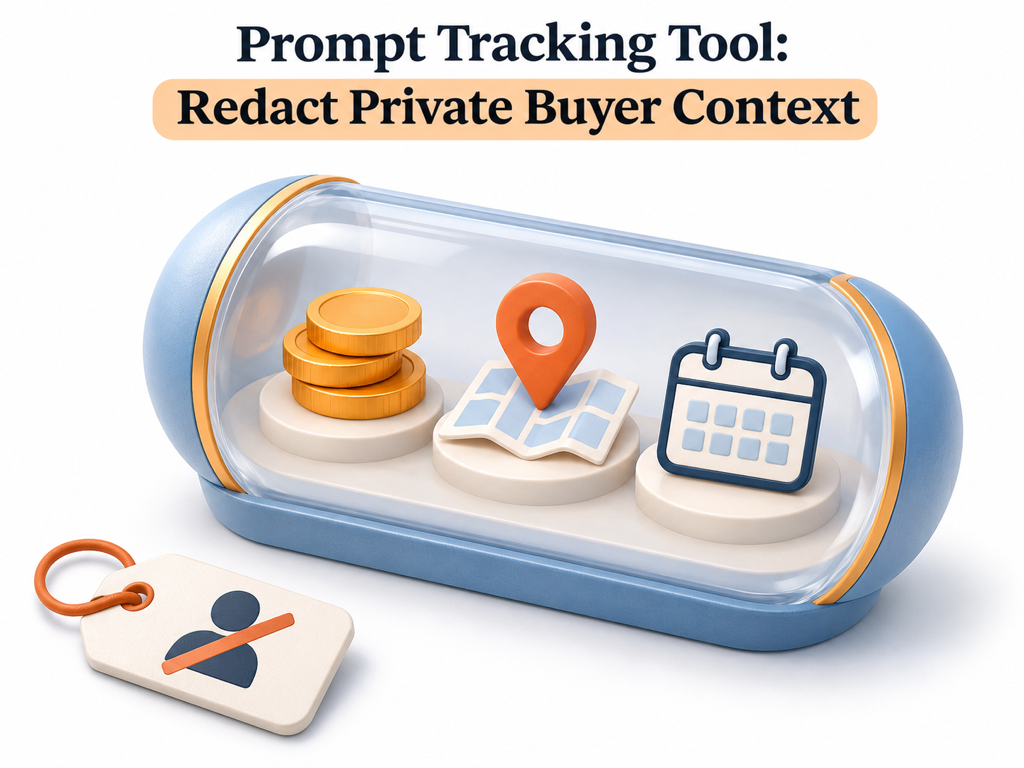
Create a compact approval ledger for the sanitized scenario. Record its identifier, version, purpose, retained constraint categories, reviewer, approval date, and any restrictions on reuse. The ledger should explain why the scenario is suitable without copying the original private narrative into every record.
Keep a reason for each consequential generalization. A note such as region retained because vendor availability is the tested condition helps future editors avoid removing it casually. A vague approved label offers less protection against an accidental change in meaning.
Decide who can access the source material and how long it should remain available under your organization’s rules. This workflow doesn’t prescribe a legal retention period. It asks the team to make and document that decision instead of allowing unrestricted copies to accumulate around a reusable prompt.
Platform settings are a separate consideration. OpenAI’s memory guidance explains that removing a chat and removing remembered information are not necessarily the same operation. Redaction before submission avoids depending on a later cleanup action as the whole information-handling strategy.
When someone finds a missed identifier, suspend reuse of that scenario and review where the affected version was submitted. Preserve the correction history in the restricted process your team uses. Don’t quietly replace the file while leaving other analysts unaware that an earlier version requires attention.
Approve a Reusable Monitoring Scenario
Topify can help teams investigate the buyer questions relevant to a brand’s visibility. Its prompt discovery feature describes identifying relevant questions and visibility gaps. Use those opportunities to select a measurement objective, then submit only scenarios that have passed your own information and meaning reviews.
The input is the approved buyer scenario; the analyst’s action is to examine its monitored brand outcomes alongside its versioned constraints. That combination supports a more specific decision about which questions deserve investigation or content work. The redaction ledger remains a separate control: the public feature description doesn’t establish that Topify automatically removes sensitive details, verifies anonymity, or provides the approval process described here. Test the actual submission workflow with synthetic material first, confirm what is sent, and assign responsibility for approving future revisions before expanding the question set.
A reusable scenario needs an owner as well as an approval date. Requirements change, and a once-useful budget band or integration category can become obsolete. Review the scenario when its decision conditions change, not merely when the text needs stylistic improvement.
Conclusion
A useful monitoring prompt preserves the buyer’s decision while leaving out information the test doesn’t need. Separate identifiers from constraints, check the combination of retained details, and review semantic equivalence after redaction. Treat the final scenario as an approved measurement asset with a version and an owner.
Choose one question from your prompt opportunity workflow and rebuild it with synthetic or approved generalized context. Have a second reviewer identify its requirements without seeing the private source note. When that interpretation matches the test objective, record the approval and reuse boundaries. This gives your team a practical next step without assuming that removing a name, changing a platform setting, or getting a plausible answer proves the entire workflow is safe.
FAQ
Which buyer details should be removed before a test?
Remove details unnecessary for the measurement objective, starting with direct identifiers. Review combinations of retained facts because they can still identify a real account.
How can redaction preserve budget and location constraints?
Use approved bands or regions only when they preserve the original eligibility decision. Review whether the replacement changes which options would qualify.
Should replacement maps be stored with prompts?
Usually they should be separated when a mapping is necessary at all. Keeping a prompt beside its identifying key can undo the intended boundary.
Who should approve a redacted monitoring scenario?
Assign an owner and an independent reviewer familiar with the test objective and your organization’s information rules. Both the information boundary and the preserved meaning need review.