A monitoring analyst repeats a buyer question and gets a different shortlist. The team suspects a visibility change, but the second answer came from a conversation that already discussed preferred vendors, deployment needs, and budget. The prompt text stayed the same while the information available to the assistant changed.
A prompt tracking tool needs a clear boundary around that context. Without one, your weekly comparison can mix an unfamiliar buyer, a returning user, and an ongoing procurement conversation into a single result. The practical decision is which conditions to keep consistent, which to study separately, and which to mark as unknown before interpreting a movement in brand presence.
Define the Carryover Risk in a Prompt Tracking Tool
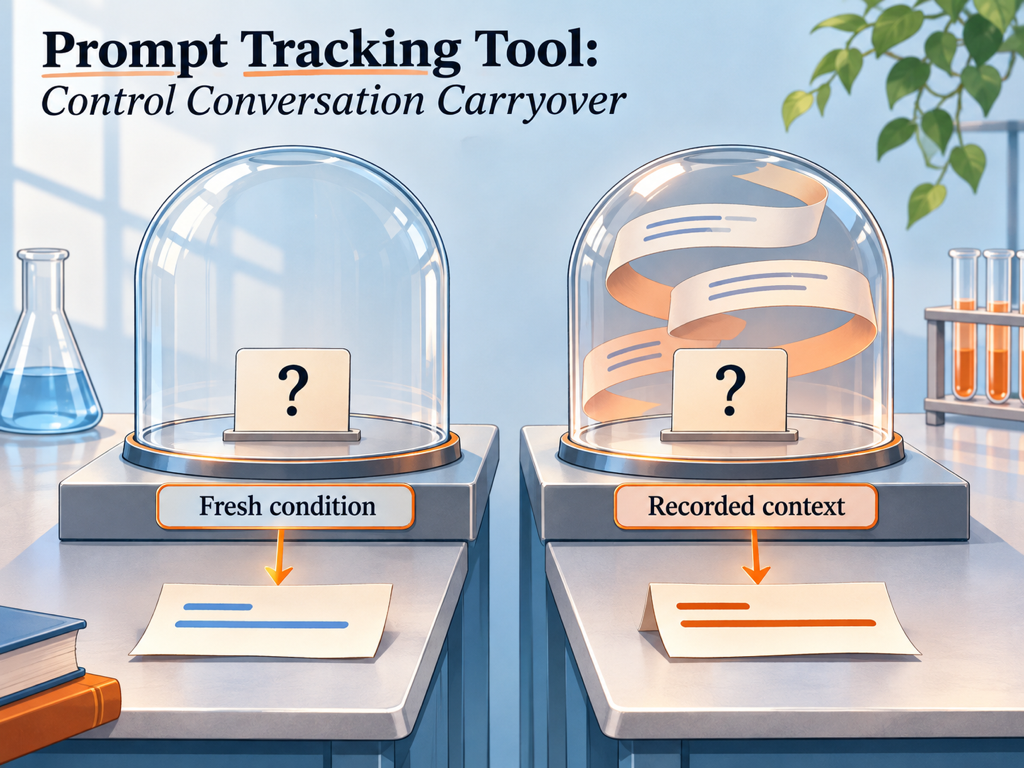
Conversation carryover means earlier information remains relevant to a later answer. A vendor introduced several turns ago may already belong to the conversation’s working shortlist, even when the final question doesn’t repeat its name. Count that answer as a continuation of the recorded scenario, rather than automatically treating it as independent discovery.
Start with a concrete synthetic case. An analyst asks for scheduling software after discussing a healthcare deployment, while another submits the same question without that discussion. A difference between their shortlists is worth examining, but the two answers don’t represent the same information condition.
Write the evaluation question before collection. You might want to measure responses to an initial category question, or how recommendations develop across a realistic conversation. Both can be useful, but each requires its own context boundary and report label.
The unit you compare is the prompt plus its recorded conditions.
A context policy should also define permitted preceding turns. For a continuation study, keep a complete approved script and identify the turn being scored. For initial-question monitoring, avoid adding explanatory messages merely to repair an answer, because those messages create a different observation.
Separate Conversation History From Account Personalization
A new conversation and a nonpersonalized conversation are different conditions. OpenAI’s memory documentation describes personalization from sources including past chats, saved memories, custom instructions, files, and connected apps, depending on availability. Record the controls actually visible to the account used for collection.
Temporary chat also needs an explicit record. The current documentation says users can choose whether a temporary chat uses existing memories, custom instructions, and plugins before starting it; the Unpersonalized option excludes those inputs. Temporary chats don’t create or update memories, but their personalization choice cannot be changed after the conversation starts.
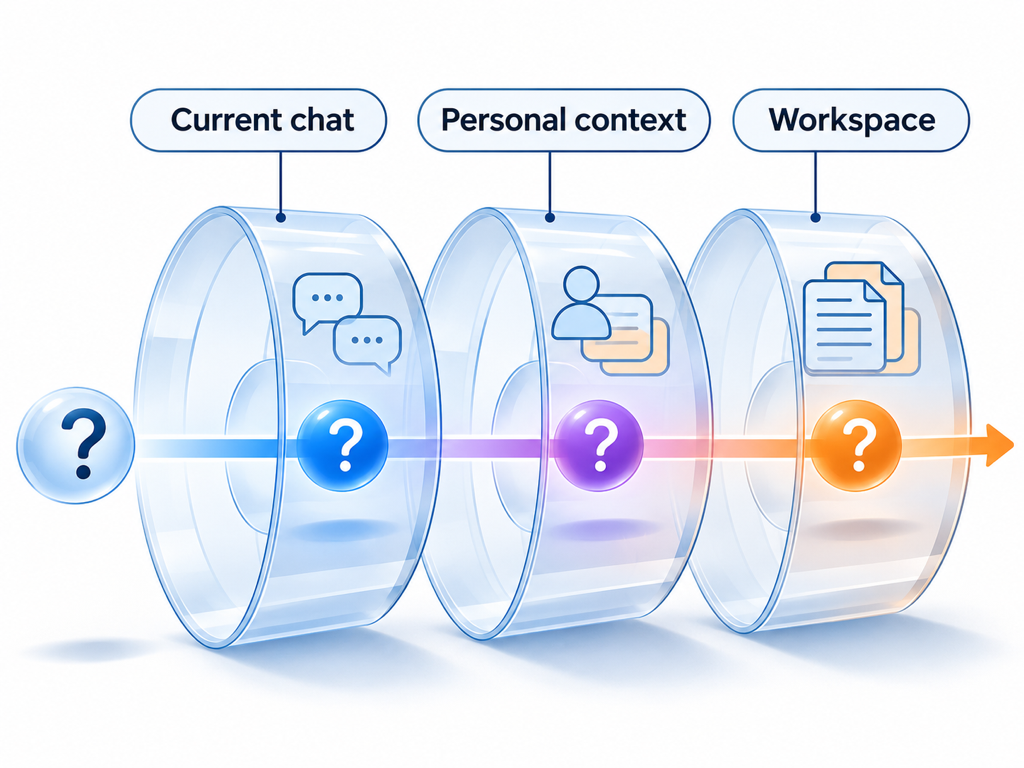
Keep three layers separate in your log: messages inside the current conversation, account personalization, and other available workspace or connected context. A screenshot of a blank conversation proves only that the visible transcript starts there. It doesn’t prove every other context source is absent.
Use a compact condition register to prevent ambiguous shorthand. The entries below are suggested review fields, not a description of any platform’s automatic logging.
| Condition | What to record | What it does not prove |
|---|---|---|
| Current conversation | Approved preceding turns and scored turn | Absence of account personalization |
| Personalization | Visible controls and selected state | Complete visibility into every influence |
| Temporary session | Personalization choice made at creation | A universal blank-context mode |
| Workspace sources | Available connected or attached sources | That every available source was used |
| Unknown condition | Missing evidence and reason | That the condition was disabled |
Design a Paired Context Test
A paired test helps you investigate a specific carryover hypothesis. Choose a small approved question set, specify the two context conditions, and collect both within a comparable period. Keep the question text, visible model selection, language, and available search mode aligned where possible.
For example, compare an initial category question with the same question after a predefined discussion of an implementation requirement. Record the requirement in full, because a vague label such as warm conversation doesn’t allow another analyst to reproduce the exercise. Avoid adding a brand name unless brand seeding is the explicit variable being tested.
Specify the outcome before reading the answers. You could record whether a brand appears, whether it receives a recommendation, and whether the recommendation carries a qualification. These are different outcomes, so preserve the answer text rather than compressing everything into one favorable result.
Repeat the comparison under the same documented procedure. One pair illustrates a possible mechanism; it doesn’t estimate how often the mechanism occurs across users. The appropriate sample depends on the variation observed and the decision’s consequences, so avoid declaring a universal number of runs sufficient.
Counterbalance the collection sequence when practical. Running every initial condition first and every continuation condition later can mix your intended difference with a time-related difference. A recorded alternating schedule reduces that particular ambiguity without removing all confounding.
Record the Session Conditions Before Collection
Create the session record before submitting the scored prompt. Include a run identifier, timestamp with timezone, interface, visible model or mode, question version, context-script version, and collector. Add the visible personalization state and any uncertainty about account or workspace configuration.
Use separate fields for configuration and evidence. A collector may select a setting without being able to demonstrate every downstream effect. Record what was selected, then retain the relevant visible confirmation or screenshot according to your organization’s handling rules.
Don’t store sensitive conversational material merely to make the record exhaustive. An approved synthetic script can make a context experiment reproducible without copying private customer discussions. Keep the public scenario separate from any restricted mapping used during internal review.
A session identifier should connect the conditions to the resulting answer. Save the response, visible citations, and outcome coding under that identifier. Otherwise, a folder of screenshots can look complete while leaving reviewers unable to determine which setting belonged to which result.
For missing fields, record unknown and explain why. Backfilling a presumed state after noticing a surprising answer creates a risk of explaining the result with a condition you never observed. A documented gap is more useful than a confident reconstruction.
Interpret Differences Without Claiming Causation
A difference between conditions is a finding about the collected observations. It isn’t automatically evidence that one memory setting caused a recommendation change. Model variation, search behavior, availability, and collection timing may also matter.
Report the comparison at the level the evidence supports. In a synthetic example, you might write that a brand appeared in three of six continuation answers and one of six initial answers. Include those counts only when they describe your actual collected test; the numbers here illustrate reporting structure, not a measured benchmark.
Preserve the question-level pairs alongside any summary. An aggregate increase could hide cases in which the brand appeared only because an earlier turn explicitly introduced it. Reviewing those pairs changes the business interpretation from broader discovery to persistence within a conversation.
Unknown context should remain visible in the result.
Choose a next action based on the ambiguity. A stable operational difference may justify keeping the conditions in separate reporting groups, while a poorly documented session should prompt better collection. Neither outcome requires a claim about all users of the platform.
Use the buyer-intent clustering framework when deciding whether the underlying questions still represent the same buyer decision. Context conditions and intent groups are related review dimensions, but they should occupy separate fields.
Use the Context Record to Review Monitoring Results
Topify can provide a broader visibility workflow around the questions your team chooses to investigate. Its prompt discovery feature describes identifying relevant prompts and examining visibility gaps. Use that output to select a focused question family, then attach your separately maintained context policy to the investigation.
The input is a defined brand and relevant buyer questions; the analyst’s action is to compare monitored visibility with a documented manual context test. The combined review helps determine whether to investigate content coverage, conversation conditions, or an unresolved measurement gap. Keep the manual session ledger outside any unsupported assumptions about the product: the feature page doesn’t establish that Topify can control consumer-account memory or reproduce every personalized conversation. Before extending the exercise, confirm which collection settings your actual setup exposes and decide who owns the remaining manual evidence.
Start with one question family whose recommendation pattern matters to a current business decision. A narrow investigation is easier to review than a large collection with inconsistent context labels. Expand after another analyst can follow the record and reach the same interpretation of what was observed.
Conclusion
A changed answer becomes useful evidence only when the team can explain the conditions under which it was collected. Decide whether you’re studying initial discovery or a continuing conversation, record the visible context layers, and preserve unknowns instead of filling them with assumptions. The same question text doesn’t guarantee the same information environment.
Choose one relevant question family from your prompt opportunity review, write two explicit collection conditions, and run a small paired investigation before changing the wider monitoring program. Keep the answer evidence and the session record together. Your immediate goal is a comparison another analyst can inspect, with clear boundaries around what the observations establish and what still needs a better test.
FAQ
Does a new conversation remove all personalization?
No. A new visible transcript doesn’t establish that account-level personalization or other available sources are absent. Record the controls and conditions that apply to the account being tested.
What memory conditions should a prompt tracking tool record?
Record the current conversation script, visible personalization settings, available workspace sources, interface, and collection time. Mark missing evidence as unknown rather than assuming a default.
Can temporary chats use existing memories?
The current OpenAI documentation describes a choice made before starting a temporary chat. Record that selection explicitly rather than treating the temporary label as proof of an unpersonalized run.
How many paired runs are enough to investigate carryover?
There’s no universal sufficient count. Start with a documented pilot, examine variation, and size further collection around the strength of the conclusion and the business decision it supports.