A growth team can receive a hundred polished buyer questions and still have no defensible reason to fund the resulting content calendar. The questions sound plausible, the intent labels look orderly, and the export feels complete. What remains unclear is whether anyone actually asked them, where the wording came from, and what the accompanying demand numbers represent.
A prompt research tool becomes useful when you can connect each suggestion to an appropriate kind of evidence. That does not require every question to come from a recorded conversation. It requires knowing which questions were observed, which were inferred, and which were generated as hypotheses before you treat them as editorial priorities.
A Prompt Research Tool Needs an Evidence Trail
Start procurement with a decision rather than a feature list. Are you buying help discovering unfamiliar questions, estimating demand, identifying visibility gaps, or selecting prompts for ongoing measurement? Those jobs require different evidence, even when the interface presents them in the same table.
A generated question can be valuable for exploration without proving that customers use its exact wording. A question captured in your support system can prove that someone asked it, but one interaction cannot establish market demand. An estimate can help compare opportunities while still depending on assumptions about the sampled population.
Ask the provider to walk one row backward through its creation. The explanation should identify the input, any transformation, the observation period where applicable, and the meaning of each numerical field. A vague reference to proprietary intelligence does not tell you whether the row is suitable for your intended decision.
This is a provenance problem. The W3C PROV overview describes provenance through the entities, activities, and people involved in producing information. You can apply that principle in an ordinary spreadsheet without implementing a formal provenance system.
The useful question is what the evidence permits you to conclude.
Separate Observed, Inferred, and Generated Questions
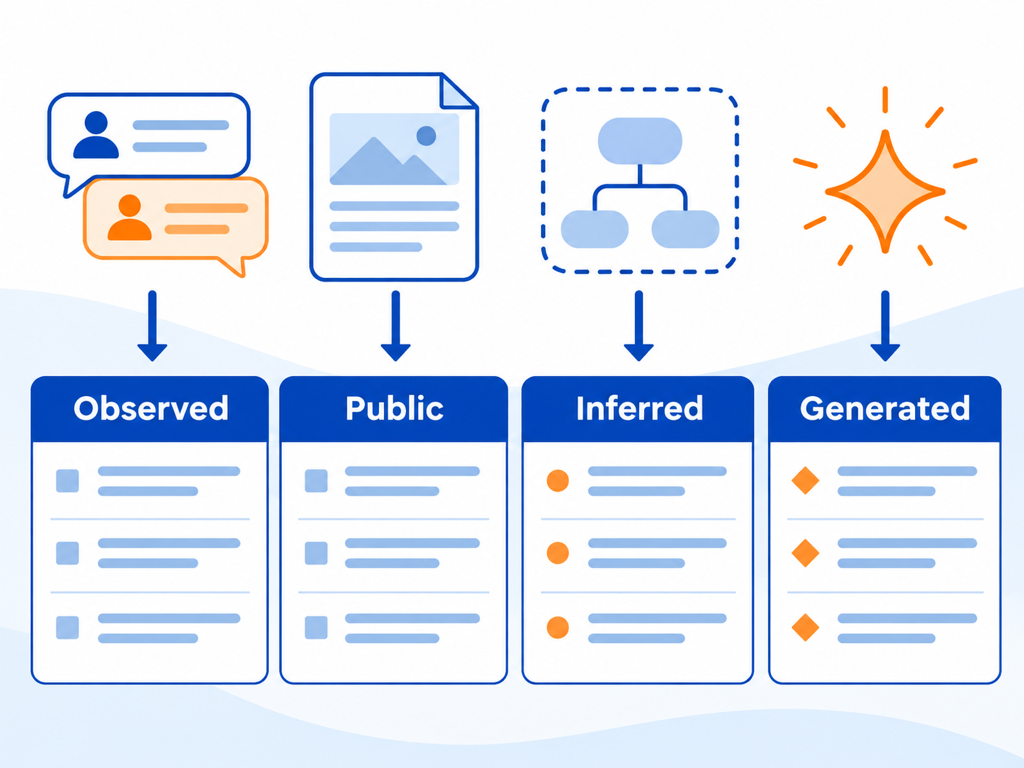
Use a small operational vocabulary before comparing exports. The following four categories are a recommended review system, not a universal vendor taxonomy. Keep the original provider label beside your own classification so a later reviewer can reconstruct the decision.
An observed first-party question comes from an authorized interaction your organization can verify. Preserve the relevant buying constraint, but remove identifying details before using the question outside its original system. A cleaned version should retain a restricted pointer to the source, rather than duplicating confidential transcripts throughout the content workflow.
A public question comes from a page or discussion that a reviewer can inspect. Record its date and context, because an individual complaint in an old forum thread may no longer describe the product or market. Public availability establishes traceability, not representativeness.
An inferred question is reconstructed from another signal, such as keyword demand or a group of related customer needs. A generated question is proposed by a model or rule from your category description. Both can extend discovery, provided their origin remains visible when they move into planning.
For example, a hypothetical question about moving a ten-person sales team between CRMs may be a useful scenario. Unless a source record exists, do not present that sentence as an actual buyer quote or use its existence as a frequency measurement.
Create a Question-Level Provenance Ledger
Give every candidate a stable identifier before editing its wording. Keep a source version, an editorial version, and the relationship between them. Otherwise a heavily rewritten question can quietly inherit credibility from a record that no longer says the same thing.
A practical ledger can use the fields below. Add detail only when it changes a decision or makes the record reproducible; a large number of empty columns creates the appearance of governance without improving it.
| Field | What to record | Decision it supports |
|---|---|---|
| Question and version | Original wording plus the approved test wording | Reproduce the same research or monitoring input |
| Origin class | Observed, public, inferred, or generated | Distinguish evidence from hypotheses |
| Source pointer | Authorized record reference or public URL | Check where the question came from |
| Date and market | Collection period, language, and relevant location | Judge freshness and audience fit |
| Transformation | Translation, paraphrase, merging, or model generation | Identify what changed between source and export |
| Numerical meaning | Unit, population, period, and whether estimated | Decide whether a number supports prioritization |
| Review outcome | Accepted use, unresolved issue, reviewer, and date | Control what enters the content backlog |
Keep missing information explicit. “Source not provided” is a useful state; an empty cell invites another person to assume the information was checked. You can still accept an unsourced candidate for exploration while preventing it from entering a demand-ranked report.
The PROV notation distinguishes derivation and responsibility. In your ledger, the practical equivalent is a source pointer, a description of the rewrite, and a reviewer. That combination lets a colleague challenge the conclusion without rerunning the entire procurement process.
Test Claims Before You Compare Vendor Lists
Give shortlisted providers the same public category brief and ask them to explain a small sample of outputs. Use material you can share, such as a public product description and a clearly defined buyer situation. A procurement test should not require exposing customer transcripts merely to see how the service works.
Evaluate the outputs against the claims you intend to rely on. When the claim is question discovery, inspect relevance and distinct decisions. When it is demand estimation, inspect the stated unit and method. When it is visibility research, ask what platform, market, and observation conditions produced the result.
Test an awkward row as well as an attractive one. Select a duplicate, a question about a discontinued feature, and a suggestion outside your buyer segment. Ask whether the system exposes enough context for your team to reject those rows responsibly.
Do not turn the exercise into a beauty contest for the longest list. Ten questions with clear uses may be more actionable than a hundred loosely related suggestions, but the appropriate acceptance level depends on your workflow. Set your criteria before seeing the output so you do not redefine success around the provider that happens to impress you.
Request a written explanation of what will change over time. If the underlying discovery process updates, you need to know whether existing rows retain their identifiers and whether earlier estimates remain available. Otherwise a later reporting change can be difficult to separate from changing research inputs.

Reject Unsupported Demand and Frequency Claims
Treat demand claims as measurements with units. “Monthly questions” might refer to estimated topic activity, observed interactions in a panel, or a modeled allocation across related phrases. Those descriptions cannot be substituted for one another simply because the same column heading says volume.
A suggested prompt count is a production quantity. It tells you how many ideas the tool returned, not how many people asked them. Similarly, a keyword appearing in your search data supports a discovery lead without proving that the full conversational question is popular inside a particular AI assistant.
Keep estimates in the ledger with their published method and limitations. When that information is unavailable, use the question to investigate an intent rather than to forecast traffic or revenue. You can validate its usefulness through authorized customer research and a controlled answer sample without inventing a population estimate.
The distinction also protects planning from false precision. A question with modest apparent demand may concern a high-consequence procurement constraint, while a broadly phrased question may attract attention from people outside your market. Evidence quality and decision relevance deserve separate judgments.
Related terminology needs the same care. AI Search Volume Has Three Meanings. Buying the Wrong One Costs You provides context for separating the objects behind similarly named volume fields. Establish the unit first, then decide whether two exports are comparable.
Require a traceable explanation before assigning a demand-based priority.
Use Topify to Move From Candidates to a Reviewed Set
Topify can provide a starting point for question discovery. Its Prompts Researcher accepts a brand or keyword, optionally a website, and describes an output of ten research prompts organized by intent. Use those outputs as candidates, then assign provenance and review status before adding them to a demand-based plan.
For a broader workflow, Prompt Discovery describes opportunities through demand estimates, brand visibility gaps, and competitive context. Your team can use that context to choose which questions merit examination and which sources or pages to inspect next. The provenance ledger remains a separate control: a relevant suggestion or a favorable opportunity score does not establish that an individual sentence was observed in a customer conversation. Keep that distinction visible when moving from discovery to monitoring, and review the actual output available in your account before committing a larger research budget.
Conclusion
A useful prompt research tool helps your team decide what to investigate and why. The quality of that decision depends on the evidence behind each row, not on the fluency of the question or the apparent precision of an attached score. Observed questions, public examples, inferred intents, and generated suggestions can all contribute when their permitted uses remain clear.
Start with a small provenance ledger and a consistent acceptance task. Keep original wording, record transformations, and require a meaningful unit before using a number to rank demand. You can explore candidates with Topify’s prompt research workflow, then approve the questions that match your audience and evidence requirements. The next content brief should explain the buyer decision it serves and the evidence supporting that choice.
FAQ
Does a generated prompt prove consumer demand?
No. It supplies a research hypothesis. Evidence about demand requires an appropriate observed dataset or an estimate with a defined population, period, and method.
What provenance fields should a prompt research tool expose?
Look for origin, collection period, market, transformations, and the meaning of numerical fields. Record missing information explicitly when the product does not expose it.
Can search keywords validate a conversational question?
They can support the underlying topic or intent. They do not establish that users ask the exact expanded question on a specific AI platform.
How should teams use questions without a published source?
Keep them in an exploration queue, label their origin, and validate audience relevance before treating them as demand evidence or approved monitoring inputs.