A content team can improve every question in its weekly visibility report while learning very little about unfamiliar buyer decisions. Writers see the tracked prompts, reshape pages around them, and use the same questions to declare success. The report may accurately describe that small set while overstating how broadly the work helped.
A prompt research tool can feed a more disciplined process. Separate the questions used to guide content from a protected group used to evaluate whether improvements extend beyond familiar examples. That holdout set will not turn a changing AI platform into a controlled laboratory, but it can expose a narrow win before the team scales it into a larger investment.
A Prompt Research Tool Should Feed Two Different Work Queues
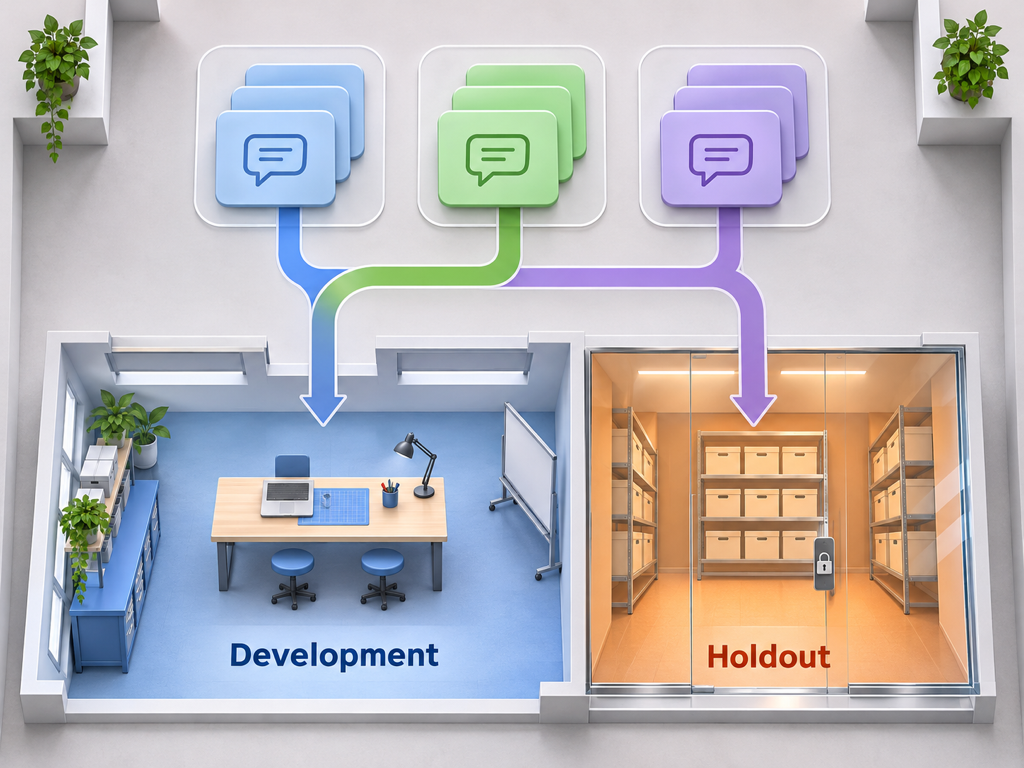
Discovery and evaluation have different responsibilities. The discovery queue should help writers understand buyer problems, inspect competing answers, and decide which evidence a page needs. The evaluation queue should test the resulting work under conditions the writers have not repeatedly optimized against.
This distinction borrows a useful principle from machine learning. The scikit-learn guidance on data leakage warns that using test information to make development choices produces overly optimistic performance estimates. Applying a holdout discipline to content evaluation is an analogy, not a claim that a marketing campaign is a model-training experiment.
Create three statuses: development, protected evaluation, and retired. Development prompts can be inspected freely. Protected questions have a named custodian and a planned evaluation window. Retired questions remain available for history but cannot silently return as supposedly unseen tests.
The separation concerns your team’s workflow. A public page may naturally answer both development and evaluation questions, and an AI provider may already know their wording. The control prevents your own repeated inspection from turning the evaluation list into another content specification.
A hidden checklist stops being independent once it drives the edits.
Split by Decision Family Before You Split by Wording
Allocate related decision families before assigning individual sentences. A random split of near-identical paraphrases can leave both sides asking essentially the same thing. That makes the evaluation appear unfamiliar while preserving most of the answer specification the writers already saw.
Consider a hypothetical software campaign. “Which CRM works for a small agency?” and “Recommend a CRM for a boutique agency” may be close variants. A question about migration from a legacy system with a fixed renewal deadline introduces a different decision, even when it shares the same product category.
Use the following review before assigning groups. The examples illustrate test design rather than measured outcomes.
| Candidate relationship | Leakage risk | Better treatment |
|---|---|---|
| Same decision, minor paraphrase | Familiar answer appears in both groups | Keep the family together |
| Same category, different procurement constraint | Depends on whether evidence requirements change | Review as a distinct decision family |
| Brand name substituted into the same comparison | Known comparison structure may dominate | Group by comparison relationship and task |
| New market with different availability | Evaluation may test market fit rather than generalization | Label and report it separately |
| Unrelated question added to increase difficulty | Tests an audience the campaign never served | Exclude or create another study |
Do not make the holdout artificially obscure. It should represent plausible decisions within the intended audience, not a set designed to produce failure. A useful evaluation challenges generalization while preserving the campaign’s stated scope.
AI Prompt Clustering: How to Group Buyer Questions Without Hiding Intent offers a related starting point for identifying decision boundaries. Here the purpose is narrower: prevent those boundaries from leaking across development and protected evaluation.
Lock the Holdout Conditions and Access Rules
Write the evaluation contract before content production begins. Record prompt wording, decision-family assignment, language, market, platform or experience, observation schedule, and the outcomes you will label. Include a rule for refusals, collection failures, and answers that do not fit the expected format.
Choose the split size according to available decision families and the cost of repeated observations. There is no universal percentage that makes an AI visibility test reliable. A large protected set with little meaningful coverage can be less useful than a smaller, coherent evaluation whose limits are explicit.
Give the custodian authority to protect the list from routine editorial review. Writers can see the campaign’s audience and broad decision scope without seeing every evaluation question. If a protected prompt is revealed to guide an edit, record the reveal and retire or reclassify it for future independence claims.
Freeze the evaluation rules as well as the inputs. Changing the definition of a recommendation after seeing results can bias the conclusion just as surely as rewriting the questions. Keep an adjudication process for ambiguous answers so the custodian does not need to invent a new rule every week.
Use public or sanitized material for the prompt set. A protected evaluation is not a reason to distribute private customer conversations more widely. Store any restricted source pointers separately from the prompts used for measurement.
Run Matched Evaluations Without Promising Causality
Collect development and holdout observations during comparable windows. Keep the platform mix and declared conditions aligned where possible, and preserve raw answers so a reviewer can examine the labels. Repeated observations show variability; they do not make runs independent or remove provider changes.
An October 2026 preprint on AI citations examines retrieval and model knowledge alongside content properties. Its findings concern particular engines and markets, but they reinforce the need to avoid treating one answer as a stable content score. Your evaluation needs a record of what was observed and when.
Choose a primary outcome before collecting results. Depending on the campaign, that might be brand inclusion in eligible answers, a verified recommendation, or an owned-page citation. Keep these outcomes distinct rather than blending them into a score that hides how the campaign changed.
Match the reporting units too. If one family contains many more paraphrases, an answer-weighted average may let that family dominate. Report family coverage alongside answer counts, and disclose any weights selected for business priorities.
An untreated comparison group can strengthen interpretation when it is relevant and measured consistently. It still may face different demand, source competition, or platform behavior. A before-and-after holdout result supports a bounded observation; it does not by itself prove that the new content caused the change.
Read Generalization Gaps Before Expanding the Campaign
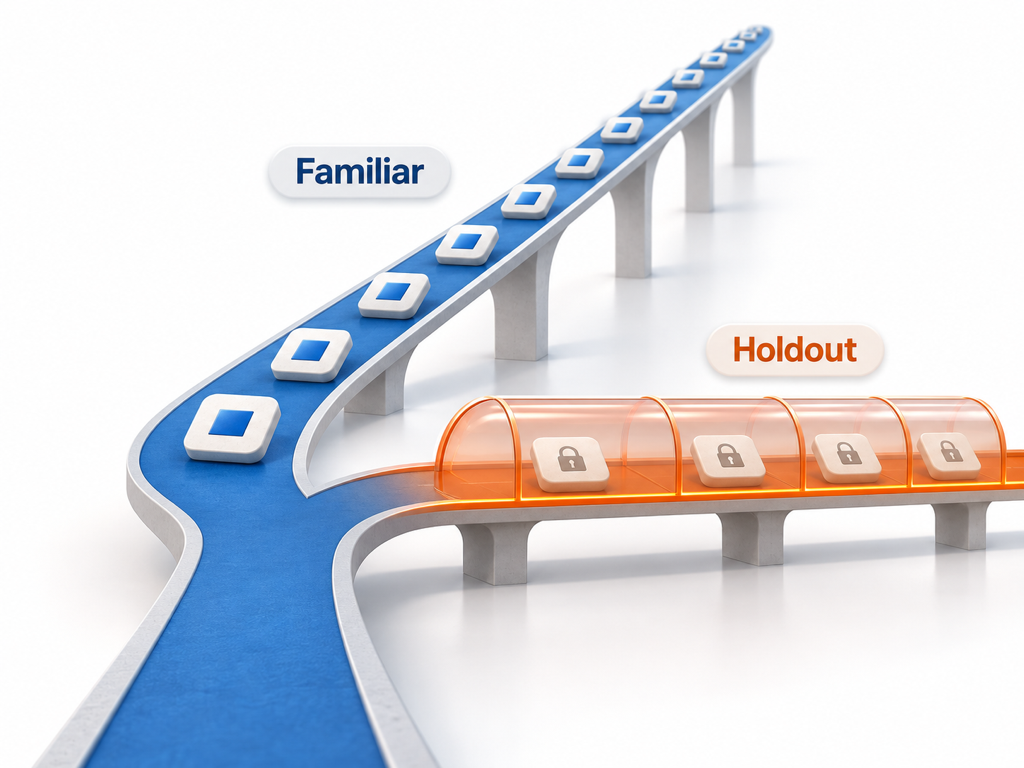
Interpret the two queues together. Development improvement with flat holdout performance suggests that the win may be narrow, although sampling variability and differences between families remain alternative explanations. Improvement in both groups is more encouraging, but still requires checking coverage and execution conditions.
Use an explicitly hypothetical example to see the distinction. Suppose development answers mentioning the brand rise from 20 of 100 to 35 of 100, while protected answers rise from 18 of 100 to 19 of 100. The changes are 15 and 1 percentage points. Those arithmetic differences describe the example; they are not significance tests or evidence from a live campaign.
Before expanding, inspect which protected families failed. A missing integration requirement may point to a product-documentation gap. A failure across unrelated families may suggest that your content changes addressed a familiar phrase more effectively than the broader decision.
Define success in terms of the decision the campaign needs to support. A purchase-focused program should not scale solely because the brand appears more often in generic educational answers. Review the actual recommendation context and whether the cited pages support the relevant claims.
Report the familiar-set result and the protected-set result separately.
Use Topify for Discovery While Keeping Evaluation Independent
Topify can supply candidates and competitive context for the development side. Its Prompt Discovery describes demand estimates, visibility gaps, and competitor presence around relevant questions. Use that information to define the campaign scope and organize a reviewable set of buyer decisions before assigning protected families.
Your team should own the separation between development and evaluation. Keep an independent register of the chosen families, access decisions, observation conditions, and reveal dates; do not assume an opportunity score creates a protected test. Topify’s AI search analytics can provide visibility and citation context for a defined monitoring workflow, while the custodian checks whether the same conditions and labeling rules were applied. Review the controls and outputs available in your account before promising an automated holdout process. The value comes from connecting useful discovery with disciplined evaluation, without claiming that the product establishes causality or guarantees unseen-prompt performance.
Conclusion
A prompt research tool should help you discover important questions without turning every familiar question into proof that your campaign worked. A protected holdout creates a practical boundary between the prompts used to shape content and those used to examine whether the benefit extends to other buyer decisions.
Start by grouping related decisions, then assign development and evaluation families before writers inspect the protected list. Freeze wording and labels, record reveals, and compare results within consistent conditions. Keep counts and uncertainty beside every percentage. You can use Topify’s prompt discovery capabilities to develop candidates while managing the evaluation register separately. Scale only after the evidence supports the audience and decision scope you intend to serve, and treat a narrow result as a reason to investigate rather than a reason to manufacture a broader claim.
FAQ
What is a holdout prompt set?
It is a protected group of questions reserved for evaluation rather than routine content development. Its purpose is to examine performance beyond the prompts the team repeatedly optimizes against.
Should paraphrases be split across research and evaluation?
Usually keep close variants in the same decision family. Splitting them randomly can create an evaluation that looks new while testing a familiar answer specification.
How often should a holdout set be replaced?
Replace or reclassify it when questions are revealed for optimization or the audience changes materially. Preserve prior versions and document why a replacement was needed.
Does improvement on held-out prompts prove causation?
No. It is useful evidence of broader observed performance, but platform changes, source changes, and sampling conditions can still affect the result.