A source report can list several domains while telling a much smaller evidence story. A launch announcement appears on the original publisher, an authorized syndication partner, and a trade aggregator. The answer links to all three. The marketing team sees broad coverage, but the underlying product claim still comes from one publication event.
AI citation share can accurately describe displayed source presence without revealing that dependency. To understand what the citations mean, keep the platform metric intact and add a separate audit of URLs, publishers, and content lineage. The result is a clearer distinction between being linked across the web and being independently corroborated.
AI Citation Share Counts Links Within a Defined Pool
Start with the metric you actually received. Microsoft’s Citation Share announcement describes the proportion of displayed citations attributed to a site for a grounding query. It concerns supported Microsoft experiences and was introduced in preview. It is not a universal measure of every AI platform.
That definition describes relative source presence. It does not establish that each cited page contains independent reporting, that the answer recommends the publisher, or that a reader visited the destination. Those are different questions requiring different observations.
Preserve the reporting period, filters, and provider definition alongside the exported value. If your team later groups syndicated articles into one family, the resulting analysis must have its own name and counting rule. Rewriting the original denominator would make the custom audit difficult to compare with the provider’s report.
This matters even when the audit identifies obvious repetition. A mirrored page may still be a displayed citation in the original system. Your reporting can acknowledge that fact while explaining why several displayed sources should not be interpreted as several independent confirmations.
Preserve the original metric before adding an audit view.
Separate Displayed URLs From Independent Evidence
Choose the unit according to the question. A displayed URL is useful for inspecting the exact destination. A domain groups destinations by hostname. A publication organization may own several domains. A content lineage groups documents that derive from the same underlying material.
None of those units automatically equals independent evidence. Separate organizations can publish the same supplied release, while two articles on one domain can contain different original tests. Independence requires looking at what produced the claim, not merely where the text is hosted.
The W3C provenance framework provides a useful conceptual distinction between an information entity and the activities that produced it. A practical citation audit can record that relationship without claiming to implement the standard in full.
| Audit unit | What it answers | What it cannot establish alone |
|---|---|---|
| Displayed citation | Which link appeared in the observed answer? | Whether the destination supplied independent evidence |
| Destination URL | Which page did the reader reach? | Whether other URLs contain the same material |
| Domain | Which host received the reference? | Who produced the underlying claim |
| Publisher organization | Which organization controls publication? | Whether the reporting was original |
| Content lineage | Which pages derive from the same release or report? | Whether the originating claim is correct |
| Evidence activity | What test, interview, dataset, or documentation supports the claim? | How often that evidence is cited elsewhere |
Keep these views separate in the report. A brand may have strong distribution of one announcement and weak independent testing. That is a specific evidence gap; it is not a reason to dismiss all of the observed citations.
Trace Canonical Pages, Mirrors, and Syndication Credits
Inspect the destination before assigning a lineage. Record the final URL after redirects, the visible publication date, byline, publication organization, and any syndication credit. Then compare the claim-bearing passages with the suspected original.
A close match can be a lead rather than a verdict. Product specifications naturally repeat across legitimate documents, and articles covering the same public event may share factual descriptions. Look for explicit attribution, substantial copied structure, identical distinctive passages, or a link identifying the original publication.
Canonical annotations provide another clue with a different purpose. Google describes canonical signals for duplicate or very similar URLs. Those signals indicate a preferred search URL; they do not certify who independently verified a claim, and they should not override contradictory publication evidence.
Record at least three relationship states: confirmed derivation, probable derivation, and unresolved. A confirmed state should have a supporting pointer, such as an explicit republishing credit. Probable matches need a written reason, while unresolved cases remain visible rather than disappearing through automatic deduplication.
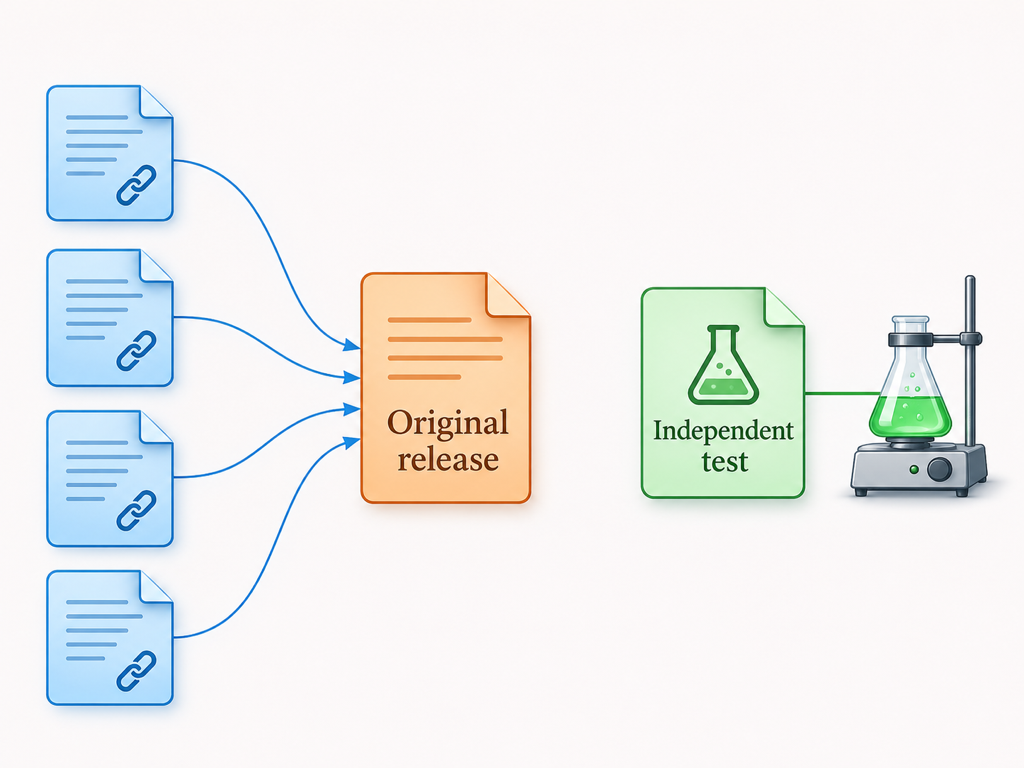
A hypothetical example makes the boundary concrete. A manufacturer’s release and a partner’s verbatim republication belong to one release lineage. An independent laboratory report that quotes the release and performs a new test contains an additional evidence activity. Do not collapse the entire laboratory report simply because its introduction repeats the original specification.
Keep a Raw Metric and a Separate Lineage Audit
Build two connected reporting panels. The first preserves the provider’s original metric, dates, filters, and scope. The second records the pages your team inspected and the provenance relationships established for the claims relevant to the business decision.
In the audit panel, show reviewed URLs, confirmed lineages, unresolved relationships, and the evidence roles represented. These are descriptive audit counts. Unless your sample covers a defined universe, do not turn them into a claim about the independence of all citations across the platform.
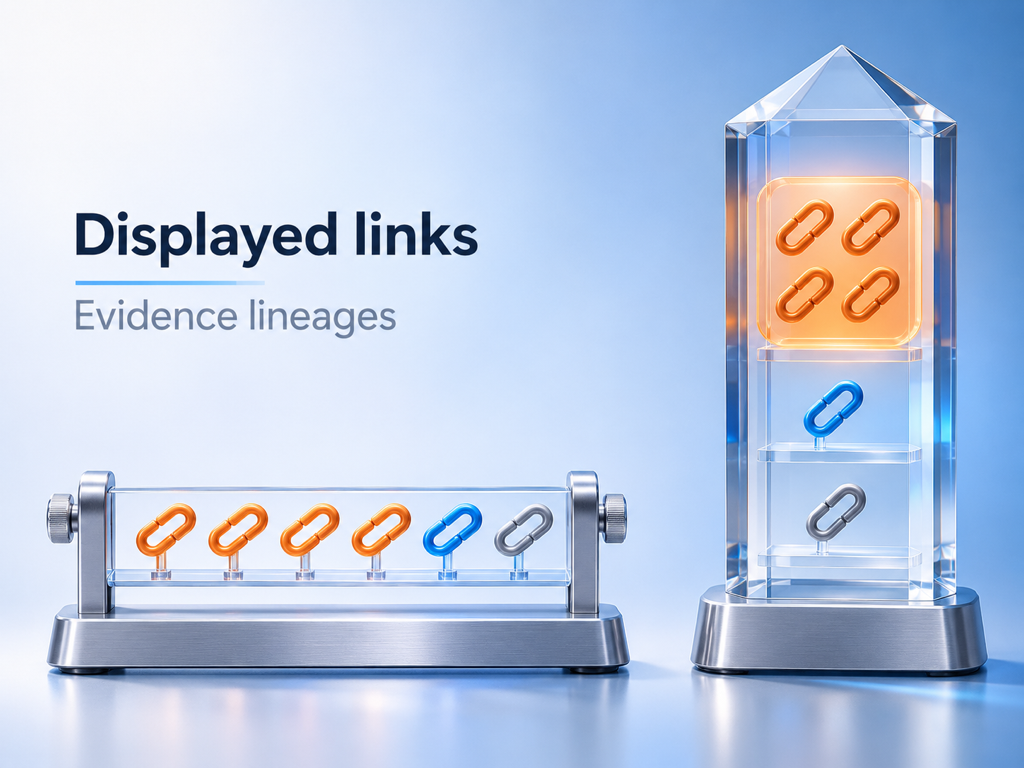
Use an explicitly hypothetical example: an inspected answer contains six displayed links. Four reproduce the same announcement, one contains an independent test, and one cannot be inspected. Your audit can report six links, one confirmed announcement lineage, one separate test, and one unresolved source. It should not call the unresolved page an independent endorsement.
Decide how to treat partial derivation. A reported article may copy one specification table but add interviews and original analysis. Record the relationship at the relevant claim level instead of assigning an oversimplified independent-or-duplicate label to the entire domain.
The distinction complements a broader benchmark. AI Citation Share: How to Benchmark Your Visibility Against Competing Sources explains the importance of a defined comparison universe. A lineage audit adds an evidence-quality lens without replacing that universe or its denominator.
Review Ambiguous Cases Before Collapsing Sources
Use human review when the relationship affects a consequential claim. Shared ownership, common wording, and similar publication times can justify investigation, but none proves that one document is a simple copy of another. Avoid labeling an organization’s entire output based on one matched page.
Give reviewers a small decision record. It should identify the claim, the compared passages, the suspected original, the relationship evidence, and the remaining uncertainty. A second reviewer should be able to reproduce the classification from that record without relying on the first reviewer’s intuition.
Distinguish distribution from verification in the resulting action plan. Syndication can make accurate information easier to encounter. Independent testing or reporting serves another role by supplying an additional basis for judging the claim. The appropriate next investment depends on which role is missing.
Do not respond to every duplicated source with a new blog post. The missing asset may be a current specification, reproducible test method, clear documentation, or genuinely independent assessment. Adding more copies of the same announcement would increase publication activity without resolving the evidence dependency.
Review lineages when documents change. An originally syndicated page may later add reporting, while an original report may be corrected or withdrawn. Keep the audit date and the relevant captured passage so the report does not silently describe an earlier version as current.
Distribution and independent verification need separate evidence records.
Use Topify to Inspect URLs Before Assigning Source Families
Topify can help identify which source destinations deserve closer inspection. Its AI citation analysis describes domain and URL tracking across AI platforms, along with citation-gap analysis. Use those destinations to assemble a focused review queue for the buyer decisions or product claims your team needs to understand.
Assigning source families remains an editorial task. For each selected destination, inspect attribution and the claim-bearing passage, then record confirmed, probable, or unresolved derivation in a separate ledger. The useful output is a connection between observed citation presence and the evidence behind it: which questions rely on one release, which have additional verification, and which remain uncertain. Do not assume that source tracking automatically detects syndication, establishes publisher independence, or validates the underlying claim. Keep the provider’s original measurements beside the manual audit so each retains a clear meaning and a reproducible scope.
Conclusion
AI citation share tells you about relative source presence within a defined reporting pool. A syndicated-source audit asks a different question: how many distinct evidence activities sit behind the links your team inspected? Both views can be useful when their units and limitations remain visible.
Preserve the original platform metric, then examine the destinations that matter to your audience. Trace explicit republishing credits, inspect claim-level derivation, and keep unresolved cases in the ledger. Use Topify’s citation-source analysis to identify review candidates, then decide whether the next investment should improve distribution, documentation, or independent verification. A report becomes more useful when it describes the evidence dependency directly instead of treating every additional domain as a new confirmation of the same claim.
FAQ
Do syndicated articles count as separate AI citations?
They may appear as separate displayed links under a provider’s counting rules. Your lineage audit can group their shared origin separately without changing the official metric.
Does a canonical tag prove that two sources are independent?
No. It concerns a preferred URL for duplicate or similar content in search. Independence requires examining how the relevant evidence was produced.
Should teams recalculate Bing Citation Share after deduplication?
Preserve Bing’s reported value. Label any custom lineage analysis separately and state its sample, grouping rules, and unresolved cases.
How can citation share and source independence be reported together?
Show the provider metric beside a reviewed-source ledger. Include displayed links, confirmed derivation relationships, distinct evidence activities, and inspection limits.