A publisher wants a report to be discoverable while keeping the complete analysis available only to subscribers. The site sends the full report to every browser and hides most of it behind an overlay, while a different template blocks crawlers entirely. Both pages are called paywalled, but they create very different access and discovery conditions.
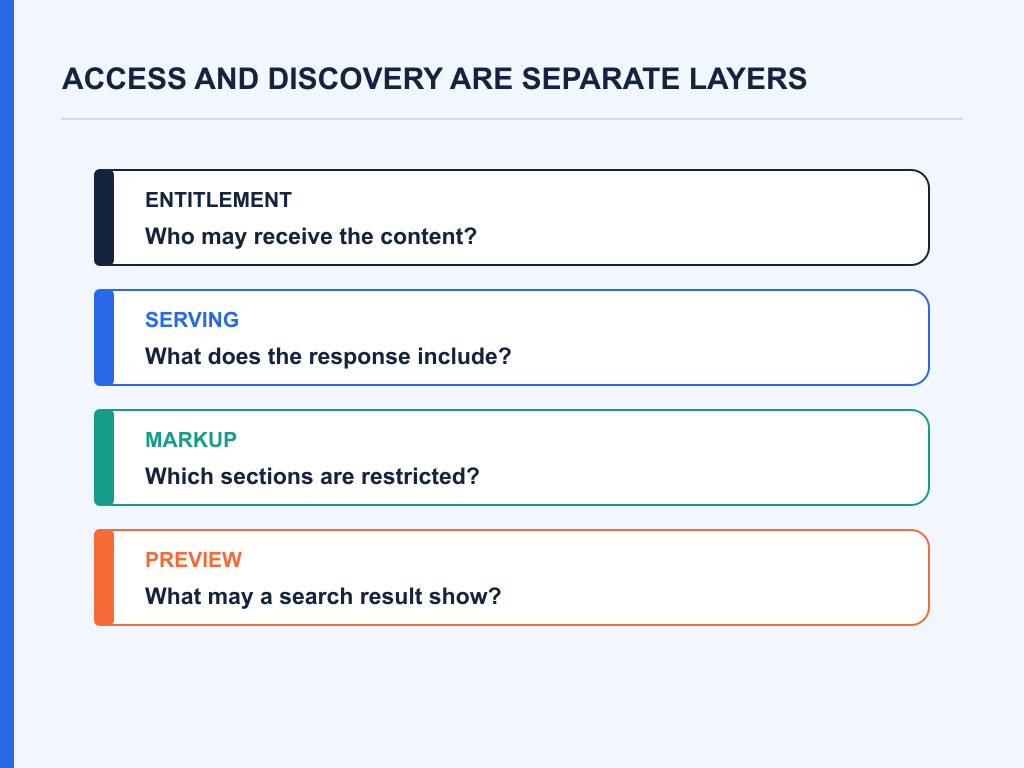
Paywalled content SEO begins by separating the commercial access decision from crawl, indexing, and preview choices. Markup can describe a boundary, but it cannot create access control by itself. The team needs an intentional serving model, a clear public explanation, and a test that verifies what each kind of visitor actually receives.
Paywalled content SEO starts with the intended boundary
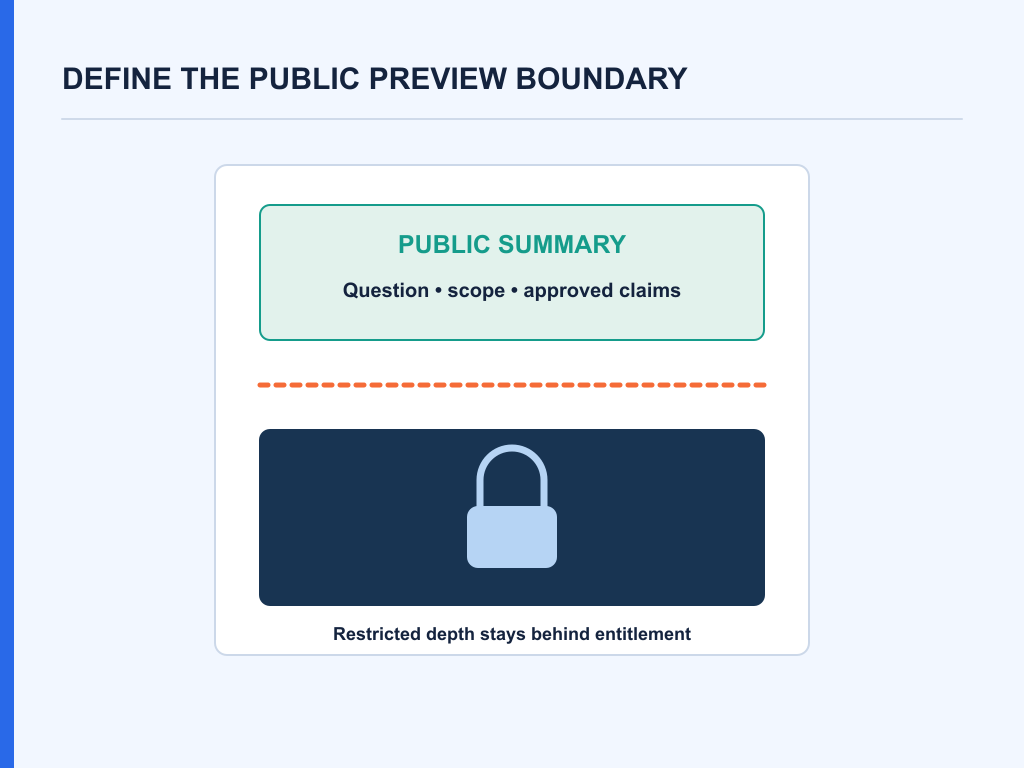
Write down which information is public, which requires authentication, and which the publisher wants eligible for indexing. These decisions should be approved before a template or plugin chooses the implementation. A default setting is not a publishing policy.
Google’s paywalled-content documentation describes markup for content intended to be crawled and indexed. It helps distinguish appropriately identified paywalled material from cloaking. It is not a mechanism that grants a crawler access to a server-protected document.
Use three representative requests in the design discussion: an anonymous reader, an authorized subscriber, and the search crawler behavior the publisher intentionally supports. Describe the content each receives and why. Keep authentication and entitlement enforcement within the approved security implementation.
An access boundary must exist in the serving system.
Maintain a decision record for each content class. It should name the editorial owner, intended public excerpt, permitted crawler behavior, and subscriber entitlement. Review that record whenever a new template or distribution format is introduced. This makes it harder for a routine design change to become an accidental change in access policy.
Match the markup to the actual page
The structured representation should describe the real public and restricted portions. Google’s example uses isAccessibleForFree with hasPart and a CSS selector to identify a paywalled section. Confirm that the selector still matches the intended element after the page is rendered and after template updates.
Avoid copying a paywall annotation across all articles regardless of access state. A public announcement and a subscriber report should not be indistinguishable in the content model. Keep editorial access status connected to the renderer that emits the markup.
Test articles with one restricted section and pages with several distinct content regions. A selector that becomes too broad can label navigation, summaries, or unrelated modules incorrectly. The audit should compare the annotated boundary with the actual reader experience.
Retain a simple map in the publishing record: content block, access class, visible explanation, and technical enforcement. This makes the implementation reviewable by editors who do not write markup. It also gives engineers a reference when refactoring the page structure.
An overlay is not equivalent to server-side restriction
An anonymous browser can receive content that is visually covered or collapsed. That is different from a response that never includes the restricted material. Inspect the delivered response and relevant application data rather than relying on the appearance of the page.
Google explicitly advises publishers that do not want content accessible to the browser at serving time to use an implementation that does not supply it to the browser. Apply this as an implementation decision with the appropriate technical owner. Do not treat CSS concealment as proof that premium material is protected.
Check alternate formats and endpoints within the authorized audit scope. A page can enforce an entitlement while a public export, print view, or application response publishes the same report elsewhere. The approved access policy should be consistent across the surfaces the publisher controls.
Do not test by bypassing a third party’s controls. The purpose is to verify the publisher’s own intended serving behavior using approved test accounts and requests. Keep the inspection scoped to the system and content the team is authorized to assess.
Preview controls need their own decision
Search previews and paid access are related but separate. A publisher may permit indexing while limiting excerpts, or make a public summary available while withholding the full report. Choose the outcome first, then use the controls documented for the relevant platform.
| Decision | Mechanism to evaluate | What it does not establish |
|---|---|---|
| Restrict subscriber material | Authentication and entitlement enforcement | Search eligibility |
| Describe a paywalled section | Supported structured data | Actual access protection |
| Exclude a page from indexing | Applicable noindex implementation | Confidentiality of a publicly served response |
| Limit a search preview | Documented snippet controls | Universal restrictions across all AI providers |
| Offer a public discovery asset | Useful summary page | A guaranteed citation or subscription |
| Observe answer use | Saved responses and cited sources | Complete internal retrieval provenance |
Google’s robots meta and snippet specifications describe nosnippet, max-snippet, and data-nosnippet behavior. Review the current documentation and any separately granted uses before deciding how a control applies. Do not assume a Google setting expresses the policy for unrelated providers.
Use precise language in the internal policy register. A label such as AI protected hides whether the team means authentication, search exclusion, preview limitation, or training preference. Record the intended outcome and the actual mechanism separately.
Verify production behavior before evaluating discovery
Build a small test set across public, registration-required, subscriber-only, and partially restricted pages. Include an older article and a newly published article. This exposes template drift and differences between legacy and current publishing paths.
For every page, inspect the response status, anonymous content, authenticated content, markup boundary, robots controls, and public explanation. Use current Google testing tools for Google-specific checks where access is authorized. Keep the result tied to a timestamp and deployment version.
Check error and expiration states too. An expired subscription, logged-out session, or unavailable entitlement service should produce an intentional experience. A fallback that accidentally serves the complete article defeats the intended boundary even if the ordinary path works.
Document the conversion journey from the public explanation. A reader should understand what the subscription provides, how access works, and whether the public page answers their immediate question. A blank teaser can protect content while providing very little discovery value.
Google’s flexible-sampling guidance describes publisher choices around public access and subscriptions. Treat it as platform guidance, then choose an approach that fits the publication’s own audience and business model. Do not borrow a sampling threshold as an automatic commercial recommendation.
Observe public answers without promising paid-content visibility
Once the implementation is intentional, define what successful public discovery means. It could be an accurate description of the report, a citation to the public abstract, or a qualified referral to the subscription page. These outcomes should not be collapsed into a claim that the entire premium article is visible to AI.
Topify can support the public answer-observation workflow. Supply questions that the public summary or accessible evidence can legitimately answer, then inspect brand mentions, positions, and cited sources using AI search analytics. Compare the response with the public claim boundary and identify cases where the publication is omitted, misdescribed, or represented through a stale source.
This monitoring does not access subscriber material on your behalf or validate the paywall’s security. It also cannot guarantee that an eligible page will be retrieved or cited. The related AI Search Content Controls: What Google’s Generative AI Setting Actually Changes helps keep platform-specific controls distinct. Use the observation record alongside direct delivery tests so a discovery question does not become an unreviewed change to the access policy.
Conclusion
Paywalled content SEO requires deliberate choices about serving, indexing, and previews. Define the public and premium boundary, enforce it in the serving system, and make the markup reflect the real page. Then test anonymous, authorized, and failure states before drawing conclusions about discovery.
Begin with a small inventory of access models and a representative production test set. Agree on the public outcome the publication wants, such as an accurate report description or a useful abstract citation. Topify’s AI search analytics can help observe those public outcomes over time. Keeping access verification and answer observation connected gives the team a clearer decision process without confusing discoverability with entitlement enforcement.
FAQ
Does paywall markup protect the article?
No. It describes the content boundary. Authentication and entitlement logic determine what restricted material the system actually serves.
Is a visual overlay enough to prevent access?
Not when the full content is already delivered to the anonymous browser. Inspect the response and application behavior, not just the screen.
Can a paywalled page be eligible for indexing?
It can, depending on its intended access model and the search platform’s requirements. Eligibility does not guarantee indexing or citation.
Do Google preview controls govern every AI service?
No. Apply documented controls to the systems that support them and keep other providers’ policies separate.