A regional product page describes one support commitment while the global help center describes another. Both pages carry the same brand name, and an assistant combines their claims into a confident answer. The local team calls it a hallucination, but the public evidence may already contain the contradiction.
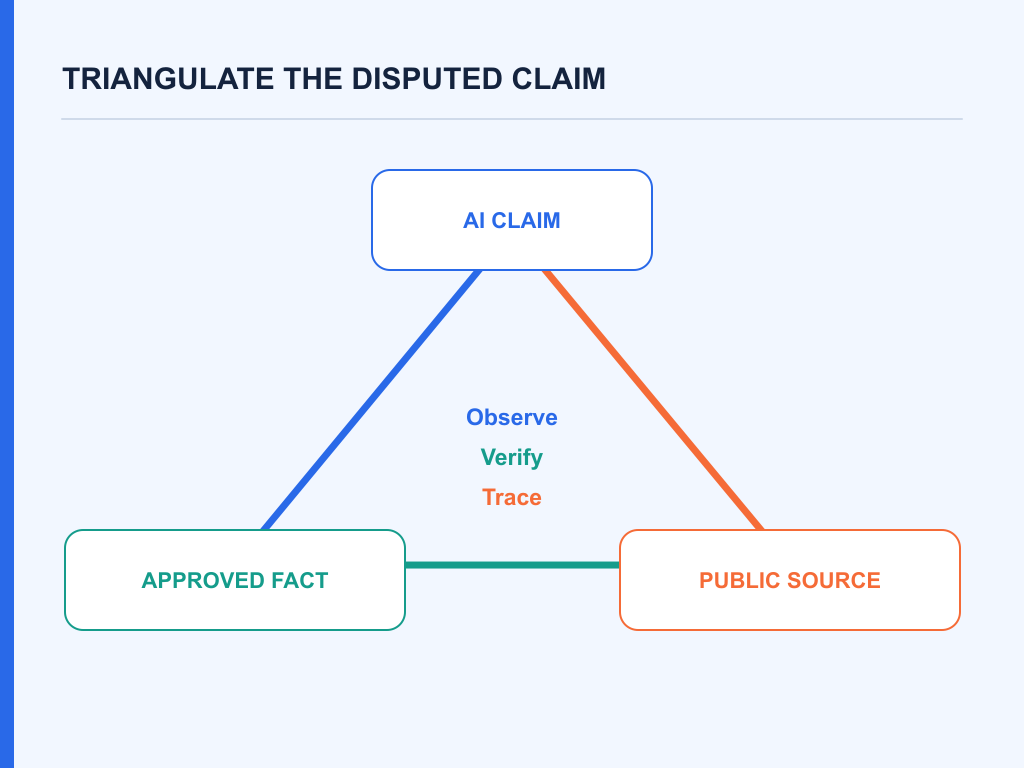
An audit of multilingual AI visibility should trace the disputed fact before trying to rewrite the answer. The key questions are which market the statement concerns, what the approved fact is, and which sources could have supplied the conflicting version. Build the audit around claims with owners and dates so corrections can reach the right system and be verified afterward.
Multilingual AI visibility errors need a fact-level record
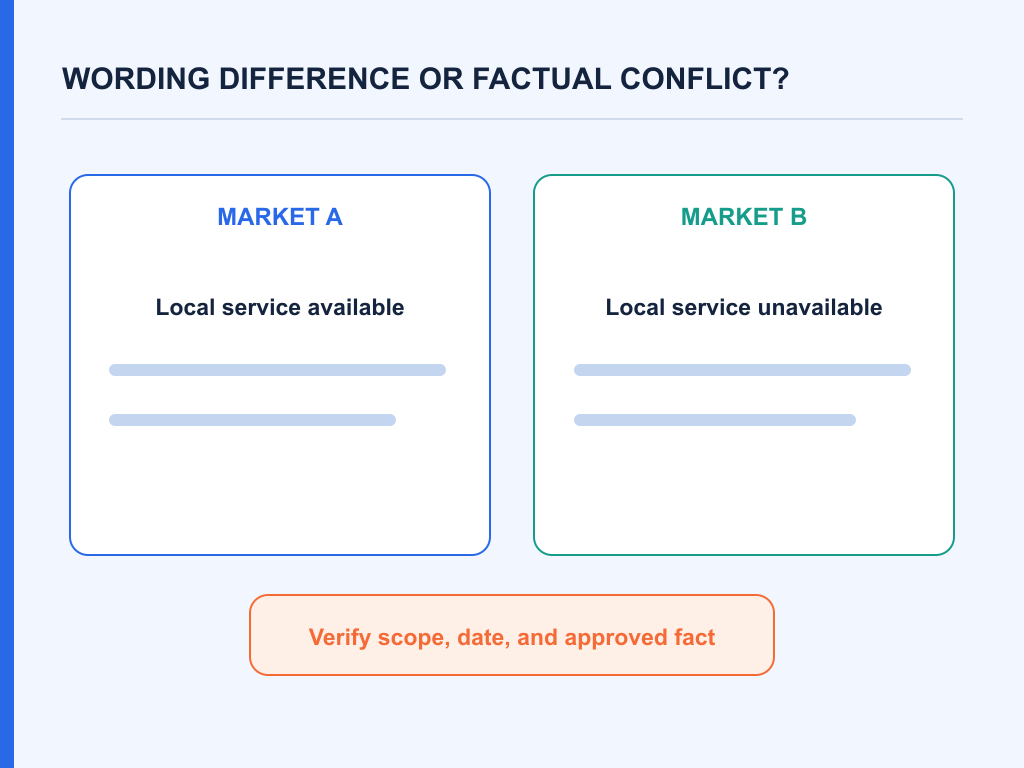
Record the exact claim, not a general complaint about sentiment. Product availability, integrations, support hours, shipping regions, pricing conditions, and eligibility rules can all vary legitimately by market. A negative description may be accurate in one context and misleading in another.
Start with the saved prompt and complete response. Preserve its language, market conditions, timestamp, engine, and visible citations. Keep any conclusion about the source of the mistake separate from the observed wording.
Create a short expected-fact statement approved by the responsible team. The statement should include the relevant region and effective date. A global marketing phrase is not an adequate reference when the dispute concerns a local commercial restriction.
Build a register for facts that change across markets
The register connects a claim to its owner and publishing surfaces. It should be small enough to maintain and specific enough to resolve the important buying questions. Begin with facts whose errors could materially alter a purchase or support decision.
Keep an invariant field for claims that should remain the same everywhere, and an exception field for approved local differences. This prevents reviewers from treating every wording difference as a factual defect. Natural phrasing can vary while meaning remains consistent.
Google’s people-first content guidance emphasizes accurate, useful information and clear evidence of how content was produced. Apply that principle to your own claim register: keep the basis for the statement visible to reviewers rather than relying on authority by repetition.
| Claim class | Example scope question | Correction owner |
|---|---|---|
| Availability | Is the product sold in this market? | Commercial operations |
| Integration | Is the capability supported for this version? | Product team |
| Support | Which hours and channels apply locally? | Customer operations |
| Policy | Which country and purchase conditions apply? | Approved policy owner |
| Identity | Is this a local alias or another company? | Brand operations |
| Historical statement | Was the claim true at the cited date? | Source and lifecycle owner |
Do not publish the private register wholesale. It may contain internal approvals or unreleased plans. Use it to verify the public statement, then publish only the information authorized for customers.
Trace the evidence without assuming a citation proves provenance
A visible citation is a useful lead, but it may not support every sentence around it. Open the source and locate the exact passage that would justify the disputed claim. Record whether it supports the statement, contradicts it, or leaves the issue unresolved.
Inspect official pages first, including translated help content, release notes, product pages, policy summaries, and old campaign destinations. Then review cited third-party sources. The same obsolete claim can persist through several copies even after one official page changes.
Distinguish current facts from historical reporting. An old launch announcement may accurately describe the product at that time while being unsuitable evidence for today’s availability. The correction may require a clearer current reference rather than deleting the historical record.
Call a source-path explanation a hypothesis unless the evidence supports it. A model can generate a claim that resembles an old page without exposing whether that page influenced the answer. Keep observed text, supporting sources, and inferred mechanisms in separate fields.
Prioritize by decision harm and recurrence
Treat factual accuracy separately from recommendation position. A brand can appear first while being described with an incorrect limitation. A lower position can still contain accurate information and useful citations.
Prioritize errors that would cause a buyer to choose an unsuitable product, expect an unavailable service, or misunderstand a material policy. Then consider how often the error recurs across comparable observations and how broad the affected market is. Avoid turning a single unusual response into a company-wide emergency.
Keep technical failures out of the factual-error denominator. A timeout, language-setting failure, or unavailable mode tells you something about measurement coverage. It does not establish that the system stated the wrong fact.
Accuracy is not a sentiment score.
For example, an illustrative software team might discover that a local page describes weekday support while an old global page still promises continuous coverage. The first action is to resolve the approved commitment for that market. Only then can the reviewer classify the generated answer as accurate, incomplete, or wrong.
Give the resulting issue a claim identifier and link its public surfaces. When another language later repeats the same contradiction, the team can recognize a shared source problem instead of opening an unrelated content ticket. This reduces duplicated investigation while preserving the local context that made the statement consequential.
Use a review queue with explicit states: observed, verified against the approved fact, source issue identified, corrected, and rechecked. A state should reflect evidence, not a team’s confidence that the problem probably disappeared. Assign a next review date to unresolved cases.
Correct the source network and preserve local meaning
Fix the authoritative public explanation first, then inspect dependent surfaces. A corrected product page can coexist with an outdated localized FAQ, feed, press page, or policy badge. List those surfaces as part of the issue rather than assuming a single edit propagates everywhere.
Ask local reviewers to verify the intended customer meaning. Translation can alter an obligation, qualification, or time reference without introducing an obvious grammatical error. Review the statement in the buying context, including units, currency, dates, and product version.
Maintain direct locale URLs and corresponding links. Google’s localized-version guidance describes how alternate pages can be associated in Search. These relationships help organize your own publishing inventory, but they do not guarantee that every answer engine will choose a particular local source.
Record the correction time and any cache or deployment delay. Recheck public delivery before evaluating the next observed answer. Otherwise, a monitoring report may blame a platform for repeating a claim that the corrected system has not yet served publicly.
For external sources, use the publisher’s normal correction process when appropriate and authorized. Do not manufacture supporting pages to outnumber an inconvenient claim. The goal is accurate evidence, including limitations that remain true.
Use Topify to maintain a focused verification panel
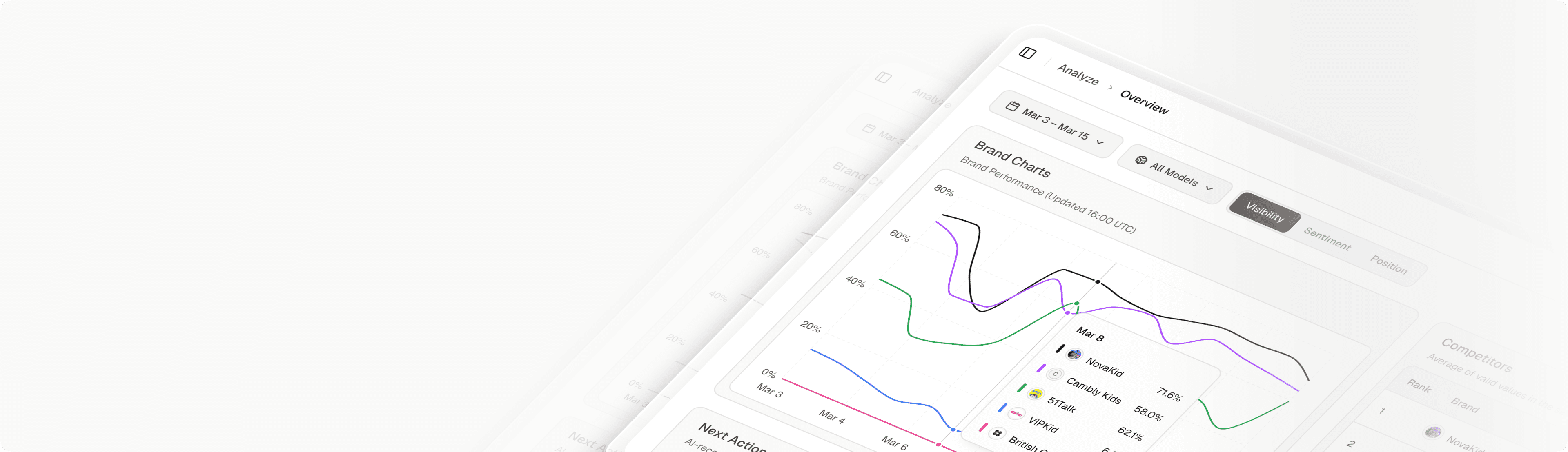
Topify can support repeated observation of the questions attached to verified issues. Supply the reviewed prompt, brand aliases, and relevant market context, then inspect mentions, positions, and cited sources in AI search analytics. Link each observation to the claim register so reviewers can tell whether the response preserves the approved local fact.
The useful output is an issue history: what was said, which source appeared, what changed publicly, and what later observations showed. Monitoring does not expose every internal retrieval decision or prove that a particular correction caused a response change. The related AI Prompt Gap Analysis: Find the Evidence Competitors Supply and You Do Not helps separate factual gaps from citation and recommendation gaps. Keep these classifications visible so the team can assign a source correction, product clarification, or further investigation rather than treating every unfavorable answer as the same problem.
Conclusion
A multilingual fact audit turns a vague complaint about AI answers into a claim that can be checked and owned. Preserve the response, define the approved market-specific fact, inspect the cited evidence, and distinguish historical information from current promises. Prioritize by customer consequence and recurrence.
Begin with a small register of high-value commercial facts and a reviewed set of local questions. Correct the public source network, verify production delivery, and retain the deployment timeline. Topify’s AI search analytics can then support a focused verification history. This gives regional teams a practical way to improve factual clarity while remaining candid about what an observed answer can and cannot reveal about its underlying cause.
FAQ
Is every cross-language wording difference an error?
No. Compare meaning, scope, and customer consequence. Different natural wording can express the same approved fact.
Does a citation identify the source of every claim?
No. Inspect the linked passage and label source-path explanations as hypotheses when direct support is missing.
Which facts should enter the register first?
Start with availability, compatibility, support, policies, and other claims that could materially change a customer’s decision.
How should a correction be verified?
Check the live public source first, record the deployment, and then repeat comparable answer observations over time.