A research publisher has a detailed paid report and a public landing page that says little beyond the title and a download button. Prospective readers cannot tell whether the work addresses their decision, and external summaries may become the most accessible explanation of what the research actually found. The publication protects the report but leaves its public evidence thin.
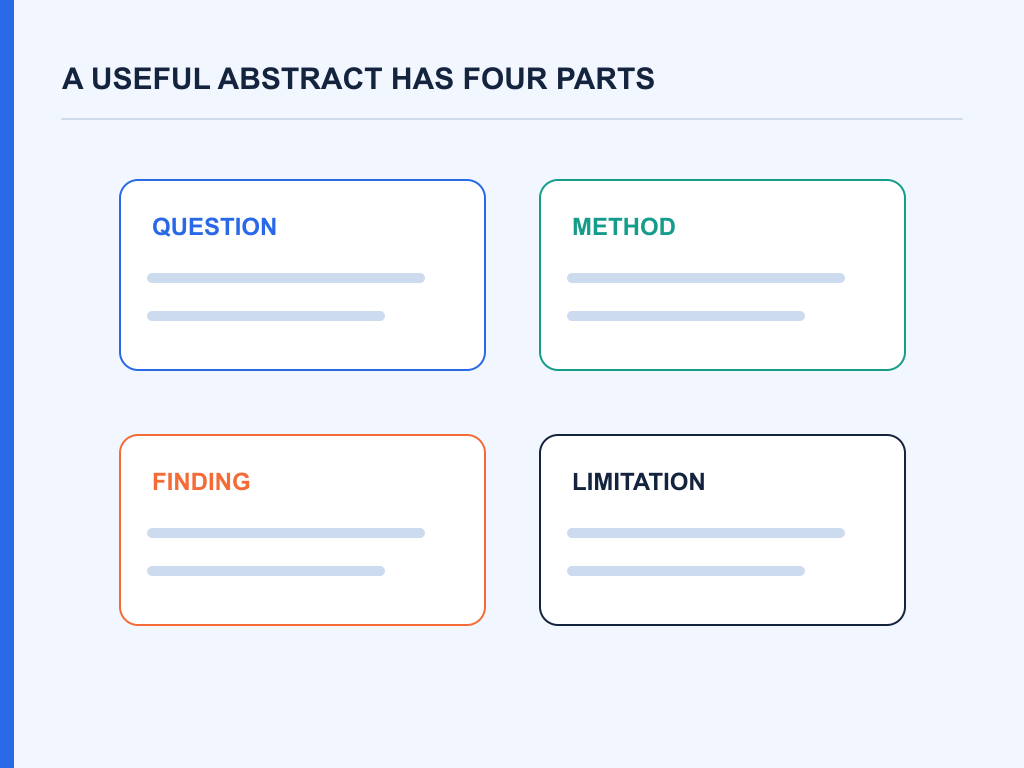
Paywalled content SEO can include a useful public research summary with a deliberately defined scope. The summary should explain the question, method, finding, and limitation well enough to support an informed decision about the full work. It should also make the boundary between public conclusions and premium analysis explicit, so discoverability does not depend on accidental disclosure or unsupported promotional claims.
Paywalled content SEO needs a public evidence decision
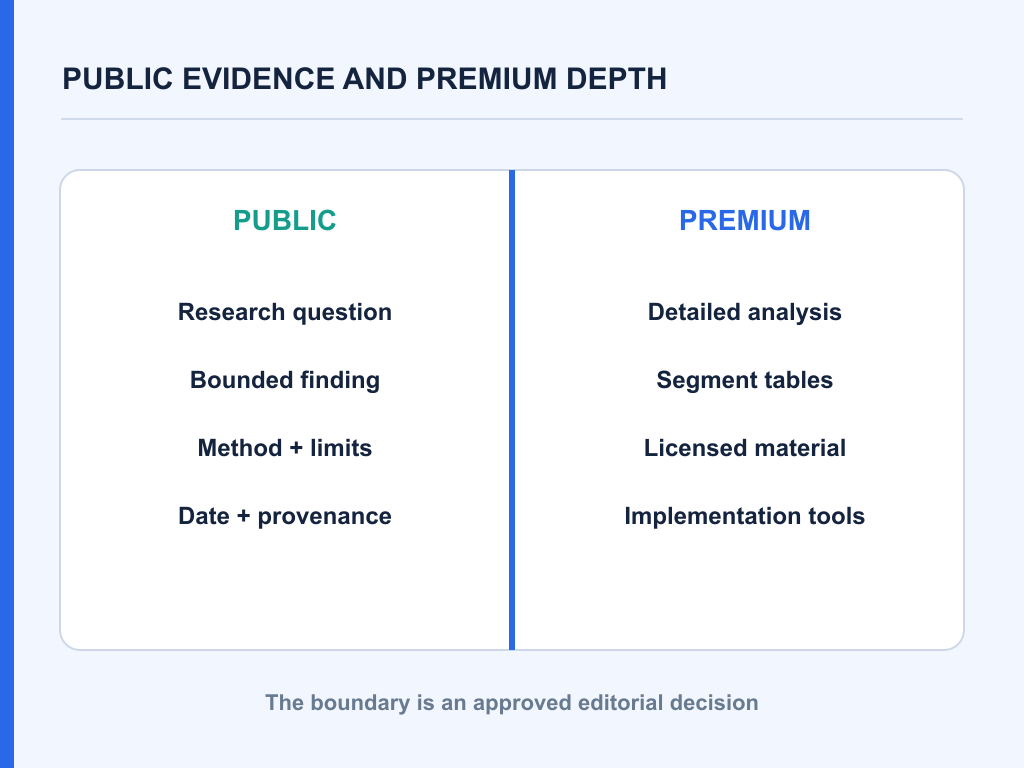
Decide which information the publication is willing to make independently useful. A public abstract can describe the research question and a limited finding without reproducing the entire analysis. The exact boundary belongs to the report’s editorial and commercial owners.
Avoid defining success as the largest possible excerpt. A shorter page that answers the right qualification questions can be more valuable than a long promotional summary that obscures the study’s scope. Give the reader enough evidence to judge relevance and limits.
Google’s people-first content guidance asks publishers to provide original value and explain relevant production methods. Use that principle to make the summary a credible research asset. Do not describe a synthesized opinion piece as a measured study merely because it sits beside a paid download.
Explain the research question before promoting the report
State the problem the study examined and the audience it concerns. Define the population, market, product category, or time interval where those boundaries affect interpretation. A finding without its scope is easy for both people and generated answers to overgeneralize.
Describe the method at a useful level. A survey, observational log analysis, controlled experiment, and expert review support different conclusions. Name the method honestly and explain what it cannot establish.
Keep any numerical claim attached to its denominator and observation period. If the report does not have a defensible measurement, publish the qualitative insight instead of inventing a percentage. A commercially attractive number is not a substitute for a reproducible basis.
Use a short limitations paragraph beside the key finding. Limitations belong in the public interpretation, not only in a premium appendix that the person quoting the claim cannot access. This reduces the chance that a carefully bounded result becomes a universal market statement.
Separate public claims from premium depth
A clear boundary can protect the report’s distinctive analysis while allowing the summary to stand on its own. Decide which examples, datasets, detailed cuts, implementation tools, or recommendations remain premium. Explain the additional value without implying that the public finding is incomplete or misleading.
| Element | Useful public treatment | Possible premium depth |
|---|---|---|
| Research question | Exact decision and scope | Extended literature or market context |
| Method | Design, period, and major limitations | Instrument, detailed protocol, or appendices |
| Main finding | Approved claim with denominator | Segment analysis and supporting tables |
| Interpretation | Bounded practical implication | Detailed recommendations and scenarios |
| Evidence provenance | Author, date, version, source basis | Licensed data and authorized raw material |
| Next step | Clear route to the complete report | Subscriber tools or advisory access |
Treat the right column as a commercial design option, not a universal formula. Some research should publish more methodology publicly, especially where reproducibility is central. Other material may have licensing restrictions that require a narrower summary.
Review the public page against the report’s actual findings. Marketing edits can remove qualifiers or combine results that were measured separately. Keep the research owner involved in the final claim review.
Make each claim easy to trace and cite accurately
Give the summary a stable URL and a clear title. Name the report, its author or responsible organization, publication date, and relevant version. Use a visible correction note when a substantive finding changes.
Place the main conclusion near the explanation that supports it. A reader should not need to combine a hero statistic, an image caption, and a hidden footnote to understand the result. Clear prose and a compact table can make the claim easier to quote with its limits intact.
Distinguish measured results from recommendations. An observed association does not establish a causal effect, and a planning scenario is not a forecast. Mark illustrative examples as illustrative so they do not become apparent customer outcomes in later summaries.
The summary should survive being read alone.
Use an independent reader as a final check. Ask them to state what was studied, what was found, and what the result does not establish, using only the public page. When the answers differ materially from the research owner’s interpretation, revise the summary before promotion. This is a practical editorial test, not a claim about how any particular search system ranks the page.
Link directly to the complete report or its authorized access page. The destination should preserve the report identity and explain the access requirement. Sending every link to a generic subscription home page creates unnecessary uncertainty for a reader who has already decided the research is relevant.
Maintain the abstract as a published research asset
Assign an owner and a review event. A report revision, a correction, a new edition, or a material change in the underlying product can make the abstract stale. Keep the public summary and the paid document on the same versioning schedule.
Test the public page from a fresh session. Confirm that the approved summary remains accessible, the access route works, and restricted material is not accidentally included in the anonymous response. Google’s paywalled-content guidance explains the structured representation of restricted sections when publishers want the relevant content indexed.
Avoid duplicating nearly identical abstracts across campaign URLs. Keep a stable research destination and use campaign tracking appropriately. If an older edition remains public, label its date and relationship to the current edition clearly.
Check image text, downloadable previews, and translated versions during updates. These surfaces often preserve old findings after the primary body changes. A corrected paragraph does not repair a superseded chart that is still shared publicly.
Use the publication’s analytics to measure qualified visits and report-access actions. Those outcomes describe the page’s commercial usefulness, while answer monitoring describes external representation. They should inform each other without being treated as the same metric.
Observe which research claims appear in public answers
Build questions from the study’s actual scope. Ask about the decision the research examined, the method, and the bounded finding. Record whether answers identify the publication, preserve the denominator, and cite the correct version.
Topify can support this ongoing observation. Supply a stable panel of topic and research questions, then review brand mentions, answer positions, and cited URLs through AI search analytics. Compare observed statements with the approved public claim register and flag answers that omit a material limitation, cite an obsolete edition, or attribute the finding elsewhere. The useful output is a prioritized source and abstract review queue.
The workflow does not establish that a summary caused a citation or a subscription, and it does not expose every source used internally by an answer system. Pair the observations with page analytics and the publication timeline. The related AI Prompt Gap Analysis: Find the Evidence Competitors Supply and You Do Not helps distinguish a missing public explanation from a different recommendation outcome. Correct the evidence first, then evaluate comparable observations over time without promising a guaranteed discovery lift.
Conclusion
A public research summary should let readers understand the question, method, finding, and limitation before deciding whether the full report is relevant. Define the public and premium boundary deliberately, preserve provenance, and keep the summary aligned with the current report version. A useful abstract can protect commercial depth while providing credible public evidence.
Choose one report whose landing page currently offers little context. Approve a bounded claim set, publish a stable summary, and test the access journey. Use Topify’s AI search analytics to observe how public answers describe and cite that research, alongside your own referral and access metrics. The next improvement should follow the evidence, whether it concerns claim clarity, source freshness, or the reader’s route to the complete work.
FAQ
How much of a paid report should the summary reveal?
Enough to explain relevance, method, a bounded finding, and limitations. The publication should approve the exact commercial and licensing boundary.
Should every public summary contain a statistic?
No. Publish numbers only when the research supports them and the denominator and period can be explained accurately.
Can the summary be a separate useful page?
Yes. Give it a stable URL, clear provenance, and an explicit route to the complete report rather than treating it as an empty teaser.
Does a public abstract guarantee AI citations?
No. Observe actual answers, maintain accurate sources, and assess referral and access outcomes separately.