A regional team has translated a complete product library, yet a fresh visitor is repeatedly redirected to the default language. Employees can reach the localized pages because their cookies remember the right setting. A crawler or answer system arriving without that state may encounter a different document, an incomplete selector, or no useful route to the local content.
Multilingual AI visibility requires a delivery check before a content-volume decision. A translated page must be addressable, internally discoverable, and consistent with its declared relationships. The immediate task is to verify what a new request actually receives, then separate URL delivery problems from language quality and observed answer behavior.
Multilingual AI visibility needs a reproducible local destination
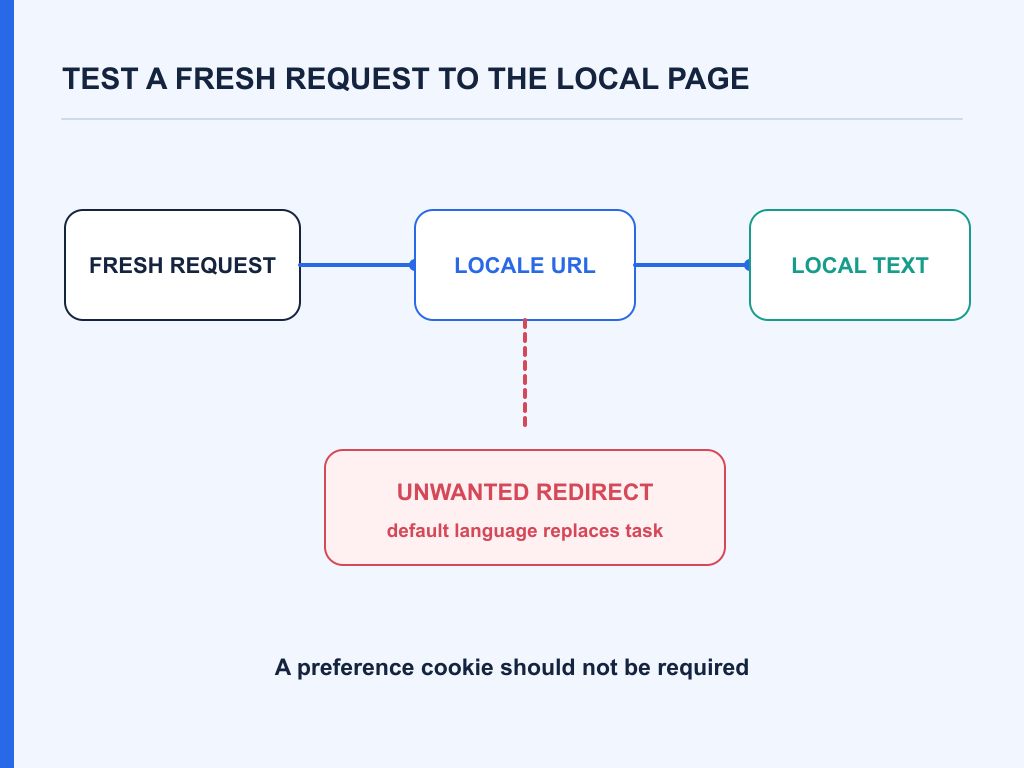
Start with a direct URL for every important localized page. Open it without an existing session and record the response, redirects, visible language, and selected market. A translated document that requires prior navigation is harder to use as a dependable discovery destination.
Google’s locale-adaptive crawling guidance explains that IP-based or preferred-language delivery can leave some locales uncrawled or unindexed. It recommends separate locale URL configurations with hreflang annotations. This is documented Google behavior; do not assume every other crawler follows the same pattern.
Use that limitation to design tests rather than to invent a universal AI crawler rule. Compare requests with and without language preferences and from the markets your team can legitimately test. Record which conditions alter the content and whether a direct locale URL remains stable.
Keep navigation independent of remembered preferences
A language selector should expose usable destinations. Confirm that a visitor can move to the corresponding page in another language, not only to that language’s home page. The same-task destination is especially useful when a buyer is comparing specifications or support instructions.
Avoid making a cookie the only source of language identity. A preference can improve convenience, but it should not make a copied URL ambiguous. Test a saved link in a fresh browser and after switching markets.
Google’s multi-regional and multilingual guidance recommends distinct URLs for language versions. Plan the relationship at the content level so templates do not invent alternate pages that do not exist. A nonexistent translation should not be linked as though it were complete.
Also inspect consent and location overlays. They may prevent the main content from being seen or lead users into an unintended market selection. A successful status code is only the beginning of the access test.
Hreflang describes relationships rather than translating content
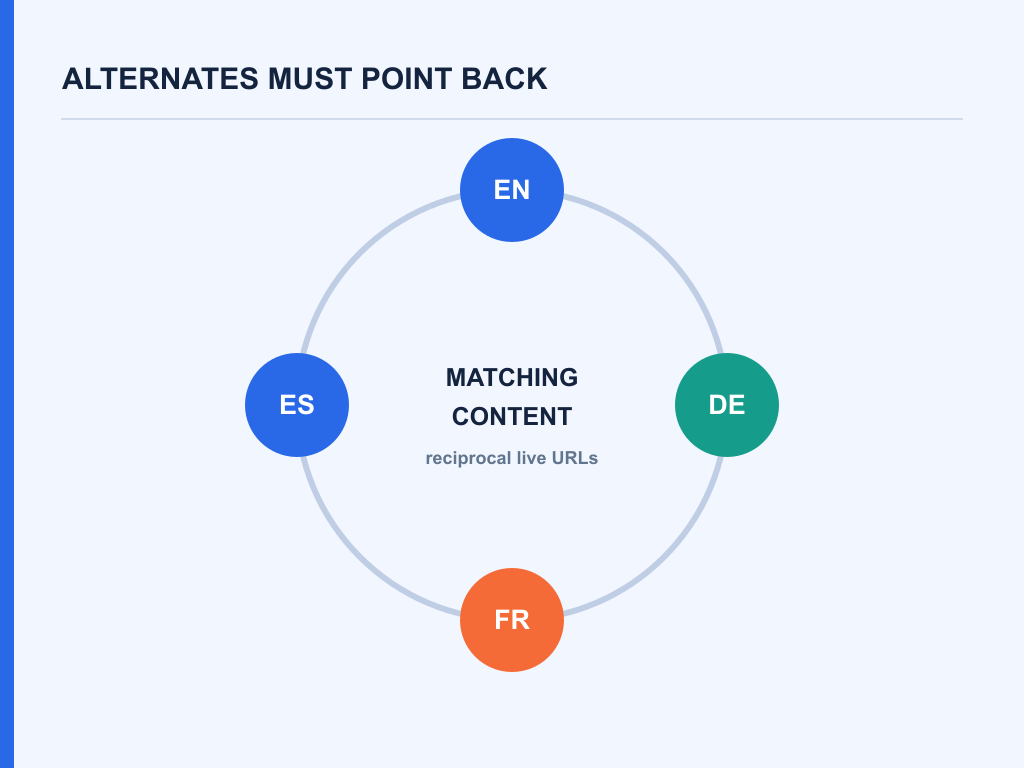
Hreflang annotations identify alternate versions. They do not translate the body or repair an incorrect locale destination. A reciprocal relationship should connect pages that serve the corresponding content in their intended languages or regions.
Google’s localized-version requirements describe self-references, fully qualified alternate URLs, and reciprocal links. It supports HTML, HTTP headers, and sitemaps as equivalent methods for this purpose. Choose the implementation your team can maintain reliably.
Keep the alternate map near the content inventory. When a page is added, removed, or redirected, update the relationships deliberately. A language rollout is incomplete if navigation changes while the alternate graph still references retired destinations.
The relationship must match the destination.
Separate language, canonical preference, and market targeting
These controls answer different questions. The document language helps software process the text, alternate relationships connect local versions, and canonicalization addresses duplicate-page representation. Treating them as interchangeable can make a technical report appear complete while the intended page remains unclear.
| Control or signal | Primary question | Check against |
|---|---|---|
| Stable locale URL | Can the document be addressed directly? | Fresh-session arrival |
| HTML language declaration | What language is this text? | Actual document content |
| Hreflang relationship | Which versions are alternates? | Reciprocal live destinations |
| Canonical declaration | Which URL represents overlapping content? | Current architecture and duplication |
| Market information | Where is the offering relevant? | Availability and local business facts |
| Answer observation | Which source was used in this response? | Saved prompt and cited URL |
The W3C’s language declaration guidance recommends declaring the default language on the html element and marking changes where needed. Google’s documentation separately explains that hreflang and the HTML lang attribute are not its method for detecting the page’s language. Preserve that distinction when explaining the implementation to stakeholders.
Do not force every translated page to point canonically to the source-language page as a routine cleanup. Review the actual content and current international guidance before choosing canonical behavior. A sitewide rule can erase the intended distinction between useful local destinations.
Test production delivery as a matrix
Choose priority pages from different templates: product, comparison, support, policy, and editorial. Include a newly translated page, an older localized page, and a page with a retired alternate. This exposes both current publishing defects and historical relationship drift.
For each page, record requested URL, final URL, HTTP status, visible language, canonical, alternates, internal links, and any location-dependent content. Keep initial HTML and rendered observations when the site relies on client-side delivery. A page may look correct after scripts execute while its initial metadata belongs to another locale.
Test market switching without losing the task. A product or help article should ideally take the visitor to the corresponding available destination. When no equivalent exists, give a clear choice rather than silently substituting unrelated content.
Use URL Inspection and relevant Search Console reports for Google-specific verification where authorized. Do not treat an indexed page as proof that another platform has retrieved it. Keep platform observations separate from your site’s direct delivery evidence.
Assign a recurring owner for the locale inventory. The initial rollout team may disappear while new pages continue to be added, so maintenance needs to be part of normal publishing. A lightweight preflight check can prevent broken relationships from accumulating.
Use one controlled example to make a defect reproducible. Record a localized support article that opens correctly for an employee but redirects in an anonymous session, then attach both request paths and the expected corresponding page. The engineering team can reproduce the delivery difference without debating translation quality.
After the fix, repeat the same requests and inspect an adjacent page from the template. This checks whether the change restored the intended route and whether it introduced a new redirect rule elsewhere. Preserve the example in the publishing checklist so future locale launches inherit a concrete test rather than an instruction to check international SEO generally.
Observe whether local answers use the intended pages
Once delivery is coherent, test questions that should be answerable from the localized pages. Record the cited language and destination, along with whether the answer preserves important market facts. A source in another language is not automatically wrong, but it may reveal a useful investigation.
Topify can maintain a reviewed panel of local questions and competitors for ongoing observation. Use AI search analytics to examine mentions, positions, and cited sources, then compare those sources with your locale inventory. The output can show where a local product or policy explanation is absent from observed answers despite being available on the site.
This monitoring does not validate hreflang or prove that an alternate-tag correction caused a citation change. Retain deployment dates and direct URL tests alongside the answer record. The related AI Prompt Gap Analysis: Find the Evidence Competitors Supply and You Do Not helps distinguish missing evidence from a different recommendation choice. Use those distinctions to route work to engineering, localization, or content owners rather than translating additional pages by default.
Conclusion
Accessible locale URLs are a foundation for useful multilingual discovery. Verify fresh-session delivery, maintain task-preserving navigation, and keep alternate relationships aligned with real pages. Language declarations, canonical preferences, and market facts should each express their own purpose.
Audit a representative set of live templates before commissioning another translation wave. Fix direct-access and relationship defects, document their deployment, and then observe actual local answers with Topify’s AI search analytics. This sequence helps the team determine whether a gap begins with delivery, evidence, or the platform’s observed response. It also gives regional colleagues a concrete record they can use to improve the next publishing release.
FAQ
Does hreflang translate a page?
No. It describes alternate versions that already exist. The content still needs to be translated and served correctly.
Is a language cookie enough?
It can store a preference, but it should not be the only way to reach a localized document. Test stable direct URLs without the cookie.
Can a page be accessible but absent from an AI answer?
Yes. Accessibility establishes a delivery condition, not a guarantee of retrieval, citation, or recommendation.
Which pages should be tested first?
Start with priority product, comparison, policy, and support templates, including new and retired alternate relationships.