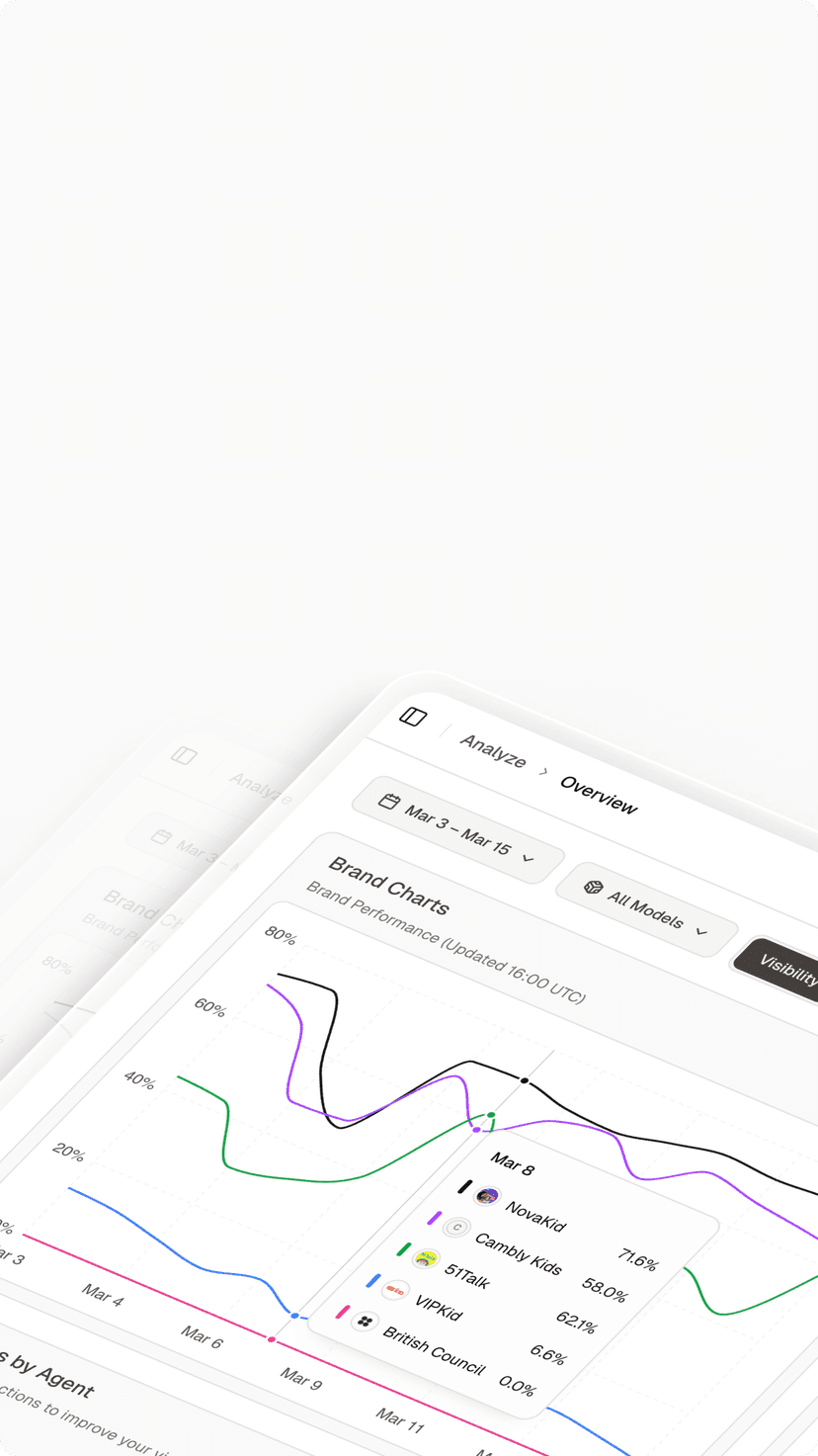
An international growth team sees a strong global visibility average while one priority market barely appears in the underlying sample. The largest English prompt set dominates the score, translated questions describe different buying situations, and a regional product restriction is treated as a brand omission. The number looks comparable before the measurement design has made it comparable.
Multilingual AI visibility needs a benchmark built around equivalent decisions and explicit market conditions. Language, location, product availability, and prompt intent should remain visible in the record. Start by deciding what you want to compare, then build a panel that can distinguish genuine market gaps from differences introduced by the test itself.
Multilingual AI visibility starts with equivalent buying decisions
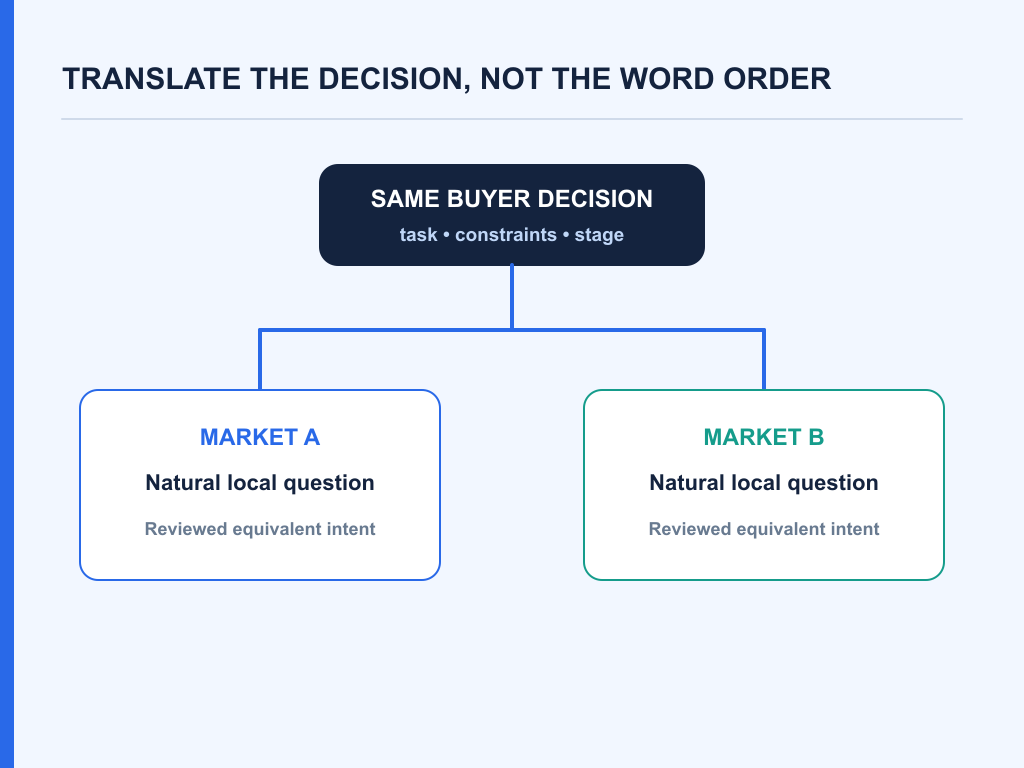
A literal translation does not always preserve intent. A phrase that implies a procurement shortlist in one market may sound like a general definition in another. Ask local reviewers whether each question represents the same decision, level of knowledge, and commercial constraint.
Use a master decision brief rather than an English sentence as the source of truth. It should name the reader, problem, product category, required attributes, and buying stage. Translators can then write natural questions that preserve the task instead of the word order.
Google’s explanation of multilingual search shows why display language alone does not determine the language of results. For measurement, keep prompt language and market context as separate fields. Apply that discipline when observing other engines without assuming their mechanisms are identical.
Keep language, market, and availability separate
One language can serve several markets, and a single market can contain several common search languages. A global panel that collapses these dimensions cannot tell whether the team needs localization, distribution changes, or a different sampling design.
Document product eligibility for each market before scoring absence. A service that is not sold in a country may reasonably fail a local recommendation prompt. That should not automatically be counted as a content defect or an unexplained visibility loss.
Keep currency, delivery region, supported language, and local competitors in the prompt brief where relevant. These conditions can change the buying decision materially. Record them as intentional design choices, not hidden text variations introduced during translation.
| Dimension | Keep fixed when comparing | Record separately |
|---|---|---|
| Buyer decision | Same job and funnel stage | Natural local wording |
| Product requirements | Equivalent constraints | Legitimate market differences |
| Observation conditions | Comparable engine and mode | Date, locale, and availability |
| Brand identity | Same entity and approved aliases | Local names and transliterations |
| Scoring | Same definitions | Market-specific sample sizes |
| Commercial weighting | Explicit approved policy | Raw unweighted results |
The comparison should make its assumptions inspectable. A market lead should be able to explain why a question is in the panel and what a positive result means. When that explanation is difficult, revise the brief before collecting more answers.
Design repeated observations before calculating a score
One response is evidence of one observed answer. Build a repeat schedule that fits the volatility and business importance of the topic, then keep the schedule stable long enough to compare like with like. Do not describe a small convenience panel as the entire market.
Record prompt version, engine, available mode, language, market, timestamp, cited URLs, brand mentions, and relevant factual claims. Preserve the complete response where permitted. A summary score without the underlying answer makes disagreement hard to investigate.
Use a defined rule for failed or unavailable observations. A timeout is not a negative brand recommendation, and an unsupported market setting is not equivalent to a completed local test. Keep those cases out of the outcome denominator and report them as coverage limitations.
Also control conversation state. A question asked after several brand-specific messages has a different context from the same question in a fresh session. Choose the observation method deliberately and document it consistently.
Comparability comes from the protocol.
Run a rehearsal before treating the panel as a baseline. Ask two local reviewers to classify the same small set of prompts by buyer stage and required outcome. When their classifications disagree, revise the decision brief and retain the reason for the change.
Freeze the reviewed version for the first observation window. New questions can enter an exploratory panel, but keep them separate from the stable comparison until the next planned revision. This gives the team room to learn without silently changing the denominator behind an executive trend chart. A simple version history is often more useful than a more elaborate aggregate score.
Report the denominator before the global average
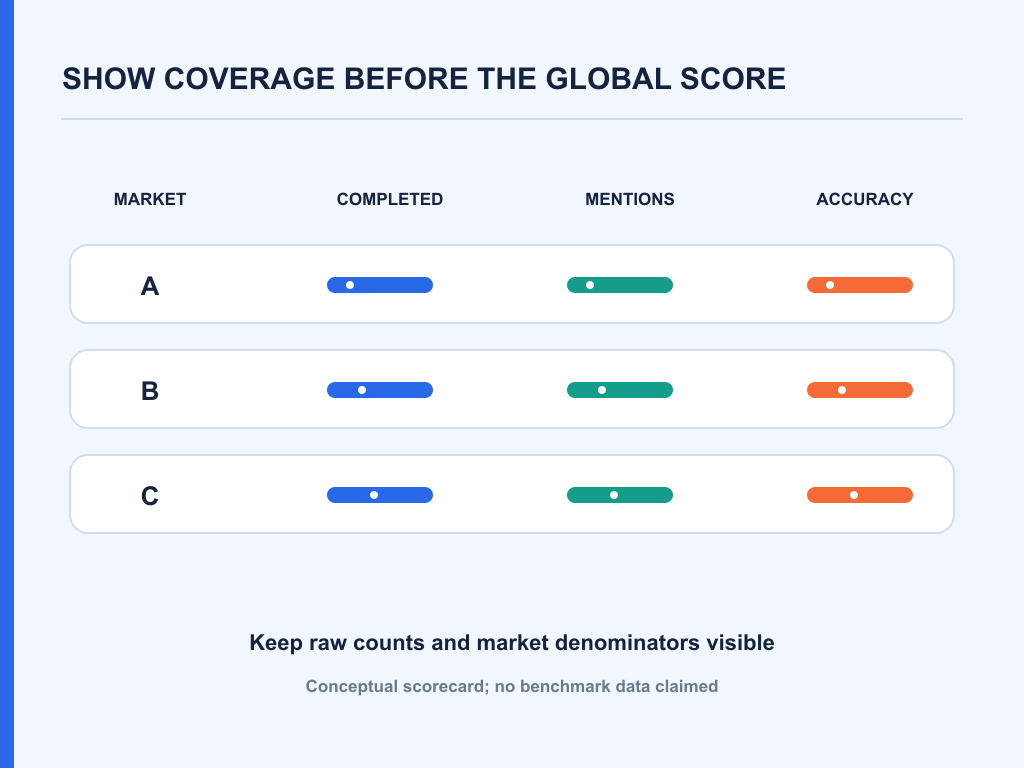
Show each market’s sample size and coverage before reporting an aggregate. A global score can rise simply because more observations were added from a strong market. Keep a stable-panel view beside any expanded-panel view so this effect remains visible.
Separate brand presence, recommendation position, citation presence, and factual accuracy. An answer can mention the brand while citing an unrelated source or misstating a local limitation. Combining those outcomes into one success flag hides useful decisions.
If the business needs a weighted aggregate, agree on the weights before reviewing the results. Revenue, strategic priority, or eligible audience can support different weighting choices. Label the result as a business-weighted view rather than a neutral measure of all demand.
Show raw counts with percentages for small panels. An illustrative result of two mentions out of four answers has much less information than a stable pattern across a broader set of comparable decisions. The percentage alone does not communicate that limitation.
Investigate gaps before commissioning more translations
A weak market result can originate in several places: unavailable product coverage, missing local evidence, poor URL delivery, entity ambiguity, or a different competitor set. Review the cited sources and the actual wording before assigning a content brief.
Google’s multi-regional site guidance distinguishes multilingual and multi-regional websites. That distinction is useful operationally even when the observation concerns another platform. Translating text does not automatically resolve a market-specific offering or access problem.
Create a case note for each important gap. State the expected decision, observed answer, relevant source, local business truth, and next verification step. The note should be precise enough to route to localization, product marketing, engineering, or distribution.
Do not infer causality from a simultaneous content release and score change. Check whether the prompt panel, engine behavior, product availability, or sample coverage changed too. Keep uncertain explanations labeled as hypotheses until the supporting evidence improves.
Use Topify to keep the observation workflow consistent
Topify can support the ongoing measurement layer. Supply a reviewed panel of decision-equivalent questions, approved brand aliases, and relevant competitors, then inspect results using AI search analytics. Its current product changelog describes multi-region prompt tracking, which provides a practical reason to keep market and language settings explicit in the measurement plan.
Use the resulting mentions, positions, and cited sources to assemble a market-level investigation queue. Compare stable subsets and review the underlying answers before concluding that a localization project succeeded or failed. Topify’s sampled observations do not establish total audience demand, and available engines or locale controls should be checked for the intended setup. The related AI Prompt Gap Analysis: Find the Evidence Competitors Supply and You Do Not provides a useful way to classify missing evidence and recommendation gaps without turning every omission into a translation assignment.
Give each market lead an opportunity to review high-priority cases. Their role is to verify commercial context and natural intent, not to rewrite an unfavorable answer into a positive result. Preserve disagreements in the record so the benchmark can improve transparently.
Conclusion
A fair multilingual benchmark compares equivalent decisions under explicit market conditions. Start with reviewed briefs, keep language separate from location and availability, and preserve the denominator behind every score. Repeated observations and source-level review make the result useful for operational decisions.
Pilot the protocol in two priority markets before expanding it globally. Agree on scoring, failed-observation handling, and any business weights in advance. Use Topify’s AI search analytics to maintain the observation workflow, then route individual gaps to the team that owns the underlying problem. The objective is a defensible comparison that tells each market what to investigate next, rather than a global average that disguises different questions and uneven coverage.
FAQ
Should prompts be translated word for word?
No. Preserve the decision and constraints while allowing natural local phrasing. Use a native-language reviewer for important markets.
Is prompt language the same as target market?
No. Record both. Availability, currency, local competitors, and audience context can differ within the same language.
Should failed observations count as absent mentions?
No. Report technical failures and unsupported conditions separately from completed answers.
Can one global percentage summarize performance?
It can be a labeled aggregate, but retain market-level sample sizes, raw counts, and stable-panel comparisons alongside it.