A seasonal campaign can extend the return window while a clearance collection keeps its ordinary restrictions. Customer support knows the distinction, but the product badge, policy page, merchant configuration, and translated help center may each describe a different rule. The resulting confusion can persist after the campaign ends because older descriptions remain easy to find.
A merchant return policy audit before holiday shopping should test dates, scope, and the actual customer explanation together. The deliverable is a resolved policy for representative orders, not a screenshot showing that an exception was saved. Work backward from the decisions a shopper or support agent must make, then verify every system that publishes the answer.
A merchant return policy audit begins with an order scenario
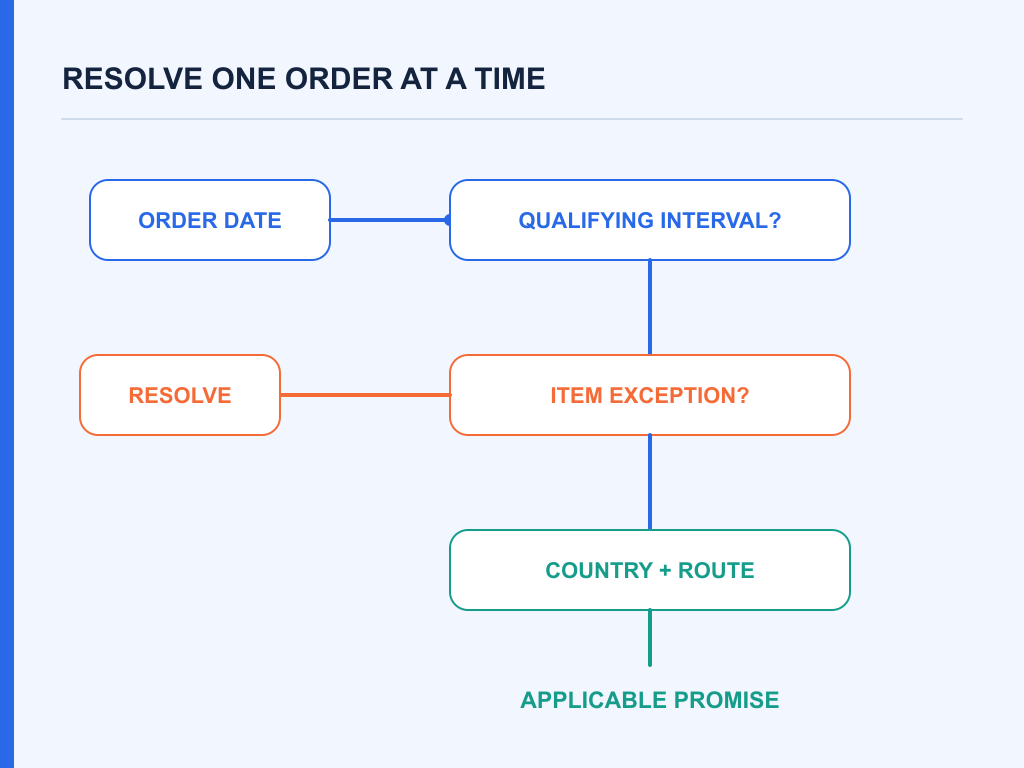
Define the purchase conditions before inspecting settings. An order scenario should identify the item, customer country, order date, delivery context, return reason, and proposed return route. These fields prevent a broad seasonal statement from being mistaken for a universal rule.
Include ordinary products and products with exceptions. A gift campaign may cover most stocked merchandise while personalized, hygiene-sensitive, or final-sale items have different approved terms. The exact policy requires the business’s qualified owner; the audit checks that published representations follow that approved rule.
Write an expected outcome for each scenario in plain English. Ask the policy owner to approve those outcomes before engineers translate them into configuration. A technically accurate implementation of an ambiguous requirement remains ambiguous for the customer.
Separate the purchase interval from the return deadline
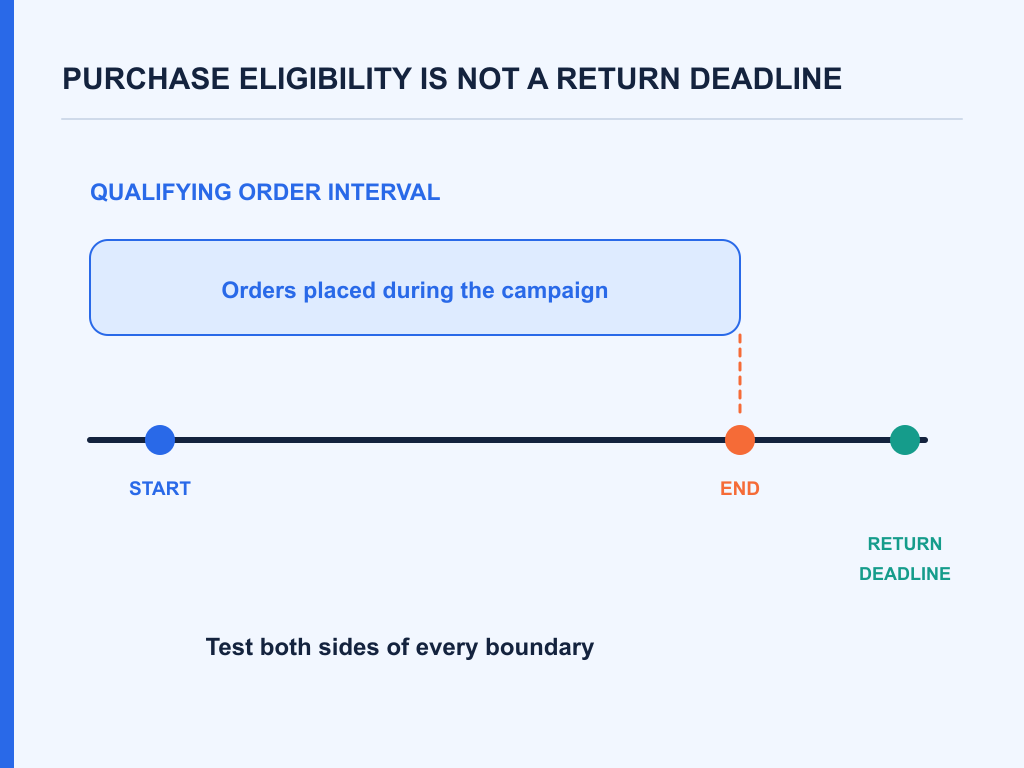
A seasonal rule can describe which orders qualify and how long those orders remain returnable. These are different dates. Confusing them can shorten or extend the intended promise without anyone changing the visible headline.
Google’s return-policy structured data includes a seasonal-override model. Its Merchant Center instructions for exceptions also describe exceptions for specific products or dates. Use the current requirements for the surface you are configuring rather than assuming the fields are interchangeable.
Test the day before the qualifying interval, the first qualifying day, the final qualifying day, and the day after. Also test the return deadline itself. State the governing timezone and the event from which any rolling window is calculated.
Dates are part of the offer.
Ask a support reviewer to resolve a boundary case without seeing the configuration screen. Give them the public policy and an illustrative order date, then compare their answer with the approved scenario. A disagreement reveals an explanation problem before customers encounter it. Keep the test focused on the policy meaning, not on whether staff can memorize internal labels.
Keep an annotated calendar in the release record. It should show order eligibility separately from the deadline customers see. This allows reviewers to catch an inversion or stale year without reading implementation code.
Build an exception matrix before touching configuration
Use the matrix to expose combinations that the broad campaign copy hides. The table should resolve the relevant rule instead of listing every possible property. Add a row whenever a real customer situation changes the answer.
| Scenario | Question to resolve | Evidence needed |
|---|---|---|
| Standard item bought during the campaign | Does the seasonal window apply? | Approved interval and item eligibility |
| Final-sale item during the campaign | Is the item excluded? | Product-specific rule and visible notice |
| Order placed before the start date | Does the ordinary policy remain active? | Boundary test and archived copy |
| Return requested after campaign end | Is the original seasonal promise preserved? | Order-date resolution and policy version |
| Cross-border customer | Which route and fee apply? | Country-specific policy and instructions |
| Defective item | Does a separate policy govern? | Approved distinction and support guidance |
Do not hide a meaningful exception in a generic legal footer. The audit should check whether the customer can discover the limitation while making the purchase. A clear policy page cannot compensate for an unqualified product-level promise.
Check missing and retired labels as deliberate negative tests. Google’s invalid return policy label guidance describes a default-policy fallback when a matching label is not found. A populated field is therefore not proof that the intended exception applies.
Reconcile public copy and merchant data at the same time
Inspect the product destination, support policy, structured data, merchant account, and relevant feed entries. Keep timestamps because each surface may update on a different schedule. The audit should be able to distinguish an intentional release sequence from an unresolved contradiction.
Compare the exact statements customers can quote. A banner saying free returns, a help page assigning postage to the buyer, and a product badge saying extended returns may all need clarification. Record the conflicting phrases and their locations rather than filing a vague consistency issue.
Translate the policy meaning as well as the words. A localized page may preserve an outdated calendar date or use a different starting event for the return window. Have a market reviewer verify the customer outcome, not only grammar and terminology.
Check direct access from a fresh browser session. Country redirects, consent layers, and help-center search can make a policy difficult to reach even when an employee’s bookmarked view works. Test the link a customer actually receives from the product page or confirmation email.
Plan activation, monitoring, and expiration together
Name one release owner and one policy approver. Record the deployment sequence, expected propagation time, and rollback trigger. A seasonal setting should have an expiration plan before it is activated.
After launch, inspect a small set of qualifying and nonqualifying scenarios. Repeat the check when the campaign ends, then confirm that older orders still resolve to their original approved terms. Removing a public promotion should not erase the support record needed for previous purchases.
Preserve prior policy pages or internal versions in a controlled archive. The archive should help staff answer historical questions without creating confusing public duplicates. Define which current URL is the authoritative customer destination.
Create an exception route for unexpected conflicts. Support should know where to report a mismatch and which evidence to attach: order context, product URL, quoted statement, and inspection time. The policy owner then resolves the rule while engineering corrects its publication.
The campaign is not finished when the banner disappears.
Review the incident log after the season. Repeated confusion about the same fee, route, or date often points to a policy-model problem rather than a copy-editing problem. Fix that model before carrying it into the next promotion.
Track policy accuracy in generated shopping answers
Build a small question panel around the seasonal conditions that matter. Include a product exception and a market-specific case instead of asking only a generic question about the store’s returns. Save the answer and the source it uses so a wrong claim can be traced.
Topify can support repeatable answer observation during the campaign. Use a fixed set of policy-sensitive buying prompts and review mentions, positions, and cited sources in AI search analytics. Compare the observed claim with the approved scenario matrix and identify answers that omit a material limitation or repeat a retired promise. That creates an evidence-based queue for policy-page and source investigations.
This workflow does not establish an individual customer’s rights or replace support’s order-level resolution. A generated answer can remain stale after the merchant’s own surfaces are corrected, and monitoring does not prove the cause of the delay. The related AI Prompt Gap Analysis: Find the Evidence Competitors Supply and You Do Not helps distinguish a source gap from a recommendation gap. Keep the policy record, release timeline, and observed answers together when deciding what to investigate next.
Conclusion
A holiday return audit should resolve representative orders across dates, products, countries, and methods. Approve the scenarios first, then verify that public copy and merchant data express the same rule. Test campaign activation and expiration, preserve historical policy versions, and give support a clear escalation path for conflicts.
Choose a small set of high-risk scenarios before the next seasonal launch and retain evidence from every publication surface. After deployment, use Topify’s AI search analytics to observe whether shopping answers repeat the current promise accurately. The goal is a policy that remains understandable throughout the customer journey, including the period after the promotional artwork and campaign banners have been removed.
FAQ
What is the most common date ambiguity to check?
Separate the interval in which purchases qualify from the deadline or rolling window in which returns are accepted.
Should holiday rules automatically apply to all products?
Only when that matches the approved business policy. Test exclusions explicitly and make them clear at the purchase decision point.
What should happen when the campaign ends?
Current promotional copy should update, while staff retain the policy version needed to resolve orders placed during the campaign.
Can monitoring prove every policy source has updated?
No. Inspect the merchant’s own systems directly and use answer monitoring to observe external descriptions and cited evidence.