A revenue operations analyst checks an answer that compares two products. Every quoted number appears in the linked tables, yet one price is per user per month and the other is per team with annual billing. A footnote changes the minimum commitment, and the answer never mentions it. The citations are present while the comparison remains unreliable.
LLM citation tracking should preserve the context that gives a table value its meaning. A number needs a row, a column, a unit, a period, and any applicable condition before it can support a decision. The analyst’s task is to recover those relationships, distinguish quoted values from calculations, and decide whether the answer’s comparison remains valid.
Define a Table Claim in LLM Citation Tracking
Begin with the complete claim made by the answer. “Product A costs less” requires more evidence than “the table contains the number 20.” The first statement depends on comparable pricing units and conditions; the second merely locates a value.
Use a proposed evidence tuple for each material number: source URL, table location, row label, column label, value, unit, period, condition, and review time. The tuple is an analyst record, not a promise that a monitoring tool exports each field. Preserve unknown elements explicitly.
Choose the review scope from the decision. A purchase comparison needs billing basis and eligibility, while a performance comparison needs workload, metric definition, and sample conditions. A numeric match cannot compensate for missing context that changes which option is preferable.
Separate the source’s statement from the answer’s interpretation. Record the original value and its context first, then record the proposition the answer builds from it. That makes it possible to identify whether the failure lies in extraction, conversion, or the final conclusion.
A number is evidence only within its scope.
Recover the Header Relationships
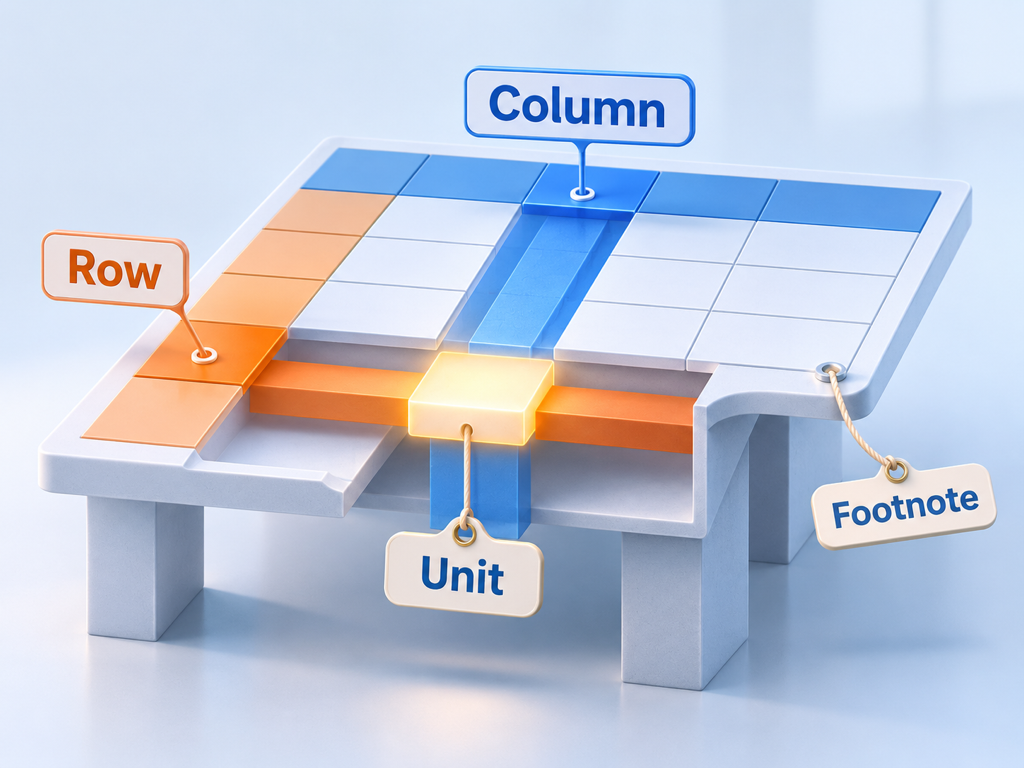
Find the headers that apply to the cited cell. A visually adjacent label is not always the correct one, especially in tables with grouped columns, merged cells, or separate sections. Inspect the whole header hierarchy before assigning the number to a product or metric.
The W3C tables tutorial explains that data cells need defined relationships with header cells, and that complex tables can require explicit associations. That is guidance for accessible structure. It does not establish that any particular answer engine will interpret a table correctly or that a cited value was obtained from its markup.
Use both the rendered table and available structural information when reviewing an ambiguity. A screenshot may preserve a visual grouping but hide a header relationship; a text extraction may retain labels while losing the spatial association. Record which representation you actually inspected.
When the relationship remains uncertain, narrow the finding. “Value located, applicable column unresolved” is more useful than marking the whole citation correct. It also gives the content owner a concrete issue to investigate without assuming that a markup change will guarantee better AI citations.
Preserve the table’s title and section context. Two tables on one page may use identical row labels for different plans, markets, or periods. The URL and cell value alone are insufficient to distinguish them.
Check Units and Denominators Before Comparison
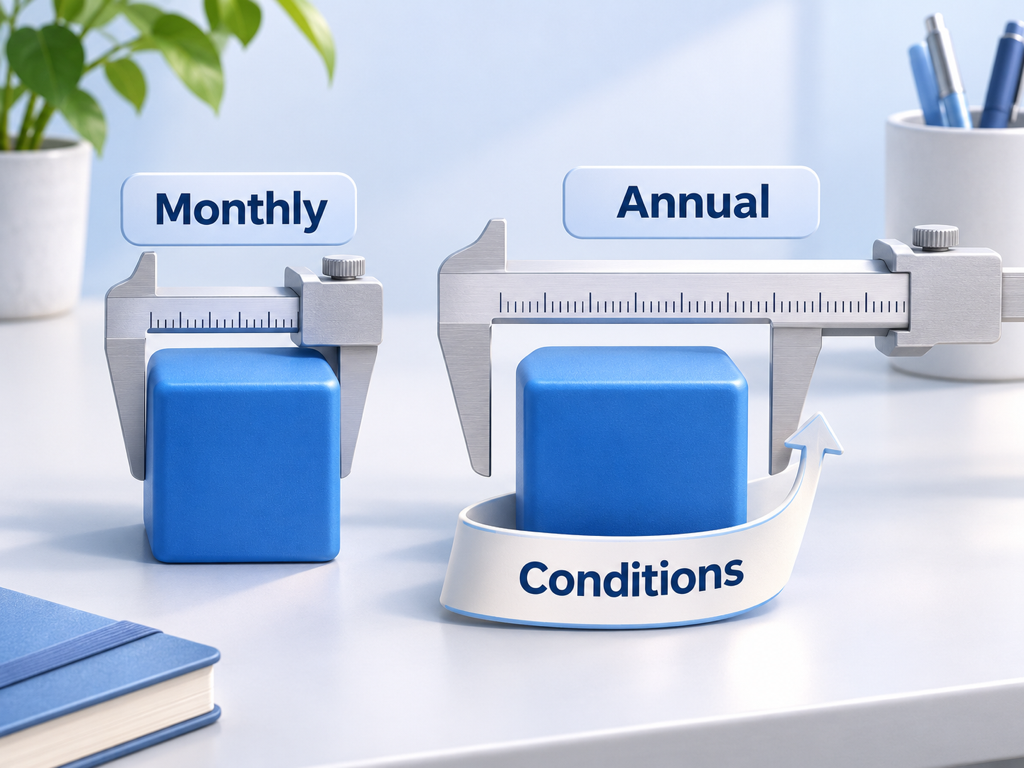
Write out the unit in words before doing arithmetic. “Per user per month, billed annually” contains both a rate and a commitment condition. “Per team per month, billed monthly” describes a different purchase basis even when the displayed numbers are similar.
The following synthetic examples illustrate review decisions. They are not current prices, benchmarks, or observations about named vendors.
| Located value | Context in the source | Claim made in an answer | Review decision |
|---|---|---|---|
| 20 | Dollars per user per month | The team pays 20 dollars monthly | Denominator missing |
| 20 | Monthly equivalent under annual billing | Cancel any month for 20 dollars | Commitment overstated |
| 95 | Percent of successful requests in a defined test | Typical users are 95 percent satisfied | Metric changed |
| 10 | Seconds under a named workload | Every task completes in 10 seconds | Workload scope missing |
| 100 | Records in the measured sample | There are 100 customers in the market | Population changed |
Check the denominator before calculating a total. A hypothetical five-user team facing a rate of 20 dollars per user has a different basis from a flat team charge. State the assumed team size and any minimum commitment instead of presenting the arithmetic as a directly quoted source fact.
Keep time bases aligned. A monthly equivalent can be useful for comparison, but a report should still preserve whether payment is monthly or annual. A normalized rate and an actual invoice schedule answer different business questions.
Attach Footnotes to the Affected Cells
Read the footnotes as part of the claim. A note can restrict a value to a region, an account type, an introductory period, a specific test setup, or a subset of observations. Treating it as optional page decoration can reverse the conclusion.
Map each note to the cell, row, column, or table it qualifies. A note attached to one plan should not be applied automatically to every plan on the page. Conversely, a table-wide condition should not disappear because the quoted cell carries no visible marker of its own.
Create a short scope statement for the review record. For example, a synthetic benchmark might apply to one hardware configuration and one workload. The retained statement should identify both conditions and explain whether the answer preserved them, narrowed them, or generalized beyond them.
Distinguish absence from unreadability. A footnote may be unavailable in a captured representation, hidden by a collapsed section, or missing from the source itself. These findings lead to different next actions and should not be collapsed into a single “no qualification” label.
Resolve material conditions before scoring the comparison. A number that is correct only under a restricted condition should receive a qualified support finding. Do not mark it fully supported and hope a separate caveat elsewhere in the report repairs the interpretation.
Classify Unsupported Calculations Separately
Label calculated values as calculations. A source may supply two inputs without publishing the ratio, total, savings claim, or percentage change that an answer derives from them. The derivation needs its own check even when both inputs were extracted correctly.
Preserve the formula and assumptions. A proposed calculation record should include source values, units, conversion steps, rounding, and the condition under which the result is meaningful. Another analyst should be able to reproduce the number without guessing whether a monthly equivalent or billed total was used.
Set rounding tolerance from the decision rather than convenience. A rounded descriptive percentage may be acceptable in a broad summary, while a procurement total can require a more exact basis. Explain the tolerance and avoid treating a small numeric difference as either automatically harmless or automatically disqualifying.
Use separate review labels for a quoted value, a reproducible calculation, an unresolved calculation, and a conclusion unsupported by the inputs. This prevents a valid source link from laundering a calculation the source never made.
The right inputs do not guarantee the right comparison.
Use Source Monitoring to Route Table Reviews
Topify can help prioritize the source side of this work. Start with a defined brand and relevant buyer questions, then review cited domains and URLs through its AI citation analysis. Sources that recur in consequential comparisons can become candidates for a focused table review, especially when the answer relies on pricing, capacity, or performance numbers.
Carry the answer claim and cited URL into an independent evidence worksheet. Monitoring can show which sources appear in the collected answer set and help an analyst decide where to spend review time. It does not establish correct cell extraction, interpret every footnote, or validate an arithmetic conclusion. Preserve row and column relationships, units, conditions, and calculations separately unless a specific available feature has been verified to retain them. Keep a source-frequency finding distinct from a finding about numerical support.
The difference between a citation and a brand mention helps set the first boundary. The presence of a product name cannot replace the source record needed to audit the number behind a comparison.
Complete the review with a decision-ready correction. Identify the unsupported scope, state the narrower claim the evidence permits, and assign any remaining verification task. A useful finding tells the next reviewer which unit or condition changes the outcome, rather than simply saying that the answer was inaccurate.
Conclusion
A table citation needs more than a matching number. Recover the applicable headers, write out units and denominators, attach the relevant footnotes, and distinguish source statements from derived calculations. Preserve unresolved context instead of allowing a valid URL to make an unsupported comparison look complete. The review should explain whether the evidence supports the decision the answer invites.
Begin with one numerical claim from a material product or performance comparison. Build the evidence tuple, check the source context, and reproduce any calculation with its assumptions visible. Use citation-source monitoring to select further reviews, while keeping the cell-level judgment independent. A defensible result preserves the number and the conditions that make it meaningful, including the limits that can change the choice.
FAQ
Can a correct number still support a wrong claim?
Yes. A different unit, denominator, period, population, or condition can change the meaning even when the quoted digits match the source.
What should a table evidence record contain?
Retain the source and table location, row and column labels, value, unit, period, conditions, and review time. Mark unresolved elements explicitly.
Does accessible table markup guarantee correct AI use?
No. Accessible relationships help describe table structure, but they do not guarantee how a particular answer engine extracts or interprets the information.
How should calculated values be labeled?
Identify them as derived results and preserve their formula, source inputs, assumptions, and rounding. Do not present an analyst calculation as a statement directly published by the source.