A content operations analyst opens a source from last month’s citation report and finds a rewritten page. The URL still works, but the paragraph discussed in the review has disappeared. A colleague remembers what it said; the report contains only a link and a positive status.
LLM citation tracking needs a record of the observation, not just a route to today’s webpage. Answers, source pages, and access conditions can change on different schedules. The practical task is to preserve enough context to explain a historical finding while keeping collection scope, access rights, and storage costs proportionate. Start by deciding what was actually observed and which parts can still be verified later.
LLM Citation Tracking Needs More Than a Live URL
A URL identifies a location, but it doesn’t by itself preserve the content seen during an earlier review. The page may be updated, redirected, removed, or delivered differently under another locale or session. A working link today cannot establish what the reviewer saw weeks ago.
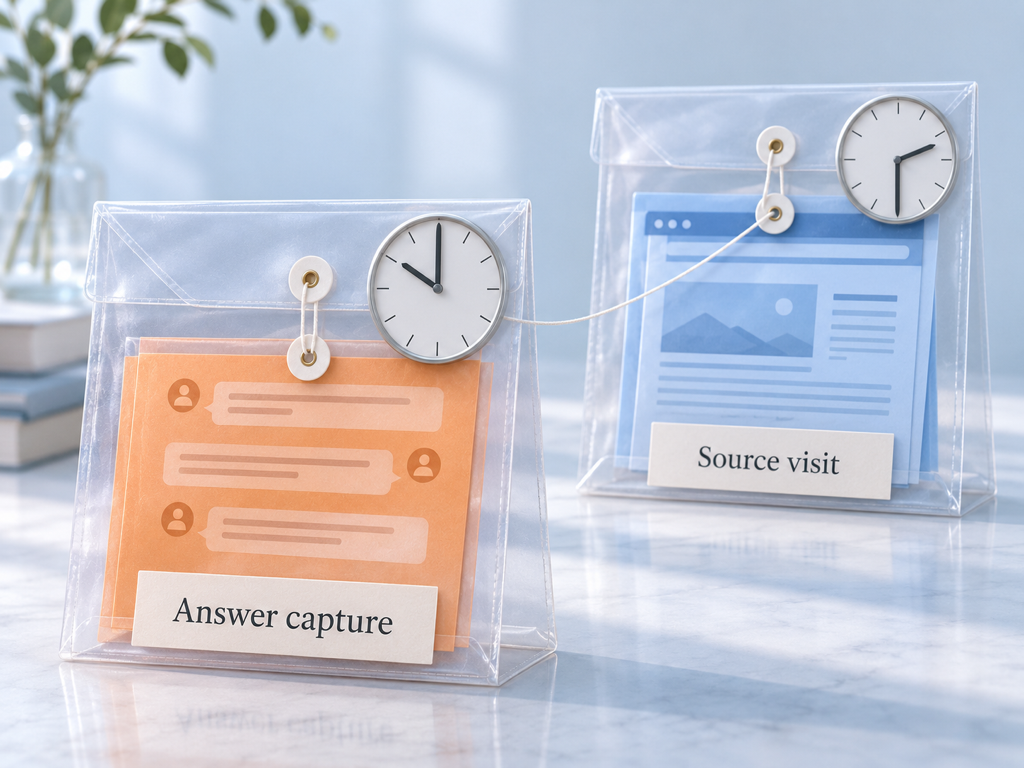
Distinguish an answer observation from a source-page observation. The first records the generated response and its visible references. The second records what your team could access at a particular time, potentially after the answer was collected.
The W3C provenance framework provides a useful foundation for documenting the data and activities behind a record. For this workflow, the operational implication is to connect preserved evidence with its collection context. It doesn’t establish which page version an external model actually retrieved.
That boundary matters during disputes. A team may have strong evidence that an answer displayed a particular link and that a reviewer later saw a conflicting page. Without additional evidence, it should not claim to know the exact source text available inside the model’s retrieval process.
Record the Answer and Source Access Separately
Create linked records with independent timestamps. Preserve the answer collection time, the displayed URL, and the source access time without collapsing them into a generic “checked” date. A delay between the two may explain a discrepancy rather than prove an answer was wrong when generated.
The following is a proposed evidence record. Store unavailable fields as explicitly unavailable rather than filling them with guesses.
| Evidence component | What to retain | What it can establish |
|---|---|---|
| Answer observation | Collected text, platform, prompt, time | What the monitoring process captured |
| Visible reference | Displayed URL and answer location | Which link appeared in that answer |
| Source access | Requested URL, time, access result | What the reviewer could reach then |
| Preserved context | Relevant excerpt, screenshot, or permitted archive | What was retained from that visit |
| Interpretation | Reviewer, finding, rule version | How the evidence was assessed |
| Relationship | Stable IDs connecting the records | Which source visit supports which review |
Keep the original visible URL even when it redirects. Add the resolved destination as a separate observation so later reviewers can distinguish the answer’s reference from the page reached during inspection. A normalized reporting URL should not replace either historical field.
Use a short narrative note when structured fields aren’t enough. “Answer collected Monday; page first inspected Thursday after a documented revision” tells a reviewer more than an unexplained mismatch flag. Attach the supporting evidence rather than relying on a memory of the sequence.
Preserve Enough Context to Recheck the Observation
Choose the preservation method according to the decision. A narrowly scoped excerpt may support a wording check, while a screenshot can show a visible condition or layout. A permitted archived copy can preserve broader context when a short passage would be misleading.
Avoid saving only the sentence that supports your preferred conclusion. Include the nearby qualifiers, applicable product version, and relevant date or policy boundary. Evidence is more useful when another reviewer can understand why the selected passage was considered relevant.
A content hash can help detect whether two retained files differ, but it cannot explain their meaning or recover a file that wasn’t stored. A screenshot can show what was visible, but it may omit interactive conditions or text below the captured area. Record these limitations beside the artifact.
Keep the evidence package small enough to maintain. Save the minimum material needed for the defined investigation through authorized access, and retain a reference to the full source location. A disciplined scope is easier to review than an indiscriminate collection nobody can navigate.
Label Unavailable and Changed Sources Honestly
An inaccessible page is an access result, not proof that the citation never had support. Distinguish removal, permission requirements, temporary failure, and an unresolved technical problem. These states suggest different follow-up actions and shouldn’t be merged into a single “bad source” label.
Likewise, a changed page doesn’t automatically invalidate an earlier review. Compare retained evidence with the current visit and describe the change you can observe. If no historical artifact exists, state that the earlier content cannot be independently rechecked from the available record.
Preserved evidence limits what you have to guess.
For a hypothetical example, an answer cites a documentation page on Monday, and a reviewer opens it Friday after a product release. Friday’s wording may differ because the documentation changed. The evidence log should preserve those two observations without inventing Monday’s page content or silently treating Friday’s version as historical fact.
Assign a next action according to the uncertainty. Revisit a temporary failure, request a permitted source from its owner, or mark the finding unresolved. Don’t convert an unavailable source into a precise factual verdict simply to complete a report.
Set Retention and Review Rules Before Incidents
Retention should follow the purpose of the evidence. A short operational review and a long-running reporting obligation may need different durations. Define who can access retained material, when it should be reviewed, and which records can be removed through normal policy.
Append new observations rather than replacing earlier artifacts. A current page visit can update the team’s understanding while the original capture remains available for the historical report. Link a correction or superseding finding to the earlier interpretation so the audit trail explains what changed.
Prioritize preservation where future disagreement would be expensive. Repeated high-value citations, volatile commercial claims, and sources central to an important decision may deserve more attention than low-impact incidental links. This is a risk-based editorial choice, not a universal storage requirement.
The existing LLM citation analytics explainer frames how source patterns can guide content work. An evidence-retention process supplies the narrower historical record needed to revisit those decisions after the web has moved on.

Test retrieval of your own evidence package before relying on it. Ask a colleague to locate the original answer, the relevant source capture, and the review note using only the record identifier. Broken storage references can undermine an otherwise careful preservation policy.
Keep corrections linked to the evidence they supersede. A reviewer may later discover that the wrong product version was assessed or a qualifier was overlooked. Preserving the earlier finding with a clear correction makes the report more trustworthy than replacing it with an unexplained new verdict.
An archive that cannot be navigated cannot support a practical review.
Use Topify for Citation Discovery and a Separate Evidence Log
Topify can help identify which citations deserve further review. Its citation analysis feature describes examining cited domains and URLs. Start with your brand and relevant monitored questions, inspect recurring references, and choose the observations that materially affect a content or reporting decision. Those selected references become inputs to a dated evidence log maintained through your team’s authorized preservation process.
Keep the product boundary clear. The cited feature description doesn’t establish that Topify automatically archives every source page, preserves all historical revisions, or exposes the exact text an external model retrieved. Confirm the evidence available in your account and supplement it where necessary with separately documented source visits. The useful output is a traceable investigation queue: which answer was collected, which reference appeared, what the team later accessed, and what conclusion the available material actually supports.
Conclusion
Historical citation review needs more than a link that still opens. Preserve the collected answer, its visible reference, and the later source visit as distinct observations. Keep timestamps and access results attached so a changed page doesn’t force the team to reconstruct its earlier decisions from memory.
Start with a small group of citations that matter to a current report. Choose a proportionate preservation method, capture the relevant context, and define what to do when a source is unavailable. Use Topify’s citation analysis to locate useful review candidates while retaining the evidence through a clearly documented process. A good archive explains what the team saw and when, while leaving unknown retrieval history honestly unknown.
FAQ
Why isn’t a source URL enough for historical review?
The content and access conditions at that URL can change. A historical review needs retained context and an observation date if later verification matters.
Does a screenshot prove what the model retrieved?
No. It records what the reviewer captured at a particular time. The model may have accessed a different version or used other information that the screenshot cannot establish.
Should every cited page be fully archived?
Not necessarily. Choose a permitted and proportionate method based on the investigation. Relevant context, access results, and stable relationships may be sufficient for a limited review.
How should a missing historical capture be handled?
Mark the evidence gap directly. You can describe the current page and the preserved answer, but shouldn’t invent the source text that was present at an earlier time.