A technical analyst revisits a cited page after a company moves its documentation to a new domain. The old link now opens the new site, and a normalization job credits every historical citation to the destination. The report shows a dramatic change in source ownership even though no new answers were collected.
LLM citation tracking needs to preserve the link that appeared as well as the destination reached later. Redirects can make an old reference useful without turning it into a newly observed citation. The practical decision is how to retain raw URLs, record access paths, and present current ownership without overwriting the evidence behind an earlier report.
LLM Citation Tracking Must Preserve the Displayed URL
The URL displayed in a collected answer is part of that observation. Store its original value before resolving redirects, stripping parameters, or applying domain ownership rules. Later transformations should create additional fields rather than replace the evidence.
A redirect inspection is a separate activity performed at a specific time. It can show where a request went under the conditions of that inspection. It cannot establish that the model followed the same path, used the same location, or retrieved the same page when generating its answer.
Google’s redirect documentation distinguishes permanent and temporary redirects and explains their search-indexing implications. That distinction is useful technical context. It isn’t a rule for reallocating every historical AI citation to today’s final destination.
Define the report’s question first. “Which URLs appeared in collected answers?” and “Which organizations currently receive visitors from those URLs?” are both useful questions. They require different fields and may produce different domain-level summaries without either being erroneous.
Separate Raw, Resolved, and Canonical URLs
Keep three concepts distinct. The raw URL is the observed reference; the resolved URL is the destination reached during a particular inspection; a canonical URL is a declared or selected representative associated with content indexing. These values may agree, but one shouldn’t be assumed from another.
Use a record like this to prevent a cleanup step from silently changing the meaning of the dataset. Canonical hints should be treated within their documented context, not as evidence that a browser redirect happened.
| Field | Meaning | Preservation rule |
|---|---|---|
| Raw citation URL | Link captured from the answer | Retain exactly as observed |
| Requested URL | Address used for the inspection | Record any deliberate modification |
| Redirect steps | Status and destination at each observed hop | Keep order and inspection time |
| Final URL | Destination reached by that inspection | Append without overwriting the raw link |
| Canonical hint | Representative URL declared by the page | Store separately from network behavior |
| Reporting identity | Domain or owner under a stated rule | Version the mapping and label the view |
A raw link may contain tracking information that the reporting view doesn’t need. Preserve the original in a controlled evidence field, then create a documented normalized representation for analysis. This keeps the report readable without making the cleanup irreversible.
Record failures too. A loop, unavailable destination, or interrupted chain is a meaningful inspection result. An empty final-URL field should not automatically be interpreted as a direct link or as evidence that the cited source never existed.
Inspect Redirect Chains as Dated Observations
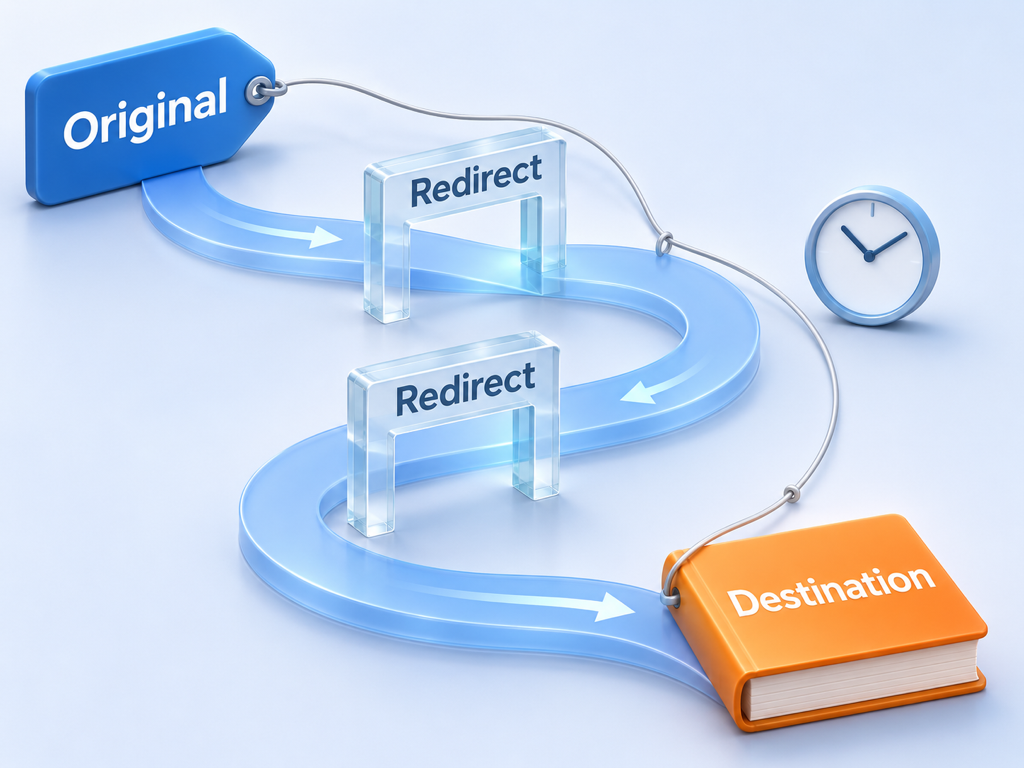
Trace the access path using an authorized inspection method and retain the time of the check. For each observable step, record the requested address, returned redirect status, and destination. Separate server redirects from page instructions or other navigation behavior when the distinction is available.
Google documents 301 and 308 as permanent server redirects, and 302, 303, and 307 as temporary forms in its guidance. Use the actual status returned during your inspection rather than guessing from the destination. A familiar new domain doesn’t establish how the original address reached it.
A chain can change after your report. Store a new inspection when the path is revisited rather than replacing the earlier sequence. That makes it possible to explain why one reviewer reached a working page and another later encountered a failure.
For an illustrative case, a collected answer links to an old documentation address, which later redirects through a migration service to a new documentation host. The report should preserve one original citation plus the observed path. Counting the intermediate hosts as additional citations would create evidence the answer never displayed.
Handle Tracking Parameters and Locale Destinations Carefully
Normalization should remove only differences that your use case can safely ignore. Some query parameters track referrals; others select a product, language, documentation version, or search result. Deleting every query string can merge pages whose meaning is materially different.
Write normalization rules with examples and exceptions. Test a parameter before classifying it, and keep an unresolved category when its role is unknown. A clean-looking URL is not necessarily a more faithful representation of the cited content.
Locale behavior deserves the same care. A visitor’s region, language, or session can affect the destination reached. Record the relevant inspection conditions when you can, and avoid assuming that a destination observed from one environment is universal.
A cleaner URL can be a less accurate record.
Keep human-readable titles as descriptive fields rather than identity keys. Several pages may share a title, and the same page can change its heading without changing address. Combining URL evidence with page context supports review; substituting the title for the evidence makes the join fragile.
Report Ownership Changes Alongside Historical Attribution
Offer separate historical and current views when both questions matter. The historical view groups raw citations under the rule applied to the original observations. The current view can show where those references resolve and which owner is associated with the destination today.
Label the date and basis of each mapping. A domain acquisition, documentation migration, or reseller relationship can change ownership interpretation without generating a new citation. Readers need to see whether a number changed because answers changed or because the reporting map changed.
Don’t infer independent source diversity from redirect hops. Several addresses leading to the same content can be relevant for access diagnosis, but that doesn’t make them separate supporting publications. Keep access-path analysis distinct from evidence-lineage analysis.
The citation analytics overview explains why source patterns are useful for content decisions. A historical URL ledger makes that work more reliable by showing when a source trend reflects new observations and when it reflects a changed destination or ownership rule.

Test ownership rules on a few deliberately difficult examples. A documentation subdomain, a regional site, and a marketplace page can require different grouping decisions even when their addresses look similar. Preserve the reason for each accepted mapping so a new analyst doesn’t have to infer the policy from the output.
Reconcile counts before and after normalization. The number of original answer references should remain explainable even when several raw addresses share a reporting group. If the total changes, identify whether the cause is an intentional exclusion, a duplicate rule, or an accidental expansion of the dataset.
A reporting view should simplify access to evidence without replacing it.
Use Topify Source Reports to Prioritize URL Reviews
Topify can help select the source references worth investigating. Its citation analysis workflow describes examining cited URLs and domains. Start with the prompts relevant to your brand, identify recurring or materially changed sources, and inspect the links behind those observations. The output is a prioritized set of references for a dated URL review, helping the team decide whether a source-access issue or an attribution rule needs attention.
Keep the redirect ledger as a separate control unless your supported product workflow explicitly supplies it. The feature description doesn’t establish complete hop-by-hop history, retrospective domain ownership, or visibility into an external model’s network requests. Preserve the raw citation evidence available to your team, document any normalization, and append current inspection results. This lets the report explain a migration without presenting it as new citation growth or claiming to reconstruct hidden retrieval behavior.
Conclusion
Redirects improve access, but they don’t rewrite what an earlier answer displayed. Preserve raw citation URLs, inspect destinations as dated observations, and keep canonical hints and ownership mappings in separate fields. A migration should remain explainable without manufacturing additional citations or erasing the original source address.
Begin with a small set of high-impact links that changed domains or became unavailable. Record the paths you can observe, review parameters before removing them, and decide whether your report needs historical attribution, current destination ownership, or both. Use Topify’s citation analysis to prioritize that work. The resulting ledger should tell readers which evidence changed and which interpretation changed, so they can judge the trend on its actual terms.
FAQ
Should a redirected citation count as a new citation?
Not merely because its destination changed. A new citation observation requires a newly collected answer or reference under the reporting definition. A later redirect check is separate evidence.
Is the final destination the same as a canonical URL?
Not necessarily. A redirect is observed navigation behavior, while a canonical hint concerns a representative content URL. Store both separately when available.
Can all URL parameters be removed for reporting?
No. Some affect product identity, locale, version, or content. Preserve the raw value and apply only tested normalization rules with documented exceptions.
Can redirect inspection reveal the model’s retrieval path?
No. It shows the path your inspection encountered at that time. The model may have used another path, another version, or information not visible in your check.