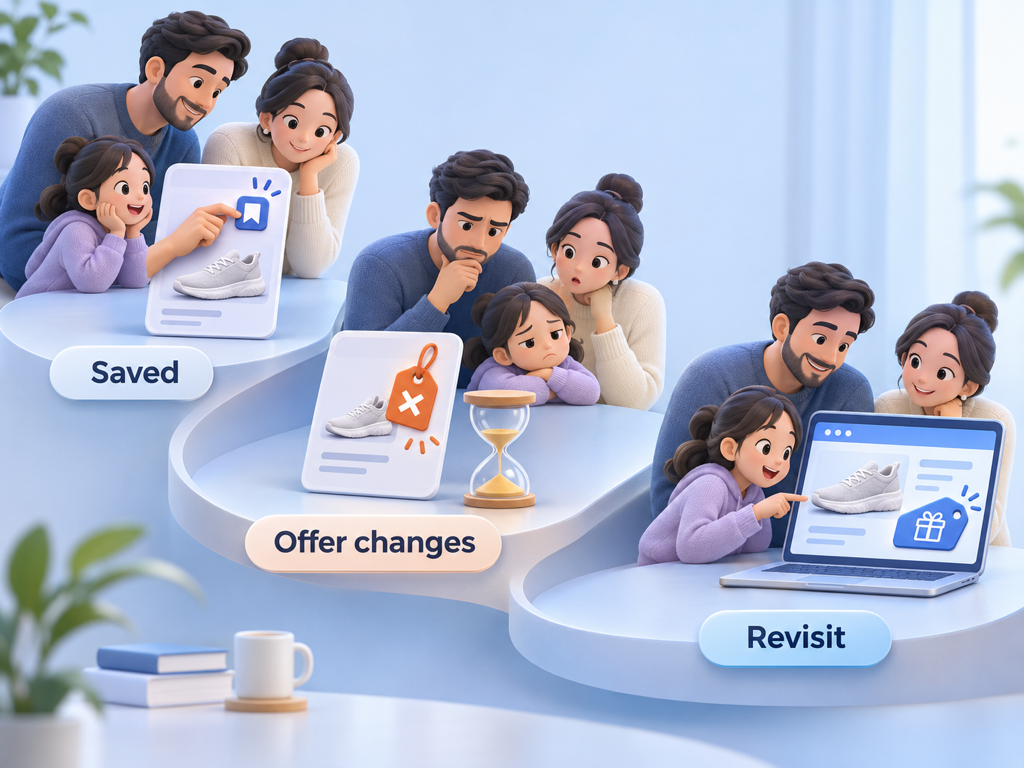
An ecommerce operations lead reviews a product that a shopper saved during a promotion. On a later visit, the offer has changed: the discount ended, the selected size is unavailable, or the merchant destination shows a different bundle. The saved item still helps the shopper remember a choice, but it doesn’t establish that the original buying conditions remain available.
ChatGPT shopping visibility can therefore extend into a return visit that needs its own evidence. A discovery check captures one moment, while a saved product may be revisited after commercial facts change. The useful task is to compare those moments without assuming that every saved surface refreshes instantly or that every changed offer is a platform error.
ChatGPT Shopping Visibility Continues After a Product Is Saved
Saving a product creates a reason to revisit it, not a guarantee that all associated facts remain fixed. The audit should distinguish the saved item identity from the current offer and merchant destination. A shopper can return to the same product while encountering different legitimate terms.
OpenAI’s current shopping help page describes saving products in Library and advises checking purchase details with the merchant. It also notes that merchant updates may take time to appear. These statements justify a return-visit check, but don’t establish a universal refresh schedule for every saved item.
Record the interface actually available to the authorized reviewer. Features and presentation can differ, and a current help description doesn’t prove that an older saved item will behave identically in every account. If the relevant surface isn’t available, label that part of the exercise untested.
Keep this review focused on observable information. You can compare the saved representation, a later visible state, and the merchant’s current offer. Without suitable historical evidence, you cannot reconstruct what every shopper saw or identify exactly when a background data update occurred.
Create a Save-and-Revisit Observation Pair
Build a paired record for a small, clearly defined test. Preserve the initial product identity and the visible offer conditions, then create a new observation on the return visit. Link the pair without replacing the earlier evidence with today’s values.
Use a public demonstration item or an authorized test account and keep unrelated personal information out of the review record. The point is to test information continuity, not to collect a shopper’s private Library or browsing history.
| Field | Initial observation | Return-visit observation |
|---|---|---|
| Time and surface | When and where the product was saved | When and where it was reopened |
| Item identity | Product, model, visible variant | Same identity or documented difference |
| Merchant | Visible seller and destination | Current visible seller and destination |
| Commercial terms | Price, currency, qualification shown | Current terms and any changed conditions |
| Availability | Visible stock or size information | Current item and variant availability |
| Evidence status | What was actually preserved | What can now be directly compared |
A paired record should include a reason for the revisit interval. The end of a promotion or a known inventory transition may be more informative than an arbitrary delay. The method doesn’t require a universal waiting period; choose the timing according to the commercial fact being tested.
Mark examples as demonstrations. A hypothetical item saved at a promotional price can illustrate the procedure, but it doesn’t establish the frequency of stale offers in the wider service. Avoid turning a handful of manual checks into a platform-wide error rate.
Recheck the Merchant Offer at the Return Visit
At the return visit, inspect the saved surface before following the merchant link. Capture the information actually displayed and any visible indication that the offer or destination changed. Then record the merchant page as a second, separately timed observation.
Confirm that the destination still represents the same product and variant. An updated color, pack size, subscription condition, or seller can explain a price difference. Comparing two prices without checking item identity may create a false discrepancy.
Review conditions that determine what the shopper can actually buy. Taxes, shipping charges, quantity requirements, membership conditions, and promotion end times may affect the final offer. Record which details are visible at each stage rather than assuming a displayed headline price represents the complete transaction.
Treat unavailable evidence as a limit. If the initial capture omitted shipping or the selected size, the later review can’t establish whether that detail changed. Preserve the gap and improve the next test rather than filling it with a plausible memory.
Classify Stale, Changed, and Unverifiable Offers
Use categories that distinguish different explanations. A legitimate changed offer means the merchant’s terms evolved; a stale representation means a visible surface still presents superseded information supported by your evidence. An unverifiable case means the available records don’t settle the comparison.
Don’t label an offer stale simply because today’s price differs from the saved price. The saved surface may clearly represent a historical observation rather than a current promise. Inspect its wording and behavior before deciding what the interface communicates to the returning shopper.
A changed price isn’t automatically an information error.
For an illustrative case, a promotion ends before the return visit, and the merchant correctly shows its standard price. If the saved surface also shows the current terms, the pair records ordinary change. If it continues to present the expired offer as current, preserve both states and investigate the discrepancy without guessing which upstream system caused it.
Add a separate category for identity mismatch. A destination that opens a different bundle is not merely a stale-price case. Its owner needs the product and variant evidence so the problem can be reproduced and corrected at the appropriate layer.
Route Fixes to the Owner of the Changing Fact
Assign work according to the evidence, not according to which interface the analyst happened to open first. An incorrect merchant page belongs with the merchant’s content or commerce owner. A mismatch between supplied data and the current page may require the responsible data provider to investigate delivery or update timing.
Use a concise discrepancy record containing the paired observations, item identity, visible conflicting fact, and expected source of truth. Include the relevant times and any known promotion boundary. That package is more actionable than a screenshot labeled “shopping broken.”
When the merchant page is correct but another visible surface remains inconsistent, use the platform’s supported reporting route. Report the reproducible issue without claiming to know its internal cause. A subsequent correct result may show resolution in your observation, but not prove exactly which intervention caused it.
The broader shopping visibility benchmark method focuses on repeatable observations. A save-and-revisit audit applies that discipline to one lifecycle transition, preserving both moments instead of treating the first discovery check as the end of the journey.

Test the record with another reviewer before expanding the exercise. They should be able to identify the same item, locate both observations, and explain the exact disputed condition without a verbal briefing. Missing context is easier to repair while the original review is still recent.
Keep resolved cases in the log with a clear outcome. A merchant correction, an ordinary price change, and an unresolved surface discrepancy contribute different lessons to the next audit. Reporting those outcomes separately makes the process useful for operations without converting it into a misleading platform accuracy score.
A reproducible case is more useful than an unexplained mismatch total.
Use Topify for Discovery Trends and a Revisit Audit Log
Topify can help identify which shopping-related brand observations deserve closer attention. Its AI search analytics describes brand visibility and citation analysis. Begin with relevant category questions and your brand context, review the available answers, and select priority products or concerns for a separate return-visit exercise. The output should help an ecommerce team decide where to spend its limited manual review time.
Keep that exercise outside any unsupported product assumptions. General answer monitoring doesn’t establish access to a person’s private Library, the ability to save products on their behalf, or complete historical offer tracking. Use an authorized test context and maintain the paired record through your own documented process where necessary. Combine the discovery signal with the return-visit evidence only at the planning level, preserving the distinction between broad brand representation and the specific offer states you actually inspected.
Conclusion
A saved product can remain relevant after its offer changes. The audit should preserve both moments, verify product and merchant identity, and distinguish a legitimate commercial update from a stale representation or an evidence gap. The original discovery observation alone cannot settle what a returning shopper can buy.
Start with one priority item and a meaningful change boundary, such as the end of a promotion. Capture the initial state, revisit the available surface, and check the current merchant offer before assigning responsibility. Use Topify’s AI search analytics to prioritize discovery concerns while retaining a separate return-visit log. The practical outcome is a reproducible discrepancy record that points to the responsible facts, with no invented refresh guarantee or unsupported platform-wide error claim.
FAQ
Does saving a product freeze its price?
Do not assume that it does. Treat the saved item and the current merchant offer as separate observations, and verify the conditions available when the shopper returns.
When is an offer properly called stale?
When preserved evidence shows that a surface presents superseded information as current. A historical price or a legitimate merchant change needs a different interpretation.
Can a single revisit measure a platform’s error rate?
No. It documents one case under specified conditions. Broader estimates require a defined population, adequate sampling, and consistent review rules.
Can Topify inspect a shopper’s private saved products?
This workflow makes no such assumption. Use an authorized test context for manual return-visit checks and keep those records separate from supported brand-monitoring capabilities.