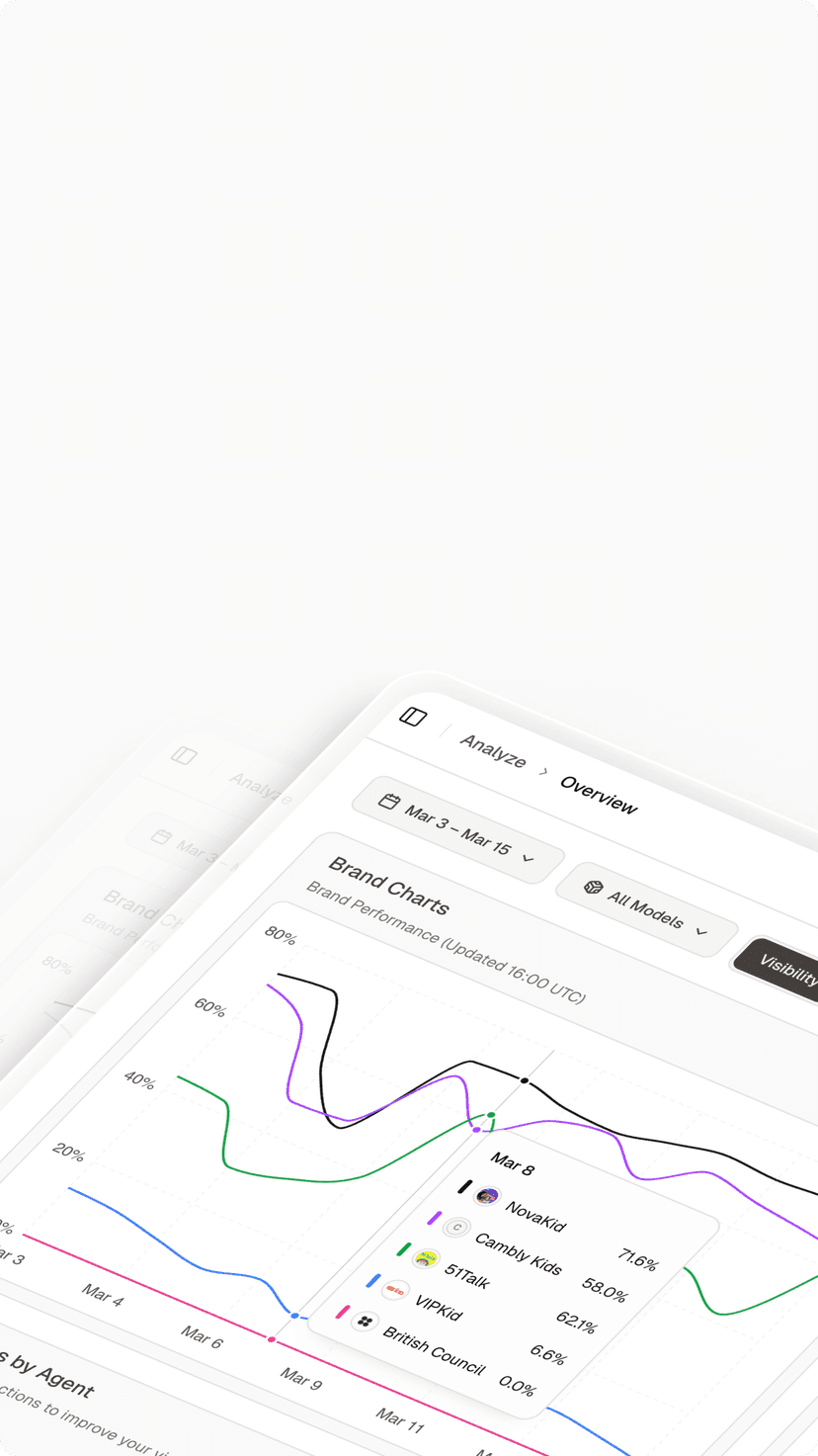
A weekly visibility line drops just before a campaign review. The dashboard shows fewer brand appearances, but several scheduled answers never arrived and another group could not be parsed. The marketing lead must decide whether to investigate the content, the monitoring process, or both before explaining the decline to management.
An AI search monitoring dashboard needs to distinguish a missing brand from a missing observation. Those states can look identical when an export reduces everything to a zero. A small collection-state model, clear denominators, and a separate coverage report make the difference visible before an operational problem becomes an unsupported performance narrative.
An AI Search Monitoring Dashboard Needs Collection States
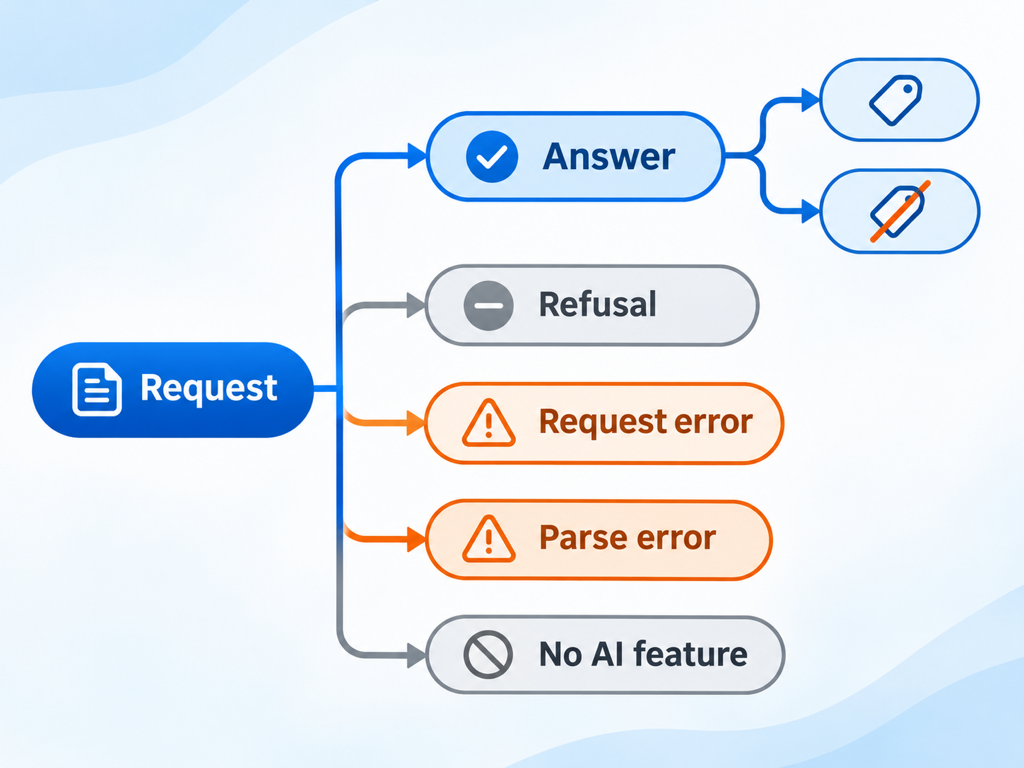
Record what happened during collection before interpreting the answer. A completed response, an explicit refusal, a request failure, an unavailable AI feature, and a parsing failure describe different events. None should inherit another state merely because a numerical field is empty.
Use two layers of status. The collection layer records whether a usable observation exists. The interpretation layer records what that observation says about the brand, its recommendation context, and cited sources. Keeping the layers separate lets an analyst revise a parsing label without pretending that the original request changed.
The following workflow is a recommended reporting design, not a claim about every monitoring provider’s implementation. Ask your provider which raw statuses, answers, and execution details are actually available before building reports around them. Where a field is unavailable, preserve that limitation instead of inventing a precise failure diagnosis.
Source-specific semantics matter when combining datasets. Google’s Search Console data guidance notes that unavailable values can become zeros in downloaded data. That behavior does not define all AI monitoring exports, but it demonstrates why an exported number needs its original status context.
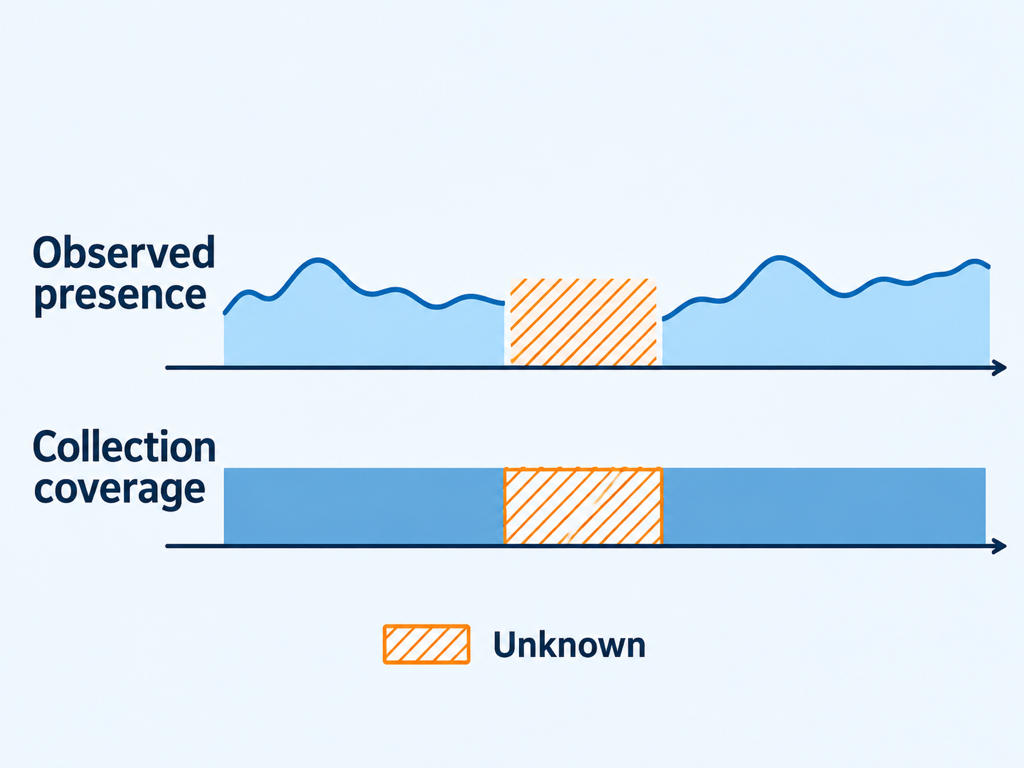
An unknown observation should remain visibly unknown.
Distinguish a Missing Brand From a Missing Answer
Count brand absence only when the observation meets your declared interpretation rule. For example, a completed, inspectable answer may discuss the relevant category without naming the brand. A failed request provides no answer from which to infer that absence.
Define refusals explicitly. A refusal is an observed system response, but it may not be an eligible category recommendation. Depending on your research question, you may report it separately or include it in a broader user-experience outcome. State the rule before calculating brand presence so it cannot be changed to improve the result.
A missing AI feature requires another distinction. In a search interface, the feature might genuinely not appear for the observed query. That can be a valid observation about feature availability while remaining ineligible for a conditional measure of brand inclusion inside AI answers.
| Observed state | Brand-presence treatment | Companion reporting | First review owner |
|---|---|---|---|
| Usable relevant answer, brand absent | Count as absence in the declared eligible-answer pool | Retain answer context | Marketing analyst |
| Usable relevant answer, brand present | Count according to the labeling rule | Record mention or recommendation separately | Marketing analyst |
| Explicit refusal | Apply a predeclared eligibility rule | Show refusal count separately | Research owner |
| Request failure | Do not infer brand absence | Show failed collection and available error evidence | Operations owner |
| Parsing failure | Keep brand label unknown until reviewed | Preserve raw response for repair | Data owner |
| AI feature genuinely not shown | Exclude from answer-conditional presence; retain feature observation | Report feature incidence separately | Research owner |
Do not discard inconvenient states from the report entirely. Excluding a failed request from an answer denominator may be appropriate, but the failure still reduces coverage. A clean visibility percentage with poor collection coverage can mislead a reader about how much of the planned sample was actually examined.
Report Coverage Beside Every Visibility Rate
Show planned observations, completed eligible observations, and exclusions beside the headline percentage. Define what constitutes one observation, such as a scheduled prompt-platform-market combination at a planned time. Repeated attempts to collect it should not automatically create new measurement units.
Consider a hypothetical collection plan with 100 scheduled observations. Eighty yield eligible answers, and 24 of those mention the brand. Answer-conditional presence is 24 divided by 80, or 30 percent. Eligible-answer coverage is 80 divided by 100, or 80 percent.
Reporting 24 percent by dividing mentions by all scheduled observations would silently assign absence to the twenty excluded cases. Reporting only 30 percent would conceal the missing coverage. Showing both the presence rate and the coverage figure preserves the meaning of the result.
The remaining twenty observations also need reasons. If they are concentrated on one platform or one difficult question family, the observed sample may be systematically different from the plan. A global coverage total cannot rule out that selection problem.
Report per-platform and per-family coverage where it changes interpretation. A platform with complete observations can support a bounded comparison even if another platform failed. Keep the conclusion at that narrower scope rather than either discarding all useful evidence or presenting a false cross-platform average.
Do not interpret operational coverage as market coverage. Completing every scheduled task shows that your defined sample was collected. It does not establish that the sample represents all buyers, all wording variations, or all AI search activity.
Every visibility percentage needs a visible coverage denominator.
Handle Retries Without Duplicating Observations
Assign one observation identifier to the scheduled unit and a separate attempt identifier to each execution. Record the first attempt, retry time, available failure evidence, and the rule used to choose the retained answer. This makes it possible to repair collection without inflating the denominator.
Choose the retry policy before inspecting brand outcomes. Retrying until the brand appears would bias the sample, even if every individual response were genuine. An operational retry should respond to a defined collection problem, not to an unfavorable answer.
Keep the original attempt history after recovery. A later successful response may describe a different platform state or retrieval moment. The report should reveal whether the result came from the planned window or a delayed replacement, especially when the campaign concerns a short-lived event.
Set practical limits appropriate to the collection method and provider terms. A fixed retry budget and a documented fallback are easier to audit than indefinite retries. Do not promise a universal retry count or claim that a particular provider exposes internal error details unless its current documentation establishes that behavior.
A repair that changes parsing logic needs its own record. Preserve the raw answer and the earlier label so reviewers can distinguish a measurement correction from a change in what the AI actually said. That distinction also helps explain historical revisions to stakeholders.
Suspend Comparisons When Coverage Changes Materially
Pause the broad comparison when missingness could explain the observed movement. The relevant threshold depends on which observations are missing and what decision the report supports. A small gap concentrated in high-value commercial prompts may matter more than a larger random-looking gap elsewhere.
Check known provider reporting issues before creating a content-performance explanation. Google maintains a Search Console anomalies log documenting logging and reporting incidents. Historical entries illustrate a possible cause; they are not evidence that a current drop has the same explanation.
Use complete and comparable windows where possible. If the newest data remains preliminary, label it and keep it separate from a finalized period. Do not replace missing data with a smooth line that suggests observations were made when they were not.
A useful escalation note states what is known, what remains unknown, and what comparison still holds. For example, the team may be able to report a stable trend on two platforms while withholding the combined total until a third platform’s coverage recovers. That is more actionable than either a confident global decline or a vague warning.
Google Search Console AI Performance: A Field Guide to the New Report provides related context for interpreting first-party reporting. Keep its source-specific rules distinct from the execution states in your own monitoring process.
Use Topify Evidence With a Separate Operations Log
Topify can support the interpretation layer by showing how a brand appears in selected AI answers. Its AI search analytics describes visibility, position, sentiment, and citation-source context. Those observations can guide investigation of a genuine change once the team establishes which answers were collected and eligible for comparison.
Pair the available answer evidence with a separate operations register covering scheduled units, usable results, exclusions, and recovery actions. Review the fields your account actually exposes rather than assuming native access to every request status or retry attempt. Your combined report should explain whether a movement reflects observed brand behavior, reduced coverage, or an unresolved mixture of both. A citation or competitor view helps interpret usable answers; it cannot recover an answer that was never captured or prove that an incomplete sample is representative. Keep those responsibilities explicit when preparing the executive summary.
Conclusion
An AI search monitoring dashboard becomes more trustworthy when collection quality is visible beside brand outcomes. A completed answer without your brand is useful evidence of absence under the declared conditions. A failed request or unreadable response leaves a different kind of uncertainty, and reporting should preserve it.
Start by defining collection states, eligible-answer rules, and one stable observation identifier. Show coverage with the visibility percentage, retain retry history, and narrow conclusions when missingness changes the sample. Use Topify’s AI search analytics to investigate the answer evidence available to your team, supported by an operations log that explains how the sample was obtained. The first task after a sudden decline is to establish what was actually observed before deciding what the content team should change.
FAQ
Should a failed AI request count as a missing brand?
No. A failed request supplies no usable answer from which to infer brand absence. Report it through collection coverage and failure counts.
Is a refusal the same as an empty answer?
No. A refusal is an observed response with its own meaning. Define whether it is eligible for the specific outcome you measure and report it separately.
How should retries be counted in visibility reports?
Keep attempts linked to one scheduled observation and use a predeclared retention rule. Do not let repeated attempts inflate the measurement pool.
When should a visibility comparison be withheld?
Withhold or narrow it when missing observations, changing eligibility, or preliminary data could materially alter the interpretation. Explain the affected scope and recovery plan.