An opportunity list can make a content backlog feel scientific while quietly making it worse. A phrase appears with a citation range, a competitor is visible, and the team assumes a new article is required. The missing step is diagnosis. Bing opportunity queries show grounding activity where other sites appear and yours does not, but absence can have several causes: no relevant page, weak evidence, poor eligibility, classification noise, or an intent the business should not pursue. The useful workflow is not “publish against every gap.” It is to validate the query, identify the missing job, and choose the smallest action that can produce measurable evidence.
Opportunity Queries Show Absence Inside a Topic
Microsoft’s Topics Portfolio announcement describes opportunity queries as phrases within a topic where other sites appear and yours does not. The feature uses actual grounding activity in Bing’s AI ecosystem and presents citation volume as ranges.
The query is not necessarily the exact text a person typed. AI systems can decompose a request into retrieval steps, expanding the original prompt into supporting searches. Treat the phrase as evidence about retrieval context, not as a verbatim customer transcript.
Opportunity queries are also personalized to the site’s portfolio. They are more actionable than a generic keyword list because they sit beside themes where the site already has some presence. They still require editorial judgment.
Filter Branded and Irrelevant Suggestions First
Microsoft notes that a competitor-branded query can appear in the opportunity list. Do not build a page merely because another company’s name shows activity. Ask what decision sits underneath the phrase. A branded comparison may reveal a real category question, while a support or login query may be purely navigational and inappropriate.
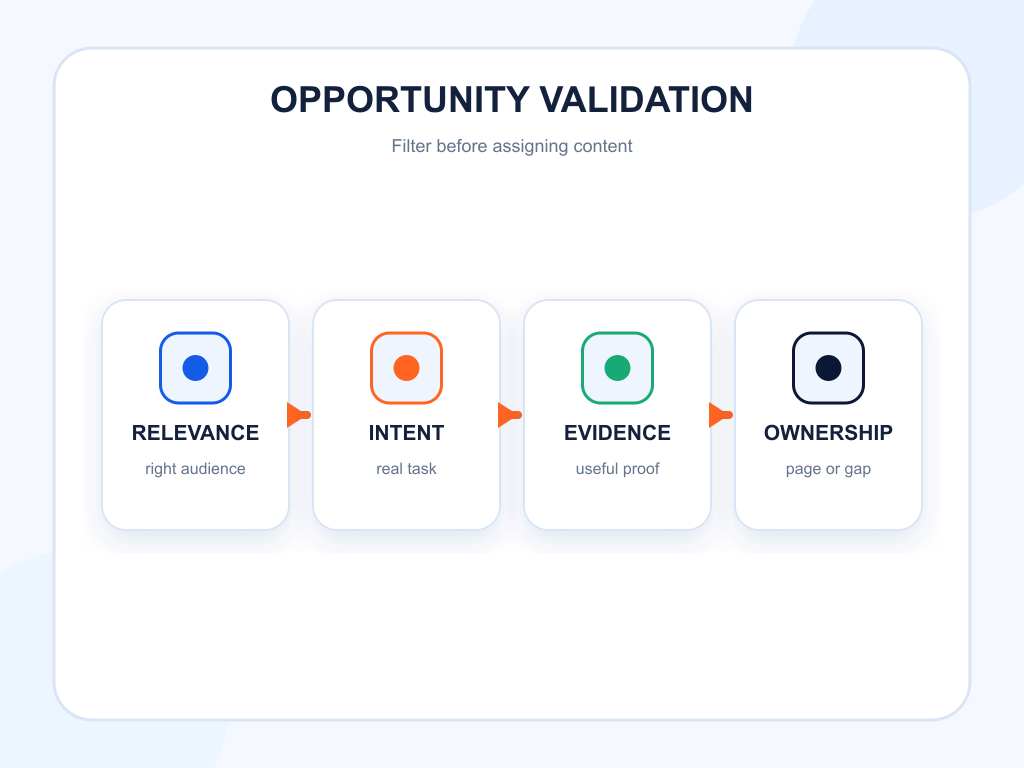
Use three exclusion checks:
- Does the query describe an audience the business serves?
- Can the site contribute first-hand evidence, expertise, or a useful workflow?
- Would a page improve a real user decision even if no AI system cited it?
Reject the query if the answer is no. A small, clean queue produces more learning than a large backlog filled with weak matches.
Diagnose the Gap Before Choosing the Asset
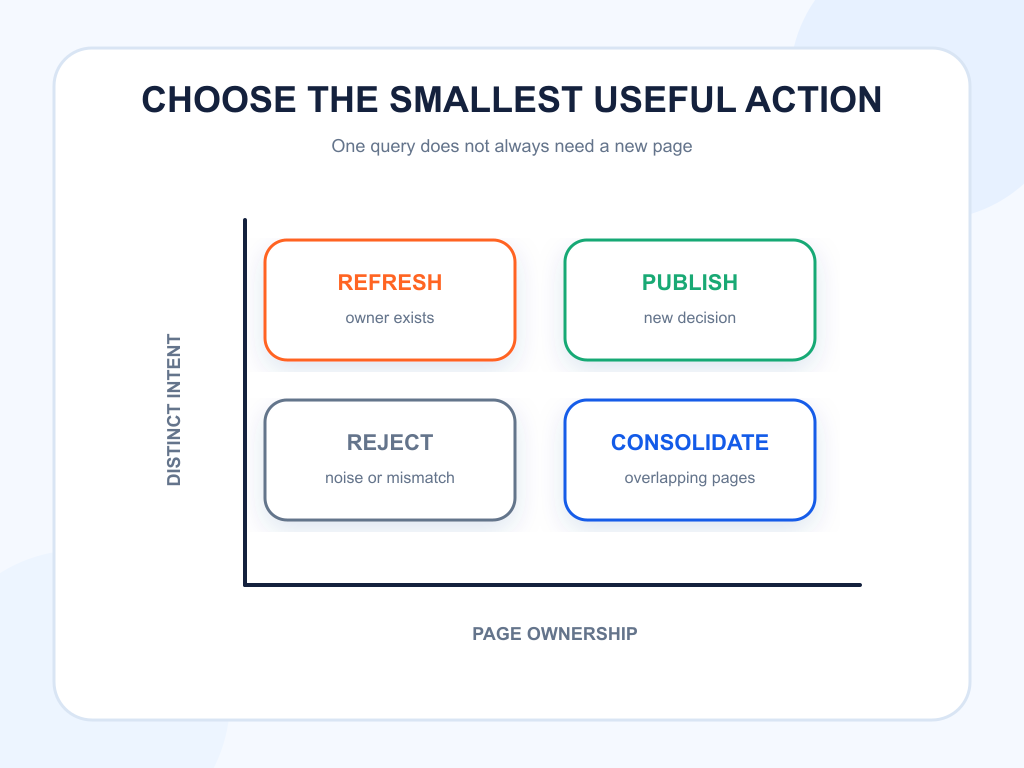
Absence from a grounding query does not always mean a page is missing. Search the current site and classify the situation.
| Opportunity condition | Validation check | Best first action | Reject or escalate when |
|---|---|---|---|
| No relevant page | No URL owns the intent | Create a focused page | The intent has no product or audience fit |
| Relevant page lacks the answer | Page is eligible but omits key evidence | Add a bounded section | The new section would distort the page’s purpose |
| Several pages overlap | Multiple weak URLs target the same need | Consolidate and clarify ownership | One page serves a genuinely different decision |
| Strong page, weak retrieval | Page has evidence but unclear structure or freshness | Improve headings, sourcing, and internal links | Eligibility or access is broken |
| Branded or noisy query | Intent is navigational, ambiguous, or misclassified | Monitor or reject | A broader non-branded need is validated separately |
This prevents content inflation. The objective is a better answer system, not a higher page count.
Match the Query to a Page Job
Translate each accepted query into a job. Common jobs include defining a concept, completing a task, comparing options, verifying a claim, troubleshooting a failure, or making a purchase decision. The job determines the page format.
A definition may belong in documentation or a glossary. A multi-criteria decision needs a comparison. A recurring implementation problem may need a how-to with checkpoints. A time-sensitive claim may need a dated update rather than a permanent evergreen page.
Write one sentence stating what the reader should be able to decide or do after the page. If the sentence is vague, the asset is not ready for production. Query wording alone does not define a useful promise.
Prefer a Targeted Refresh When Ownership Is Clear
When an existing page already owns the intent, improve it before creating another URL. Add the missing distinction, current source, example, limitation, or decision table. Make the answer explicit near the section heading where a retrieval system and a human reader can find it.
Do not paste the opportunity query repeatedly. Grounding systems operate across concepts, and natural coverage is easier to maintain. The page should answer the need in language appropriate for the audience, with evidence linked to the exact claim.
Update the title only when the page’s promise has genuinely changed. Preserve a stable canonical URL where possible. A clean refresh makes later measurement easier because the treated asset remains identifiable.
Publish New Pages Only for Distinct Decisions
A new page is justified when the query reveals a different audience, task, or decision. It should not be a paraphrased copy of an existing article.
Before approving the draft, record the proposed slug, primary intent, exclusion boundary, internal-link plan, evidence advantage, and measurement window. Search the public inventory for close titles and overlapping slugs. If the new page cannot claim a distinct owner, consolidate the idea into the existing cluster.
This discipline matters for Topify because AI-search content can easily fragment into many near-identical posts about citations, prompts, and visibility. A new URL should sharpen the library rather than create another ambiguous source.
Rank the Queue by Fit, Evidence, and Effort
Citation range is only one input. Score opportunities on business fit, audience value, existing authority, evidence readiness, implementation effort, and cannibalization risk. Add a confidence note because the feature is beta and classification is approximate.
High-fit opportunities with strong evidence and a clear owner should move first. High-volume but low-fit suggestions should not. Low-effort refreshes can be useful experiments, but they should not crowd out pages that close an important decision gap.
Define the Test Before Making the Change
Record a baseline for the topic, query range, cited pages, and answer-level brand visibility. Change one page or one coherent page group. Then compare equivalent periods after allowing for discovery and reporting lag.
Microsoft’s AI Performance documentation warns that citations do not indicate ranking, authority, or placement in a particular answer. A post-update increase therefore needs context. Inspect whether the treated page appears, whether the topic classification remains relevant, and whether brand mentions or useful visits change.
Avoid a causal claim from timing alone. Say that the movement followed the change and is consistent with the hypothesis unless a stronger design supports more.
Join Bing Opportunities With Topify Monitoring
Bing shows first-party citation opportunity inside Microsoft experiences. Topify can monitor a controlled prompt set across answer engines and reveal brand inclusion, position, sentiment, and cited sources. The combination helps distinguish a Microsoft-specific source gap from a broader market gap.
For each accepted opportunity, create a small prompt group that represents the underlying job, not just the displayed grounding phrase. Monitor the same group before and after the content action. Keep platform-specific results separate because different systems can retrieve different sources.
When the evidence disagrees, investigate. A new Bing citation without stronger recommendations may still be an authority gain. A stronger recommendation supported by a third-party page may suggest distribution matters more than another first-party update.
Keep a rejection log beside the active queue. Record why a suggestion was excluded, such as brand mismatch, ambiguous intent, weak evidence, an existing owner, or insufficient business value. The log makes later reviews faster because the same noisy phrase does not need to be debated every month. It also exposes recurring classification problems. If many rejected suggestions share one ambiguity, the team may need clearer entity language, stronger navigation, or a more explicit explanation of what the company does and does not offer.
For accepted opportunities, write the expected answer change before production begins. A useful statement is specific: the updated page should be cited for a defined claim, the brand should appear in a particular comparison set, or a missing decision factor should enter the generated answer. That expected change determines the evidence to collect and prevents a vague improvement in total citations from being mistaken for success.
Conclusion
Bing opportunity queries are most useful as diagnostic leads, not automatic article assignments. Filter branded and irrelevant suggestions, identify the page job, check whether an existing URL already owns it, and choose the smallest credible action. Rank the queue by fit and evidence rather than citation range alone. Then define the test before changing the site and pair Bing’s first-party source data with answer-level monitoring. Start with five opportunities, not fifty. A focused queue makes it possible to learn which gaps respond to better content, which require distribution or technical work, and which should never have entered the roadmap.
FAQ
What are Bing opportunity queries?
They are grounding queries within a Topics Portfolio theme where other sites appear as cited sources and the selected site does not.
Are opportunity queries the same as user prompts?
Not necessarily. They can represent retrieval steps generated from a broader request, so treat them as contextual evidence rather than exact prompt transcripts.
Should every opportunity query become a new article?
No. Many gaps are better solved by refreshing, consolidating, or restructuring an existing page. Some queries should be rejected as irrelevant or noisy.
How should opportunity-query performance be measured?
Track the relevant topic, query range, treated pages, citations, answer-level brand visibility, and useful business outcomes across equivalent periods.