A content team can have hundreds of cited pages and still lack a coherent view of what it is known for. Query-level exports create rows, not strategy. They show isolated retrieval phrases while hiding whether those phrases form a durable area of authority, a narrow spike, or a collection of unrelated mentions. Bing Topics Portfolio addresses that planning gap by grouping grounding queries into broader themes and adding directional measures for demand and competition. The opportunity is useful, but the labels and counts are approximate. The real decision is how to turn that portfolio into a content plan without mistaking an AI-generated classification for market truth.
Topics Portfolio Changes the Unit of Analysis
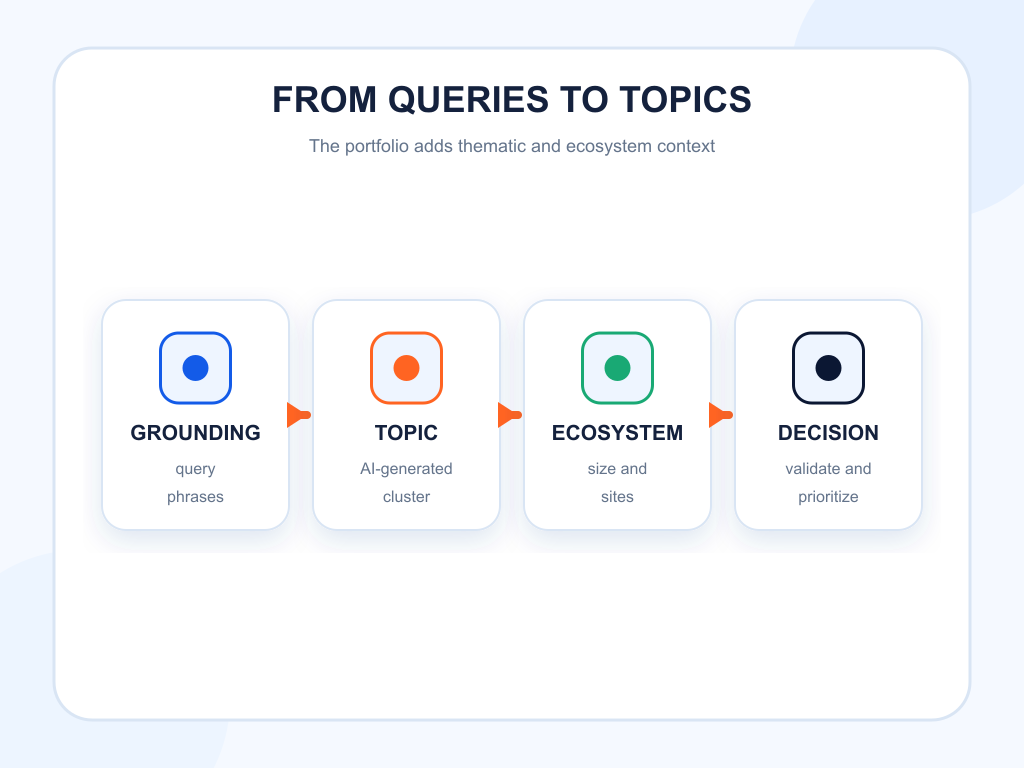
Microsoft introduced Topics Portfolio in Bing Webmaster Tools on October 13, 2026. It sits inside AI Performance and groups the grounding queries associated with a site into broader topics. Instead of reviewing one retrieval phrase at a time, publishers can see the thematic shape of their presence across Microsoft-powered AI experiences.
That changes the planning unit from the keyword to the topic. A query such as “AI chatbot reporting” may sit beside “measure Copilot citations” and “track brand mentions in AI answers.” The phrases are different, but they can represent one audience problem: measuring visibility in generated answers.
The portfolio view is personalized. Microsoft says the topics and opportunity queries come from a site’s own presence and activity, not from a universal category list. This makes the report more relevant than a generic trend database, but it also means two sites in the same market may receive different portfolios.
Read Every Column as a Directional Signal
The table combines four fields. Topic names summarize related grounding activity. Topic Size estimates citations across all sites for that theme. Sites Cited approximates how many sites appear in the topic. Queries estimates the number of distinct grounding queries in the cluster.
Each field supports a decision, but none is a direct forecast.
| Portfolio field | What it indicates | Useful decision | What it does not prove |
|---|---|---|---|
| Topic | AI-generated thematic cluster | Where the site appears to have subject presence | A canonical taxonomy or perfect classification |
| Topic Size | Approximate citations across sites | Relative scale of observed AI-search activity | Search volume, users, clicks, or revenue |
| Sites Cited | Approximate number of cited sites | How distributed the source pool appears | Keyword difficulty or competitor quality |
| Queries | Approximate distinct grounding phrases | Breadth of retrieval activity | Complete user-prompt demand |
Microsoft explicitly labels the feature beta and says its classifications can be imperfect. Use the numbers to decide where to investigate, not to declare market share.
Validate a Topic Before You Fund It
Start by reading the grounding queries and cited pages inside each topic. A useful cluster should have a recognizable audience need, a consistent relationship to the business, and pages that plausibly satisfy that need. If a topic combines unrelated meanings of the same word, relabel it in your working notes or exclude it from planning.
Next, inspect branded queries. Microsoft warns that opportunity tables can include another company’s branded request. A competitor’s product name may reveal category activity, but publishing a weak page around that name is rarely the right response. Decide whether the underlying comparison intent belongs in your strategy before treating the phrase as an opportunity.
Finally, check whether the topic is stable across a longer window. Topics based on a short campaign, a news spike, or one unusually cited page can look larger than the site’s durable authority. Compare one-, two-, and three-month views where the account has enough data.
Separate Topic Authority From Page Concentration
A large topic can still be fragile. Open the cluster and calculate how much of its citation activity comes from the top page, top five pages, and top content type. If one old guide carries most of the topic, the portfolio is concentrated rather than broad.
Concentration changes the editorial decision. A coherent set of documentation, research, comparisons, and product pages suggests a real topic system. One page receiving repeated citations suggests a maintenance and expansion opportunity. Ten unrelated pages each receiving a single citation may indicate classification noise.
Review the role of each cited page as well. AI systems may use a glossary to define a term, a report to support a number, and a comparison to evaluate options. Strong topic authority usually includes several evidence roles, not ten pages that repeat the same answer.
Prioritize Fit Before Raw Topic Size
The largest topic is not always the best investment. A smaller cluster tied directly to a product decision can be more valuable than a broad informational theme with little commercial relevance. Score each topic on business fit, evidence strength, existing authority, content gap, and measurement clarity.
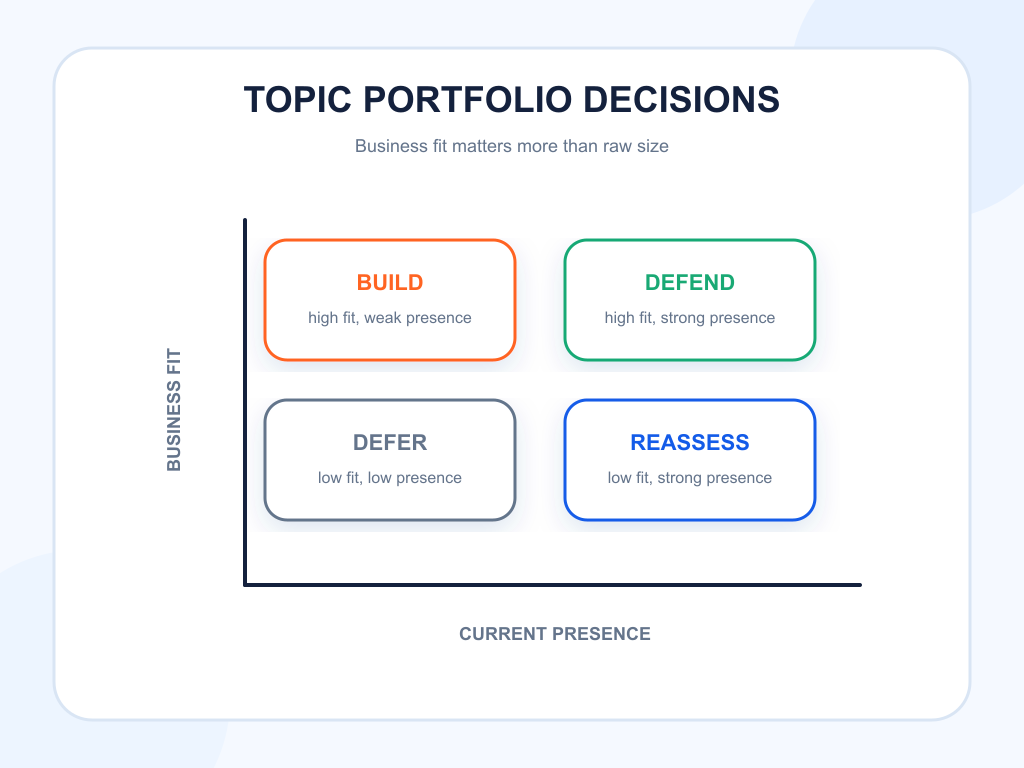
Use a simple portfolio matrix:
- High fit and strong presence: defend accuracy, freshness, and page breadth.
- High fit and weak presence: investigate opportunity queries and missing evidence.
- Low fit and strong presence: decide whether the authority supports the brand or distracts from it.
- Low fit and weak presence: monitor or exclude.
This keeps the content calendar tied to real decisions. Topic Size can help break a tie, but it should not override product relevance or editorial credibility.
Turn One Topic Into a Coverage Map
For every priority theme, map the jobs a reader needs completed. Most useful topics contain definitions, mechanisms, implementation steps, comparisons, evidence, limitations, and decision pages. Mark which existing URL owns each job and where no credible owner exists.
Do not create a new article for every opportunity query. First ask whether an existing page can answer the need with a clearer section, better evidence, or a more precise title. Publish a new page only when the intent, owner, or decision differs enough to deserve a separate URL.
Then connect the pages. Internal links should help readers move from explanation to implementation and from implementation to evaluation. The same structure also gives retrieval systems clearer relationships between the pages in the cluster.
Pair Bing Data With Answer-Level Evidence
Topics Portfolio describes source participation across supported Microsoft experiences. It does not show every answer’s wording, brand position, recommendation strength, or sentiment. Microsoft also does not expose competitor domains in this report.
Use Topify as a separate answer-level layer. Monitor a controlled set of prompts within each priority topic, then review which brands appear, how they are framed, and which domains support the answer. Do not blend Bing’s aggregate figures and Topify’s prompt sample into one synthetic score. Put them beside each other.
The disagreement is often useful. Strong Bing citations with weak brand recommendations may indicate informational authority without commercial inclusion. Strong recommendations supported by third-party domains may show brand influence that the site’s own citation portfolio does not capture.
Run a Monthly Portfolio Review
Use weekly checks only for anomalies. A monthly review is better for editorial decisions because topic classifications and citation activity can move with demand, model changes, and reporting coverage.
For each selected topic, record the window, Topic Size, Sites Cited, Queries, your citation count, leading pages, concentration, answer-level brand visibility, and next action. Limit the action to one of five choices: maintain, refresh, consolidate, expand, or defer.
Assign an owner and a confirming signal. If the action is to strengthen a comparison page, the confirming evidence may include broader cited-page coverage, relevant opportunity-query movement, stronger recommendation inclusion, or qualified visits. No single signal should carry the conclusion alone.
Before closing the review, write a short decision memo for each funded topic. State why the topic matters, which page or page set owns it, what evidence is missing, and what would cause the team to stop investing. This memo prevents the portfolio from becoming a passive dashboard. It also gives editors, SEO leads, product marketers, and analysts the same definition of success. Revisit the memo after the next reporting window and record whether the original assumption held. A topic that repeatedly fails validation should leave the active roadmap even if its reported size remains attractive.
Conclusion
Bing Topics Portfolio is valuable because it moves AI-search analysis from scattered queries to a thematic portfolio. Its value disappears when approximate classifications are treated like exact demand forecasts. Validate each topic against its queries and pages, measure concentration, prioritize business fit, and map the content jobs the audience actually needs. Then pair first-party Microsoft citation evidence with answer-level brand and source monitoring. Start with one high-fit topic and one bounded improvement rather than rebuilding the entire content calendar. A portfolio is useful when it produces a defensible decision, not when it merely adds another colorful table to a report.
FAQ
What is Bing Topics Portfolio?
Bing Topics Portfolio is a beta view in Bing Webmaster Tools that groups a site’s AI grounding queries into themes and shows approximate topic demand, cited-site breadth, and query counts.
Is Topic Size the same as search volume?
No. Topic Size is an approximate citation measure across sites for the selected period. It does not represent searches, users, clicks, or revenue.
Why might a branded query appear as an opportunity?
The beta identifies where other sites appear and yours does not. That can include another brand’s query, so every opportunity needs an intent and relevance check.
How often should Topics Portfolio be reviewed?
Use monthly reviews for planning and weekly checks for anomalies. Compare consistent windows and avoid making decisions from a single short-lived movement.