A dashboard can place two precise-looking numbers beside a topic and make the next decision feel obvious. Large Topic Size means demand. Many Sites Cited means competition. Publish where the first is high and the second is low. That shortcut is appealing and wrong. Bing describes both figures as approximate ecosystem measures inside a beta report. They concern observed citations, not searches, clicks, conversions, or ranking difficulty. Used carefully, the pair helps teams compare the shape of AI-search themes. Used carelessly, it produces false forecasts and content built for numbers the report never claimed to measure.
Topic Size Estimates Citation Activity
Microsoft defines Topic Size in Topics Portfolio as the approximate total citations across all sites for a topic during the selected period. It is intended to indicate how much AI-search activity the theme represents within the observed Microsoft ecosystem.
The numerator is not disclosed as a traffic count. A citation can appear in an answer without a click, and one user request can produce several retrieval steps and sources. Topic Size therefore cannot be converted into monthly search volume or expected sessions.
Use it comparatively. Within the same property, reporting window, and interface, a larger topic may warrant investigation before a much smaller one. Do not compare numbers captured under different scopes as though they share a stable denominator.
Sites Cited Measures Breadth, Not Difficulty
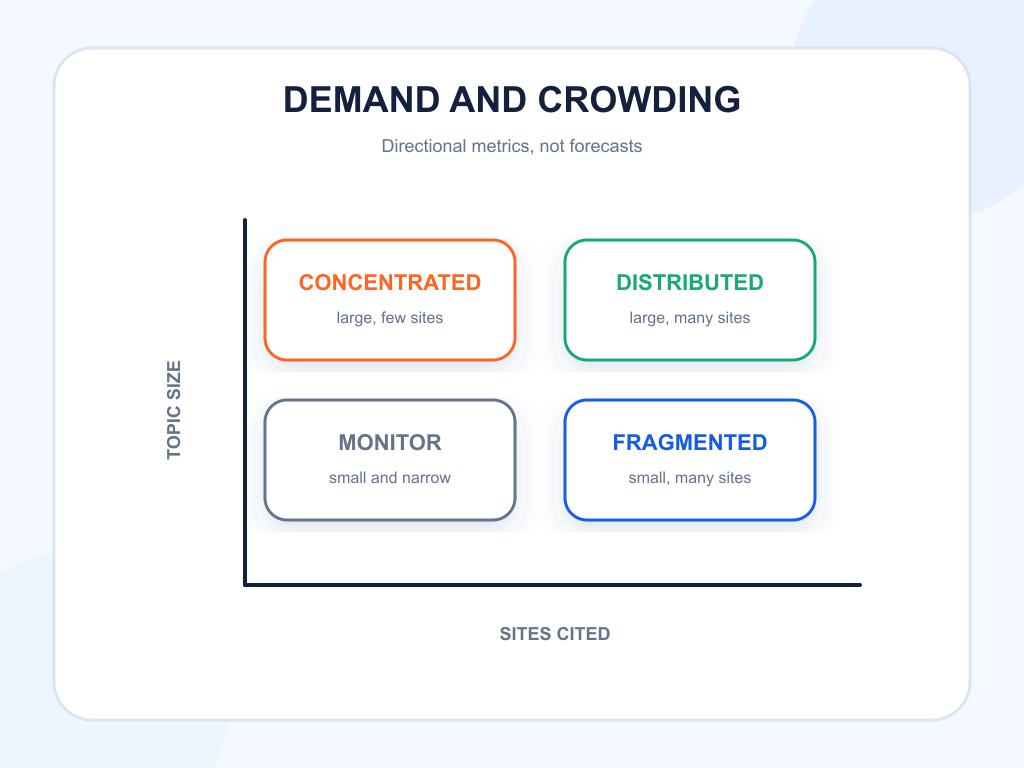
Sites Cited is the approximate number of sites appearing for queries in the topic. A large value suggests the source pool is distributed across many domains. A small value suggests more concentrated sourcing.
Neither case directly reveals difficulty. A topic with many cited sites can be open to diverse evidence, or it can be crowded with strong specialists. A topic with few sites can be underserved, or it can be dominated by authoritative sources that are hard to displace.
Inspect the kinds of pages and domains appearing in actual answers before assigning a competitive interpretation. The metric supplies breadth, not a quality score.
| Topic pattern | Plausible interpretation | First investigation | Main caution |
|---|---|---|---|
| High size, many sites | Broad demand and distributed sourcing | Segment by intent and source role | Crowding may include many weak or unrelated sources |
| High size, few sites | Concentrated authority or constrained source pool | Study leading evidence and eligibility | Low site count does not mean easy entry |
| Low size, many sites | Fragmented niche or noisy classification | Validate queries and business fit | Activity may be too thin for a durable plan |
| Low size, few sites | Emerging, narrow, or low-demand topic | Monitor before investing heavily | Apparent whitespace may reflect little demand |
Normalize the Numbers to the Reporting Window
Always record the date range. Microsoft lets users select one-, two-, or three-month windows, and the same topic can look different as a news event enters or leaves the period. Compare like with like.
Use complete windows and note reporting changes. A partial current month should not be compared directly with a complete prior month. If Microsoft changes the beta classification or data coverage, record the event before interpreting a discontinuity.
Also check whether the topic itself changed. AI-generated labels can merge, split, or regroup queries as classification evolves. A chart movement may reflect taxonomy movement rather than audience demand.
Add Your Own Presence and Concentration
Topic Size and Sites Cited describe the ecosystem. They become more useful when paired with the site’s own citations and cited-page breadth. Calculate a directional presence ratio only if the underlying measures are comparable, and label it carefully.
Then add concentration. Count the share of your citations represented by the top page and top five pages. A site can appear strong in a large topic while depending almost entirely on one URL. That is not the same strategic position as broad coverage across several evidence roles.
Microsoft’s separate Citation Share metric operates at the grounding-query level and is observational, not a rank or traffic share. Do not mix topic-level approximations, query-level share, and brand mention rate into one unlabeled percentage.
Segment by Intent Before Comparing Topics
Two topics of similar size can have very different business value. One may be largely informational; another may contain commercial evaluation, local, or solve-oriented requests. Microsoft’s earlier AI Performance expansion introduced intent categories such as informational, commercial, navigational, research, local, creation, and learn-and-solve.
Break the topic into its leading intents and page roles. A broad informational cluster may support awareness and authority. A smaller commercial cluster may have greater downstream value. The metric pair does not choose between them; the business goal does.
Avoid attaching a universal target. There is no defensible statement that a certain Topic Size or Sites Cited count is “good.” Use the site’s historical baseline and the topic’s decision value.
Distinguish Opportunity From Eligibility
Before investing, confirm that the site can participate. Pages must be crawlable and suitable for the supported search and AI experiences. Robots preferences, canonical signals, rendering, freshness, and visible evidence all affect whether a page can become a useful source.
If the topic shows attractive ecosystem activity but the site’s relevant pages are blocked or stale, the first project is technical and editorial maintenance. Publishing more pages will not solve a basic eligibility failure.
If eligibility is sound, inspect the evidence gap. Does the topic require current data, first-hand testing, local detail, comparison criteria, or expert interpretation that the site does not supply? Build that asset instead of repeating what the source pool already contains.
Use a Weighted Portfolio Score
Create a planning score with explicit components rather than copying Topic Size into the priority column. Useful inputs include business fit, audience value, current presence, evidence advantage, attainability, trend stability, and implementation effort. Topic Size can represent directional ecosystem activity. Sites Cited can inform, but not determine, attainability.
Keep the raw fields visible beside the score. Weighted models simplify decisions but can hide why a topic moved. A human reviewer should be able to see whether the priority comes from business fit, a fresh opportunity, or a large but uncertain metric.
Reject false precision. Whole-number ratings with written rationale are often more honest than several decimal places built on approximate inputs.
Combine Ecosystem Metrics With Answer Evidence
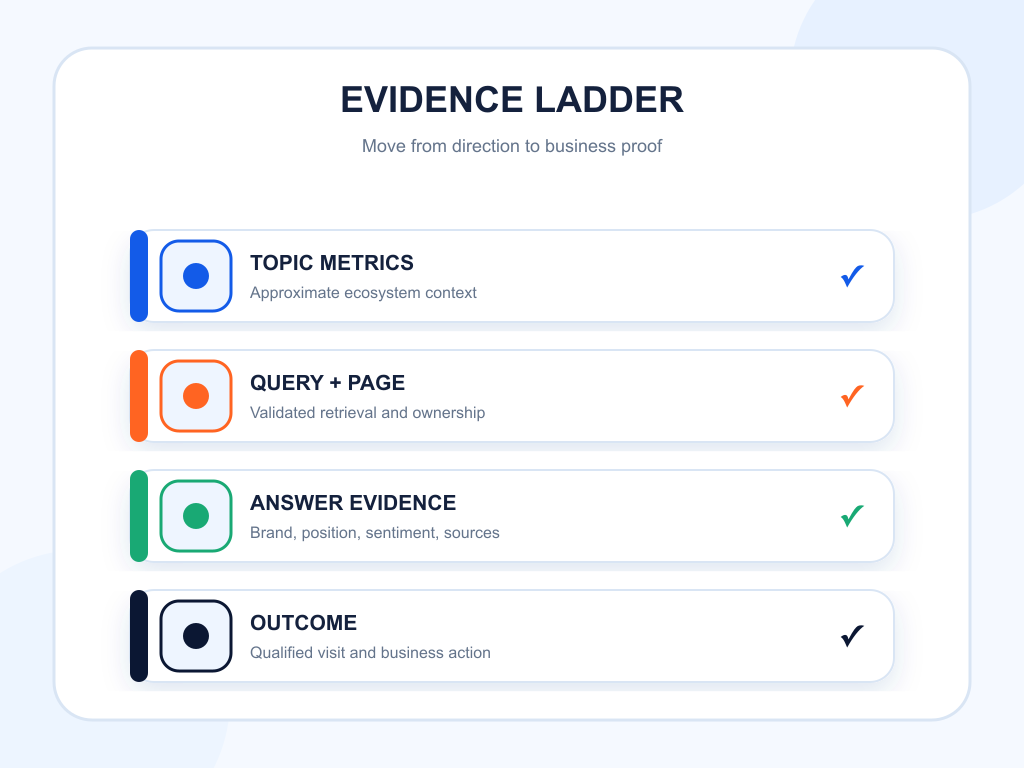
Topify can supply a complementary layer by monitoring selected prompts and showing brand inclusion, position, sentiment, competitors, and cited sources. That sample is different from Bing’s aggregated ecosystem view, so keep both systems’ denominators visible.
Use Bing to find where themes appear large, distributed, or open. Use Topify to inspect how the brand and competitors are actually represented in important decisions. Then connect both to analytics or pipeline evidence where clicks occur.
A large topic with weak brand inclusion may justify a focused authority project. A small topic with strong recommendation visibility may already be efficient. A large topic with high citations but no commercial fit may require no action at all.
Add a confidence label to every recommendation derived from the report. High-confidence decisions have a stable topic, relevant grounding queries, several owned pages, and corroborating answer-level evidence. Medium-confidence decisions have useful direction but one unresolved assumption. Low-confidence decisions depend on a short window, a single page, or an unclear cluster. The label does not make the underlying estimates more precise. It tells stakeholders how much commitment the evidence can support.
This distinction is especially important when budgets are compared across topics. A large Topic Size with low confidence may justify a small research sprint, not a full content program. A modest topic with high fit, clear page ownership, and repeatable visibility may justify immediate maintenance. Matching investment size to confidence keeps approximate platform metrics in their proper role: inputs to judgment rather than substitutes for it.
Record the evidence date and selected reporting window beside every confidence label so the recommendation can be reproduced and challenged later.
Conclusion
Bing Topic Size and Sites Cited can improve AI-search planning when they are treated as directional ecosystem measures. Topic Size estimates citation activity, not demand in users or clicks. Sites Cited estimates source breadth, not difficulty. Record the window, validate the topic, segment by intent, add your own presence and page concentration, and confirm eligibility before funding new content. Then combine the report with answer-level brand evidence and business outcomes. The goal is not to turn a beta metric into a traffic forecast. It is to make the next content decision more informed, more bounded, and easier to review.
FAQ
What does Bing Topic Size measure?
It approximates total citations across sites for a topic during the selected period. It is a directional measure of observed AI-search activity.
Is Sites Cited a keyword-difficulty score?
No. It estimates how many sites appear for the topic. It does not assess their quality, authority, or how hard they are to compete with.
Can Topic Size predict traffic?
No. Citations do not equal users, searches, clicks, or sessions. Use traffic and conversion data separately.
What is the best Topic Size to target?
There is no universal threshold. Prioritize using business fit, evidence advantage, current presence, intent, stability, and effort alongside the metric.